 Slashdot Mirror
Google's Diversity Chief: Mamas Don't Let Their Baby Girls Grow Up To Be Coders
theodp writes: Explaining the reasons for its less-than-diverse tech workforce, Google fingered bad parenting for its lack of women techies. From the interview with Google Director of Diversity and Inclusion Nancy Lee: "Q. What explains the drop [since 1984] in women studying computer science? A. We commissioned original research that revealed it's primarily parents' encouragement, and perception and access. Parents don't see their young girls as wanting to pursue computer science and don't steer them in that direction. There's this perception that coding and computer science is ... a 'brogrammer' culture for boys, for games, for competition. There hasn't been enough emphasis on the power computing has in achieving social impact. That's what girls are interested in. They want to do things that matter." While scant on details, the Google study's charts appear to show that, overall, fathers encourage young women to study CS more than mothers. Google feels that reeducation is necessary. "Outreach programs," advises Google, "should include a parent education component, so that parents learn how to actively encourage their daughters."
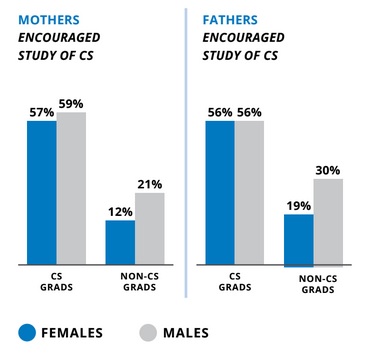
Same as for males, actually.
Human beings in general aren't very rational, even though we may think we are. Those who have these grand notions of purpose behind their actions are usually merely very good at rationalising.
Why would *anyone* encourage their child, regardless of gender, to spend a decade or more training for what is quickly becoming a minimum-wage job at best.
We should instead be encouraging kids to become investment bankers, hedge fund managers or politicians.
Really? And that must be why there are more battered husbands shelters than battered wives shelters ...
60-70% of domestic violence is initiated by women. The reason we don't have "battered men" shelters is that it is socially acceptable for women to be violent, and that any man that "can't handle it" isn't a real man, and should be ashamed of himself. In the media, when women are depicted as violent toward their partners, it is almost always supposed to be funny.
It would seem to me that if you need to be "reeducating" kids about what they want, you're doing something wrong. Let's examine a few of these points in the summary.
Parents don't see their young girls as wanting to pursue computer science and don't steer them in that direction.
And... should they be? You seem to be coming at this from the perspective that it doesn't matter what the individuals want, there should be more women in tech because reasons.
There's this perception that coding and computer science is ... a 'brogrammer' culture for boys, for games, for competition.
A couple thoughts on this point. This retarded "brogrammer" media push has happened much more recently than 1984. I seriously doubt that people perceived it the same way back then. And even if they do now, you seem to gloss over the fact that it could simply be the result of this shrieking media push about the culture. In other words, it may be that this push has caused the results that you're looking at now.
There hasn't been enough emphasis on the power computing has in achieving social impact. That's what girls are interested in. They want to do things that matter.
Okay, you raging sexist. Let's take it down a notch for a second here. We'll just assume for a moment that you're right and that's what girls are interested in. How is it the case that "achieving social impact" and "things that matter" are the same? What a ridiculous conflation. First off, you assume that social impact is always good. Secondly, you assume that nothing else matters besides social impact. Could these be, I don't know, products of your bias?
Q. What explains the drop [since 1984] in women studying computer science? A. We commissioned original research that revealed it's primarily parents' encouragement, and perception and access.
And now for this point. I looked at the linked abstract and it only focuses on the individual's decision-making process without taking into account factors that the individual may use. For example, it doesn't even bother to look at hours worked. And then has the gall to call the perceptions of the field "flawed." It still blows my mind that every time this comes up, almost nobody talks about the elephant in the room: Women are smarter and value their time better than men in general.
http://www.washingtonpost.com/news/to-your-health/wp/2014/11/19/gifted-men-earn-more-than-gifted-women-and-they-value-time-differently-but-both-report-being-happy/
http://www.bentley.edu/centers/center-for-women-and-business/millennials-workplace
http://www.huffingtonpost.com/2011/10/31/professional-women-time_n_1068291.html
There are more if you're curious about this phenomenon.
If we look at the numbers for women in CS, we see:
http://media.npr.org/assets/img/2014/10/21/womencoding-d463ab944849ed2fce2df3d7d27d2f1c4daa7689.jpg?s=1400
I looked pretty deep trying to find a graph of hours worked in the sector since the mid-1980s (or earlier too), but couldn't find anything. The closest thing I could find was "services" sector hours worked, which I assume includes things like restaurants and so on. Not very useful for this purpose. If hours being worked was a part of the discussion at all, you would think that information would be a bit easier to find. But it's not, despite the fact that it's probably kind of important. If anybody can wrangle that info somehow, I'd love to see it.
That said, if we look at when the Internet hit big (circa 1995), we see a lag time before the sharp dropoff. Once the Internet became popular, 24/7 on call became a common thing and hours worked went way up. If the industry is the input and schooling is the output of that industry, you would expect something like this.
Pissing and moaning about "the culture" doesn't seem all that useful, especially because it paints women as delicate beings that need everyone around them to give them big toothy smiles and pats on the head. I don't deny that there is likely to be a perception problem (or more than one perception problem), but the question is whose perception problem(s) it is/they are.
And that must be why there are more battered husbands shelters than battered wives shelters ... oh wait ...
Did you know most domestic violence in initiated by women? Did you know that by far lesbian relationships have more physical abuse than any other gender pairing? Abused men are just SOL - why do you need support or a shelter? Just man up! Perhaps not an argument for rationality, I'll grant you.
Socialism: a lie told by totalitarians and believed by fools.
Parents don't see their young girls as wanting to pursue computer science
OR
and don't steer them in that direction.
Which is it? I get the feeling it's that girls just aren't that interested. People like to point out that more girls were interested in the 80s but that was a very different era. Few people actually knew what was involved with "programming computers".
All of this effort reminds me of a similar misunderstanding that I came across years ago. In the 50s Lionel decided that girls didn't play with trains because they weren't "girly" enough. They were black and steel and perhaps too boyish. So the genius marketers came up with this:
http://www.pbs.org/wgbh/roadsh...
http://www.lionel.com/Products...
Should you wish to see one in person go to Holiday World and check out the old toy museum.
It flopped badly. The reason was simple: girls generally don't like trains, but those who do want an authentic train. Black, steel, menacing - a real train.
Every time I see people trying hard to make computer science appeal to girls I see the same thing. It simply doesn't appeal to most girls, and to those to whom it does appeal it will have that appeal without any sugar coating.
Ultimately, the SJW crowd needs to understand that men and women - and boys and girls - are very different creatures who aren't interested in the same sorts of things. The roots of this are genetic and stem from the social order tens of thousands of years ago. Nothing's going to "fix" it, but, then again, there's nothing to fix.
Do you have ESP?
Stop this bullshit SJW slashdot.
little boys want a place to 'perform', while little girls want a place to 'relate'.
That's BS. The prevalence of girls/women in theater disproves it.
Also, coding on computers hardly counts as "performing". It's something that socially awkward boys like to do because computers are highly predictable and won't make fun of you. Boys who like to perform go into sports and theater, not computers. Girls go into cheerleading, sports, and theater; they too like to perform.
...it's a harsh fucking world out there, and if you don't learn the skills needed for a good job, your life will suck forever...
There are vast differences between countries. North and South Korea are good examples for people who like to claim that the differences are all due to race, culture, religion, etc. But people in South Korea and other "successful" Asian countries aren't all that happy.
So better examples would be to compare the happiest countries in the world (e.g. the Scandinavian socialist countries) to countries countries that are clearly dysfunctional - but not in the middle of a civil war. Myself, I'm familiar with Southeast Asia, so Indonesia and the Philippines would be good examples. But there are lots of dysfunctional countries all over the world.
Anyway, the point is that someone growing up in, say, Denmark will be very likely to have a secure comfortable life even if they make some mistakes and don't try all that hard. On the other hand, someone growing up in, say, Indonesia, will be very likely to remain trapped in poverty even if they try really hard and don't make any mistakes. Life in Denmark is a positive sum game - most people are winners. While life in Indonesia is a negative sum game - most people are losers.
Obviously a person's individual effort and judgement do matter. But so do government policies. It's useful to think about what a person can do as an individual to increase their chances of having a secure comfortable life. But it's also useful to think about what governments can do to increase everyone's chances of having secure comfortable lives.
Good government matters.