 Slashdot Mirror
Google Diversity Report Straight Out of 'How To Lie With Statistics' Playbook
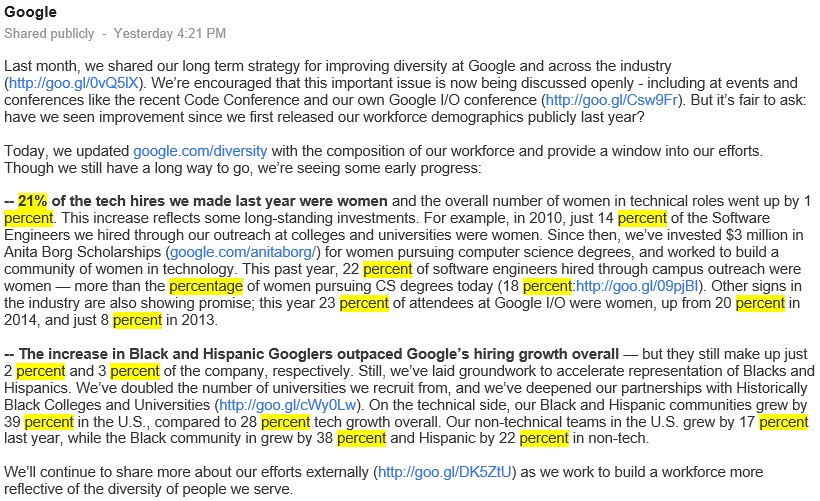
theodp writes: Among the books recommended by Bill Gates for beach reading this summer is How to Lie With Statistics, the published-in-1954-but-timely-as-ever introduction to the (mis)use of statistics. So, how can one lie with statistics? "Sometimes it is percentages that are given and raw figures that are missing," explains the book, "and this can be deceptive too." So, does this explain Google's just-released Diversity Report and the accompanying chock-full-o-percentages narrative (find-all-%-image), which boasts "the Black community in grew [sic] by 38 percent", while the less-impressive raw figures — e.g., the number of Google employees increased by 5,928, but the ranks of Black females only increased by 35 (less than 0.6% of the net increase) — are relegated to a PDF of its EEO-1 Report that's linked to in the fine-print footnotes? To be fair to Google, Microsoft, Twitter, Apple and Amazon didn't want people to see their EEO-1 numbers, either.
My father told me that when I took math classes in college, that Statistics I will teach me everything I really needed to know about the subject, but that Statistics II would teach me how to lie with what I learned. He was not incorrect. There's so many ways to manipulate the data that I find it very, very difficult to trust ANY stats that I find in the news without also having access to the raw data, the methodology, questions used, selection process, etc., etc., etc.
Love sees no species.
Your comment is absolutely true. But that's not the whole story... in a study a few years back, "applicants with white-sounding names were 50% more likely to get called for an initial interview than applicants with black-sounding names." This is a real problem that affects minorities, so while preferential treatment is also a problem the biases have to change quite far before it's likely that minorities are getting actual preferential treatment.
"I will trust Google to 'do no evil' until the founders no longer run it." Hello Alphabet.
But that's fiction. Black kids aren't being told that at all. Instead, many deliberately avoid academic and STEM fields because their own peers disapprove of it.
The poverty and lack of achievement associated with African Americans is not primarily a consequence of discrimination or lack of outreach.
You can't address a problem if you don't understand its causes.
The selection process is still done on merit alone, no question
As someone that has been involved in the hiring process at a large tech company that has not been my experience.
>> many deliberately avoid academic and STEM fields because their own peers disapprove of it.
Break it down. Where do you get your information from? The addressing of any problems
requires understanding the framework in which they work, which begs the question.
Institutional discrimination, impoverishment from colony establishment, obfuscated history,
and extremely biased education create the problems you speak of.
In some ways, yes, the black kids you talk of are being told they cannot achieve, in
wide-scale ways, from their marketed culture, to their lack of family structures, to their
loss of history, knowledge of who they are in the world, and a myriad of other ways.
Understanding why these things exist leads to one of two conclusions: 1) that for some
reason 'these people' can't seem to get it together, either due to genetic or cultural deficiencies
or that 2) their destruction was systematic, planned, and on-going, in such an extreme way
that precludes all notions of a segregated society where everyone 'gets along'.
The only words of wisdom available now are "don't trust a conquerors history, listen to the oppressed."
If you're interested in facts I'll tell you what they are and I'll give you sources - Chomsky on The Big Idea