 Slashdot Mirror
Despite $30M Tech Push, Half of US States Had Fewer Than 300 AP CS Test Takers
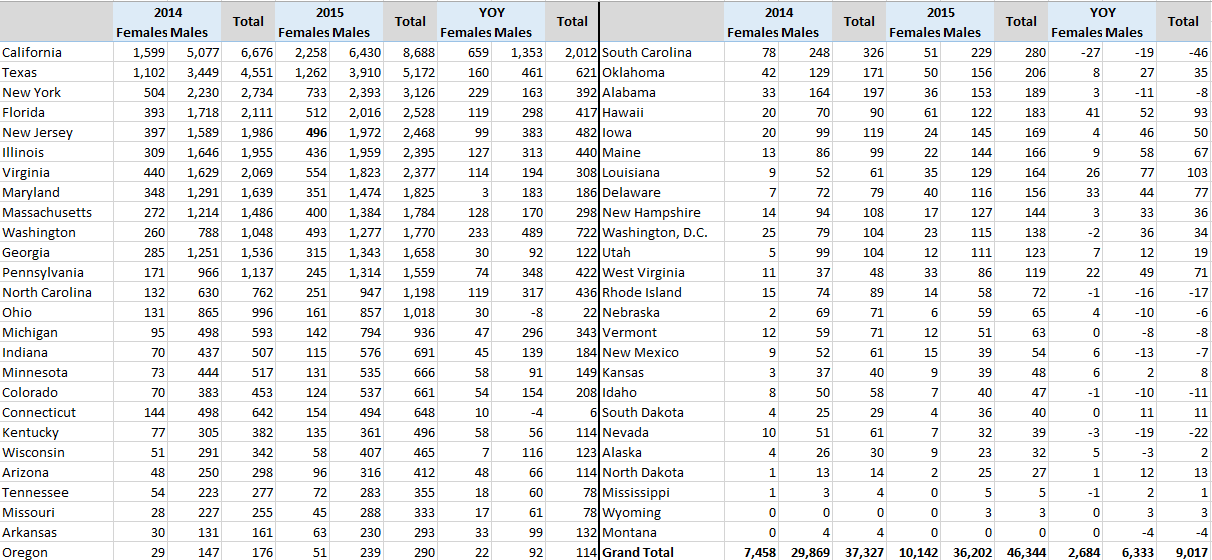
theodp writes: As President Obama was 'taught to code' last December, Politico reported that the $30 million tech-financed campaign to promote computer science education was a smash success. And indeed it has been, at least from a PR standpoint. But Code.org and its backers have long spun AP Computer Science test metrics as a true barometer of CS education success, and from that standpoint, things don't look quite so rosy. The College Board raved about "massive gains in AP Computer Science participation (25% growth) AND scores" in a June tweetstorm and at its July conference, where AP CS was declared the '2015 AP Subject of the Year.' But a look at the recently-released detail on 2015 AP CS scores shows wide differences in adoption and success along gender and ethnicity lines (Asian boys and girls, in particular, set themselves apart from other groups with 70%+ pass rates). And, for all the praise the NSF lavished on Code.org for 'its amazing marketing prowess', half of the states still had fewer than 300 AP CS test takers in 2015, and ten states actually saw year-over-year declines in the number of test takers (if my math is correct — scraped data, VBA code here).

I don't know what beef theodp has with Code.org, or H1B's, or Asians, but his diatribes against education needs to stop. The fact is that there IS growth in CS education (25%). The fact that there are still differences between genders and ethnicity means that we need to target those groups more, which Code.org is doing. Also, some states are not participating as well as others. This just means that Code.org needs to target those states.
I don't understand how theodp gets every rant posted to Slashdot. His linkspam xenophobic, anti-education rants are disgusting.
Maybe it's just the Mathematics and Computer Science educator in me, but I think the biggest problem is finding good people to teach CS. Here in South Carolina, you are required to take a CS class prior to graduating HS (of course, learning Word counts as a CS course, but that's a discussion for another time). The problem is, the people who teach these "CS" courses are the baseball coaches, PE teachers, random administrators, and anyone else who don't already teach a full load. There is no such thing as an accredited Computer Science Education degree in the state. Even NCATE wedges a CS education certification under "Educational Communications and Technology (Initial & Advanced Preparation)" instead of it's own category. Lets nail down what type of content needs to be taught to high school students, start training teachers, and I think the increase in AP CS takers will follow.
I convinced several young students to NOT even look at CS because most companies are Asshole scumbags to their programmers. Also the fact that some moron BSA will find he can save $1.25 this quarter by firing all the programmers and outsourcing to China or India yet again makes job volatility.
I convinced them to chase down Cyber Security or if they really want to program, specalize in embedded systems with a EE degree along with CS so they end up above the typical CS grad applying for the jobs.
General CS is the factory work of the 21'st century. Nobody sane will go into it until it's unionized and a lot of managers forcing 60-80 hour work weeks get their knees broken. Because these asshole companies and managers are not going to change out of the goodness of their own hearts.
Do not look at laser with remaining good eye.
After graduating high school in 1980 I was told that computer programming was going to be essential in the future economy. I took it - twice - and learned from it. But I would say it's kind of like knowing how to fix a car. As much as I admire car mechanics, the "essential" skill of being able to replace spark plugs and timers which my grandfather showed me as a child in the 1960s turned out less urgent than advertised. The essential thing is to know just enough about fixing a car to know what a mechanic is charging you for. I think we should be generally concerned about kids getting a general education in how stuff works, and coding is a part of that, but TFA seems to be elevating it above geography, languages, math, shop, finance, logic, etc. I'm actually most alarmed by the lack of logic courses in school, when I'm hiring logic and ability to think are the most important skill sets. And coding is a great indicator of that, but not the only one.
Gently reply
This is my second full year teaching 11th and 12th graders at the local BOCES CTE department. I have no industry background, but a strong interest in programming. I know I am not an ideal candidate for teaching the content, so you'll have to trust me when I say there is no one more qualified who would do the job for the money, and the change from my last job is a huge benefit for me as suddenly I'm spending a lot less money on gas and I have a job that is challenging but worth the challenge. For some reason, an actual Computer Programming course is the only thing for which funding is not on offer, unless of course we cater to several girls, which does not seem to happen much.
As noted in several other comments, this type of job usually falls to someone who has never written a line of code; I have a goal this year to write a program that the students at least will use, and that I will post to GitHub. I have been a follower of many open source projects and I am very familiar with the community. I have little teaching experience, but I am making the most of my PD and taking the courses required for CTE teacher certification (i.e. not a Master's in teaching but a handful of required undergrad courses).
The current "industry-based" assessment for the program is the NOCTI -- a test that has no guidelines on content, language or other skills but requires students to make a form to purchase music items in order to be certified. I am open to suggestions and have put a feeler out to Google's Education twitter handle to see if they know of something more relevant, but have gotten no response. Without a certified industry assessment, I am doomed to fail my students, and to be labelled ineffective as a teacher. I am willing to work on an assessment and curriculum based on community and open source software, but to my knowledge no one else is working on this. It would be great to produce it myself, and I am not afraid of the work, but I doubt that I could get it certified by any authority without backing from a major household-name industry player such as Google. For some reason all material I find online is geared toward teachers in core subjects teaching a week or so of programming.
As for AP CS, the requirement for me to be able to give my students the credit for AP is that I myself have taken all the required courses in CS that a professor in college would have -- i.e., a Master's in CS plus a prereq undergrad courses. I started college in a CS program, but changed colleges and majors in order to earn a BA in English (I know, I know...). The AP seems to favor Java, which is not problematic for me as that's on what my first year of college focused. The initial courses required for AP require hundreds of dollars that are not on offer for new teachers; I have dropped over $1000 so far just to maintain the requirements for initial certification and the course I am taking now will cost another $1000. Reimbursement is offered but there are so many gotchas that it's worth it to plunk down the cash and then beg for it back.
The good news is that between O'Reilly's free "Safari for Schools" library containing much recent material on diverse fresh topics such as Raspberry Pi, Arduino, Python, web apps and mobile apps, and traditional technologies and languages such as SQL (especially MySQL), C++, etc, as well as possible school-wide access to Lynda.com, I could teach the students literally anything they might want to know about programming. Unfortunately, I need to focus on a set of industry skills and narrow that to get them to pass the above-mentioned NOCTI assessment in order that some of them will earn a gold seal.
Any advice is appreciated. I'm looking forward to many years working with young people providing what I wished for during those same years. I have a supportive administration (except when it comes to finance, until I can prove I know what I need and why) and fellow faculty, and the best students I could ask for. I need to be a better programmer and teacher, and fast.
Emacs: for people who just never know when to
...despite massive investment. No surprises here: social engineering has very low success rates.
I'm a minority race. Save your vitriol for white people.
What did they do with the money? My guess is they sent Obama on a speaking tour or a vacation and didn't actually give any of it to schools. I know my kids high school didn't have any kind of discussion over how to spend the money from this new program.
Of course, even if every penny was sent to schools, which I'm pretty sure it was not, when you divide it amongst 131,000 public and private schools, that is only $229 each, so there probably doesn't have to be a big discussion about what to do with it. You could buy a desk and chair that you could eventually put a computer on after you have raised the money for one.
If you are not allowed to question your government then the government has answered your question.
The last 40 years American education has worked to make everyone equal. No one stands out. If they do, they likely get shunted over to a specialized tech high school. Too many kids are brought up with the all-participants-get-a-ribbon mentality. The bright kids that are capable of working hard to get ahead are actually discouraged by the US educational system, so that the dumber ones don't feel bad. The US has hurt itself in so many ways with the stupid PC thinking. In life there are winners and losers. Teach the kids to compete and win, until they find what they're good at. Asian kids know that they have to work hard to get ahead, while many US kids are coddled at school and by their parents. US Education has been heading in the wrong direction since 1970, just after the Supreme Court gave kids "rights" in school not to be slapped when acting out, etc.
I think a good chunk of STEM parents hitting the magic middle age mark during their kids' schooling are living examples of why not to study STEM subjects. I'm sure there are a fair number of developers and IT workers who have been forced to train their replacements and tossed out, all while their kids are watching. I know not everyone experiences this, but when you're 18, if you hear about a field having no future, do you flock to it even if it's fun or interesting?
The only truly safe routes if you want steady employment are medicine on the high end and trades on the low end. Medicine is safe because doctors were smart enough to form a trade organization to limit entrants, set standards, bribe Congressmen, etc. Trades are safe because they're not outsourceable, and in union states, operate on a guild/apprenticeship system. Law used to be safe, but the Bar Association started doing things that IT employers are doing, such as allowing offshoring and pumping up law school enrollment to increase supply and reduce salaries. The legal profession used to be a guaranteed meal ticket, regardless of where you graduated from -- now it's a closed club requiring you to be in the top of your class at a top 5 law school to get a lucrative job and make back your investment.
I still think it's time for tech workers to form a trade guild before it's too late to rescue the profession. Companies hate paying high wages for uneven-quality work. And because tech workers refuse to associate, they're able to pass favorable immigration laws and push agendas like "everyone can code." I feel that computers are essential now, and it's time to get out of the wild west phase of the profession...sure it's great to innovate and try new stuff, but when programming languages, platforms and frameworks get thrown out every year, nothing stable ever gets built. As an experienced worker who learned from a lot of other experienced pros on the way up, the loss of entry level (apprentice-level) work to offshoring bothers me because that's where your next generation of talent comes from -- not coder academies and forcing disinterested high school students into AP CS classes.
The fact that there are still differences between genders and ethnicity means that we need to target those groups more...
Name one good reason we need to "target" anybody. If people don't want to work in a field then that's their decision. Whether the reason is cultural or whatever, you're only going to make everyone miserable my lying to them and making them think that they want to work someplace that they don't. This is as dumb as saying that we need more white rappers so let's target white people somehow. Diversity for its own sake doesn't help anybody, so stop pretending that it's a goal worth chasing.
If everyone had a job that they desired (or even liked) the US economy would collapse.
You know the saying "Do what you love and you'll never work a day in your life"? The whole saying should include "because they're not going to pay you for doing something you love". Oh yeah, I can hear people saying "rabble rabble I do what I love rabble you're stupid if you don't rabble rabble". You guys are the vast vast minority. If everyone were like that, well, the number of Excel fetishists in the population would rise to truly disturbing levels.
Work, in summary: You perform services for pay that you would not otherwise do. And if you DO like it, never tell your employer. They'll stop giving you raises because you're less likely to quit a job if you like it.
Never underestimate the power of stupid people in large groups.