 Slashdot Mirror
Revisiting Why Johnny Can't Code: Have We "Made the Print Too Small"?
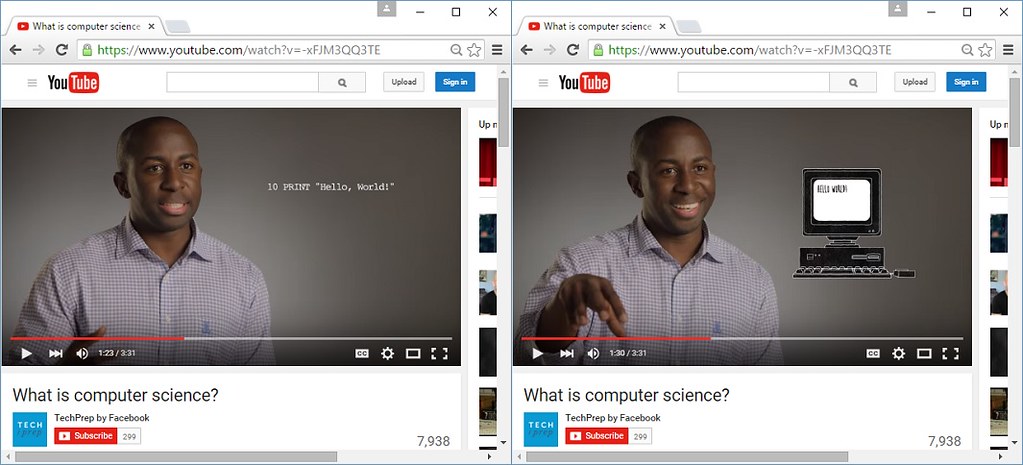
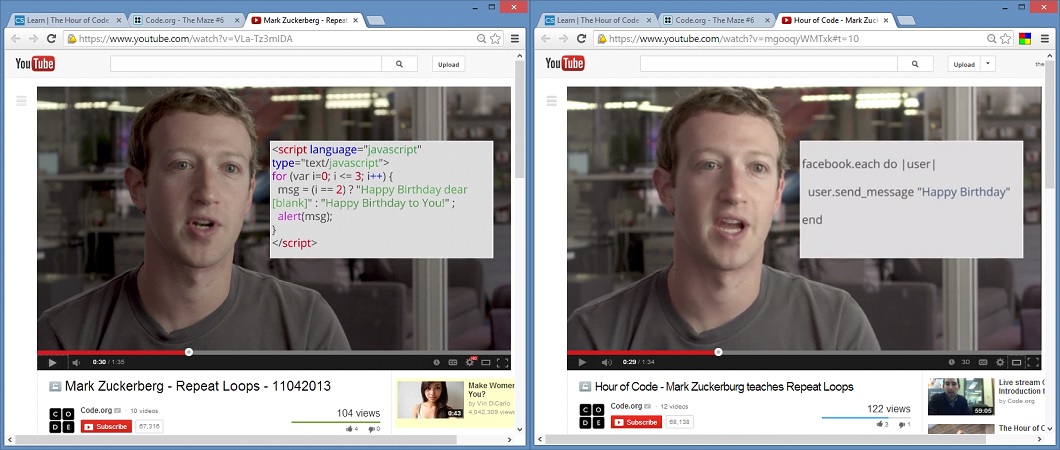
theodp writes: In What is Computer Science?, the kickoff video for Facebook's new TechPrep diversity initiative, FB product manager Adriel Frederick explains how he was hooked-on-coding after seeing the magic of a BASIC PRINT statement. His simple BASIC example is a nice contrast to the more complicated JavaScript and Ruby examples that were chosen to illustrate Mark Zuckerberg's what-is-coding video for schoolkids. In How to Teach Your Baby to Read, the authors explain, "It is safe to say that in particular very young children can read, provided that, in the beginning, you make the print very big." So, is introducing coding to schoolkids with modern programming languages instead of something like BASIC (2006) or even (gasp!) spreadsheets (2002) the coding equivalent of "making the print too small" for a child to see and understand?
Please stop shilling for Facebook. You do it endlessly. No one likes Facebook or its douchebag in chief.
The statements are too long.
Writing a working program should be as easy as:
LOL
LMFAO
ROFL
Therefore I suggest we teach beginners assembly language and exchange the mnemonics for common texting short forms.
"It is practically impossible to teach good programming to students that have had a prior exposure to BASIC: as potential programmers they are mentally mutilated beyond hope of regeneration."
-- Edsger W. Dijkstra
Kids should be introduced to programming using marble runs and physical switches or conditionals. Get them interested in the toy aspect, introduce rewards for working out how to achieve goals, and gradually introduce virtual modelling of the physical layout as complexity increases - they will gradually move completely to the virtual model, and then you can introduce the next stage of exposing the code when managing click and drag objects becomes a hassle.
Baby steps. Literally.
COBOL would be a good use for something that's extremely easy to read and understand and can do powerful things.
Maybe Johnny wants to choose his own fucking interests, instead of having them imposed by a corporate oligarchy only interested in cheap labor.
SJW's don't eliminate discrimination. They just expropriate it for themselves.
I have seen a lot of programmers who are totally dependent on the IDE to develop the code. They have no idea how it works or where it runs from once it deploys.
The need to solve a problem, being presented with a tool simple enough to understand and some help to get started seems to me to be the true trigger that can start someone off down the programming track.
Of course we have made the print too small. I recall attempting to 'grok' Fortran and Algol as a teenager and having difficulty understanding the difference between reserved words and variables and so forth.
BASIC is a brilliantly-designed language for the beginner because the concepts you need to understand are so simple. Even the much-maligned line numbers are important in the learning curve. When you start, a variable, a reserved word and a label are all concepts you have real difficulty separating. BASIC line numbers, though, you can immediately map to the idea of a sequence of control. Once you have mastered this you can then absorb the more advanced concepts gradually.
For those who take a snobbish attitude to BASIC I still feel that Kemeny and Kurtz understood absolutely how to create a language that simplified programming to its essence. As such, it really should be the starting point - it's easy to teach students better techniques once they have written some simple BASIC programs and hit issues like running out of places to insert a line, etc, because they can SEE why better techniques make their lives easier.
I think there's something to be said for learning programming on a very simple machine.
First, you need to keep in mind that kids have absolutely no idea how a computer works, at even the most basic of levels. It's a box with a keyboard and stuff happens on the screen. You need to cement the idea that you have to tell the computer to do stuff, and link the idea of coding to that stuff.
This is much easier to do when you have a computer that does pretty much nothing when you turn it on. A flashing cursor comes up and it's waiting for you to tell it what to do. 10 PRINT "HELLO" RUN and it does something. 20 GOTO 10 RUN and it does something else. You get the link between what you're telling the computer to do and what the computer is actually doing pretty quickly.
Compare that with booting up Windows/MacOSX/Linux, getting into your desktop environment, loading up a browser or IDE, creating a new project, explaining the UI of the IDE, making sure you have the right includes to do IO, directing your output to console or a UI object, etc...
My Other Computer Is A Data General Nova III.
I learned to program in 4th grade, and yes the INPUT, PRINT and IF THEN ELSE statements made up the first tutorial I went through. But as soon as I got to the section of the tutorial on PSET, LINE, etc. is when I really got interested.
I may have eventually had fun writing MUD-like text based games, I first got hooked writing games like Tic-Tac-Toe and space invaders.
-- All that is necessary for the triumph of evil is that good men do nothing. -- Edmund Burke
When I was a kid getting into programming, I constantly ran into a wall. The basics, like hello world, and command line input->output programs that can do an enormous variety of calculations, background work, execute even big and fun commands were always easy, instructions prevalent, how to's everywhere and easy to understand.
Then you want to actually move from moderately complicated programs that are useless to real ones that do something, and I hit a wall. How to make a GUI work, how to make graphics appear, how to do anything useful at all in any kind of app, desktop program, etc, and the tutorials jumped from 5 easy to understand lines to 50 page books on how to get a single line to appear, much less do anything else.
Excessively complicated syntax, and extremely difficult, complicated programming required for even simple programs in a useable context make it opaque, that is the small print. The resources are plentiful for the most basic coding, plentiful on algorithms and how they work, but the second you get to a moderately complex topic of actually making applications you can double click and use, I might as well be trying to learn how to do complex multivariable calculus in a non-euclidean geometry based on a few comments on a thread on a help page that was posted and died 8 years ago.
So...this is part of Facebook's "please don't class action us" effort and a product manager goes on video to say that the current batch of entry level languages and examples (which my kids mastered in middle school) are too hard for his target audience (women) so we need to step back to a simpler language with fewer moving parts? OK Facebook, do you really want to own that, "women are dumb so we'll come down to their level" (as long as you don't sue us) message?
I never hear of it. What's it? I even try go there today, but website is down. Maybe I tomorrow try again if it is good site.
Sincerely,
A Chinese
Logo, and a moving turtle for the win.
Tools such as Arduinos and gShields and inexpensive stepper motors (to say nothing of Grbl which is one of the most amazing programs I've ever seen in terms of memory efficiency and compactness) make this far more affordable than it was.
Still kind of surprised no one has done a Logo to G-Code translator.
Sphinx of black quartz, judge my vow.
Here in Australia, a TV show called "Good Game SP" (which does gaming news, game reviews and other gaming related stuff aimed at kids) did a series of segments using the Scratch environment to build a game. I thought it was a great way to introduce kids to programming in a simple way (with things like if statements, loops etc) but without (as far as I can tell) teaching any of the bad habits you might get from something like BASIC.
The LEGO Mindstorms robotics kit also seems like a great way to teach the simpler programming concepts without teaching bad habits (coincidentally both LEGO Mindstorms and Scratch came out of the MIT Media Lab)
for decades. I learned it when I was 7, learned basic when I was 9 and was using proper programming languages within 2 years of that.
Give them LOGO and turtle graphics.
It was the best tool for the job in 1967. It's still the best tool for the job today.
The reason is because nobody has tried to build a better one. You don't teach 7 year olds ruby or javascript or python but FFS you don't teach them BASIC either - give them LOGO, and when they mastered that, they will be able to grasp any modern language you throw at them.
And if you want something new and shiny, then design that something FOR CHILDREN. That's why LOGO remains the best for the job - because it was designed specifically for children by a team that included a behavioral child psychologist.
Unicode killed the ASCII-art *
Johnny can't cook a souffle, Johnny can't make a dove joint, Johnny, can't fix a car, Johnny can't set a broken arm, Johnny can't balance and income statement, etc.
But there is at least SOME people that can do it. These are all disciplines/careers that people elect to pursue. Not everyone needs to know how to code. That's stupid. Does everyone need to know how to design, cut, and sew together a pair of pants?
Does knowing how to code make it any better when Windows or Windows apps go toe up? Really? Are you going to debug Windows or Mathematica because you took a coding class?
When Fascism comes to America, it will call itself Anti-Fascism, and tell you to give up your guns.
As the parent of a 12 year old girl, I can assure you all, kids today are not having trouble learning to code. They have resources today that I couldn't have dreamed of when I was their age, and they are using them. There are two major problems that I see happening: there are too many languages out there and no one works in text/console mode anymore.
Computers were text based when I was learning basic 3 decades ago. As such, BASIC made a perfectly sensible starting point. Instead, today, a web or mobile app requires knowledge of HTML, JavaScript, CSS, some backend language such as C# or Java, SQL, and probably some other things AI haven't thought of.
Really, if you want to bring back a version of BASIC that was reasonably accessible but could still write something resembling a modern app, bring back Visual BASIC 6.
But like I said, kids today aren't really having much of a problem. My kid and her friends are learning JavaScript and C# and C++ and I have no idea what else. There are lots of resources out there and kids are taking advantage of them.
Johnny (and Jane) can code. They just don't want to. Back in the 80s and 90s, computers were new and cool and if you could code, you could even make the computer do what you wanted it to do. Back then coding was freedom. It's like hot rods in the 50s. If you could soup up a car and make it run fast, others looked up to you. Now, fast cars, like computers, are common place and the "skill" isn't needed or valued like it was.
In the future, today's hot fields will be asking the same question. Once the newness and prestige wear off, the Johnny's and Jane's of the world move on to something else.
The reason Johnny (and Jenny) can't code is simple: coding is not easy. Most kids hate math word problems. Yet, that's what coding is. You're given a math word problem with all these variables and facts and rules, and you have to come up with a solution, that is translated into a foreign language of simple instructions for a very dumb machine that is fussy about how you talk to it. If you can't stand problems that start out, "A train leaves Chicago traveling 42 miles per hour...", then you are not ever going to like coding, and you most likely will never be very good at it.
Proverbs 21:19
My first computer was a TRS-80 color edition. https://en.wikipedia.org/wiki/TRS-80_Color_Computer
At the time I got it, I spent a large part of my time finding and making materials to build tree houses. The best part of the computer was I didn't need physical materials to build something. I could type up a set of materials and use them. This really satisfied my need to invent and build stuff.
I have just started showing my daughter, age 7, how she can build stuff on a computer using the Unreal Engine. She already does "art work" in Minecraft design mode. The idea of more realistic materials got her interest.
I only look human.
My mother is a halfling and my dad is an ogre, so that makes me an Ogreling
The first programming language I learned was BASIC.
I had to unlearn BASIC to learn FORTRAN.
I had to unlearn FORTRAN to learn C.
My brain is at its erase cycle limit.
Now I basically program in FORTRAN using C.
Actually, he can't edit a fucking comment once posted.
When Fascism comes to America, it will call itself Anti-Fascism, and tell you to give up your guns.
Or you could just dig up an old BASIC interpreter and a simple text editor. No need for linux, vim, gcc or whatever. Let them run it locally in a terminal (full-screen is nice for kid's eyes and makes it easier to spot a typo such as a single quote instead of a double quote, etc. Absolutely no need to add overhead such as a web browser and the need for both an internet connection and a server. You could do this on computers that are two or more decades old, so if they don't have a box at home (or someone else is using it) they can still play around. And no hassles about malware, antivirus, etc. A simpler, gentler time.
"Transparent" is a shit show that trades on every stereotype going. A man in drag is NOT a transsexual.
I generally agree. When I went to teach one my children programming, I chose BASIC over newer alternatives. There's too many features and abstraction for newbies in say Python.
I can explain BASIC in simple English: "A GOSUB statement allows you to reuse the same lines of code from different spots in the program. It's like our little "execution guy" [already explained to kid] has a rule: when he sees GOSUB X, he writes down the line number of the next statement after that GOSUB in the "Return List". He then jumps to the given destination (line # X) and keeps executing until he sees a RETURN statement. When he sees that, he then checks the Return List we talked about to see where to go back to, crosses it out, and goes back."
It's simple "mechanical" rules of the form: if the "execution guy" sees such and such, he does this and that.
No crazy abstraction speech that goes over a kid's head, just easy step by step rules and clear-cut "parts". Statements have a clear-cut reference ID (line numbers) that can be written down per our model's "rules". You can check their work to see the line numbers.
(I don't need to get into stacks yet when starting out, but when the time comes, it's merely a clarification on how multiple items on the Return List are written and used by the Execution Guy. One can build on existing explanation idioms.)
If you think otherwise, I challenge you to present a simpler, more approachable way to explain function or sub-routine calls in say Python...
Table-ized A.I.