 Slashdot Mirror
Planetary Exploration In 2016 (planetary.org)
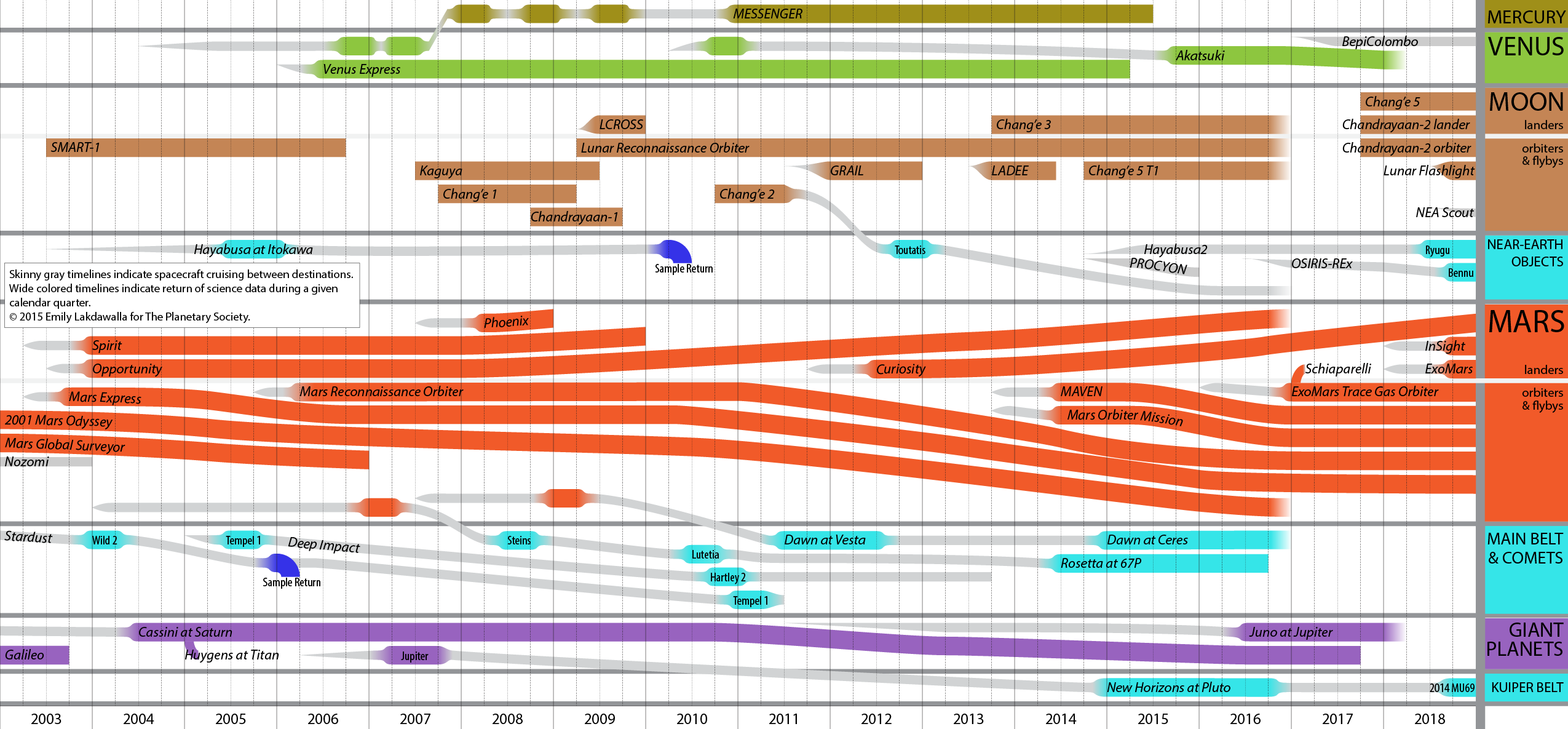
An anonymous reader writes: Emily Lakdawalla at the Planetary Society blog has put together a post about all of the space missions set to return data from planets, moons, and other bodies in the solar system this year. She's also assembled some cool visualizations of when the missions are active at their locations of interest. In summary: "Akatsuki is at Venus, Lunar Reconnaissance Orbiter and two Chang'e missions at the Moon, two rovers and five orbiters are active at Mars, Dawn is at Ceres, Rosetta is at 67P, Cassini is at Saturn, and although New Horizons is far past Pluto, it'll be sending back new Pluto science data for most of the year, so I'm counting that as still doing science. Another two missions (Hayabusa2 and Juno) are in their cruise phase; Juno arrives at Jupiter in August. Two (ExoMars Trace Gas Orbiter and OSIRIS-Rex) or three (if you count the Schiaparelli lander separately) will launch this year, with their science starting after 2016."
uh, people are still 'doing science' on Viking data. The real science is not done for years and decades after the observation which is mostly an engineering exercise.
The Juno mission to Jupiter this year looks pretty interesting. We should find out if Jupiter has a rocky core, some nice polar images, and detailed measurements that might shed light on the early solar system formation. As far as I understand it isn't known if Jupiter formed near the Sun and moved out or not, and this has huge implications for Earth's early history and more generally for systems around other stars.
Please elaborate, it seems to me that it still exists and I'm not sure what's wrong with it.
If builders built buildings the way programmers wrote programs, then the first woodpecker would destroy civilization.
but. the earth is flat
We're in a golden age of robotic exploration. The diagram doesn't really show this quite as much because it only goes back to the year 2003, but you can see it a little bit in this diagram based on how few lines trail off the left-hand side of the diagram and how many more don't just start sometime in the last decade but have very long lines. Since 2003 there has been no point where we haven't had at least three Mars missions ongoing giving back actual data and often four or five. Mars currently has 7 different active missions, and that number is set to actually grow over the next few years. The situation for other bodies looks not as extreme, but very similar. At the start of the diagram, there are zero Venus missions or Mercury, either active or underway, and since 2005 for both planets there's been at least one each active or underway for each planet. Similar statements apply to the other categories in the diagram. The only one we are roughly holding steady is missions to the gas giants. Even there there's been an uptick but not as large.
Not the original AC, but the difference is:
1) planetary.org blogs consist of people reporting on current or original content.
2) The Planetary Society has actively supported space exploration for 40 years.
3) that asshole Ethan is still shitting up the queue with links to his Forbes blogspam, he's just posting for clicks as an AC now.
4) that asshole Ethan just cuts and pastes shit from Wikipedia and intersperses them with barely-relevant pictures that he gets off GIS.
I'm all for space exploration and all for science reporting on Slashdot. StartsWithAFail is neither.
Don't bogart.
I'm on tenterhooks.
Excellent choice.
NASA's recent mismanagement, including the James Webb Space Telescope debacle will become apparent in the years ahead. People are not paying attention to the recent dearth of robotic probe launches. In the years ahead, however, young people may begin to notice that they are not being treated to the regular arrival of new probes at their destinations that we older folks have seen. It's possible a new President will take NASA seriously, and perhaps NASA will get the funds to launch some truly amazing landers and sample-return missions with their shiny new SLS rocket, but I'm not going to hold my breath in anticipation.
We stand at a crossroads, and the advocates for robotic exploration need to decide which path they want to follow in the decades ahead:
1. Well-planned, responsible missions that hit their budget targets by using tried-and-true instruments and architectures where the focus is on gathering new data from new places.
- or -
2. JSWT-style missions whose proposals to congress and budgets are a total lie, and whose teams are so wrapped-up in making personal careers out of their probes that they make every bit of hardware unique and hyper-expensive, eventually trapping NASA management into the "sunk-cost" fallacy which then leads to the cannibalization of nearly all other projects to get the many billions of dollars needed to cover the overruns and produces a one-of-a-kind probe that could ruin the agency if it is lost during launch or if it fails to properly deploy.
The people building JWST have spent more years designing and building it than many taxpayers spend at one employer and they plan to run-out their careers operating it; they've made it a jobs program for people with too many sheepskins on the wall and sacrificed nearly all other robotic exploration in the process. JWST will only ever generate images of things so far away that no human will ever be affected by them or travel to them, showing us where they WERE long ago and what they looked like THEN, not where they are now or what they look like now. A large number of identical little rovers built on an assembly line and sent to Mars for far less cash would have provided more immediate and practical knowledge of a place we may actually be able to go to soon and utilize, and yes it would have even provided more jobs for more researchers. Landers for moons of Jupiter and Saturn would also have been a better use of all that cash spent trying to build ONE JSWT that could well be destroyed on launch. The wors part is that if JWST actually succeeds, it will bolster every bad habit of the people who created it and any future probe from that dark corner of NASA will be proposed with an even more dishonest schedule and budget thereby exposing competing exploration programs to even more risk of being cannibalized.