Slashdot Mirror


Planetary Exploration In 2016 (planetary.org)

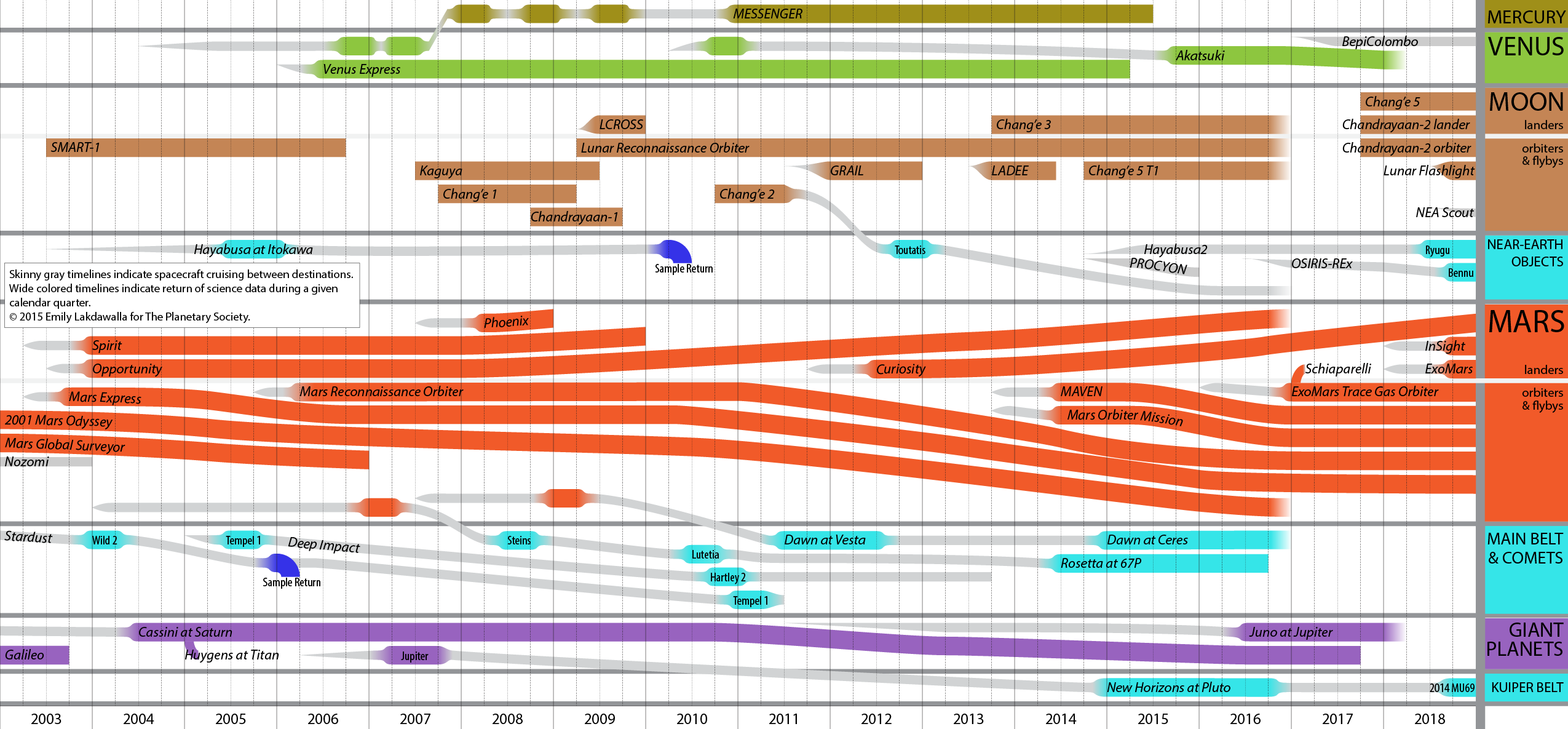
An anonymous reader writes: Emily Lakdawalla at the Planetary Society blog has put together a post about all of the space missions set to return data from planets, moons, and other bodies in the solar system this year. She's also assembled some cool visualizations of when the missions are active at their locations of interest. In summary: "Akatsuki is at Venus, Lunar Reconnaissance Orbiter and two Chang'e missions at the Moon, two rovers and five orbiters are active at Mars, Dawn is at Ceres, Rosetta is at 67P, Cassini is at Saturn, and although New Horizons is far past Pluto, it'll be sending back new Pluto science data for most of the year, so I'm counting that as still doing science. Another two missions (Hayabusa2 and Juno) are in their cruise phase; Juno arrives at Jupiter in August. Two (ExoMars Trace Gas Orbiter and OSIRIS-Rex) or three (if you count the Schiaparelli lander separately) will launch this year, with their science starting after 2016."
16 of 27 comments (clear)

  1. Counts as still doing science by thinkwaitfast · · Score: 3, Insightful

    uh, people are still 'doing science' on Viking data. The real science is not done for years and decades after the observation which is mostly an engineering exercise.

    1. Re:Counts as still doing science by thinkwaitfast · · Score: 1

      You, my friend, are a citizen scientist of the highest magnitude.

    2. Re:Counts as still doing science by Z00L00K · · Score: 3, Interesting

      That was science as well, it marked the start of a new batch of science data to be processed.

      There's always use for old data when doing science, the Viking probe data on Mars is very useful when it comes to analyzing the more modern data from the later probes. Both as a reference and also when new data provides new reference points it can be used to re-evaluate the old Viking data.

      --
      If builders built buildings the way programmers wrote programs, then the first woodpecker would destroy civilization.
    3. Re:Counts as still doing science by Teancum · · Score: 2

      And western culture didn't need to leave Greece either to study how the universe worked. That at least was a major philosophy a couple thousand years ago where deductive logic was thought to be able to tell us everything we needed to know.

      Unfortunately, there are times you need to put those ideas into practice and get out of your mother's basement. There is a whole universe waiting for us, and hoping a bunch of robots are going to do all that work for you is just plain lazy.... and won't give you the necessary insights for understanding either. The robots are just the early explorers picking off the low hanging fruit as it were.

  2. Looking forward to Juno mission by InfiniteLoopCounter · · Score: 4, Interesting

    The Juno mission to Jupiter this year looks pretty interesting. We should find out if Jupiter has a rocky core, some nice polar images, and detailed measurements that might shed light on the early solar system formation. As far as I understand it isn't known if Jupiter formed near the Sun and moved out or not, and this has huge implications for Earth's early history and more generally for systems around other stars.

    1. Re:Looking forward to Juno mission by stevelinton · · Score: 2

      I thoiught current thinking was that Jupiter and Saturn formed pretty far out then were drawn in, swapping places with each other and collectively with Uranus and Nepture (and possibly ejecting a fifth large planet) going closer to the Sun than their present locations before finally settling down.

    2. Re:Looking forward to Juno mission by InfiniteLoopCounter · · Score: 1

      I thoiught current thinking was that Jupiter and Saturn formed pretty far out then were drawn in, swapping places with each other and collectively with Uranus and Nepture (and possibly ejecting a fifth large planet) going closer to the Sun than their present locations before finally settling down.

      I think that was the idea before large numbers of Jupiter-sized exoplanets were found orbiting close to their parent stars. Then the new idea came up that Jupiter and Saturn may have formed close to the Sun. In a 3-body-problem manner, Saturn might have been pushed out and took Jupiter with it (similar in part to how our own moon is moving away from us). Then, with the space close to the Sun cleared of debris and pushed into clumps, Mars-sized protoplanets started to form and were pushed into orbits around the Sun. If the orbits were too close, because not entirely circular the differential pull of the Sun would have sped up or slowed down planets on the same orbits causing a collision. This may have occurred for Venus, knocking it so that it now has virtually no spin, for the Earth, giving us our current size and moon(s), and also to create the asteroid belt past Mars.

      It all ties in with the bombardment phase when/where the inner planets received water, possibly from the motions of Jupiter away from the Sun pulling in the distant icy comets from the outer solar system towards the Sun. It's an interesting model where the actual reality might even be more intricate or different. However, this is a gap in our current understanding that we may begin to solve by analyzing Jupiter in detail.

    3. Re:Looking forward to Juno mission by InfiniteLoopCounter · · Score: 1

      Sorry I put the wrong link. I meant to put this one about how another planet could not share our same orbit behind the Sun on the other side or otherwise.

    4. Re:Looking forward to Juno mission by stevelinton · · Score: 1

      The speaker I saw (a professional astronomer) said that they ran huge families of simulations and in many of them gas giants fomed far from the star (not much option there, close in the radiation from the star pushes the gas away) and head inwards as they interact with the remainder of the proto-planetary disk, Then the simulations split into two families -- hot Jupiter scenarios where the gas giants stay very close in and others where they move back out -- something to do with how fast the small bodies and dust get cleaned out, I think.

  3. We're at a golden age of robotic exploration by JoshuaZ · · Score: 3, Interesting

    We're in a golden age of robotic exploration. The diagram doesn't really show this quite as much because it only goes back to the year 2003, but you can see it a little bit in this diagram based on how few lines trail off the left-hand side of the diagram and how many more don't just start sometime in the last decade but have very long lines. Since 2003 there has been no point where we haven't had at least three Mars missions ongoing giving back actual data and often four or five. Mars currently has 7 different active missions, and that number is set to actually grow over the next few years. The situation for other bodies looks not as extreme, but very similar. At the start of the diagram, there are zero Venus missions or Mercury, either active or underway, and since 2005 for both planets there's been at least one each active or underway for each planet. Similar statements apply to the other categories in the diagram. The only one we are roughly holding steady is missions to the gas giants. Even there there's been an uptick but not as large.

    1. Re:We're at a golden age of robotic exploration by JoshuaZ · · Score: 1

      I should read the entire TFA before commenting. Later down, they have a diagram that goes back for the previous 15 years and they note explicitly this massive jump and discuss it. (Also, I have to say I really like the way they've presented the data here. It is a novel but highly readable way of organizing the data.)

    2. Re:We're at a golden age of robotic exploration by Applehu+Akbar · · Score: 1

      What we need to concentrate on now for maximum science return is closeup exploration, with rovers if possible, of the Jupiter and Saturn icy moons.

    3. Re:We're at a golden age of robotic exploration by Teancum · · Score: 2

      A really interesting thing to look at is to note when the last time that a Hohmann Transfer Orbit to Mars from the Earth has been empty? I think at this point you can reliably state that it will always have something enroute to Mars for at least as long as mankind is going to be in space at all and is a permanent activity of mankind to be sending something there when the window of opportunity opens up.

      Even more remarkable is how countries other than the USA and Russia are now sending stuff to Mars. That to me is quite exciting, and shows just how widespread the interest is with doing stuff there. Even the politics of the U.S. Congress and Russian Duma are no longer relevant to the exploration of the planets anymore. And even Europe is starting to get serious about making their own vehicles as a part of that quest for knowledge.

      If anything, I think the same may be said about Jupiter in the next decade or so, where such transfer orbits will constantly be used in the future as well.

    4. Re:We're at a golden age of robotic exploration by stevelinton · · Score: 1

      Why? Surelty better to explore multiple bodies at a lower cadence. That way each mission can learn from more earlier ones and scientists with a larger range of interests get more data.

      For me, a Uranus or Neptune orbiter is the big obvious hole in the plans, followed by a Mars sample return.

  4. Re:we're not welcome in space yet? by Deadstick · · Score: 1

    Don't bogart.

  5. Re:Wow by Deadstick · · Score: 1

    I'm on tenterhooks.

    Excellent choice.