 Slashdot Mirror
Inside Google's Self-Driving Car Test Center (medium.com)
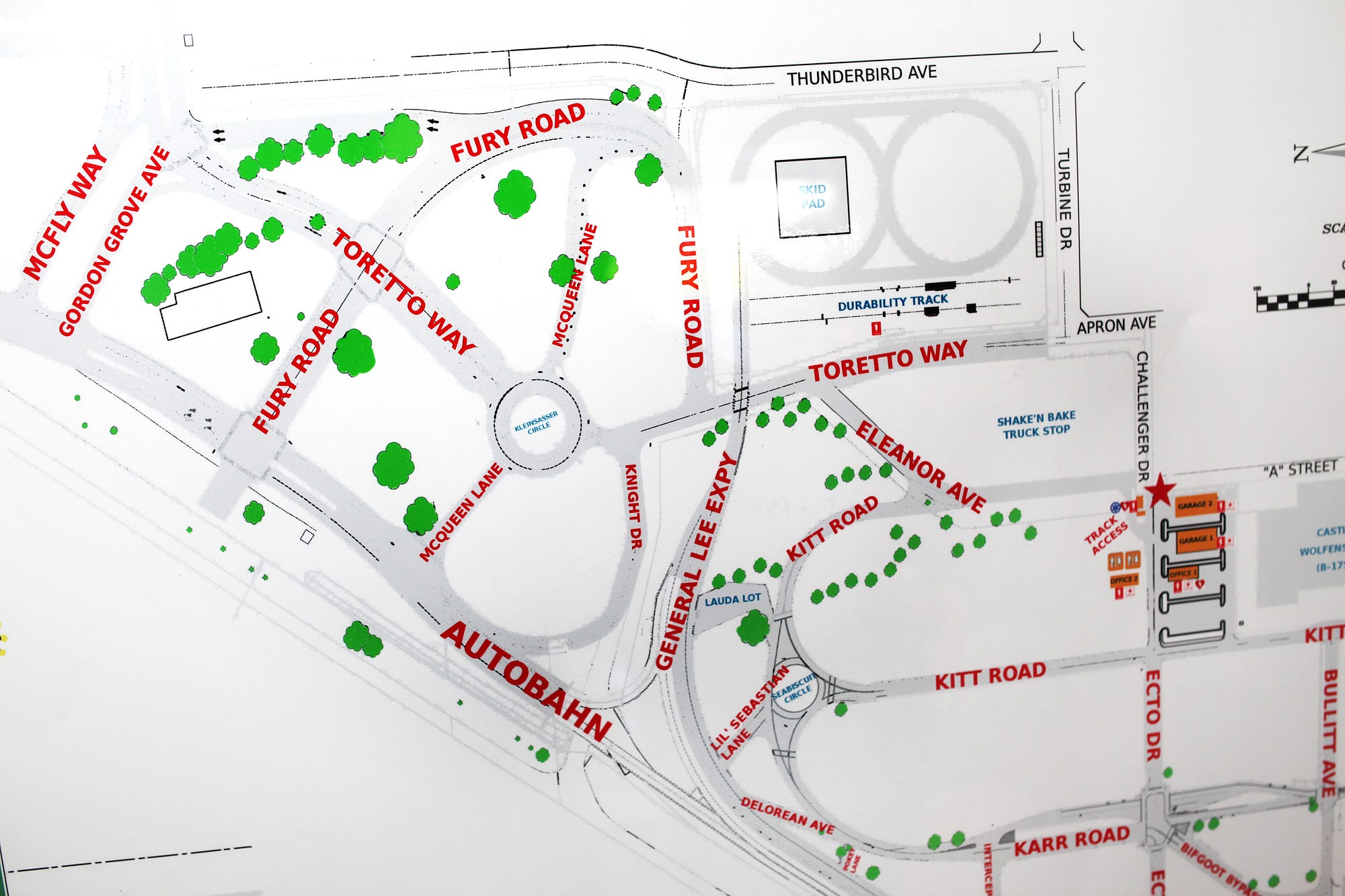
An anonymous reader writes: Steven Levy reports on his trip to the facility where Google tests is autonomous vehicles (here's a map). The company apparently has a four-week program to certify people to not-drive these cars, and they gave Levy an abbreviated version of it. "The most valuable tool the test team has for making sure things are running smoothly is the laptop on the co-driver's lap. Using an interface called x_view, the laptop shows the world as the car sees it, a wireframe representation of the area that depicts all the objects around the car: pedestrians, trees, road signs, other cars, motorcycles—basically everything picked up by the car's radar and laser sensors.
X_view also shows how the car is planning to deal with conditions, mainly through a series of grid-like "fences" that depict when the car intends to stop, cautiously yield, or proceed past a hazard. It also displays the car's path. If the co-driver sees a discrepancy between x_view and the real world, that's reason to disengage. ... At the end of the shift, the entire log is sent off to an independent triage team, which runs simulations to see what would have happened had the car continued autonomously. In fact, even though Google's cars have autonomously driven more than 1.3 million miles—routinely logging 10,000 to 15,000 more every week—they have been tested many times more in software, where it's possible to model 3 million miles of driving in a single day."
X_view also shows how the car is planning to deal with conditions, mainly through a series of grid-like "fences" that depict when the car intends to stop, cautiously yield, or proceed past a hazard. It also displays the car's path. If the co-driver sees a discrepancy between x_view and the real world, that's reason to disengage. ... At the end of the shift, the entire log is sent off to an independent triage team, which runs simulations to see what would have happened had the car continued autonomously. In fact, even though Google's cars have autonomously driven more than 1.3 million miles—routinely logging 10,000 to 15,000 more every week—they have been tested many times more in software, where it's possible to model 3 million miles of driving in a single day."
Google will be paying some accident victim millions of dollars in the future. It is inevitable.
they have been tested many times more in software, where it's possible to model 3 million miles of driving in a single day."
Here's the software.
it's not bigger on the inside. :(
Anons need not reply. Questions end with a question mark.
Why doesn't medium.com just buy Slashdot and get it over with?
and what about the prison / jail time when the car runs though the framers market?
Please remember, these cars are only in autonomous mode approximately 56% of the time.
So these statistics are, as usual, not telling the whole story. When they boast about how many accidents or miles driven, it's completely and wholly skewed by the fact that the human is driving the car in almost every situation other than "cruising in a straight line down the road".
Is it fair to say these cars are currently safer than human drivers when a dedicated copilot is nearly always present and double checking on the cars and who then shuts it off for a human to take over at the slightest problem? How many accidents have been prevented?
For those of you that haven't seen the university of Michigan report
Self-driving car = Google
Driverless car = Everyone else
You mean the wireframer's market?
In fact, even though Google's cars have autonomously driven more than 1.3 million miles—routinely logging 10,000 to 15,000 more every week—they have been tested many times more in software, where it's possible to model 3 million miles of driving in a single day."
That would be three million miles over the same few miles of well understood track and roads. The real world is much more varied than that.
The company apparently has a four-week program to certify people to not-drive these cars...
Have you ever not been on a boat?
Google revealed that their vehicles had been involved in 341 "disengagements" (when the driver had to take over) between September 2014 and October 2015. Of those "disengagements", 79.8% were due to a failure of the autonomous system.
Read the details here which outline the results of the report.
We will bankrupt ourselves in the vain search for absolute security. -- Dwight D. Eisenhower
Why would a car test center need to drive?
Confucius say, "Find worm in apple - bad. Find half a worm - worse."
How many miles on average does it drive before disengagement? That's the only thing that matters. If it disengages once per mile, then who cares if it was 3million miles.
in TFA the car has to be taken off auto-drive because it comes to a construction area and slows down so much it was barely moving
these things are not going to work in this form, and pushing them into the market will be a disaster
car AI is much, much improved, and I can see groups of electric semi-trucks following one lead driver on an interstate, but that's about it
Thank you Dave Raggett
So as crazy as it sounds there is a lot of activity in that part of California.
There is a new UC in Merced, which is about 5 miles from the test facility that graduates over 1,000 engineers each year.
Google also operates a Loon test base at the same facility which is also one of the largest air strips in the US - old B-52 base.
Other high tech operators and aviation are seated there as are solar companies and a major flight academy.
UC is building over a million square feet of labs in this area so a handful of starving start-ups are relocating there because the cost is 1/20 the Bay Area and only a short flight or 2 hour drive away - like driving from Berkeley.
The Hyper Loop deal is down the road not too far.
A lot of retired Air Force in the area - the air museum has one of the few SR-71 on the way to Yosemite.
I love that one of the buildings on the map is called "Castle Wolfenstein"!