 Slashdot Mirror
Inside Google's Self-Driving Car Test Center (medium.com)
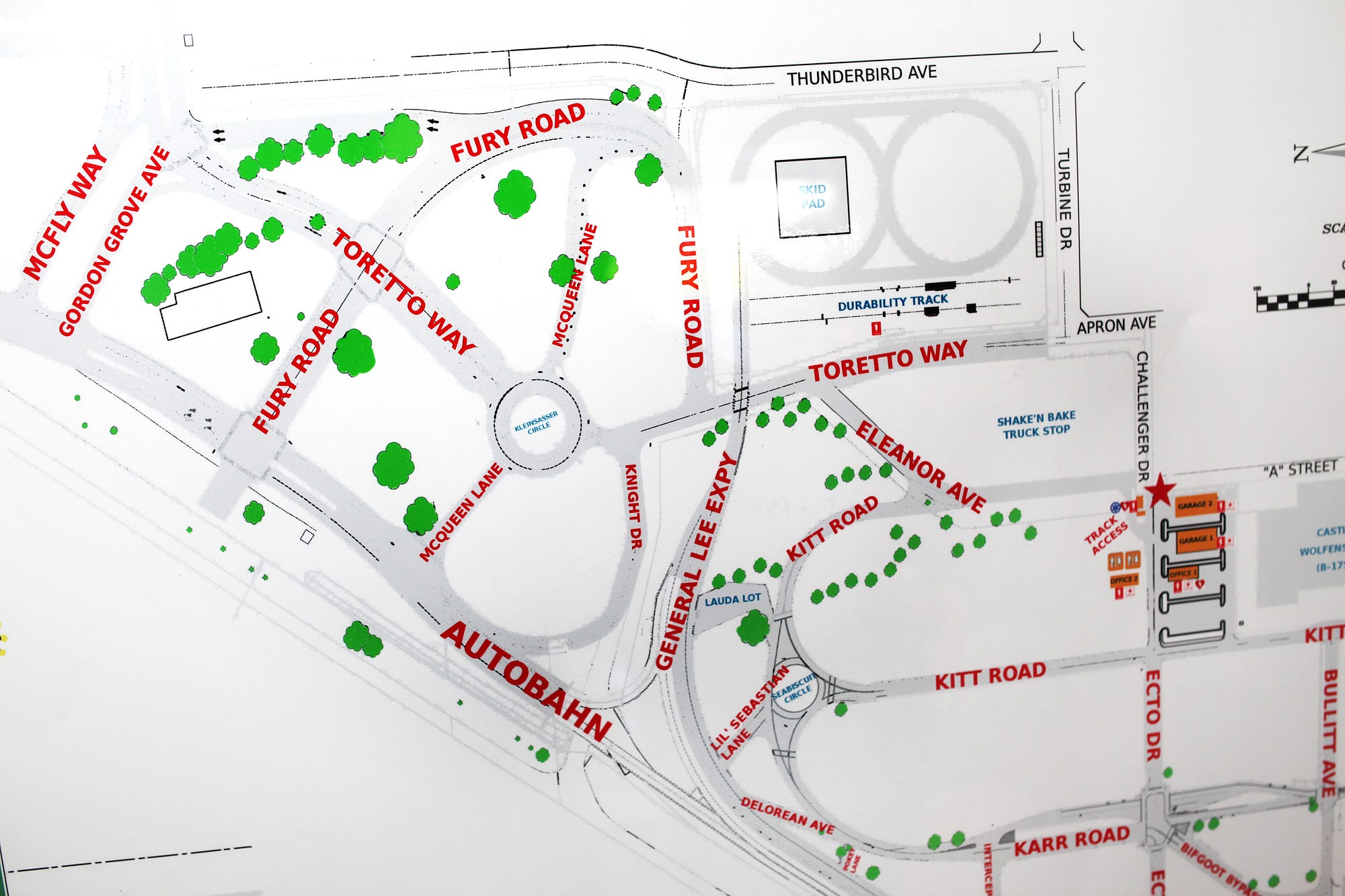
An anonymous reader writes: Steven Levy reports on his trip to the facility where Google tests is autonomous vehicles (here's a map). The company apparently has a four-week program to certify people to not-drive these cars, and they gave Levy an abbreviated version of it. "The most valuable tool the test team has for making sure things are running smoothly is the laptop on the co-driver's lap. Using an interface called x_view, the laptop shows the world as the car sees it, a wireframe representation of the area that depicts all the objects around the car: pedestrians, trees, road signs, other cars, motorcycles—basically everything picked up by the car's radar and laser sensors.
X_view also shows how the car is planning to deal with conditions, mainly through a series of grid-like "fences" that depict when the car intends to stop, cautiously yield, or proceed past a hazard. It also displays the car's path. If the co-driver sees a discrepancy between x_view and the real world, that's reason to disengage. ... At the end of the shift, the entire log is sent off to an independent triage team, which runs simulations to see what would have happened had the car continued autonomously. In fact, even though Google's cars have autonomously driven more than 1.3 million miles—routinely logging 10,000 to 15,000 more every week—they have been tested many times more in software, where it's possible to model 3 million miles of driving in a single day."
X_view also shows how the car is planning to deal with conditions, mainly through a series of grid-like "fences" that depict when the car intends to stop, cautiously yield, or proceed past a hazard. It also displays the car's path. If the co-driver sees a discrepancy between x_view and the real world, that's reason to disengage. ... At the end of the shift, the entire log is sent off to an independent triage team, which runs simulations to see what would have happened had the car continued autonomously. In fact, even though Google's cars have autonomously driven more than 1.3 million miles—routinely logging 10,000 to 15,000 more every week—they have been tested many times more in software, where it's possible to model 3 million miles of driving in a single day."
it's not bigger on the inside. :(
Anons need not reply. Questions end with a question mark.
Why doesn't medium.com just buy Slashdot and get it over with?
Google will be paying some accident victim millions of dollars in the future. It is inevitable.
... which will be covered by their insurance company ... the same insurance companies that are already paying millions to accident victims. The only thing that will change with SDCs, is that they will be paying a lot less.
SDCs don't need to be perfect. They just need to be better than human drivers. That is not a high bar.
The problem with that report is that it only covers reported accidents.
ANY accident that involves an autonomous car gets reported.
A similar accident between two humans may not be reported.
And, finally, the report even states that NONE of the accidents were the fault of the autonomous cars. They were ALL the fault of the human drivers. So, yes, the autonomous cars are better drivers than the humans in those instances.
I will be surprised if Google's insurance company ever has to pay a claim. The cars will have so much data on the accident that it should be trivial to show that the car was obeying all the laws and that any accident was either impossible to avoid or the fault of someone else.
Google itself might pay in the case of an accident that was not their fault BUT has a PR issue attached to it.
But, overall, I think that the insurance companies will love the autonomous cars that they're insuring. It's free money for them.
Two things.
1) The first sentence of the report says "after correcting for underreported accidents".
2) Most of the mileage of autonomous cars is going 25mph on residential streets or on the open, non-congested highway under perfect driving conditions.
so I'm not sure it's comparing apples to apples. I haven't been able to find a non-pay walled version if anyone has I would like to read it but am not paying.
Google revealed that their vehicles had been involved in 341 "disengagements" (when the driver had to take over) between September 2014 and October 2015. Of those "disengagements", 79.8% were due to a failure of the autonomous system.
Read the details here which outline the results of the report.
We will bankrupt ourselves in the vain search for absolute security. -- Dwight D. Eisenhower
Who exactly is Google conning? So far, the only ones losing money on self-driving cars are the companies like Google that are researching them.
We hope your rules and wisdom choke you / Now we are one in everlasting peace
Or let's try this a different way. A mental experiment. Think of both sides as two humans. Autonomous Alice and Bob.
Alice drives less than Bob. And Alice only drives under perfect conditions in a limited area. Bob drives everywhere in all conditions.
Bob does not report every accident he has to his insurance company. But Alice does. The insurance company sees that, on average, Alice reports more accidents than Bob. And the insurance company tries to adjust for Bob's under-reporting.
But every single accident Alice is in involves Bob hitting Alice and being found to be at fault for hitting Alice.
None of the accidents involve Alice being at fault.
So, to whom does the insurance company give the best rate to?