Slashdot Mirror


Wi-Fi Hotspot Blocking Persists Despite FCC Crackdown (networkworld.com)

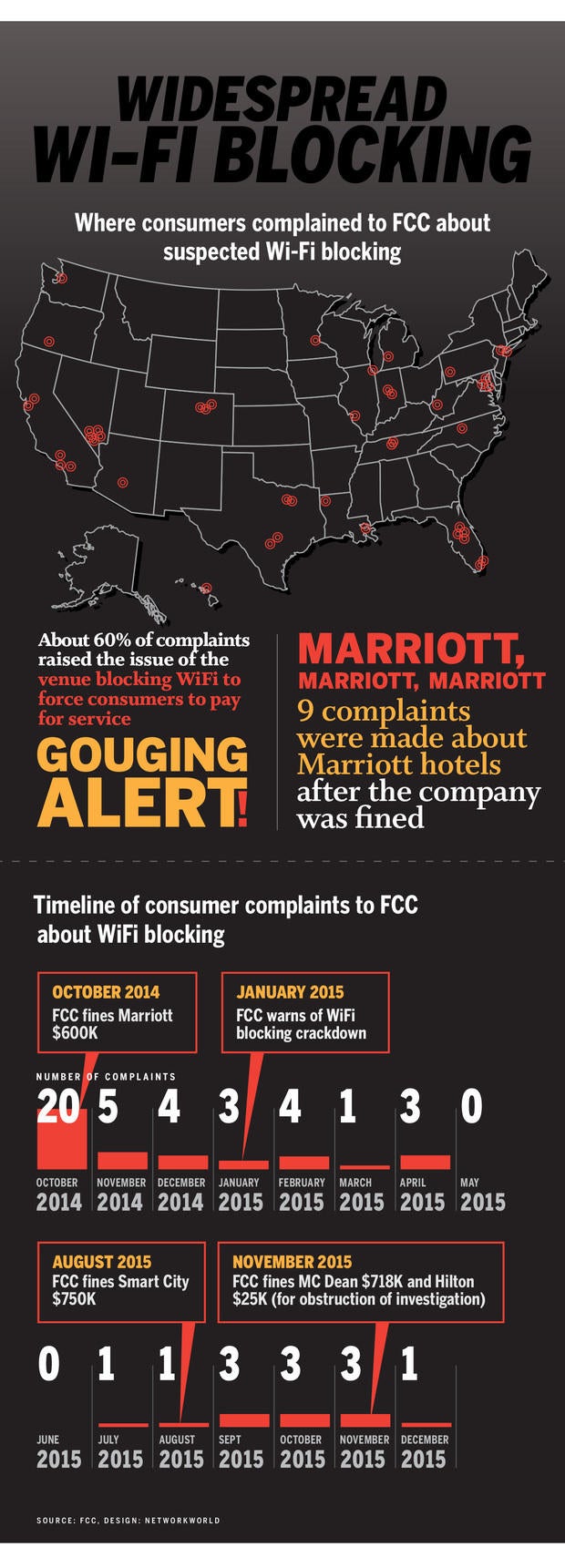
An anonymous reader writes: An examination of consumer complaints to the FCC over the past year and a half shows that the practice of Wi-Fi hotspot device blocking continues even though the agency has slapped organizations such as Marriott and Hilton more than $2 million in total for doing this. Venues argue they need to block hotspots for security reasons, but the FCC and consumers say the organizations are doing this to force people to pay for pricey Internet access.
"Consumers who purchase cellular data plans should be able to use them without fear that their personal Internet connection will be blocked by their hotel or conference center," FCC Enforcement Bureau chief Travis LeBlanc said in a statement. "It is unacceptable for any hotel to intentionally disable personal hotspots while also charging consumers and small businesses high fees to use the hotel's own Wi-Fi network. This practice puts consumers in the untenable position of either paying twice for the same service or forgoing Internet access altogether." Consumers have filed many complaints about Wi-Fi hotspot blocking to the FCC.
11 of 85 comments (clear)

  1. Not free? by Frosty+Piss · · Score: 3, Insightful

    In recent years, I have rarely stayed at a first class hotel that did not have free guest w-fi. People expect it and will bail for the local coffee shop if it's not free in the hotel.

    My guess is a lot of the offenders are in tourist traps where everything costs a lot.

    --
    If you want news from today, you have to come back tomorrow.
    1. Re:Not free? by Dcnjoe60 · · Score: 3, Informative

      In recent years, I have rarely stayed at a first class hotel that did not have free guest w-fi. People expect it and will bail for the local coffee shop if it's not free in the hotel.

      My guess is a lot of the offenders are in tourist traps where everything costs a lot.

      I think you intended to say that all of the first class hotels you stayed at had free guest wifi, but your double negative said just the opposite. However, my experience, at least in the US is just the opposite. Big name, first class hotels charge for wifi. It is the middle tier hotels that give it away as part of the room cost. Same thing with parking and other amenities.

    2. Re:Not free? by Frosty+Piss · · Score: 2

      So you have stayed in first class hotels that did not have free guest wi-fi in recent years.

      Yes, troll. Out of the last 50 hotels I have stayed in, perhaps two had charges that were very minimal.

      My point is that offensive and exorbitant wi-fi fees are in fact far and few between, even as the typically "ZOMG THE SKY IS FALLING" Slashdot article tries (and fails) to imply otherwise.

      Non-free wi-fi is simply not a huge issue anymore because while many hotels may charge a nominal fee which is their right, they don't block you from creating a wi-fi hot spot.

      You probably don't know this if you don't travel a whole lot, as I do.

      Simply put, I travel a lot. I have rarely had to pay for wi-fi, and when I did, the cost was negligible, and hot-spots where not blocked if I had chosen to use my cell data plan.

      Why did you even bother with the rest of your post?

      I don't know why I respond to Anonymous Cowards , they are usually vapid chihuahuas.

      --
      If you want news from today, you have to come back tomorrow.
    3. Re:Not free? by Gadget_Guy · · Score: 2

      In recent years, I have rarely stayed at a first class hotel that did not have free guest w-fi.

      I think you intended to say that all of the first class hotels you stayed at had free guest wifi, but your double negative said just the opposite.

      That is completely wrong. If you rarely stay at a hotel that does not have free Wi-Fi then it means that you more commonly stay at hotels that do have free Wi-Fi. It certainly does not mean, as you claim, the opposite of what was intended. Nor can you infer that the intention was that all the hotels had free Wi-Fi, as the word rarely indicates that some hotels did not have that feature. If the word used had been never then you could say that all hotels did have it.

  2. So, make their decision easier by nightfire-unique · · Score: 4, Interesting

    First offense, $5 million. Second, $50 million and jailtime for those responsible for the policy. Third offense, $500 million, and so on.

    --
    A government is a body of people notably ungoverned - AC
  3. Solution: Harsher Punishments by ThatBeDank · · Score: 2

    Make offending organizations pay $25+ million. Make them hurt. Better yet, jail some of the executive staff. Organizations are people and the board and C level suite are the head. Works for me!

  4. Some guy just got arrested for jamming cell phones by Anonymous Coward · · Score: 3, Insightful

    But wi-fi "blocking" gets a free pass? Have the FCC throw the book at them.

  5. Security by thegarbz · · Score: 5, Insightful

    Venues argue they need to block hotspots for security reasons

    Due to security reasons we are preventing people from running their own closed network between their devices and their telecom companies and instead forcing them all into our own network joined up with hundreds of other strangers ....

    1. Re:Security by DRJlaw · · Score: 3, Insightful

      Putting a fireall [sic] between the local clients and the rest of the Internet, or even port blocking certain classes of internal traffic, protects the clients and the rest of the Internet from quite a few vulnerabilities, such as unsecured sharing of the "C$" share with no admin password that is prevalent on poorly managed Windows laptops. And it reduces the cost of the service for the hotel by allowing bandwidth limiting on the controlled "free" access.

      The concept went right over your head, didn't it?

      If you set up your own WiFi hotspot, say using your cellular phone, you are not putting traffic on the facility network, you are not causing the facility to incur costs for bandwidth, and you are not in any sense the facility's local client. You are a client of your cellular provider's network, using a your own WiFi connection between your own cell phone and your other devices (over public airwaves; without connecting to the facility's WiFi network). That connection is presumably entirely private to your own devices (assuming that you're password protected your hotspot; my own device will not provide a WiFi hotspot without one).

      Putting a firewall between a customer and the customer's cellular provider is not the facility's job. Policing the internet (as opposed to the facility LAN) is not the facility's job. And appropriating public airwaves (in this case WiFi frequencies) for the exclusive use of the facility is quite simply illegal.

      Security reasons have very little to do actively interfering with WiFi hotspots. There is only one potentially valid concern - SSID spoofing. If you want to take on the FCC concerning that issue - go for it. But if the SSID is not the same as your facility's SSID, then you should not and legally cannot interfere with that other wireless network. Full stop.

      Got it?

  6. Re:How? by Anonymous Coward · · Score: 2, Informative

    Cisco calls it containment. Centrally managed access points will send deauth or deassociation frames to clients connected to "rogue" APs.

    We use it at my job, but only for our SSIDs ie., if you set up an AP or hotspot with the same SSID as ours, the containment feature will attempt to stop clients from associating. Our company name is part of the SSID, so it's not like you can innocently or accidentally have your connections to your hotspot blocked.

    That said, there have been times when I wished we simply banned the use of hotspots (we provide free, fast wi-fi) due to the RF interferences. At one point, 90 hotspots were operating in a ballroom competing for a limited number of 5ghz channels and everyone's experience suffered. When we asked people to disable their hotspots and connect to our unfiltered, unthrottled, free connection, about 70 did and the performance for everyone was (reported by them to be) better.

  7. Re:But blocking all wifi is fine? by ShaunC · · Score: 2

    I think it's the "blocking wifi" part that's getting the FCC's attention, not so much which expensive alternative is being pimped. If you're jamming frequencies or using some type of active denial to kick everyone off APs in the area, they aren't going to be happy with you.

    --
    Thanks to the War on Drugs, it's easier to buy meth than it is to buy cold medicine!