 Slashdot Mirror
Researchers Develop Atomic-Scale Hard Drive That Writes Information Atom By Atom (techcrunch.com)
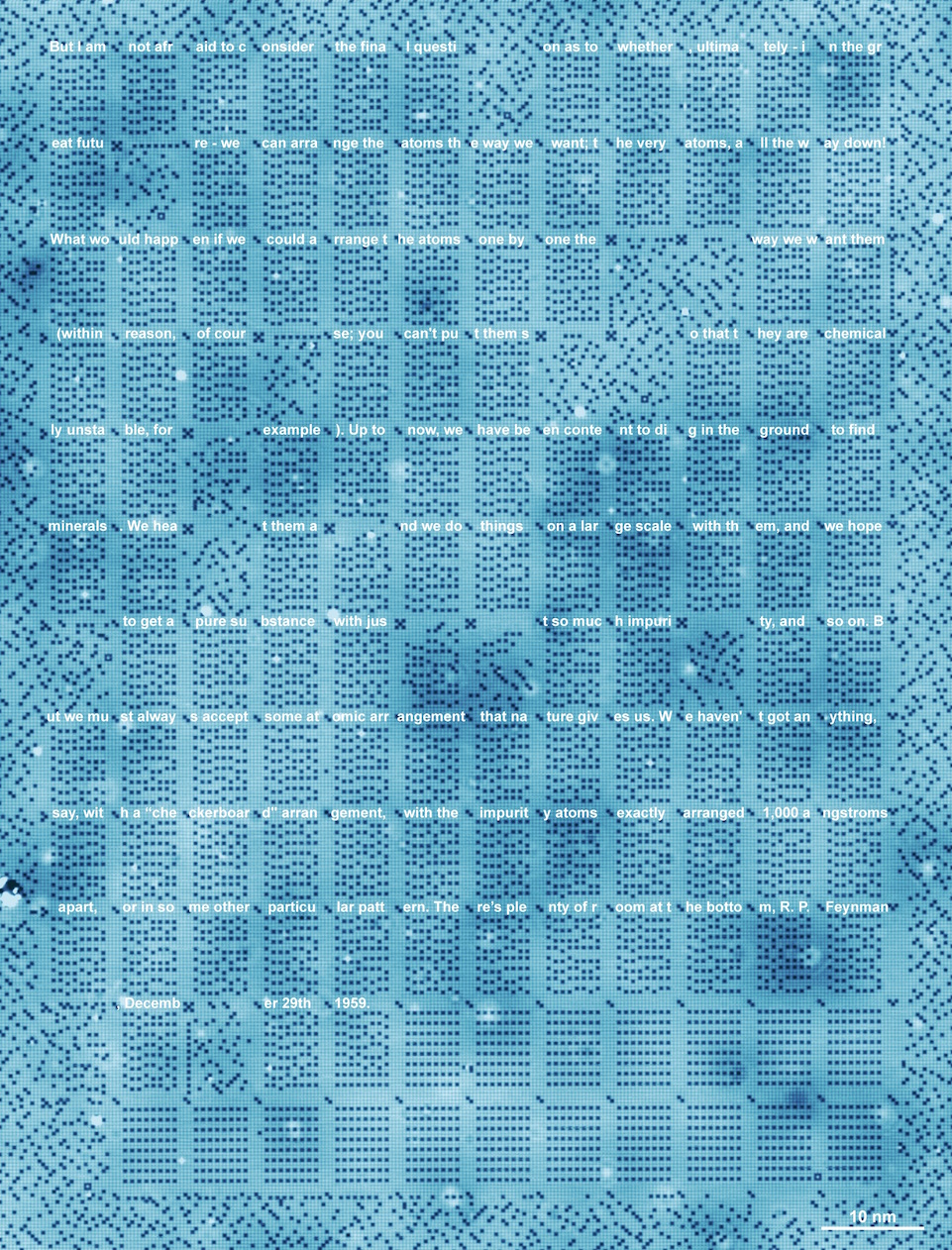
An anonymous reader quotes a report from TechCrunch: Researchers in the Netherlands have created a microscopic storage system that encodes every bit with a single atom -- allowing them to fit a kilobyte in a space under 100 nanometers across. That translates to a storage density of about 500 terabits per square inch. For comparison, those 4-terabyte hard drives you can buy today are about 1 terabit per square inch. That's because, unlike this new system, they use hundreds or thousands of atoms to store a single bit. "Every bit consists of two positions on a surface of copper atoms, and one chlorine atom that we can slide back and forth between these two positions," explained Sander Otte, lead scientist at Delft University of Technology, in a news release. Because chlorine on copper forms into a perfectly square grid, it's easy (relatively, anyway) to position and read them. If the chlorine atom is up top, that's a 1; if it's at the bottom, that's a 0. Put 8 chlorine atoms in a row and they form a byte. The data the researchers chose to demonstrate this was a fragment of a Feynman lecture, "There's plenty of room at the bottom" (PDF) -- fittingly, about storing data at extremely small scales. (You can see a high-resolution image of the array here.) The chlorine-copper array is only stable in a clean vacuum and at 77 kelvin -- about the temperature of liquid nitrogen. Anything past that and heat will disrupt the organization of the atoms. The research was published today in the journal Nature Nanotechnology.
What did YOU invent this week?
I'm still waiting for someone to invent something that somehow does NOT end up being a decade-long litigation between themselves and the fucking patent hoarders.
Good fucking luck with that shit.
This however is not, imho.
Yeah who wants tech and science related news on Slashdot, anyway? I want more black lives matter and election coverage! (Before you fools get on my ass, yes I'm aware of the irony of my comment in relation to my current sig.)
Either way, because this requires an extremely cold temperature, it will likely never even end up in even the most state-of-the-art datacenter, nevermind your PC. This is one of those neat yet 100% impractical things that come around every so often. Could a derivative of this technology some day become practical? Maybe, but not with the copper/chlorine combination seen here. I think DNA based storage would probably come sooner.
If they could figure out how to read and write to this quickly, don't lose too much space to ECC and get good durability, the temperature requirement won't keep it out of datacenters - liquid nitrogen is (relatively) cheap (10 - 20 cents/liter), and a 500X increase in density would make it very attractive - replacing 500 racks of disks with one rack of these would pay for a lot of liquid nitrogen.
look, this would be worthwhile if it had any sort of implication of it being feasible for some useful purpose some day. it does not.
it needs "clean vacuum" and a low temperature. it's less feasible,
the _only_ reason they arranged them in 8 bits and put that out in the pr was to get press time for something that otherwise would not have gotten any. they could have gone with "you can write the bible on so and so small thing" approach too.
bubble memory or whatever is more feasible for use than this, that's saying a lot.
Wouldn't a hard drive technician from 40 years ago say the same thing if you told him of your plan to build a helium filled hard drive the size of your fist that would have a million times more capacity than the washing machine sized drives that were state of the art?
Ahem. It's a proof-of-concept, technology demonstrator. Some of us have been in IT long enough to remember 10 Megabyte disk units for mainframes, that were the size of washing machines (1970s tech). My first PC had a 20MB full-height hard drive: that was 1987. My current box has 2x256 GB SSDs: their combined size is roughly that of a pack of cigarettes (Mind you, I also have several TB of magnetic disk storage. . .).
Technology evolves. This will as well. . .