 Slashdot Mirror
Researchers Develop Atomic-Scale Hard Drive That Writes Information Atom By Atom (techcrunch.com)
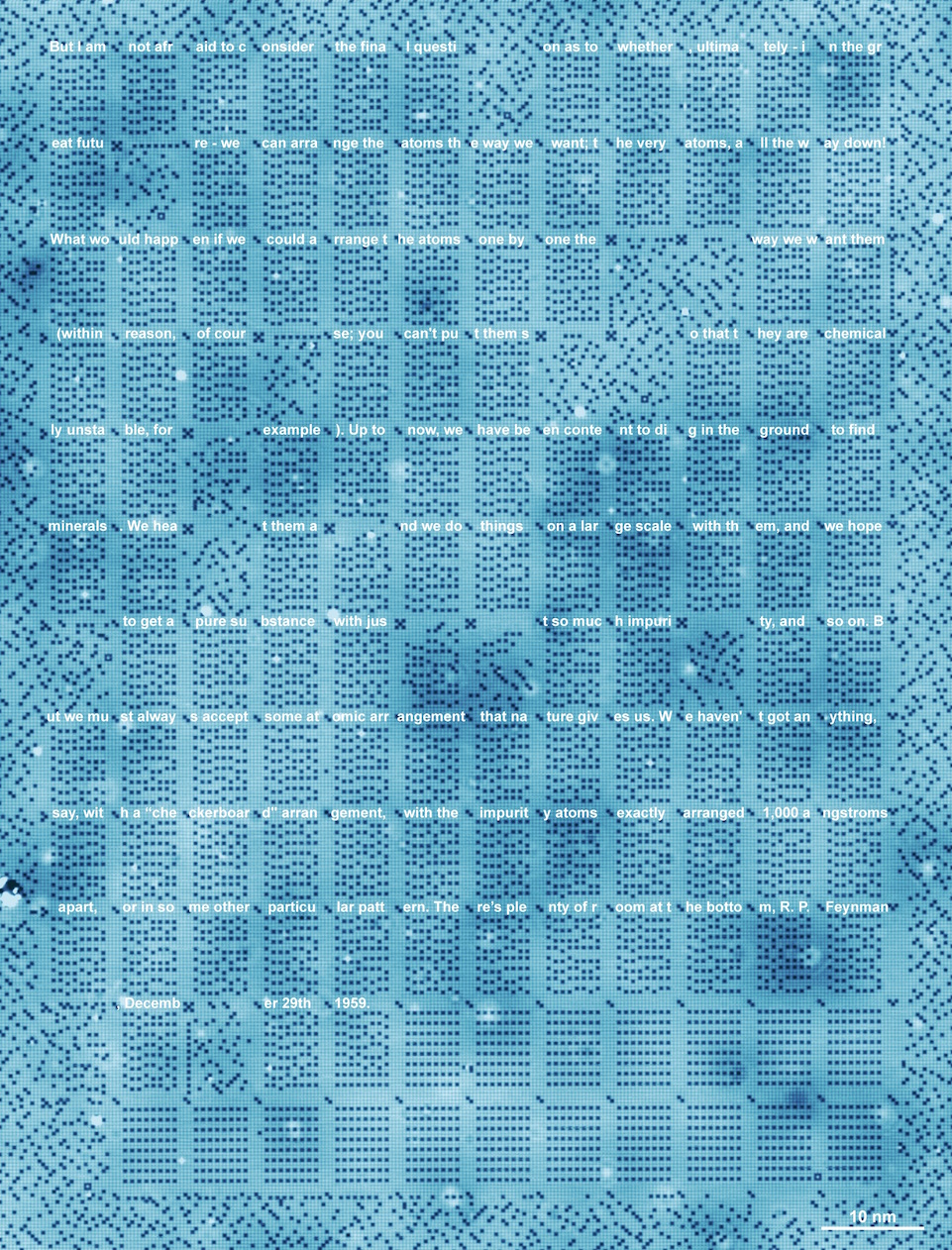
An anonymous reader quotes a report from TechCrunch: Researchers in the Netherlands have created a microscopic storage system that encodes every bit with a single atom -- allowing them to fit a kilobyte in a space under 100 nanometers across. That translates to a storage density of about 500 terabits per square inch. For comparison, those 4-terabyte hard drives you can buy today are about 1 terabit per square inch. That's because, unlike this new system, they use hundreds or thousands of atoms to store a single bit. "Every bit consists of two positions on a surface of copper atoms, and one chlorine atom that we can slide back and forth between these two positions," explained Sander Otte, lead scientist at Delft University of Technology, in a news release. Because chlorine on copper forms into a perfectly square grid, it's easy (relatively, anyway) to position and read them. If the chlorine atom is up top, that's a 1; if it's at the bottom, that's a 0. Put 8 chlorine atoms in a row and they form a byte. The data the researchers chose to demonstrate this was a fragment of a Feynman lecture, "There's plenty of room at the bottom" (PDF) -- fittingly, about storing data at extremely small scales. (You can see a high-resolution image of the array here.) The chlorine-copper array is only stable in a clean vacuum and at 77 kelvin -- about the temperature of liquid nitrogen. Anything past that and heat will disrupt the organization of the atoms. The research was published today in the journal Nature Nanotechnology.
I have seen AFM images of xenon atoms spelling out IBM on a graphite sheet as old as the 90s.
This smacks of "gimme fundingz plz!".
This work is not terribly novel. If they could dynamically change the state of the arrangement withat applied electric or magnetic fields, that would be worth reporting. This however is not, imho.
The chlorine-copper array is only stable in a clean vacuum and at 77 kelvin -- about the temperature of liquid nitrogen. Anything past that and heat will disrupt the organization of the atoms.
As someone who's been using dos/windows for the past 30 years or so.... THIS is the only problem you've got? Meh.
Fascism: An authoritarian and nationalistic right-wing system of government and social organization. See also: NAZI's
In this case I imagine "hard" refers to "storing data atom by atom at 77 Kelvin (-321 F) in a vacuum". Be sure to keep backups in case it heats up to arctic temperatures.
Don't waste your vote! Vote for whoever you want, unless you live in a swing state it won't matter anyways
Now we have a stable product to install on the dark side of the Moon, just need to figure the network end and we'll be in the money!
The a good network is key here, 'cause in space, no one can hear you stream.
It must have been something you assimilated. . . .
Now we have a stable product to install on the dark side of the Moon, just need to figure the network end and we'll be in the money!
Except that the Moon doesn't have a dark side. It has a hidden side.
What you're getting at is being able to keep an atomic drive (how cool is that just to say!) array in a naturally cold place where minimal refrigeration will be needed to maintain function. There happens to be a crater at the lunar south pole deep enough that the sun never shines into it, keeping it cold as Hillary's heart.
So according to moore's law, we have about 18 years of storage density progress left.
"...they use hundreds or thousands of atoms to store a single bit."
Those wasteful bastards!
Just cruising through this digital world at 33 1/3 rpm...