 Slashdot Mirror
Tesla's Autopilot Mode Reportedly Saves Pedestrian's Life (electrek.co)
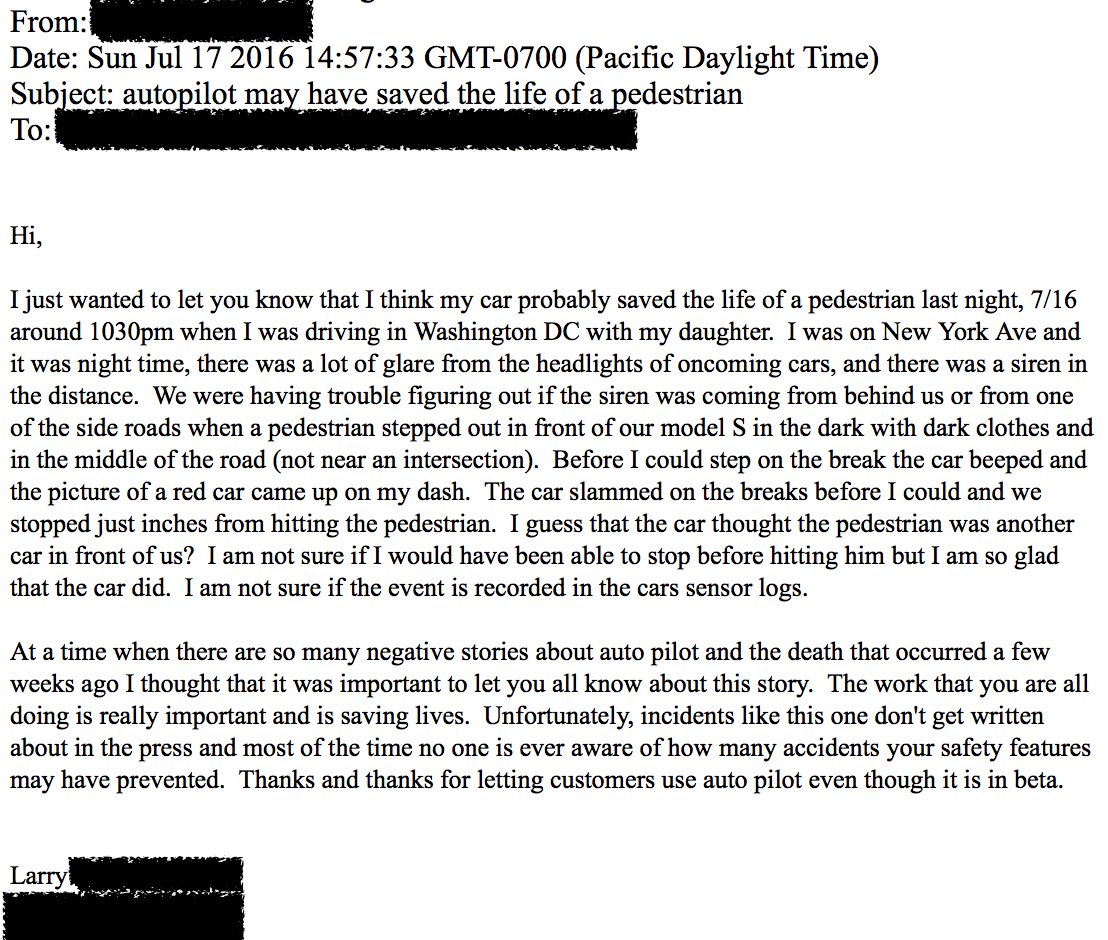
An anonymous reader writes: Following reports of Tesla's Autopilot mode being linked to a fatal crash, one Tesla Model S owner is reporting that the Autopilot mode has likely saved a pedestrian's life. The driver sent an email to Elon Musk explaining the situation, which was confirmed by Tesla through the vehicle logs: "I wanted to let you know that I think my car probably saved the life of a pedestrian last night, 7/16 around 10:30pm when I was driving in Washington DC with my daughter." The driver says him and his daughter were trying to locate where sirens were coming from "when a pedestrian stepped out in front of [their] Model S in the dark with dark clothes and in the middle of the road." The car slammed on its breaks before he could and "stopped just inches from hitting the pedestrian." The driver said, "I am not sure if I would have been able to stop before hitting him but I am so glad the car did." The Automatic Emergency Braking (AEB), which is standard on all Tesla vehicles and is part of Tesla's Autopilot mode, is what was at work here. It appears that many of the convenience features of Autopilot were not activated at the time of the incident. This is likely the first of many good press stories released by Elon Musk, who said he would consider releasing the stories of accidents prevented by the Autopilot mode with the authorization of the Tesla owners and by confirming the events through the vehicle logs. Elon Musk did also announce Tesla's 'Master Plan, Part Deux,' which includes new kinds of Tesla vehicles, expanded solar initiatives, updates on Tesla's 'autopilot' technology, and a ride-sharing program.
If I drove like a moronic asshat, and nearly killed some innocent person, only to be saved by a computer, I might not admit it so publically. Especially when the police and the DMV read the internet.
So a pedestrian in dark clothes, at night, not hearing an electric car, and jaywalking by stepping out from between vehicles means the driver drives like "a moronic asshat."
You need to recalibrate your scale.
I saw this happen in broad daylight. A woman started crossing in a crosswalk the instant the light turned green for the cars, thus blocking them. There were only cars in the right lane and a car approached the left lane and continued (since he had a green light) and the woman stepped out in front of him and got hit. The driver stopped and the lady was taken away in an ambulance. In this case I'd blame the woman since she crossed when the crosswalk said "don't walk" and there is no way the driver could have seen her.
A few months later I was driving home late at night and the same thing happened. A person wearing dark clothing waited until the signal said "don't walk" and I waited for the idiot to cross. Another car came through in the other lane and the guy missed getting creamed by only a few inches. Again, the light had been green for some time and the idiot waited until just after the cross light turned red like he had a death wish. Too many times I've seen stupid pedestrians crossing when it's not safe to do so.
Also, as a driver I too would be distracted by sirens, trying to find the source of them. No driver can look ahead all the time, i.e. checking the mirrors. If someone claims that they're always looking ahead they're either lying or a really bad driver.
This post is encrypted twice with ROT-13. Documenting or attempting to crack this encryption is illegal.
The driver says him and his daughter were trying to locate where sirens were coming from "when a pedestrian stepped out in front of [their] Model S in the dark with dark clothes and in the middle of the road." The car slammed on its breaks before he could and "stopped just inches from hitting the pedestrian." The driver said, "I am not sure if I would have been able to stop before hitting him but I am so glad the car did." The Automatic Emergency Braking (AEB), which is standard on all Tesla vehicles and is part of Tesla's Autopilot mode, is what was at work here. It appears that many of the convenience features of Autopilot were not activated at the time of the incident.
So what happened is the driver was driving the vehicle, a situation happened for which he was unprepared but was a probable accident, and the AI took over and prevented the accident.
Almost no one is complaining about this scenario, and if I recall other car companies have deployed something similar and it's a decent first step towards autonomous vehicles.
The problem with the "autopilot" is it essentially allows the AI to do all of the driving, meaning the human invariably stops paying attention and the AI becomes almost exclusively responsible for driving safely.
Its great that the AI is good enough that it prevented this accident, it still doesn't make the pseudo self-driving mode a good idea.
I stole this Sig
Actually, the shutter snap sound in digital cameras was optional when they first came out. It was only until enough women complained about men surreptitiously taking upskirt pictures that the sound was made mandatory.
I can see the value in adding some kind of noise to an electric vehicle, particularly for the visually impaired. This pedestrian, however, did not follow the exceedingly simple rule we all learn as children: look both ways. But to err is human, and walking into a street before actually looking is something we've all probably done. Momentarily averting your eyes from the road directly in front of you is something I know we've all done. So semi-autonomous driving saves the day, and no one has to be labeled an inattentive jerk.
Perhaps the noise added to electric cars could be something pleasant or natural sounding. A particular bird song or something. Is that a nuthatch or an electric car? I should look both ways just in case.
I'm sorry, but your opinion seems to be wrong.
Yes but since it was 10:30 at night one might figure the person might have seen the headlights.
Actually it is mostly the pedestrians fault, according to the way the story reads. Both parties may have been semi-distracted, but the pedestrian only has the right of way under certain circumstances, as detailed below. From what data we have available the pedestrian walked out in front of the vehicle with only enough room for computer assisted braking to save him from being struck.
Pedestrians only have the right of way:
by almost, if not all laws written, 1: in a marked cross walk ( convenient how this is left off in the quote all the time, no? ) and 2: only when it is safe for them to cross.
For number 2, many states have it written into the lawbooks that pedestrians who dart out in front of cars when the driver does not have an adequate and reasonable means of stopping have given up their right of way, and have actually committed a cite-able violation themselves. Many times, also, crossing outside of marked crosswalks is "at will" as well, with absolutely no expectation of having a right of way.
To err is human; effective mayhem requires the root password!
I don't think that's the driver's fault. The pedestrian essentially darted out into traffic, not giving enough time for a human driver to react. However the autopilot, which presumably has a quicker response time, was able to react without driver intervention.
Now, had the pedestrian gone through a crosswalk and had there been roadsigns to notify the driver as such, but the driver was relying on autopilot and the pedestrian got hit? Driver's fault.
And yes, you can have it both ways here. Why? Because it is made pretty clear that autopilot is more of a convenience and in the right circumstances it can correct driver error (including errors made by other drivers and pedestrians,) but at the same time it is not intended to be a replacement for an actual driver, nor is it ever advertised as such. This means that ultimately you, the driver, are responsible for correcting the autopilot, but the autopilot is not responsible for correcting you.
As a driver, you're obligated to pull over and make way for emergency vehicles, so it's naturally to look for the source of sirens as a driver. We're often required to divert our eyes and look behind us or to the side at times as well, even when driving in normal circumstances. Humans can't focus in all directions at once. Moreover, it's more or less impossible for a person to be 100% focused and ready to brake at an instant's notice.
Accusing him of not looking where he was going is more or less accusing him of not having eyes in the back of his head.
Irony: Agile development has too much intertia to be abandoned now.
All cars are almost silent at low speeds. Someone in a car that is coasting will make roughly the same sound as an electric car, especially to a listener in front of the car.
Learn to love Alaska
I don't think that's the driver's fault.
In most countries you'd be wrong. Driving to conditions means taking into account the ability for someone to dart out into traffic and slowing down to a point where you can see unexpected events with enough notice to safely stop. This is why driving the speed limit is not a legal defense when hitting a pedestrian.
That said it's not nearly as bad as people here make out. There's a big sliding scale between the perfectly safe driver and the horrendously dangerous one, and we can't really expect everyone to always be perfect in every situation. But in many countries the driver would be at fault.
Driving to conditions means taking into account the ability for someone to dart out into traffic and slowing down to a point where you can see unexpected events with enough notice to safely stop.
Practically speaking, that would mean an implicit speed limit of 10mph or less anywhere there's on-curb parking. Even at 10mph (15 feet per second), if someone walks out in front of you a car length ahead, you're still pretty likely to hit them.
Please stand clear of the doors, por favor mantenganse alejado de las puertas
GP was referring to use as a noun.
I don't think this discussion is for you.
At the bottom of the