Slashdot Mirror


Nvidia Calls Out Intel For Cheating In Xeon Phi vs GPU Benchmarks (arstechnica.com)

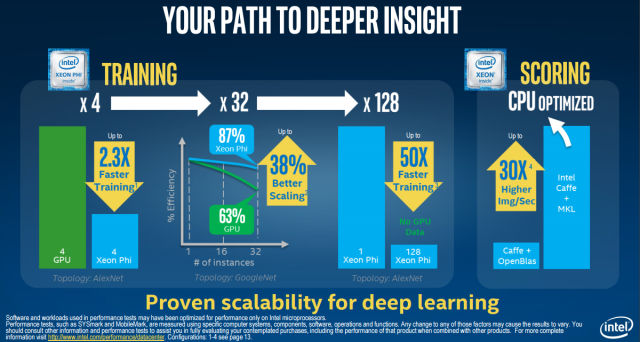
An anonymous reader writes: Nvidia has called out Intel for juicing its chip performance in specific benchmarks -- accusing Intel of publishing some incorrect "facts" about the performance of its long-overdue Knights Landing Xeon Phi cards. Nvidia's primary beef is with the following Intel slide, which was presented at a high performance computing conference (ISC 2016). Nvidia disputes Intel's claims that Xeon Phi provides "2.3x faster training" for neural networks and that it has "38 percent better scaling" across nodes. It looks like Intel opted for the classic using-an-old-version-of-some-benchmarking-software manoeuvre. Intel claimed that a Xeon Phi system is 2.3 times faster at training a neural network than a comparable Maxwell GPU system; Nvidia says that if Intel used an up-to-date version of the benchmark (Caffe AlexNet), the Maxwell system is actually 30 percent faster. And of course, Maxwell is Nvidia's last-gen part; the company says a comparable Pascal-based system would be 90 percent faster. On the 38-percent-better-scaling point, Nvidia says that Intel compared 32 of its new Xeon Phi servers against four-year-old Nvidia Kepler K20 servers being used in ORNL's Titan supercomputer. Nvidia states that modern GPUs, paired with a newer interconnect, scale "almost linearly up to 128 GPUs."
35 of 58 comments (clear)

  1. Hmmm. by Anonymous Coward · · Score: 4, Funny

    So Intel is the Volkswagon of CPUs?

    1. Re:Hmmm. by K.+S.+Kyosuke · · Score: 1

      It kind of is, in the sense that most people have it.

      --
      Ezekiel 23:20
    2. Re:Hmmm. by oic0 · · Score: 2

      Not quite. This is deceptive advertising. You can deceive customers all you want so long as you have enough fine print don't outright lie.

    3. Re:Hmmm. by Mashiki · · Score: 4, Informative

      Only if you think this is new. Intel has been doing shit like this for year and keeps getting caught, there were two lawsuits against them from AMD a few years ago where they ended up paying AMD around $7B USD for doing things like this and other forms of anti-competitive behavior which resulted in multi-billion dollar fines. Then again, nvidia has been caught doing the same. Probably the best example most recently is with their "Hairworks" API, which is likely going to land them in hot water again. Nvidia got nailed a few years ago for anti-competitive behavior over shaders.

      --
      Om, nomnomnom...
    4. Re:Hmmm. by Luthair · · Score: 1

      Didn't Apple get sued for doing this to some PowerPC benchmark to claim it was the fastest PC?

    5. Re:Hmmm. by CajunArson · · Score: 1

      Poor poor AMD. At least that's what their marketing and PR departments like to say.

      A real AMD employee who -- like most of the actual engineers -- no longer works there has a different story though:

      http://vrworld.com/2011/06/24/...

      --
      AntiFA: An abbreviation for Anti First Amendment.
    6. Re:Hmmm. by Luthair · · Score: 2, Informative

      It wasn't benchmarks, it was changing their commercial (as in users pay for it) compiler to ignore CPU flags for non Intel parts and not documenting it, then various illegal behaviour with effectively paying OEMs to not use AMD parts.

    7. Re:Hmmm. by bluefoxlucid · · Score: 3, Informative

      It's not so much "older" as "different" in the artificial benchmarking world. Real-world loads don't tend to follow benchmarks religiously, and the newer benchmark might favor a configuration that's not as good in real-world loads.

      The classical marketing maneuver is to select from multiple sets of up-to-date benchmarks and pick the ones that favor your particular product. CPUBoss usually shows that one CPU outperforms another consistently (except for single-core vs threaded with dissimilar cores or SMT--fast clock wins single-core, many-cores wins threaded); and frequently shows the same benchmark tool using different strategies and rating each CPU faster than the other based on how it was configured, or shows that one benchmark favors one CPU and another favors the other.

      This goes all the way up to real-world functional tests, where you select games which perform better because of some feature or strategy of your GPU and CPU. You have better shaders? Pick a shader-heavy game. Heavy parallelism? Pick a game that meshes with that. You've got fewer parallel operations, but a higher clock? Avoid games that work best with 387-core GPUs and pick ones that like that 1185MHz clock. Show off 6 or 7 games running at freakishly-high 292fps.

    8. Re:Hmmm. by Penguinisto · · Score: 1
      --
      Quo usque tandem abutere, Nimbus, patientia nostra?
    9. Re:Hmmm. by ausekilis · · Score: 1

      * VW emissions and mileage tests as reported during in-place testing and may not accurately represent real-world driving results.

      Thank you, VW. I'll expect my $10 million check in the mail.

    10. Re:Hmmm. by PhrostyMcByte · · Score: 2

      Intel optimized per-architecture, not per feature. This had the end result of AMD chips taking the generic path and being slower, but I wouldn't call this tactic dirty. Why would Intel go out of their way to optimize for a competitor?

      CPUs have a wide variety of timing and pipeline limitations, and optimizing purely for feature set will never get you peak performance -- this is why GCC has the exact same per-architecture optimization support.

    11. Re:Hmmm. by hairyfeet · · Score: 2, Insightful

      I guess "Windows isn't done unless Lotus won't run" by your logic is completely reasonable behavior, it WAS their OS...right?

      Or maybe if you'd stop waving your little Intel flag as hard as your squeeing fangirl ass can you'd know they didn't "not optimize" for other chips, they purposely designed their compiler to put out broken code on other chips so badly in fact that you could take a Via CPU (the only CPU that allows you to change the CPUID in software) and by simply changing the CPUID from "Centaur Hauls" to "Genuine Intel" you magically got a 30% performance boost...wow, the power of of CPUID huh?

      Of course what it really was was a classic case of "Windows isn't done unless Lotus won't run" and this kind of behavior is typical of Intel, hence why they had to shell out 1.4 billion for market rigging and anti competitive behavior in the EU just 2 years ago. Would you like a quote from the judgement?

      "The Commission demonstrated to the requisite legal standard that Intel attempted to conceal the anti-competitive nature of its practices and implemented a long term comprehensive strategy to foreclose AMD from the strategically most important sales channels. ... The General Court considers that none of the arguments raised by Intel supports the conclusion that the fine imposed is disproportionate. On the contrary, it must be considered that that fine is appropriate in the light of the facts of the case.

      In other words the exact same shit MSFT got busted for and frankly they should get no less than what MSFT did, 10 years of being monitored by the courts to keep them from pulling shit like this again.

      --
      ACs don't waste your time replying, your posts are never seen by me.
    12. Re:Hmmm. by K.+S.+Kyosuke · · Score: 1

      So they deliberately chose to use an inferior code path for AMD because they were convinced it would be better for the customer?

      --
      Ezekiel 23:20
    13. Re:Hmmm. by K.+S.+Kyosuke · · Score: 1

      That is kind of ironic. Do think that nVidia and AMD are doing more or fewer application-specific tweaks in their drivers today? Because I don't believe that the latter is the case. (After all, Microsoft does it even with regular Windows software.)

      --
      Ezekiel 23:20
    14. Re:Hmmm. by rahvin112 · · Score: 1

      They all do it. Nvidia is notorious for it, probably more so than Intel, going so far as to bin chips and creating special review boards and firmwares that make the review cards 30% faster than the retail versions.

      This is nothing more than a Pot meet kettle moment. Intel must be making waves in HPC with Phi to draw this strong of an Nvidia comment.

    15. Re:Hmmm. by PhrostyMcByte · · Score: 1

      There's no check for AMD CPUs. It runs cpuid and finds a code path in a lookup table for that specific CPU -- if it's not there, it gets the generic path.

    16. Re:Hmmm. by sjames · · Score: 1

      No. ICC certainly did look at feature flags and use them to the utmost UNLESS the cpu was AMD, then it used the worst performing code paths available. The telling part is that you could preload a library that replaced the IsThisIntel function (not the actual symbol) with a function that always returns true and greatly improve performance on an AMD processor (sometimes beating the performance on an Intel processor). The existence of that function is very much Intel going out of it's way to de-optimize AMD performance. By any reasonable measure, ICC would have been a superior product had they not expended effort to snatch defeat from the jaws of victory in support of another department.

    17. Re:Hmmm. by cheesybagel · · Score: 1

      The 'per-architecture' check included a strcmp with "GenuineIntel". There are processor flags to check if a processor supports an API already. I mean Intel designed the X86 ASM spec the least they could do is follow it in their own software.

    18. Re:Hmmm. by Carewolf · · Score: 1

      That is kind of ironic. Do think that nVidia and AMD are doing more or fewer application-specific tweaks in their drivers today? Because I don't believe that the latter is the case. (After all, Microsoft does it even with regular Windows software.)

      Considering NVidia has special driver releases right after new games that are "optimized" for the new game. Plus a special bundled tool to "optimize" games to your graphics card... Yeah, it is not even a secret any more.

    19. Re:Hmmm. by sjames · · Score: 1

      It is interesting that I got marked troll over an easily verified statement of fact. I sometimes wonder is it's just extreme fanbois or paid shills.

  2. Here's the real reason for Nvidia's complaints by CajunArson · · Score: 4, Interesting

    The real reason that Nvidia is bitching up a storm is that KNL has received a very positive reception in the HPC world.

    Oh, and KNL is actually an absolute bargain in comparison to the requirements to get a high-end Pascal system setup, not only because you can buy an entire KNL system (not just a GPU card) starting at only $5000, but because it's self-hosting and doesn't need a high-end Xeon CPU just to feed the GPU. To put it in perspective, you could build a cluster of 26 KNLs for the price of one of those 8-way systems Nvidia is selling.

    http://www.colfax-intl.com/nd/...

    --
    AntiFA: An abbreviation for Anti First Amendment.
    1. Re:Here's the real reason for Nvidia's complaints by Creepy · · Score: 4, Insightful

      Yeah, but their beef isn't about the cost, it is about the speed comparisons. Intel never has tried to compete in the GPU performance space - they are happy with being in the low cost space. If you just compare what you get for a certain cost I have no idea, but I'm guessing having so many more Intel chips in your cluster will add significant power and space requirements at the very least. You may actually be better off with the nVidia solution in the long run.

    2. Re:Here's the real reason for Nvidia's complaints by Guybrush_T · · Score: 2

      Yes, the HPC world is waiting for KNL because they don't want to port their old codes to CUDA. But that's just the expectation : people are starting to realize that running a Xeon code on KNL is by no mean immediate and you won't get much performance boost without a serious application rewrite ... just like porting to GPUs, maybe slightly easier though.

      But on the performance side, it is very clear that KNL performance is terrible. The fact that Intel only shows scaling figures is quite funny : it is very easy to make a slow code scale, because computation times are high compared to communication times. To have good scaling, you can either have a faster interconnect or a slower CPU. Since they're never showing performance comparison but only "scaling", I'd bet it is the latter.

      To illustrate, say the speed of your code is 1 on 1 CPU, and 32 on 32 CPUs, scaling is perfect. If the speed is 100 on one GPU, and 2400 on 32 GPUs, the scaling is not perfect and you can show the scaling curve from Intel saying "hey, we scale better !". That's ridiculous.

    3. Re:Here's the real reason for Nvidia's complaints by PhrostyMcByte · · Score: 1

      Yes, the HPC world is waiting for KNL because they don't want to port their old codes to CUDA. But that's just the expectation : people are starting to realize that running a Xeon code on KNL is by no mean immediate and you won't get much performance boost without a serious application rewrite ... just like porting to GPUs, maybe slightly easier though.

      Exactly this. AVX-512 is now much more GPGPU-like than traditional SIMD, so even transitioning AVX-256 code to it isn't going to be trivial. I would not expect random code to perform better on it without serious work.

    4. Re:Here's the real reason for Nvidia's complaints by sjames · · Score: 1

      If you have some actual reason to believe that, please share so others can make a good decision. If not, why chaff the discussion?

    5. Re:Here's the real reason for Nvidia's complaints by rahvin112 · · Score: 1

      According to this Phi can be had for $200 at the low end. You can't buy a Nvidia Tesla product for that.

      https://www.phoronix.com/scan....

  3. Pot meet kettle by HalAtWork · · Score: 1

    Both parties are quite guilty here

  4. Layoffs by 110010001000 · · Score: 1

    Intel is the next tech giant to have mass layoffs. It obviously is hitting a dead end if it is arguing over such small increments of performance. Moores Law was fun while it lasted, but depending on transistor count for performance gains isn't going to work.

    1. Re:Layoffs by sexconker · · Score: 1

      They've had multiple rounds of layoffs recently (or one round with the reported number increasing frequently).
      Intel will be a husk in less than 10 years if they keep this shit up.

  5. Worlds smallest violin for Nvidia by Moheeheeko · · Score: 4, Insightful

    After they spent the last decade going out of their way to force "improvements" into new games (that either never work or cause severe issues for pc games) just to make their overpriced cards look better than AMD, they can go fuck themselves.

    1. Re:Worlds smallest violin for Nvidia by thegarbz · · Score: 2

      If by improvements you mean optimsations, and by overpriced cards you mean get what you pay for, and by better than AMD you mean better than AMD then yeah you're 100% right.

      Now you can repeat the same statement for AMD.
      And for Intel
      And for ARM
      And for every other chip manufacturer who targets a specific market with specific products.

  6. Manufacturer Exaggerates Product's Virtues by mschwanke97402 · · Score: 1

    Yawn, wake me when there's some actual news.

    Also, anyone who puts much faith in Intel's claims is either naive or a company shill. This simply business as usual for Intel.

  7. Cheater A calls out Cheater B for cheating! by Gravis+Zero · · Score: 1

    People in glass houses shouldn't throw stones... and buy some damn shades because seriously, nobody wants to see that!

    --
    Anons need not reply. Questions end with a question mark.
    1. Re:Cheater A calls out Cheater B for cheating! by Carewolf · · Score: 1

      People in glass houses shouldn't throw stones... and buy some damn shades because seriously, nobody wants to see that!

      Cheaters think everybody cheats. In this case they might be right.

  8. Get used to it Nvidia by JosephDoeden · · Score: 1

    Intel has your markets in their crosshairs now and they have a track record of awesome when it comes to commercial chip success.