 Slashdot Mirror
World Energy Hits a Turning Point: Solar That's Cheaper Than Wind (bloomberg.com)
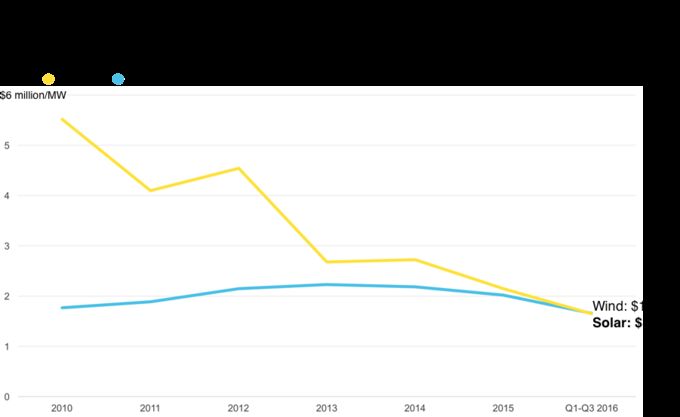
A transformation is happening in global energy markets that's worth noting as 2016 comes to an end: Solar power, for the first time, is becoming the cheapest form of new electricity. From a report on Bloomberg: This has happened in isolated projects in the past: an especially competitive auction in the Middle East, for example, resulting in record-cheap solar costs. But now unsubsidized solar is beginning to outcompete coal and natural gas on a larger scale, and notably, new solar projects in emerging markets are costing less to build than wind projects, according to fresh data from Bloomberg New Energy Finance. The chart shows the average cost of new wind and solar from 58 emerging-market economies, including China, India, and Brazil. While solar was bound to fall below wind eventually, given its steeper price declines, few predicted it would happen this soon.
Now that's great. That's like saying you're now finally running faster than the kid in the wheelchair.
Wake me when it gets cheaper than fossil fuel.
Errrr reading the statement above says.... "But now unsubsidized solar is beginning to outcompete coal and natural gas on a larger scale"
I can't comment much about your situation, as I don't know where you live. I can, however, say this in general.
* Intermittency is nothing new to grid operators; through the entire history of power generation, they've been having to deal with demand fluctuation and random losses of plants and lines. Hardware is, and always will be, built to the minimum needed to statistically guarantee a given level of uptime
* There have been many, many studies on the issue of high-renewables grids - here's an example covering cost analyses on wind + solar + HVDC + NG peaking (no power storage) using current technology only.
* A HVDC grid actually saves about three times more than it costs due to lower hardware (and thus capital) requirements for grid operators. While HVDC lines and conversion stations pose their own point of failure risks, overall they increase grid stability against localized failures, particularly cascading failures (AC sync failures don't cascade over HVDC). The stability benefits of HVDC links has led to the US to use a number of them even without long lines, just to connect different disjoint grids together (the lines are the cheap part, relatively - it's conversion stations that are expensive). HVDC provides baseload from Quebec hydro to the northeastern US. Europe and China both make heavy use of HVDC - Europe mainly for submarine links, China mainly for bringing power from the interior to the densely populated coast (plus some HVAC). Both have huge expansion plans.
* Large HVDC grids cause both timeshifting (aka, it's nighttime wind in on the east coast during the evening demand peak on the west and on the west coast during the morning rush in the east coast; likewise with solar shifting) and weather diversity (whenever a front is moving off the east, there's almost always a new one (or more) that has come in from the west).
* Solar and wind tend to run counter to each other. Wind peaks at night; solar in the day. High pressure zones create low winds and lots of sun; low pressure zones create high winds and little sun.
* Combined with NG peaking, these factors can provide a statistically guaranteed uptime with low power costs.
* All of this is based around there being no storage - which is a pessimistic assumption:
** Dirt cheap storage can be had by uprating hydro turbine houses, combined with the aforementioned HVDC grid. Hydro thus shifts from baseload to peaking. There's extensive hydro on both coasts that can be uprated.
** Pumped hydro - as standalone plants or as modifications to existing plants - can often be affordable, but depends entirely on local geography.
** Compressed air has gained some interest, although is not yet cost effective.
** Batteries used to be by far the most expensive option, but their prices too have been plummeting, to the point that li-ion is starting to make some grid penetration. There's not going to be some huge takeoff of it at current prices, but given that large scale production (gigafactory, etc) is expected to halve costs, that would seriously take off. There's other rival chemistries also seeking for the low cost per-Wh / per-W crown.
But, storage is not a necessity when you have peaking, source diversity, and geographic diversity with a modern, well-connected grid.
Sometimes I doubt your commitment to Sparkle Motion.