 Slashdot Mirror
New Analysis Shows Lamar Smith's Accusations On Climate Data Are Wrong (arstechnica.com)
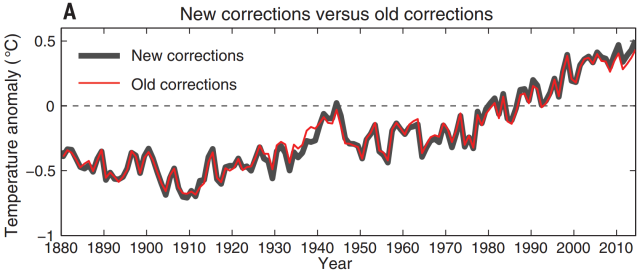
Layzej writes from a report via Ars Technica: In 2015, NOAA released version 4 of their marine temperature dataset called ERSST. The new dataset accounted for a known cooling bias introduced when ocean temperature measurements transitioned from being taken in ship engine intake valves to buoy-based measurements. The warming of the last couple decades increased ever so slightly in NOAA's new analysis. This was a red flag for U.S. House Science Committee Chair Lamar Smith (R-TX), who rejects the conclusions of climate science -- like the fact that the Earth's climate is warming. Suddenly he wanted to see the researchers' e-mails and echoed the accusations of contrarian blogs about scientists' supposedly nefarious adjustments to sea surface temperature measurements. Rather than invoking scientific conspiracies, issues like this should be settled by analyzing the data. A new study, led by University of California Berkeley's Zeke Hausfather, does just that -- and Rep. Smith won't like these results, either. To test the NOAA dataset, Zeke's team created instrumentally homogeneous temperature records from sensors available only over the last couple decades. As it happens, the Argo float data, the buoy data, and the satellite data each hew closer to the updated dataset that NOAA used. The older version (3b) gives a global average that is too cool in recent years, growing to an offset of about 0.06 degrees Celsius. The researchers repeat this same analysis for two more major sea surface datasets that are used by the UK Met Office and the Japanese Meteorological Agency for their global temperature records. Both of those datasets also drift cooler than the comparison data, but less so than NOAA's old dataset.
Or to quote Neil De Grasse Tyson: "It's basic physics. If you keep adding energy to a system, but you slow down the rate at which the energy can leave the system then the system gets hotter".
Unicode killed the ASCII-art *
This is the oversimplified explanation of climate change which I have problems with. Unfortunately, it is the argument parroted by nearly all the armchair climatologists as the reason why global warming is real and we must do something about it Right Now.
From a thermodynamics standpoint, the rate of heat radiated by a black body is proportional to the fourth power of its temperature. The Ei > Eo state is a transitory state - it is only temporary. The temperature increases causes Eo to (quickly) increase, until Eo is large enough to match Ei.. So we end up with Ei = Eo again, but at a new, higher T. In other words, the system stabilizes at a new, higher temperature. This is why glass greenhouses don't continue to increase in temperature until the inside is hot enough to melt the glass. T^4 is a huge number. It only takes a small temperature increase to offset a large Ei increase (actually Pi would be more accurate - the rate of energy coming in, or power coming in).
Unstable "runaway" systems are extremely rare in nature. The reason is simple - anything that's unstable tends to, over billions of years, destroy itself. So the overwhelming majority of things remaining in the universe are stable systems. There is no "delicate balance" of nature. There is no "runaway" greenhouse effect - all we're doing is shifting the equilibrium point. We know this to be true because global CO2 concentrations and temperatures have been higher in the past than they are today, and the Earth did not self-destruct - it is still around with life intact.
Now, from all I've read, that new equilibrium temperature point is high enough to cause massive problems for human civilization if we don't address it. But the alarming layman's explanation of the greenhouse effect that you've given is just as wrong and misleading as the climate change deniers' explanations.