 Slashdot Mirror
Raspberry Pi Gets Competitors (hackaday.com)
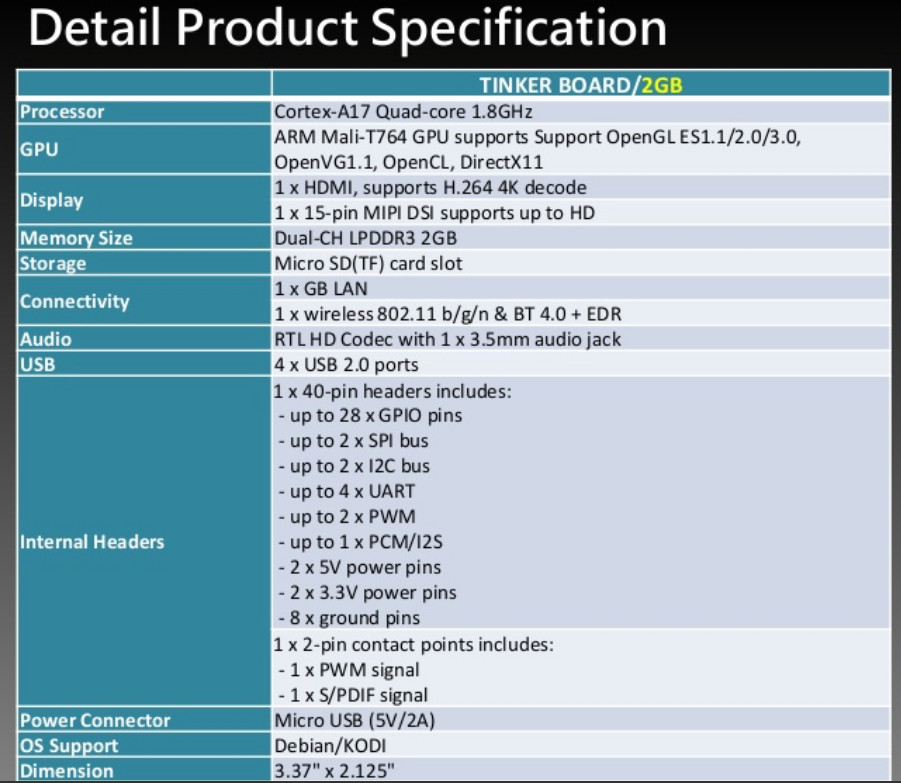
Hackaday reports that Asus has "quietly released their Tinker board that follows the Pi form factor very closely, and packs a 1.8 GHz quad-core ARM Cortes A17 alongside an impressive spec At £55 (about $68) where this is being written it's more expensive than the Pi, but Asus go to great lengths to demonstrate that it is significantly faster."
And though the Raspberry Pi foundation upgraded their Compute Module, Pine64 has just unveiled their new SOPINE A64 64-bit computing module, a smaller version of the $15 Pine64 computer. An anonymous reader quotes ComputerWorld: At $29, the SOPINE A64 roughly matches the price of the Raspberry Pi Compute Module 3, which ranges from $25 to $30. The new SOPINE will ship in February, according to the website. The SOPINE A64 can't operate as a standalone computer like the Pine64. It needs to be plugged in as a memory slot inside a computer. But if you want a full-blown computer, Pine64 also sells the $15 SOPINE Baseboard Model-A, which "complements the SOPINE A64 Compute Module and turns it into a full single board computer," according to the company...
The original Pine64 was crowdsourced and also became popular for its high-end components like a 64-bit chip and DDR3 memory... It has 2GB RAM, which is twice that of Raspberry Pi's compute module. SOPINE also has faster DDR3 memory, superior to DDR2 memory in Raspberry Pi Compute Module 3 board.
And though the Raspberry Pi foundation upgraded their Compute Module, Pine64 has just unveiled their new SOPINE A64 64-bit computing module, a smaller version of the $15 Pine64 computer. An anonymous reader quotes ComputerWorld: At $29, the SOPINE A64 roughly matches the price of the Raspberry Pi Compute Module 3, which ranges from $25 to $30. The new SOPINE will ship in February, according to the website. The SOPINE A64 can't operate as a standalone computer like the Pine64. It needs to be plugged in as a memory slot inside a computer. But if you want a full-blown computer, Pine64 also sells the $15 SOPINE Baseboard Model-A, which "complements the SOPINE A64 Compute Module and turns it into a full single board computer," according to the company...
The original Pine64 was crowdsourced and also became popular for its high-end components like a 64-bit chip and DDR3 memory... It has 2GB RAM, which is twice that of Raspberry Pi's compute module. SOPINE also has faster DDR3 memory, superior to DDR2 memory in Raspberry Pi Compute Module 3 board.
The extra processor horsepower and RAM is nice but it seems like it is not matched by I/O. is the gigabit Ethernet tied to the processor? One of the drawbacks of the Pi (not Pie, BTW) is that Ethernet is off the internal USB2 hub.You could put gigabit Ethernet on a USB2 hub and get no increase in bandwidth. The Tinker has one micro-USB connector for power. Does it support OTG? (According to the Hackaday article it does have multiple USB 2.0 ports.) Sata would be nice too.
The biggest advantage of the Raspberry Pi is the community. It's going to be hard to match that. The RPi has hit critical mass when I can go to my local Microcenter and get a Pi 3 Model B for $30 US or a Pi zero for $5.
The Pi is two things, Pi the hardware and Pi the infrastructure. Hardware-wise, there's a bazillion devices that "compete" with the Pi, many of them much, much better. In terms of the infrastructure, there's nothing that comes close. Until something can replicate and then supplant the entire industry that's evolved around the Pi, you can't call anything "competition". The hardware is mediocre, the infrastructure is unbeatable.
Before I get lots of flames for the hardware comment, it really is. I kinda hate saying this because it's completely changed the industry and totally fulfilled its promise as an educational toy, but dear Ghod you don't want to build a product around it. Compare it to my current go-to alternative, the Odroid C2: It has power conditioning and protection circuitry on both DC in and USB ports, it has a high-current, standard barrel jack connector for power not micro USB (so it can actually power its own USB peripherals rather than needing a hacked-up external USB powered hub or having things fail to work mysteriously), it has a massive heatsink to deal with heat issues, it has proper GigE not pretend USB ethernet (and a 64-bit CPU with 2GB RAM to drive it), it has proper eMMC storage rather than an SD card, and so on and so on, it's actually been designed by competent hardware engineers who know how to build a solid, reliable system.
Oh, and it costs all of $5 more than a Pi.