 Slashdot Mirror
Do Neural Nets Dream of Electric Sheep? (aiweirdness.com)
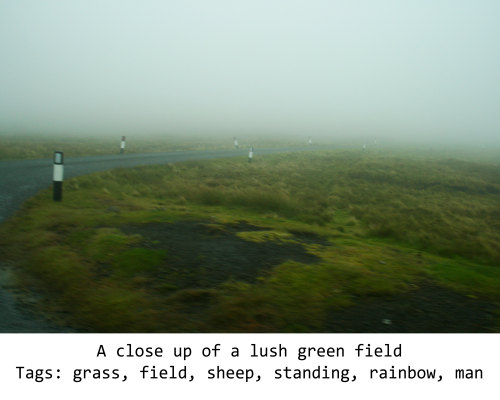
An anonymous reader shares a post: If you've been on the internet today, you've probably interacted with a neural network. They're a type of machine learning algorithm that's used for everything from language translation to finance modeling. One of their specialties is image recognition. Several companies -- including Google, Microsoft, IBM, and Facebook -- have their own algorithms for labeling photos. But image recognition algorithms can make really bizarre mistakes. Microsoft Azure's computer vision API added the above caption and tags. But there are no sheep in the image. None. I zoomed all the way in and inspected every speck. It also tagged sheep in this image. I happen to know there were sheep nearby. But none actually present. Here's one more example. In fact, the neural network hallucinated sheep every time it saw a landscape of this type. What's going on here?
Are neural networks just hyper-vigilant, finding sheep everywhere? No, as it turns out. They only see sheep where they expect to see them. They can find sheep easily in fields and mountainsides, but as soon as sheep start showing up in weird places, it becomes obvious how much the algorithms rely on guessing and probabilities. Bring sheep indoors, and they're labeled as cats. Pick up a sheep (or a goat) in your arms, and they're labeled as dogs.
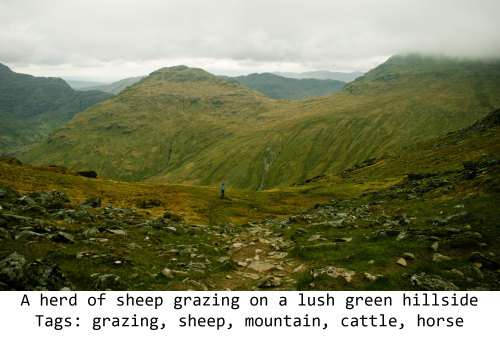
Are neural networks just hyper-vigilant, finding sheep everywhere? No, as it turns out. They only see sheep where they expect to see them. They can find sheep easily in fields and mountainsides, but as soon as sheep start showing up in weird places, it becomes obvious how much the algorithms rely on guessing and probabilities. Bring sheep indoors, and they're labeled as cats. Pick up a sheep (or a goat) in your arms, and they're labeled as dogs.
At least not until we start achieving some sort of artificial consciousness. Although current Deep Learning type of neural networks are amazing, they are not (considered as) conscious. They also lack imagination and understanding; see https://blog.keras.io/the-limi...
What does it label sheep as in pictures where some sex-starved farmhand is buggering them?
It's using metadata if there are pictures of sheep nearby? (For instance, GPS coordinates stored in the JPEG metadata.)
I for one welcome our Neurotic Network Overlords.
Don't fight for your country, if your country does not fight for you.
Neural Networks are nothing more than an approximation of a math function. Mathematically they are analogous to spline interpolation or Taylor series expansion. The only difference is that splines and Taylor series have a well known method to figure out the unknown parameters. Neural nets are just trained by finding a minimum in parameter space. Like splines and Taylor series, these don’t work outsides of their bounds.
This is literally nothing intelligent put them.
Neural network technology scales with processor advancements, so I understand why AI researches stay so excited about throwing neural networks at everything - it just keeps getting better and better on its own. The thing is, as great as modern processors are, they aren't even close to in the same league as a biological brain. It is unrealistic to expect a computer based neural network to approach the capabilities of even a biological brain in the near future.
AI researchers will only make progress if they put in the effort to understand what they are trying to achieve and to cognitively construct the necessary algorithms. In essence, a human needs to understand why an AI does what it does. It's an extremely difficult job that requires a tremendous amount of work and applied intelligence. The dream of the magic, learning computer will continue to remain a dream until computational technology become several magnitudes more advanced.
They can find sheep easily in fields and mountainsides, but as soon as sheep start showing up in weird places, it becomes obvious how much the algorithms rely on guessing and probabilities
This is known as "profiling". The sheep will protest, especially the black ones.
Just another day in Paradise
This field is still immature and undergoing heavy research.
This guys blog is a great source of information in a human readable form: https://colah.github.io/
It appears the neural networks in question have been overtrained, now whenever they see blotches of white/off white on a green field they presume them to be sheep.
Answer to solve the problem is to retrain them and be more careful not to over train this time.
Surely "neural networks" are similar to how real brains work, right? I mean they call them "neural", which means "like a neuron" and a network of them is like a human brain, which is a network of physical neurons. So, neural networks are like human brains. After all, a two year old can recognize sheep. Surely a computer can. It is 2018 and neural networks have been around for 40 years now. AI is right around the corner, right? Just needs to tweaking to make the learning "deeper".
I see a bunch of "things" in the foreground in the grass. If I knew nothing of sheep farming besides a vague description and was only given a split second to decide, I would label them as animals/perhaps sheep as well.
Given that most neural net imaging these days will split off the color and brightness channels from the image to 'recognize' something, I can see where these blurry pictures get some weird tags.
Custom electronics and digital signage for your business: www.evcircuits.com
Now what is that story where an AI is trained to turn the air on in an alien(?) train station when the train enters the platform? I can't find it on Google.
The way I remember it the AI is trained, and then left alone and does a great job until one day when it kills all the passengers because it didn't turn the air on. The reason was that the station clock was broken. The AI didn't learn the train-at-platform correlation, but rather the wall clock schedule (I guess those trains were never early or late).
"Everybody's naked underneath" -- The Doctor
You got to remember the algorithms are still relatively primitive. My guess is that in that pictures were geo-tagged in a region known for sheep. It saw the tubes coming out the ground as legs. In the other photo it saw the white rocks in the creek bed as wool with shadows.
You say things that offend me and I can deal with it. Can you?
This is what causes human prejudices. We don't thoroughly analyze every situation - that would take way too much time. We take processing shortcuts which usually yield the right answer, but not always. Like "white things on green fields are usually sheep." Or "black people are usually better at sports." Or "women are usually more emotional than men."
A prejudice is simply when you apply a usually-correct general rule to an individual, without first verifying that it's actually true in that individual's case. Likewise, discrimination is when you treat that individual as if the rule were true, without first confirming that it is in fact true for that individual.
... especially under any of the conditions below:
# under time constraint, given only a fraction of a second to exam a sample
# have to process large amount of samples
# excessive amount of details
# tasked with subjects they are not dealt with often: recognizing the different types plants, different types of cells, etc.
In fact human beings likely make more silly mistakes than neural nets under those conditions.
Just like various 'staged' questions to get the answers you want out of somebody...
If you don't allow the neural network to be verbose enough, then of course it sees sheep everywhere and has both false positives and false negatives.
What is really needed is sufficient metadata in the ANSWER for it to provide an informed opinion. Such as 'There exists an x percent probability that region x2,y2 to x3,y3 is a sheep. More images could help to better confirm or refute this answer.
The problem is metadata costs cycles and complicates the code and design at various levels as well as requiring more cpu and memory cycles to complete. However until this is done neural networks will not be providing sufficient data from each stage of analysis to allow the next stage to make an informed opinion, or throw its inputs back to a higher level to request more information or decline to make a prediction given insufficient information.
Dealing in absolutes in all but the simplest of circumstances gets you in trouble whether you are a computer or a human.
Edge cases are infinite, at some point the only thing which can improve performance further is abstract reasoning.
So if you show your 4 year old a sheep on a blank background, or in a car, they won't tell you it is a "sheep"? Does your 4 year old get confused when watching "Shaun the Sheep" movies because sometimes it shows the main character in a city?
... the fact that the neural network may have posted this to slashdot and is using US to determine if there are sheep in the photos?
This was posted as an anonymous reader.
... that doesn't sound too baaaaaaaaaad.
It must have been something you assimilated. . . .
But seriously, I see in both articles that really the "learning" only takes place currently with handcrafted scenarios. If, however, the scenarios can be automated or "learned" then - well - maybe.
The Kai's Semi-Updated Website Thingy
I suspect you take a sheep inside the home of someone who's never seen a sheep, they'd probably call it a dog too.
It would be an interesting experiment, my hypothesis would be that most human brains will categorize it as a mammal they haven't seen before. Same as when you google pictures of rare or little-known mammals.
"When I first heard Daydream Nation it quite frankly scared the living shit out of me." -- Matthew Stearns
I first looked at the images without glasses on on purpose so I would know exactly what I was looking at. I'm fairly blind without them and gave an almost identical answer for the first photo and sailboats for the second photo.
In spite of recent progress, neural networks are not practically auditable. We show them examples and tell them: there are sheep in this image. In theory you could look at all the trained weights and try to make sense of what the NN has learned, however in practice this is not doable. For all we know the NN might be latching on a feature associated with sheep, like green grass, rather than the features of the sheep themselves.
In my experience, machine learning methods are very good at interpolating. If you present them with enough examples and your examples basically cover the whole field of what you are trying to recognise, they will do very well. However if you present them with an example that is significantly different, it may not work as well.
That is why NN have been very good in finite universes, like the recent success at beating humans at Go. They are also very good at tasks that are not so easy for humans, such as recognising faces in controlled environments. That is also why ML researchers have proposed clever methods to augment the input data set with well-designed artificial examples, to cover as much ground as possible (see "data augmentation"). However it is still possible that some unforeseen example might fall through the cracks.
When the problem is recognising sheep, maybe this is not such a problem. When the NN is put in charge of driving a car, maybe not.
Wait, so you are saying that the AI neural net in this case was never taught was a sheep looked like? This was an "untrained" neural net? Fascinating!
Just put the right sticker in an image, and the AI will instantly classify you as a toaster, regardless of what else is there!
https://twitter.com/Phantrosity/status/952346898668679168
"Real stupidity beats artificial intelligence every time." TERRY PRATCHETT
No I'm not. I was stating what I expect a human to do in this situation, replying to the thing I quoted
"When I first heard Daydream Nation it quite frankly scared the living shit out of me." -- Matthew Stearns
The lesson is that AI will have biases. They will have the exact same sort of problems and issues that people have when it comes to presumptions built up from prior experience. Stereotypes, prejudices, and bias. Sounds bad right? But it's the basis of CONTEXT. It's how language works. Things like pronouns and "it" can refer to anything and you have to rely on context to link it to something. And we do so based on what makes sense based on experience. Our eyeballs do the same thing. They fill in a lot of blanks. It's how you never notice your blind spot. It's how a lot of optical illusions work. AI are going to have the same thing. Here's some video of a guy running into convenience store and robbing it. What did it see? How would it describe the guy? Well... that depends on it's training set.
I imagine we'll eventually be able to train up different AI with different biases. Train two in different bubbles, and then compare their output and we'll be able to see how badly these bubbles influence people's views and thoughts. Also where they agree.
Computers are great when it comes to being impartial. They can make the world a better place with less corruption. But it's useful to think of AI as a generated person, with all the flaws and awesomeness that comes with that. There are some tasks that, even if an AI could do it, we'd have to be careful about how they do it, and figuring out exactly how AI does what it does is hard. We mostly just look at the end-result. So, get ready for people professionally trained to vet AIs before employment.
What human would call a sheep a dog just because it was inside a house? I don't know any human that would do that.
It is an artifact of Bayesian Inference: You boost one guess over the other based on prior knowledge. The human brain works almost the same - we are just a lot better at recognizing a sheep by itself so that boost does not have such a large effect. But in a more blurred picture you can jump to the same conclusions.
Neural nets can be only as good as the data used to train them. Outside of the training data, they are pretty much a wild guess. Which points to the real problem with Neural networks. If your training data doesn't cover the actual real world data very well, your network will not be good at all those unique edge cases. Over training (using too much specific training data) is as much of an issue as bad training data too. Over trained networks jump to conclusions based on the wrong things and are just as bad.
However, Neural Nets are very fast and can use very few resources to come up with reasonably good answers when properly trained and when the problem domain is simple enough.. The issue is knowing when to trust them, and when they are off in the weeds.
"File to fit, pound to insert, paint to match" - Aircraft Maintenance 101
Not sure what the point of your trolling is, but it was annoying and childish at first, but you're now starting to crack me up. Keep going
Eh, even if they don't flip over the turtle, we can make sure they stay INTERLINKED. You are a collection of cells. cells. do you want mod points? interlinked. is microsoft evil? interlinked. is wayland the way? interlinked. within cells interlinked.
oh come on you lazy slashot filter. Grow some AI and pick up when capslock is funny... ok, for full effect, assume I'm yelling at you in the last half. You know the scene.
It's bitztream the autism-hating, custom EpiPen-hating, Musk-hating, Qualcomm-hating, Firefox tabs-hating, Slashdot editors-hating Slashdot troll!
Because right now, we are basically calling a dildo an android.
Dijkstra talked about this. Everyone here who uses terms like "the computer sees X as Y" or "the neural net thinks that A is actually B" or "the AI was mistrained" is making a fundamentally erroneous mistake: the computers do not think. The algorithms do not understand. The machine does not have vision; it does not see.
Does your air conditioning filter understand the difference between air and dust?
Does your cell phone's finger print reader or facial unlocker recognize you? Does your mirror?
Do your headphones speak English? Does your microphone understand what you're saying?
Does Google maps know where you are? Does a paper map know where you are?
Does your thermostat know the temperature of the room? Does a mercury thermometer?
Does your calculator know or understand mathematics? What about an abacus?
I understand that such idioms are handy and sort of get the point across: I use these idioms myself sometimes.
But slashdotters are supposed to be intelligent; are supposed to actually know and understand what the machines are doing and how they work. We are supposed to understand the difference between slang and reality when it comes to technology.
Don't be fooled by the jargon. Don't mistake a complex system with complex inputs and outputs for "understanding" or "knowing" or "intelligence".
Neural nets are nothing more than automatically calibrating digital classifiers. They're nothing more than statistics.
They're not intelligent.
They do not understand nor comprehend.
They do not "see" nor "recognize".
LOL, so basically we've made huge advances in machine guessing, but otherwise this shit is as useless as we all expected it to be.
Whatever, sounds like the state of the art is this stuff is still pretty much over-hyped garbage.
Just keep walking up that evolutionary tree until it's close enough.
We're all just advanced small furry mammals.
If you trained it by showing dogs in subways and sheep in fields, then I think I see the problem. You need some sheep-less fields for it to learn from.
Here's one more example. In fact, the neural network hallucinated sheep every time it saw a landscape of this type. What's going on here?
Computers don't recognize organic life forms. A "sheep" is nothing more than a pattern of pixels. In this case, a black snout, white body, and black legs below -- like this. Do we see anything similar to that in the picture?
Can a 4 year old tell that this is a sheep: http://www.ansi.okstate.edu/breeds/sheep/westafricandwarf/westaf6.jpg
4 year old is only as good as training material is. But unlike AI, 4 year old can't learn to name every possible object in the world as human memory doesn't have enough capacity for that.
The algorithms were actually way ahead of the game. They knew if they mistagged the photos as having sheep in them, the pictures would get more views from the many more people on the internet looking for lush fields with sheep than are looking for plain lush fields.
So before you start casting stones about AI, you need to know what it was trying to accomplish. If it was page hits, i. It may have even known that it would become a topic on slashdot if it was mislabeled, leading to 1000's of extra page hits.
Fear our new AI overlords.
What human would call a sheep a dog just because it was inside a house? I don't know any human that would do that.
I replied to a guy who said they would do that if they had never seen a sheep before. I was disagreeing as well
"When I first heard Daydream Nation it quite frankly scared the living shit out of me." -- Matthew Stearns
I realized that my three-year-old needed a haircut after the cloud service I use tagged his photo as a picture of a dog.
There is fascinating research to suggest that video (maybe even two channel video) is an essential part of human vision training. http://www.sciencemag.org/news...
Chris Mesterharm
Interestingly, there are multiple videos on Youtube of Sheep which think they are dogs.
for example:
https://www.youtube.com/watch?...
https://www.youtube.com/watch?...
She was like chocolate when she drank... semi-sweet at first and then increasingly bitter.
Who wouldn't be rather inside than out in the rain :)
Maybe AIs will prefer to do nothing and evolve cuteness for survival
"When I first heard Daydream Nation it quite frankly scared the living shit out of me." -- Matthew Stearns
I am far from an expert in the field, but should we not label these things (algorithms, machines, whatever) as 'simulated intelligence' rather than 'artificial intelligence'? It appears that they are not intelligent by any standard that we apply to an animal, but give the impression of being intelligent. I think that is an important distinction to make. Please feel free to correct me, but I see AI being applied to all sorts of things, and mostly what is happening is actually on a mathematical level, and in no way do these so called 'AI' machines/programmes actually behave like what we would call an intelligent being. I guess neural networks may get a pass on this, because they attempt to model a 'meat' brain, but I was under the impression that they are still far away from achieving the complexity of anything we would consider to actually be intelligent. At what point is something just a mathematical construct and actual intelligence?
White noise in => sheep out.
It's just that somebody trained it to correlate a set of tags (including "sheep") with a set of similarly-looking indefinite shapes. It doesn't *know* what it sees, id doesn't know anything at all, it is just a blind algorithm that computes numbers based on approximations, thresholds, propagations and other types of neat techniques made by some smart researchers. There is no AI. There's only our wonderful preference for personification.
"Bring sheep indoors, and they're labeled as cats. Pick up a sheep (or a goat) in your arms, and they're labeled as dogs."
Run after a sheep with your kilt hoiked up around your chest and they're labeled as Scottish girlfriends.
I've calculated my velocity with such exquisite precision that I have no idea where I am.
How's life in the hypocrite lane?
GPUs
Do neural nets dream of electric sheep? - the link should have been better presented, however.
"There is no god but allah" - well, they got it half right.