 Slashdot Mirror
Why Humans Learn Faster Than AI (technologyreview.com)
What is it about human learning that allows us to perform so well with relatively little experience? MIT Technology Review: Today we get an answer of sorts thanks to the work of Rachit Dubey and colleagues at the University of California, Berkeley. They have studied the way humans interact with video games to find out what kind of prior knowledge we rely on to make sense of them. It turns out that humans use a wealth of background knowledge whenever we take on a new game. And this makes the games significantly easier to play. But faced with games that make no use of this knowledge, humans flounder, whereas machines plod along in exactly the same way. Take a look at the computer game shown here. This game is based on a classic called Montezuma's Revenge, originally released for the Atari 8-bit computer in 1984. There is no manual and no instructions; you aren't even told which "sprite" you control. And you get feedback only if you successfully finish the game.
Would you be able to do so? How long would it take? You can try it at this website. In all likelihood, the game will take you about a minute, and in the process you'll probably make about 3,000 keyboard actions. That's what Dubey and co found when they gave the game to 40 workers from Amazon's crowdsourcing site Mechanical Turk, who were offered $1 to finish it. "This is not overly surprising as one could easily guess that the game's goal is to move the robot sprite towards the princess by stepping on the brick-like objects and using ladders to reach the higher platforms while avoiding the angry pink and the fire objects," the researchers say. By contrast, the game is hard for machines: many standard deep-learning algorithms couldn't solve it at all, because there is no way for an algorithm to evaluate progress inside the game when feedback comes only from finishing.
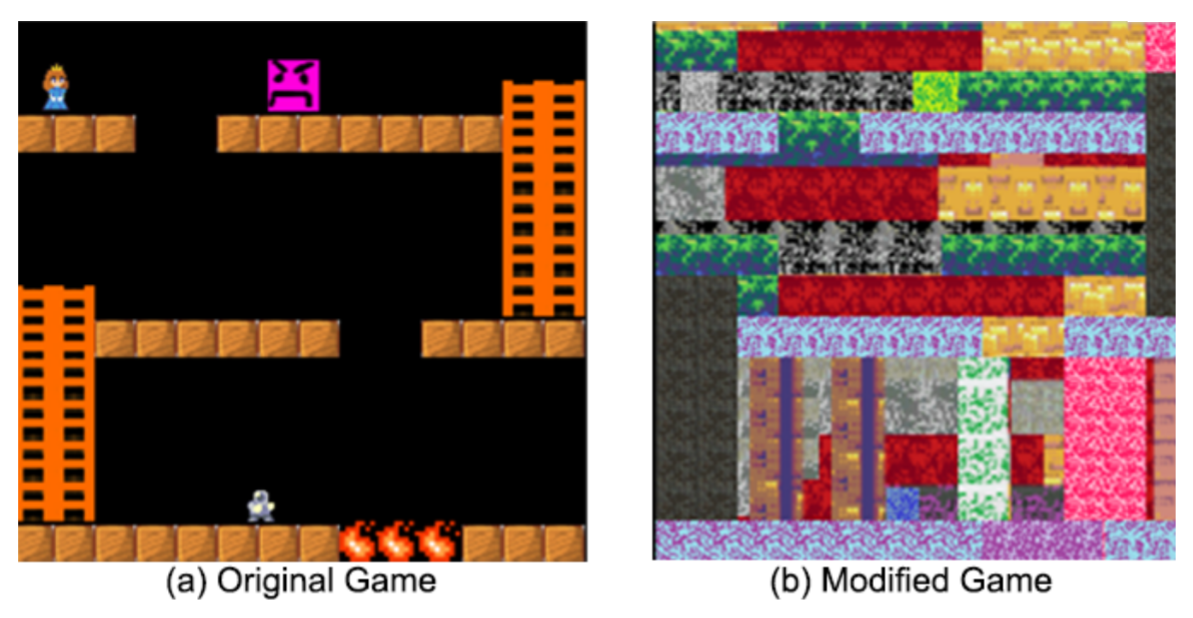
Would you be able to do so? How long would it take? You can try it at this website. In all likelihood, the game will take you about a minute, and in the process you'll probably make about 3,000 keyboard actions. That's what Dubey and co found when they gave the game to 40 workers from Amazon's crowdsourcing site Mechanical Turk, who were offered $1 to finish it. "This is not overly surprising as one could easily guess that the game's goal is to move the robot sprite towards the princess by stepping on the brick-like objects and using ladders to reach the higher platforms while avoiding the angry pink and the fire objects," the researchers say. By contrast, the game is hard for machines: many standard deep-learning algorithms couldn't solve it at all, because there is no way for an algorithm to evaluate progress inside the game when feedback comes only from finishing.
We haven't developed anything resembling actual AI yet. These systems are simple brute force machine learning or "deep" learning systems. Nothing fancy or special about them. They are a tool and nothing else. Any decision they make has already been pre-planned by their human programmers. They are not in fact learning from something and applying that to something else.
While they might be taught to open a jar of peanut butter, they would become confused if you presented them with a screw top bottle of wine and wouldn't be able to open it. However, a 2 year old, if they had the dexterity, once taught how to open a jar of peanut butter would then apply that same knowledge to any other jar and not have to be shown millions of different jars. These machine learning systems cannot yet think in generic terms and be shown something once and apply that to multitudes of different applications. Look at the image posted the other day about a machine learning system incorrectly called "AI" confusing rocks with sheep. Not even someone with an IQ of 60 would have made that mistake.
When we do finally start to crack the actual AI egg in a 50-100 years, then those system will start learning something instead of having to be told (millions or billions) of times what something is.
IQ tests and the like suffer from cultural bias. So do these games. As an English speaking human who has been exposed to pop culture and movies, I know that movement from left-right is normal, the hero saves the princess (which is a problem and another discussion). I wasn't born with this bias. I learned it. It is silly to initialize a neural networks with random weights (as if it was just born) and then declare it learns slower than a human. Let a computer create a game where a normal human cultural bias don't apply and have an infant play. Then we will see a more accurate comparison.
This is like handing a chess set to an isolated Amazon tribe and only tell them "sorry, invalid game" until they make a valid checkmate. They'd probably never even find the opening position, much less make any correct moves and certainly not how to mate. They'd just randomly do things until they got bored or made up their own game. There's no reason a machine should expect "getting to the top" to be a valid objective without a whole lot of insight into the human condition and "because it's there".
Live today, because you never know what tomorrow brings