 Slashdot Mirror
How Etsy Sellers and Big Business Make Money on Public Domain Art (vice.com)
"Some people have figured out how to turn reselling public domain content into side hustles," reports Motherboard:
On Etsy, there are thousands of listings for downloadable prints and lithographs that are in the public domain. The concept is pretty simple: these merchants round up and download the most visually beautiful art in the public domain, and then sell prints on Etsy. But some of them don't even go that far and just sell digital files of the art. Then, the buyers can print out the prints at whichever size they want and use them as they please...
With that being said, there's also big companies like Walmart that are also trying to earn money off art in the public domain... Similarly, the Museum of Modern Art is selling "Red Canna" by Georgia O'Keeffe, which is now in the public domain, for $166.50 (on sale from $185). For the love of god, don't pay $166.50 for something you could download for free and print yourself for less than $16.
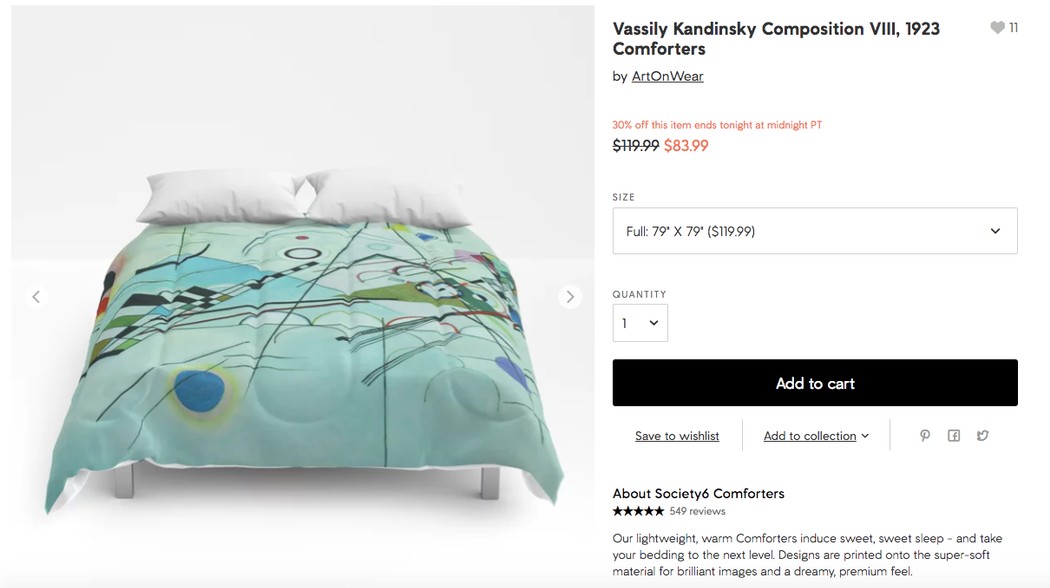
Of course, none of this is bad necessarily. The public domain exists in part so that people can give formerly copyrighted works new life -- sometimes an iconic painting simply needs to become a bedspread. But now that many new works are available for free, it's worth having a quick look around if you're thinking of buying vintage art. You might be able to get it for free elsewhere.
To be fair, the Museum of Modern Art is a non-profit -- and reportedly avoids all government funding.
With that being said, there's also big companies like Walmart that are also trying to earn money off art in the public domain... Similarly, the Museum of Modern Art is selling "Red Canna" by Georgia O'Keeffe, which is now in the public domain, for $166.50 (on sale from $185). For the love of god, don't pay $166.50 for something you could download for free and print yourself for less than $16.
Of course, none of this is bad necessarily. The public domain exists in part so that people can give formerly copyrighted works new life -- sometimes an iconic painting simply needs to become a bedspread. But now that many new works are available for free, it's worth having a quick look around if you're thinking of buying vintage art. You might be able to get it for free elsewhere.
To be fair, the Museum of Modern Art is a non-profit -- and reportedly avoids all government funding.
It’s public domain. That’s the whole point. Since when is this news that matters?
The ones never to be seen again and sometimes potentially lost to time forever are a worse issue.
Any company that puts their things in to open, public domains after a reasonable period is fine with me and whatever others do is up to them.
I have a lot of respect for those that do. I do it myself despite being able to make mad money off some art and programming. Sometimes even anonymously because I would rather they stand on their own two feet than be associated with past work.
Sometimes you just gotta make something for the Greater Good.
One thing that is especially sad is seeing some digital works go to waste, being left to rot on a HDD, potentially unused. That saddens me much much more given the potential for re-use.
This is even more hurtful from a film CGI assets perspective. They pretty much never see the light of day outside some companies drives.
Blade Runner 2049 assets in particular
That city scene from 8 minutes on. God DAMN. (I'm also madder most of it got covered by stupid smog for some "vision" of Earth being a helldump)
This likely won't even be used for a third film given the sales, never mind released.
So much work just left to rot. Untouched. Hell, most times you don't even get to see these behind-the-scenes of the rendering process!
Of course, then I have to spend time figuring out printing options, determining if the printer/printing company supports the file in a lossless format or if I have to first convert it to something like jpeg, then determining if compression artifacts will show in the print, then I have to deal with color profiles, then I have figure out framing options and get it framed...
Or, I could pay someone else $150 to figure out all this stuff and get a nice printed and framed image shipped directly to me in the size I want.
Sometimes convenience is worth paying for.
A good quality print costs - heavy acid free paper, non-fugitive ink, high resolution image which was most likely created by a professional photographer or scanned by someone that really knows what they are doing. It may cost more if it is still under copyright but even a public domain image is going to cost if you want a good quality print. If Walmart and the Museum of Modern Art ever sell the same public domain image, pretty sure I can tell you which one will still look good ten years. Sometimes, you do get what you pay for.
To be fair, that sentence has as much relevance to the story as a frog on crutches.
Beware of Sales Reps bearing gifts.