 Slashdot Mirror
Berkeley's Two-Armed Robot Hints at a New Future For Warehouses (axios.com)
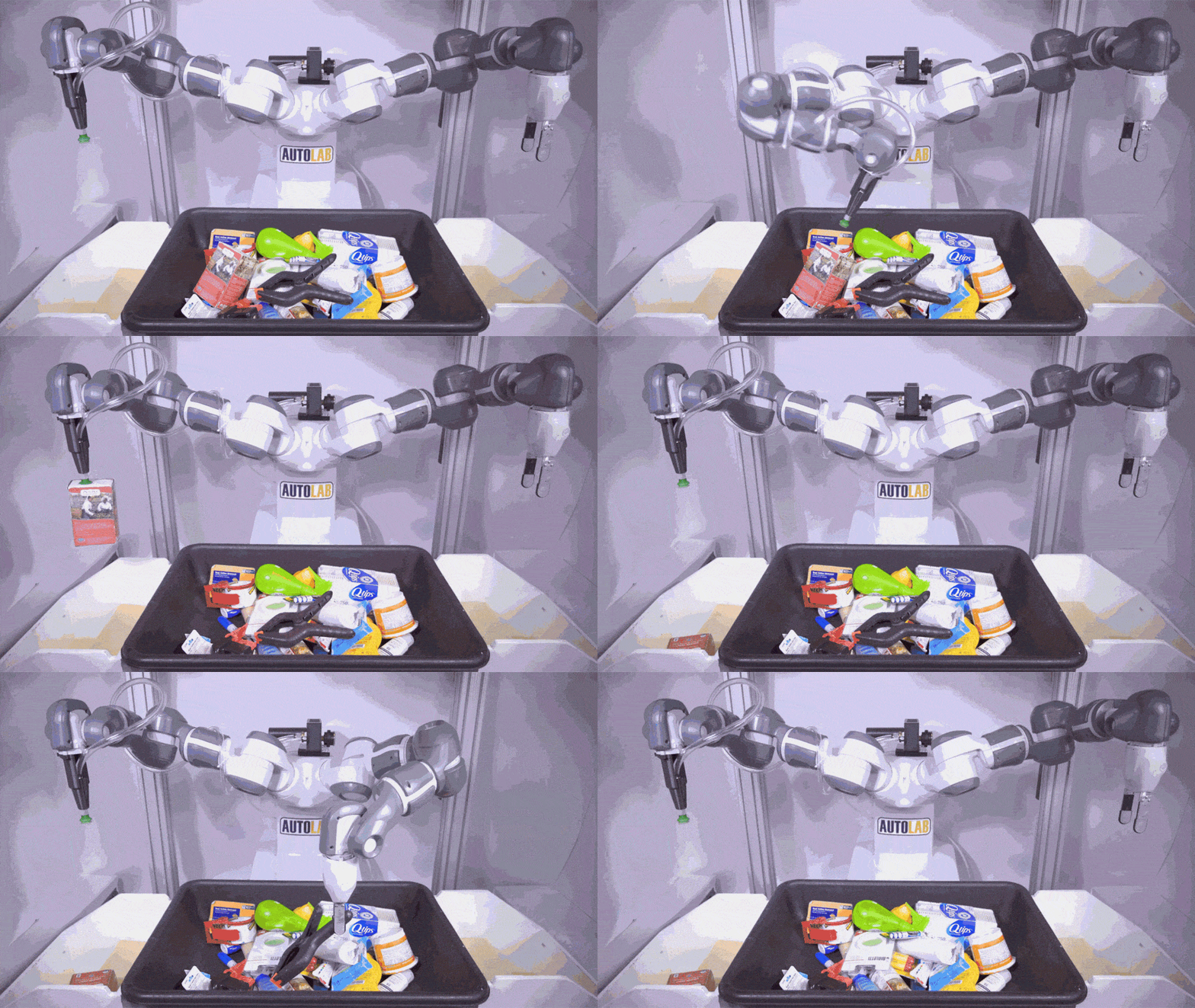
Pick up a glass of water, lift a fork: you automatically figure out the best way to grasp each object. Now researchers at UC Berkeley have developed a robot that makes similar calculation, choosing on the fly whether to grab an object with pincers or lift it with a suction cup. From a report: Berkeley's two-armed robot, seen in this video clip [GIF file], first considers the contents of a bin and calculates each arm's probability of picking up an object. Its suction cup is good at grabbing smooth, flat objects like boxes, but bad at porous surfaces like on a stuffed animal. The pincers, on the other hand, are best with small, odd-shaped items. The system learned its pick-up prowess not from actual practice, but from millions of simulated grasps on more than 1,600 3D objects. In every simulation, small details were randomized, which taught the robot to deal with real-world uncertainty. The bot can pick up objects 95% of the time, at about 300 successful pickups per hour, its creators write in a paper published this week in Science Robotics. Warehouse robots that can move around merchandise are highly sought after. Amazon is reportedly working on its own "picker" robots, as are several robotics companies.
Not right away of course, but in time. Automation will claim another job.
They already are
Pick up a glass of water, lift a fork: you automatically figure out the best way to grasp each object.
No you don't. You spend weeks learning, as a child. These researchers have completely forgotten that humans don't know these things. They learn them, with lots of spills along the way. Then they relearn them as their musculature changes as they grow older. The robot gets to skip that second part, but the human doesn't get the skip the first part any more than the robot does. They both have to perform the "more than 1600 pickups" before they can make a reasonable prediction of the best way to grasp something, and then succeed in the attempt on the first try. I don't know if anyone has counted how many pickup attempts a baby makes before it gets good at picking things up, but I'm betting it's at least 1600 attempts, and I wouldn't be at all surprised if it's many more.
There's been years and years of development in picker robots, and they're still pretty bad. Let's face it, a 95% success rate is pretty terrible. The researchers shouldn't feel bad about their continued failures though. Picking things up is hard for humans too. Hell, for some humans it's permanently hard. Even with adult-sized hands, a developmentally disabled human may never get good at picking things up.
And they know how to use them in warehouses.
Only slacker bots use two arms.
-- Tigger warning: This post may contain tiggers! --