Slashdot Mirror
Domain: academia.edu
Stories and comments across the archive that link to academia.edu.
Stories · 7
-
Measuring the Value of Open Hardware Designs
An anonymous reader writes: Industry knows open source software has an immense value, but how valuable is an open hardware design? To answer that question, Dr. Joshua Pearce, an associate professor at Michigan Tech University, analyzed three methods to quantify the value of open hardware design in the latest issue of the journal Modern Economy. The methods are summarized in an article at opensource.com. -
Psychologists: Internet Trolls Are Narcissistic, Psychopathic, and Sadistic
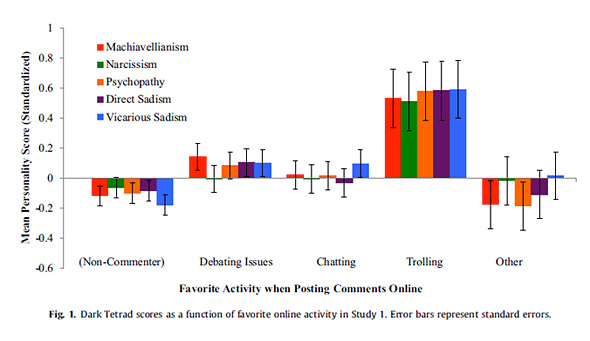
Hugh Pickens DOT Com writes "Chris Mooney reports at Slate that research conducted by Erin Buckels of the University of Manitoba confirmed that people who engage in internet trolling are characterized by personality traits that fall in the so-called Dark Tetrad: Machiavellianism (willingness to manipulate and deceive others), narcissism (egotism and self-obsession), psychopathy (the lack of remorse and empathy), and sadism (pleasure in the suffering of others). In the study, trolls were identified in a variety of ways. One was by simply asking survey participants what they 'enjoyed doing most' when on online comment sites, offering five options: 'debating issues that are important to you,' 'chatting with others,' 'making new friends,' 'trolling others,' and 'other.' The study recruited participants from Amazon's Mechanical Turk website and two measures of sadistic personality were administered (PDF): the Short Sadistic Impulse Scale and the Varieties of Sadistic Tendencies Scale. Only 5.6 percent of survey respondents actually specified that they enjoyed 'trolling.' By contrast, 41.3 percent of Internet users were 'non-commenters,' meaning they didn't like engaging online at all. So trolls are, as has often been suspected, a minority of online commenters, and an even smaller minority of overall Internet users. Overall, the authors found that the relationship between sadism and trolling was the strongest, and that indeed, sadists appear to troll because they find it pleasurable. 'Both trolls and sadists feel sadistic glee at the distress of others. Sadists just want to have fun ... and the Internet is their playground!' The study comes as websites are increasingly weighing steps to rein in trollish behavior but the study authors aren't sure that fix is a realistic one. 'Because the behaviors are intrinsically motivating for sadists, comment moderators will likely have a difficult time curbing trolling with punishments (e.g., banning users),' says Buckels. 'Ultimately, the allure of trolling may be too strong for sadists, who presumably have limited opportunities to express their sadistic interests in a socially-desirable manner.' Perhaps posting rights should only be unlocked if you pass a test." -
Support For NASA Spending Depends On Perception of Size of Space Agency Budget
MarkWhittington writes "Alan Steinberg, a post doctorate fellow in political science at Sam Houston State University, conducted a study surrounding the vexing problem of how to motivate more people to support increased levels of funding for NASA. In an October 14, 2013 piece in The Space Review, Steinberg announced the results of a study conducted with a group of college students. Steinberg's approach was based on the findings of a study by Roger Launius conducted in the late 1990s that suggested that the American public believe that NASA spending takes up about 20 percent of the federal budget. It has in fact never exceeded four percent, which it enjoyed at the height of the Apollo program, and is currently about .5 percent. Steinberg was testing a notion advanced by Neil deGrasse Tyson that if people knew the true size of NASA's budget they would be more likely to support increasing it." -
Scottish Academic: Mining the Moon For Helium 3 Is Evil
MarkWhittington writes "Tony Milligan is a teaching fellow of philosophy at the University of Aberdeen and is apparently concerned about helium 3 mining on the moon. In a recent paper he suggested that it should not be allowed for a number of reasons which include environmental objections, his belief that the moon is a cultural artifact, and that too much access to energy would be bad for the human race." -
Tylenol May Ease Pain of Existential Distress, Social Rejection
Guppy writes "Does Tylenol reduce existential distress? Acetaminophen (Paracetamol) has been used to relieve mild-to-moderate physical pain for over a century, yet its actual mechanism of action continues to be debated; modern research has demonstrated an intriguing connection with the body's endocannabinoid system, raising the question of whether it may also have subtle psychological effects as well. A recent paper claims Acetaminophen can alter our response to existential challenge; previous findings have suggested that it may blunt the pain of social rejection as well." -
Meat the Food of the Future
Hugh Pickens writes writes "BBC reports that rising food prices, the growing population, and environmental concerns are just a few issues that have food futurologists thinking about what we will eat in the future and how we will eat it. In the UK, meat prices are anticipated to have a huge impact on our diets as some in the food industry prognosticate meat prices could double in the next five to seven years, making meat a luxury item. 'In the West many of us have grown up with cheap, abundant meat,' says Morgaine Gaye. 'Rising prices mean we are now starting to see the return of meat as a luxury. As a result we are looking for new ways to fill the meat gap.' Insects will become a staple of our diet. They cost less to raise than cattle, consume less water and do not have much of a carbon footprint. Plus, there are an estimated 1,400 species that are edible to man. 'Things like crickets and grasshoppers will be ground down and used as an ingredient in things like burgers.' But insects will need an image overhaul if they are to become more palatable to the squeamish Europeans and North Americans, says Gaye. 'They will become popular when we get away from the word insects and use something like mini-livestock (PDF).' Another alternative would be lab grown meat as a recent study by Oxford University found growing meat in a lab rather than slaughtering animals would significantly reduce greenhouse gases, energy consumption and water use. Prof Mark Post, who led the Dutch team of scientists at Maastricht University that grew strips of muscle tissue using stem cells taken from cows, says he wants to make lab meat "indistinguishable" from the real stuff, but it could potentially look very different. Finally algae could provide a solution to some the world's most complex problems, including food shortages as some in the sustainable food industry predict algae farming could become the world's biggest cropping industry. Like insects, algae could be worked into our diet without us really knowing by using seaweed granules to replace salt in bread and processed foods. 'The great thing about seaweed is it grows at a phenomenal rate,' says Dr Craig Rose, executive director of the Seaweed Health Foundation. 'It's the fastest growing plant on earth.'" -
Magical Thinking Is Good For You
Hugh Pickens writes "Natalie Wolchover says even the most die-hard skeptics among us believe in magic. Humans can't help it: though we try to be logical, irrational beliefs — many of which we aren't even conscious of — are hardwired in our psyches. 'The unavoidable habits of mind that make us think luck and supernatural forces are real, that objects and symbols have power, and that humans have souls and destinies are part of what has made our species so evolutionarily successful,' writes Wolchover. 'Believing in magic is good for us.' For example, what do religion, anthropomorphism, mysticism and the widespread notion that each of us has a destiny to fulfill have in common? According to research by Matthew Hutson, underlying all these forms of magical thinking is the innate sense that everything happens for a reason. And that stems from paranoia, which is a safety mechanism that protects us. 'We have a bias to see events as intentional, and to see objects as intentionally designed,' says Hutson. 'If we don't see any biological agent, like a person or animal, then we might assume that there's some sort of invisible agent: God or the universe in general with a mind of its own.' According to anthropologists, the reason we have a bias to assume things are intentional is that typically it's safer to spot another agent in your environment than to miss another agent. 'It's better to mistake a boulder for a bear than a bear for a boulder,' says Stewart Guthrie. In a recent Gallup poll, three in four Americans admitted to believing in at least one paranormal phenomenon. 'But even for those few of us who claim to be complete skeptics, belief quietly sneaks in. Maybe you feel anxious on Friday the 13th. Maybe the idea of a heart transplant from a convicted killer weirds you out. ... If so, on some level you believe in magic.'"