Slashdot Mirror
Domain: antarcticglaciers.org
Stories and comments across the archive that link to antarcticglaciers.org.
Comments · 9
-
Re:Sadly
Unless you're an expert on the subject, back-of-the-envelope calculations in a Slashdot post are probably not the most accurate way to estimate sea level rise.
Fortunately, more knowledgeable people have done more sophisticated analyses of this very hypothetical, and they put their estimates closer to 3.44 meters, aka 11 feet of sea-level rise.
Fortunately for us, it's unlikely that all the Antarctic ice will melt any time soon.
-
Re:Global Warming Alarmism
Good post but...
Melting Greenland would raise sea level 20'.
Source: simple google question.If *all* the ice in antarctica melted, it would raise sea level by 200'.
But the average temperature in Antarctica is -37C. So it's unlikely that it would all melt while the earth was still inhabitable.
http://www.antarcticglaciers.o..."It is possible that this could collapse rapidly and raise sea levels by 3.2 m, possibly within 500 years. "
Much more likely problems include rainbelts moving hundreds of miles which would cause arable land to be infertile and rain to fall on new areas that would take thousands of years to become good farmland, increased range of tropical diseases (we are already seeing this).
The methane hasn't transitioned during warmer periods in the past. If it *did* transition, it's close to an extinction level event for humans.
-
Re:End of the glaciation was ten thousand years ag
1) The Earth is usually a lot hotter than it is right now. We are climbing out of an ice age.
We "climbed out of an ice age" (that is, came out of the glaciation) ten thousand years ago.
You didn't look at the graphs in the referenced article, did you? >By those graphs we STARTED climbing out of an ice age back then but we still have a long way to go. So they support the poster's claim, not yours.
The graphs show nothing of the sort. Look at it more closely and pay attention to the scale. http://geology.utah.gov/wp-con... The smallest time division on that graph is 50,000 years, and the temperature has been warm for about a quarter of a division.
The article summarizes it clearly: "Currently, we are in a warm interglacial that began about 11,000 years ago" which is pretty much what I just said.Here's a good graph showing the sea level rise at the end of the glaciation. You can see the warming very clearly, and it's pretty much over by eight thousand years ago.
http://cdn.antarcticglaciers.o... -
Glaciations and industry
Yawn...the Earth has been warming since the last ice age. Guess what, we didn't pollute or cause the glaciers to melt either. Blame it on the dinosaurs that emitted carbon dioxide and methane from their gargantuan farts.
Well, the Earth is currently in a warming phase after the last ice age.
No, the warming following the last glaciation finished about ten thousand years ago, and the sea level rise attributable to that is pretty much done. Here's a good graph: cdn.antarcticglaciers.org/wp-content/uploads/2012/06/Post-Glacial_Sea_Level_rise2.png
I will also point out that this is warming and sea-level rise occurring on the time scale of millennia, while the anthropogenic greenhouse effect is on the scale of centuries-- much much faster.
That means global average temperatures will continue to rise past the 2 degrees Celsius TFS mentions even if humans never existed
Again, no. We're already in the interglacial period; temperature wouldn't be likely to rise more.
and no matter what we do (unless we figure out how to make a P-U 238 Explosive Space Modulator and cause the Earth to disappear with an Earth-shattering Kaboom),
Nice Duck Dodgers reference.
a strategy consisting mainly of adaptation (along with efficient but lower-impact CO2 and pollution controls) seems to be the logical strategy. We cannot stop global temperature rise, at the very best we might, maybe, be able to slow the rate of rise by a few tenths of a degree, but at huge costs in lives, suffering, opportunities, and wealth.
This is an assertion that is not particularly well grounded. I'm relatively techno-optimistic; I see no reason we can't switch to alternate energy sources and more efficient energy use. Most of the commentary I see on slashdot saying we can't consists of "if we do XXX with exactly the same technology we have right now, it would be expensive." Well, yes: so we need to work on better technology.
The level of technology pessimism I see on Slashdot astonishes me.
If we want to minimize the impact of humans on the Earth then the logical strategy is to concentrate on moving as much of those industries, activities, and resource-gathering activities which pollute or otherwise impact the Earths' environment to space as possible as quickly as possible...hopefully before limited Earth-bound resources become too scarce/expensive to accomplish it and condemn humans to extinction.
Interestingly, the main reason that developing industry in space will help the environment on Earth is that industry in space will necessarily be efficient and have complete recycling of waste products. Space industry won't emit gigatons of carbon dioxide because in space carbon dioxide is a resource to be used, not an effluent to be exhausted.
-
Re: Think outside the box
Thank you. I went there and read the article.
Howz that for a slashdotter?
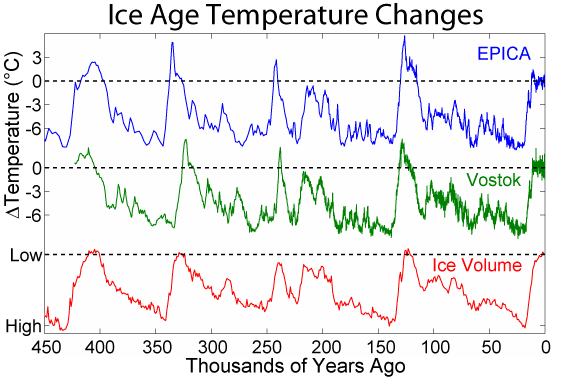
First ice cores go back to 800,000 years. That's a good span of time in but still a short period geologically speaking. (For instance it appears that the 22 ice ages we've had over the last 2 million years exist due to continental drift altering ocean and wind currents.)
I'm not seeing (I am going through the links) any information on the frequency of the data points. Ideally we would be able to say that at 4:35 in the afternoon on May 4, -802,016 at latitude/longitude x/y the temperature was 72F.
Obviously we don't need things to be that accurate to determine climate change.
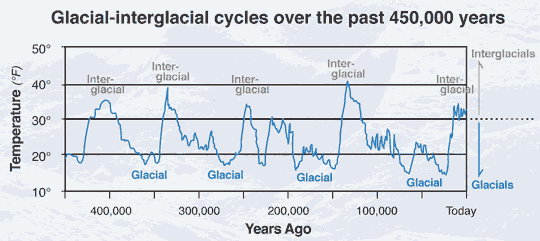
Interesting, if we look at the chart provided by the article we see that temperatures were higher at least 4 times over the last 450,000 years.
http://cdn.antarcticglaciers.o... -
Re: Think outside the box
Tree rings can go back close to 10,000 years under the right conditions. Older trees may have died but not decomposed to any great degree if the conditions are right and if they overlap with other more recent data they can be correlated and used.
As far as ice cores I found this article on ice core basics. Obviously as you go further back in time the the time scale gets a bit more muddled but it's not unusable. I found this reply from the author, Bethan Davies to a comment that pretty much supports my assertion:
Bethan Davies on 05/01/2016 at 9:00 am said:
In the upper parts of the ice core (last few hundred years), annual laminations in the ice allow us to derive annual CO2 and isotopic variations. As the ice is compressed deeper in the core, the annual layers are lost so several (not 1000s) of years may be amalgamated.
-
Re:Let's see
15 years after the prediction date the Arctic is still covered in ice and the and the Antarctic ice is expanding.
And your point is? Because one non-scientist made an ambiguous claim about a possible outcome, all scientific claims are invalid? We've started commercial shipping through the Arctic, and "Antarctic ice" is shrinking, what is growing slightly is maximum Antarctic sea ice extend.
-
Re:Whenever you want something other people have..
Sea level rise.
Antarctic ice sheet mass balance.
Greenland ice sheet mass balance. (PDF)
World wide glacier facts and figures.Unless you're willing to specifically name something they got wrong how can I evaluate your claim that the predictions haven't materialized?
-
Re:Summary of Trailer
It's possible to be precise but not accurate:
http://cdn.antarcticglaciers.o...
Imperial Stormtroopers appear to be low accuracy, high precision.