Slashdot Mirror
Domain: antiqueradio.org
Stories and comments across the archive that link to antiqueradio.org.
Comments · 11
-
'70s TV != Imprecise Signal Timing
Interesting seeing people's incorrect perceptions on 1970s/1980s TV technology.
Sorry to disappoint you, but there were very strong standards for signal timing precision - a bit of Googling found: https://antiqueradio.org/art/N...
Colour Burst frequency tolerance is +/-0.0003% which works out to roughly 10hz (I guess I mis-remembered or was thinking in terms of practical values).
It wasn't all capacitors back then - lots of silicon, although they were fairly discrete functions at the time. You can get an idea of what a Sony Trinitron TV had inside it here: https://www.manualslib.com/pro...
-
KLH Model Twenty-One FM radio.
Listening to it right now. May last forever. Computer grade capacitors, air tuning. 1965.
http://www.antiqueradio.org/KL... -
My Dad's 30 year old radio glowed in the dark
Sure - I remember my Dad's 30 year old radio, a Philco model 60 from 1936. Those thirty years were the the golden age of radio I caught just the tail end in the late1950's.
His cathedral radio glowed in the dark, thanks to 5 vacuum tubes and an incandescent dial lamp. Took a minute to warm up (boot?) thanks to the 6 volt filaments and sagging line voltage (the thing drew 60 watts just idling). Superhetrodyne tuning of the AM broadcast band gave it a response from perhaps 50 to 2000 Hz, give or take 10 db. Stereo? Naw it didn't even have FM (though you could tune in shortwave broadcasts from Moscow)
Fidelity? Well, the Lone Ranger theme came boomed in just fine, as did Jack Benny, Elvis, Carl Perkins, Jerry Lee Lewis, Buddy Holly, Ritchie Valens, and the Big Bopper. Nothing like staying up late to tune the latest releases from WKBW, CKLW, or WABCs Cousin Brucie. Or joining the Night People to catch Jean Shepherd on WOR after midnight.
I've heard plenty of music since then, on vinyl, cassette, 8-track, CD's and mp3 -- great stuff! But I miss the excitement of stalking the elusive Rock and Roll station...
-
Re:Great Scott! It Actually Makes Sense!
It should be noted, a good many 35 year old(and rather older) capitalist radios are still humming along.
What you are experiencing is the joy of (relatively simple) standards. -
Re:Because
Capacitors (excepting electrolytics) won't be breaking in your lifetime. Even those are fairly durable, provided you aren't using one of these...
Bad electrolytics on motherboards aren't the only capacitors that tend to go bad. The paper capacitors that were used in old radios and TVs tended to allow moisture through the wax or molded-plastic coating, at which point they'd go bad. If you run across a device that uses these, the first thing you should do is go through and replace the capacitors.
-
Re:HP 58" or 65" Microdisplay
I've worked on oscilloscopes that have had internal wobbulators.
See http://antiqueradio.org//trium01.htm for an elderly one. -
Re:And THAT is why you shouldn't count out Nintendtime has shown beyond the shadow of a doubt that (American) consumers prefer simple, function-specific devices to big clunky overcomplicated do-it-all boxes
The big do-it-all box doesn't seem to have hurt Dell's sales.
The integrated stereo -- now home theater -- system was displacing component audio forty-five years ago. Fisher Model 800-B Receiver (1962)
Camera phone sales are skyrocketing. 36 percent of shipments in 2004, an estimated 55 percent this year, 87 percent in 2009 Restrictions placed on camera phones
-
Re:Register lights! I want register lights!a 32 by 8 array of lamps that will display, at all times, the contents of the general-purpose regsisters... a "speed" pot... analog CPU speed meter...
Something like this could actually be very educational. I remember having gobs of fun with a KIM-1 about twenty years ago, and learning a lot. And a friend built a custom Z80 box with 16 LEDs for address and 8 more for data, and toggle switches to write his programs into SRAM, which he operated with ninja-like agility.
These days, the right way to do it would be to write a simulation with a GUI. If you really did it with hardware, people couldn't download it. But in fairness to your original idea, the GUI would need to have an antique radio theme. For instance, I got your speed pot right here. (That's actually the face of the shortwave that sat in our kitchen throughout my childhood.)
-
Re:Register lights! I want register lights!a 32 by 8 array of lamps that will display, at all times, the contents of the general-purpose regsisters... a "speed" pot... analog CPU speed meter...
Something like this could actually be very educational. I remember having gobs of fun with a KIM-1 about twenty years ago, and learning a lot. And a friend built a custom Z80 box with 16 LEDs for address and 8 more for data, and toggle switches to write his programs into SRAM, which he operated with ninja-like agility.
These days, the right way to do it would be to write a simulation with a GUI. If you really did it with hardware, people couldn't download it. But in fairness to your original idea, the GUI would need to have an antique radio theme. For instance, I got your speed pot right here. (That's actually the face of the shortwave that sat in our kitchen throughout my childhood.)
-
Re:TV hasn't changed since Milton Berle
Berle was the 'killer app' of the early TV adoption years - he said himself that a lot of sets were sold because of him ("My uncle sold his set, my cousin sold her set," this one (not mine). I was playing with my restored 1950 RCA TC125 just last night, it still picks up the locals just fine! In fact, I've purchased a cheap TV transmitter in anticipation of 2006 (which will likely get pushed back).
-
In The Days Before PC Boards - and Do-It-Yourself!
Tom's Hardware has a great intro to PCB manufacturingThat was a great intro, well written, and explaining the basics. Not so basic, however, is attempting to make your own PC boards.
It's easy once you've got the practice, and you can get all the stuff you need at Radio Shack (or better places).
Toner transfer is my method of choice. I stuck transparencies, like you'd use in an overhead projector, into my laser printer. I crank up the darkness of the page, so it puts a lot of toner onto the transparency.
Then, I print my board layout, in mirror image, onto the transparency. Rest it on the blank, clean copper-clad board, and run a hot steam iron over it for a few minutes. With some practice, you'll be able to transfer enough of the toner onto the board that when you etch the blank board, your layout comes through.
I've even managed to produce double-sided surface-mount boards for prototyping and testing the high frequency response of a radar video processing system using this technique, before we committed to actually having the boards mass-produced.
Two sheets of transfer sheet, toner side in, aligned very carefully and stapled together, then a nice long pressing.
He thought I was crazy, but I was able to confirm to my boss, before we shelled out $50,000 for the manufacturing run of PC boards, that the layouts we'd designed worked properly.
Multilayer boards, like modern computer components use, are impractical for do-it-yourselfers to attempt, but I once built a 4-layer prototype by carefully aligning two double-sided boards, made as above, over a third (blank, no copper) board, and screwing the whole sandwich together with machine screws. Carefully-installed plate-through holes were accomplished with scraps of wire soldered through. It took four tries before I got the alignment right and made the board useful for building the prototype.
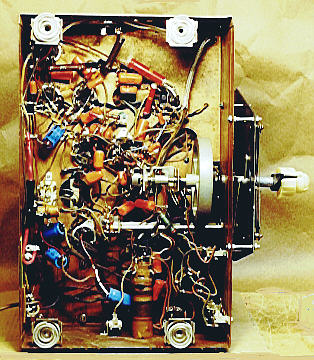
If that sounds complicated, you should see how stuff was built before Westinghouse invented printed circuit boards. Imagine a modern computer built like that. Urk.
All this and I'm still unemployed. Hit my page for my resume and stuff.