Slashdot Mirror
Domain: archimedespalimpsest.org
Stories and comments across the archive that link to archimedespalimpsest.org.
Comments · 7
-
Awesome
There have been a number of other notable manuscript digitization projects of late:
British Libraries Digitised Manuscripts
http://www.bl.uk/manuscripts/"Homer Multitext" - several manuscripts including Venetus A
http://www.homermultitext.org/The Archimedes Palimpsest
http://www.archimedespalimpsest.org/Personally I think such projects are absolutely vital to the long term preservation of these manuscripts. Modern technology makes possible the duplication of these source documents in high fidelity facsimile (Taschen in particular has published a number of fascinating editions, including Blaeu's Atlas Maior - another example would be The Book of Michael of Rhodes from MIT Press). So often works survive only as a copy of a copy of a copy, and we are left to peer through the murky glass of multiple interpertations at the far distant original author's intent. (The current definitive edition of Euclid, for example, is available to us only because of a single surviving early copy in the Vatican's library (which so far as I know has not been digitized, unfortunately, except for a couple images here: http://www.loc.gov/exhibits/vatican/math.html).)
We should be scanning and then printing many copies of these early works and depositing them in libraries around the world in order to help these early glimpses into our history survive (at least in SOME form, even if the originals are lost). Of course, multiple copies of the digital data is also very important, but we have no way of knowing how well digital data will survive on thousand-year time scales. Fingers crossed that we will see multiple volume facsimilie copies of Newton's notebooks (one volume for the facsimile, one for a modern translation ) on Amazon in the next few years...
-
Re:First thing I thought of
Something tells me the bonfire didn't include anything current from O'Reilly, Addison-Wesley, or Prentice-Hall PTR. Also unlikely to have included any popular (or vintage) RPG material, any collectible graphic novels, anything that has ever been on any high school required reading list, or anything that anyone acutually buys. I'd be willing to bet the contents of the bonfire are limited to overstocked books that were published as the extension of the writer's ego (e.g., I see large stacks of books by current politicians that nobody is expected to buy -- the value is in the perception that a stack of hardcover books generates), or various kinds of craft, collection, or coffee table books that tend to sit in the bargain aisle for years, that even the used bookstores won't take.
Now, if you told me the guy was burning a specific list of books that indicated a certain political statement, I would take a little interest. If you told me that the local government sanctioned this burning -but stipulated what books may and may not be burned- I'd pick up the torch and lead the protest. If you told me that the bookstore owner was burning somebody *else's* books without that person's consent, I'd expect civil and criminal action to follow.
As it happens, I'm merely amused that the bookstore owner got a ticket for having an unpermitted fire in a place where open fires of that type are illegal. It would have been ironic (but very unfunny) if the fire had gotten out of control and burned anything the owner considered "inventory."
I would support a law that required recycling in a situation like this. But all the comments that charity and libraries "should" take these books, don't come from a point of view that seems to understand just how useless a waste of space the sort of books that even a bookstore owner would destroy, really are.
Of course, no book is ever really useless
And it's sad to realize that paper was once considered so rare, that this was even conceivable.
-
Re:Question?
Interestingly, it seems that Archimedes was close to The Calculus when the Roman soldier killed him. See http://www.archimedespalimpsest.org/ for more. What the world would have been like if Rome's military empire building had not held it back for centuries - in this case more than 1000 years - is anybody's guess but it is one reason such emipires should be resisted even today: far from being the pinicle of civilisation, empires are the ultimate barbarians.
-
Re:100 year format
I'd use a good pigment ink photo printer (the Epson Photo R series are pretty good) and the best archival photo paper you can afford. And lock the prints in a fireproof, dark safe.
Paper is definitely the way to go for long term storage. Even if you erase and write over it there's still a good chance of data recovery, even thousands of years later. -
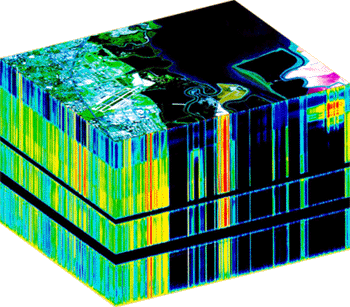
Did you notice how they use this technique????
Look at this url, from their "the Archimedes Palimpsest" Page (off of the home page of TFA): http://www.archimedespalimpsest.org/images/imagin
g _g5.gif
Now, oh fellow slashdotters, have a look at this lovely cube, and notice that it's top surface *is a map*. Okay, we here know that scanning from satellites can use techniques such that 'hiding under a tree' is preschool to the powers that be, but have you ever seen an image prove it so extremely viscerally? More lay people could use to see this image! -
Re:New stuff - Infinity
Yes - read the Scholarship section on the project web page. For example, http://www.archimedespalimpsest.org/scholarship_n
e tz2.html which shows that Archimedes knew about Infinity and used it in a proof. The Greeks were fascinated by large numbers - questions like "can you count the number of grains of sand on all the beaches of the world?" - but it was thought they did not have the concept of actual infinity. The palimpsest shows that this was known some 2000 years ago, then forgotten for centuries. -
Re:Not quite perfect
The palimpsest includes writings from authors other than Archimedes, though he is by far the best-represented.
Another book they used, we now know, contained works by the 4th century B.C. Attic Orator Hyperides. Prior to the discovery of the Hyperides text in the manuscript, this orator was only known from papyrus fragments and from quotations of his work by other authors. The Palimpsest, however, contains 10 pages of Hyperides text.
Yet further books were used to make up the Palimpsest. Six folios come fron a Neoplatonic philosophical text that has yet to be identified; four folios come from a liturgical book, and twelfve further pages come from two different books, the text of which has yet to be deciphered.