Slashdot Mirror
Domain: archive.today
Stories and comments across the archive that link to archive.today.
Comments · 406
-
Jane/Lonny Eachus goes Sky Dragon Slayer
Jane, before you try to lecture people about orbital mechanics, you should first make sure you understand more fundamental concepts like "conservation of energy".
But net radiative power out of a boundary around the source = "radiative power out" minus "radiative power in", so the equation Jane just described also says:
NO!!!!! As I have explained to you innumerable times now, you can also consider your heat source, by itself, that "sphere". The only NET radiative power out comes from the electrical power in. Further, the cooler walls do not contribute any of that NET power out. That's what net means. [Jane Q. Public, 2014-12-16]
I've already pointed out that Jane's hopelessly confused about the word "net", but that's just one of the mistakes Jane packed into these few sentences.
Jane's also wrong to imply that energy conservation across one choice of boundary could somehow contradict energy conservation across another boundary choice. That's impossible. Many boundary choices are inconvenient but they all have to be consistent. Otherwise, how could we possibly tell which boundary choice was correct?
So Jane can't object to the simple energy conservation equation I derived by claiming that some other boundary choice would somehow contradict my equation. That's completely impossible, and if Jane doesn't understand that point then he should learn about conservation of energy: example (backup), example (backup), example (backup).
As you can tell after reading those introductions, here's how to apply conservation of energy. Draw a boundary around the heat source:
power in = electrical heating power + radiative power in from the chamber walls
power out = radiative power out from the heat sourceSince power in = power out through any boundary where nothing inside is changing:
electrical heating power + radiative power in from the chamber walls = radiative power out from the heat source
I put the boundary around the heat source so the boundary is in vacuum. That's because radiation can't travel through opaque solids like the heat source. So the only way to obtain an energy conservation equation with radiative terms is to place the boundary around the heat source.
For example, I calculated the enclosing shell's inner temperature by drawing the boundary within the enclosing shell. This boundary was inside aluminum, so heat transfer through it was by thermal conduction, not radiation. Notice that even this boundary choice leads to a conduction equation where electrical heating power depends on the cooler chamber wall temperature. That's because all boundary choices have to be consistent. The resulting equations can't contradict each other unless one of them is wrong.
After I asked Jane to explain exactly where his boundary would be drawn, Jane replied:
... You can draw the boundary right around the heat source. Electric power comes in, radiative power goes out.
-
Jane/Lonny Eachus goes Sky Dragon Slayer
-
Jane/Lonny Eachus goes Sky Dragon Slayer
-
Jane/Lonny Eachus goes Sky Dragon Slayer
-
Jane/Lonny Eachus goes Sky Dragon Slayer
-
Jane/Lonny Eachus goes Sky Dragon Slayer
-
Jane/Lonny Eachus goes Sky Dragon Slayer
-
Jane/Lonny Eachus goes Sky Dragon Slayer
-
Jane/Lonny Eachus goes Sky Dragon Slayer
-
Jane/Lonny Eachus goes Sky Dragon Slayer
-
Jane/Lonny Eachus goes Sky Dragon Slayer
-
Jane/Lonny Eachus goes Sky Dragon Slayer
-
Jane/Lonny Eachus goes Sky Dragon Slayer
-
Jane/Lonny Eachus goes Sky Dragon Slayer
-
Jane/Lonny Eachus goes Sky Dragon Slayer
-
Jane/Lonny Eachus goes Sky Dragon Slayer
-
Jane/Lonny Eachus goes Sky Dragon Slayer
-
Jane/Lonny Eachus goes Sky Dragon Slayer
-
Jane/Lonny Eachus goes Sky Dragon Slayer
-
Jane/Lonny Eachus goes Sky Dragon Slayer
-
Jane/Lonny Eachus goes Sky Dragon Slayer
-
Jane/Lonny Eachus goes Sky Dragon Slayer
Jane's "interest" in that NAS report evaporated after I showed that Jane had been fooled by "Steven Goddard" once again. So let's return to Jane's confusion about basic thermodynamics.
But net radiative power out of a boundary around the source = "radiative power out" minus "radiative power in", so the equation Jane just described also says:
NO!!!!! As I have explained to you innumerable times now, you can also consider your heat source, by itself, that "sphere". The only NET radiative power out comes from the electrical power in. Further, the cooler walls do not contribute any of that NET power out. That's what net means. [Jane Q. Public, 2014-12-16]
I've already pointed out that Jane's hopelessly confused about the word "net", but that's just one of the mistakes Jane packed into these few sentences.
Jane's also wrong to imply that energy conservation across one choice of boundary could somehow contradict energy conservation across another boundary choice. That's impossible. Many boundary choices are inconvenient but they all have to be consistent. Otherwise, how could we possibly tell which boundary choice was correct?
So Jane can't object to the simple energy conservation equation I derived by claiming that some other boundary choice would somehow contradict my equation. That's completely impossible, and if Jane doesn't understand that point then he should learn about conservation of energy: example (backup), example (backup), example (backup).
As you can tell after reading those introductions, here's how to apply conservation of energy. Draw a boundary around the heat source:
power in = electrical heating power + radiative power in from the chamber walls
power out = radiative power out from the heat sourceSince power in = power out through any boundary where nothing inside is changing:
electrical heating power + radiative power in from the chamber walls = radiative power out from the heat source
I put the boundary around the heat source so the boundary is in vacuum. That's because radiation can't travel through opaque solids like the heat source. So the only way to obtain an energy conservation equation with radiative terms is to place the boundary around the heat source.
For example, I calculated the enclosing shell's inner temperature by drawing the boundary within the enclosing shell. This boundary was inside aluminum, so heat transfer through it was by thermal conduction, not radiation. Notice that even this boundary choice leads to a conduction equation where electrical heating power depends on the cooler chamber wall temperature. That's because all boundary choices have to be consistent. They can't contradict each other unless one of them is wrong.
After I asked Jane to explain exactly where his boundary would be drawn, Jane replied:
-
Jane/Lonny Eachus goes Sky Dragon Slayer
Jane's "interest" in that NAS report evaporated after I showed that Jane had been fooled by "Steven Goddard" once again. So let's return to Jane's confusion about basic thermodynamics.
But net radiative power out of a boundary around the source = "radiative power out" minus "radiative power in", so the equation Jane just described also says:
NO!!!!! As I have explained to you innumerable times now, you can also consider your heat source, by itself, that "sphere". The only NET radiative power out comes from the electrical power in. Further, the cooler walls do not contribute any of that NET power out. That's what net means. [Jane Q. Public, 2014-12-16]
I've already pointed out that Jane's hopelessly confused about the word "net", but that's just one of the mistakes Jane packed into these few sentences.
Jane's also wrong to imply that energy conservation across one choice of boundary could somehow contradict energy conservation across another boundary choice. That's impossible. Many boundary choices are inconvenient but they all have to be consistent. Otherwise, how could we possibly tell which boundary choice was correct?
So Jane can't object to the simple energy conservation equation I derived by claiming that some other boundary choice would somehow contradict my equation. That's completely impossible, and if Jane doesn't understand that point then he should learn about conservation of energy: example (backup), example (backup), example (backup).
As you can tell after reading those introductions, here's how to apply conservation of energy. Draw a boundary around the heat source:
power in = electrical heating power + radiative power in from the chamber walls
power out = radiative power out from the heat sourceSince power in = power out through any boundary where nothing inside is changing:
electrical heating power + radiative power in from the chamber walls = radiative power out from the heat source
I put the boundary around the heat source so the boundary is in vacuum. That's because radiation can't travel through opaque solids like the heat source. So the only way to obtain an energy conservation equation with radiative terms is to place the boundary around the heat source.
For example, I calculated the enclosing shell's inner temperature by drawing the boundary within the enclosing shell. This boundary was inside aluminum, so heat transfer through it was by thermal conduction, not radiation. Notice that even this boundary choice leads to a conduction equation where electrical heating power depends on the cooler chamber wall temperature. That's because all boundary choices have to be consistent. They can't contradict each other unless one of them is wrong.
After I asked Jane to explain exactly where his boundary would be drawn, Jane replied:
-
Jane/Lonny Eachus goes Sky Dragon Slayer
Jane's "interest" in that NAS report evaporated after I showed that Jane had been fooled by "Steven Goddard" once again. So let's return to Jane's confusion about basic thermodynamics.
But net radiative power out of a boundary around the source = "radiative power out" minus "radiative power in", so the equation Jane just described also says:
NO!!!!! As I have explained to you innumerable times now, you can also consider your heat source, by itself, that "sphere". The only NET radiative power out comes from the electrical power in. Further, the cooler walls do not contribute any of that NET power out. That's what net means. [Jane Q. Public, 2014-12-16]
I've already pointed out that Jane's hopelessly confused about the word "net", but that's just one of the mistakes Jane packed into these few sentences.
Jane's also wrong to imply that energy conservation across one choice of boundary could somehow contradict energy conservation across another boundary choice. That's impossible. Many boundary choices are inconvenient but they all have to be consistent. Otherwise, how could we possibly tell which boundary choice was correct?
So Jane can't object to the simple energy conservation equation I derived by claiming that some other boundary choice would somehow contradict my equation. That's completely impossible, and if Jane doesn't understand that point then he should learn about conservation of energy: example (backup), example (backup), example (backup).
As you can tell after reading those introductions, here's how to apply conservation of energy. Draw a boundary around the heat source:
power in = electrical heating power + radiative power in from the chamber walls
power out = radiative power out from the heat sourceSince power in = power out through any boundary where nothing inside is changing:
electrical heating power + radiative power in from the chamber walls = radiative power out from the heat source
I put the boundary around the heat source so the boundary is in vacuum. That's because radiation can't travel through opaque solids like the heat source. So the only way to obtain an energy conservation equation with radiative terms is to place the boundary around the heat source.
For example, I calculated the enclosing shell's inner temperature by drawing the boundary within the enclosing shell. This boundary was inside aluminum, so heat transfer through it was by thermal conduction, not radiation. Notice that even this boundary choice leads to a conduction equation where electrical heating power depends on the cooler chamber wall temperature. That's because all boundary choices have to be consistent. They can't contradict each other unless one of them is wrong.
After I asked Jane to expl
-
Jane/Lonny Eachus goes Sky Dragon Slayer
Jane's "interest" in that NAS report evaporated after I showed that Jane had been fooled by "Steven Goddard" once again. So let's return to Jane's confusion about basic thermodynamics.
But net radiative power out of a boundary around the source = "radiative power out" minus "radiative power in", so the equation Jane just described also says:
NO!!!!! As I have explained to you innumerable times now, you can also consider your heat source, by itself, that "sphere". The only NET radiative power out comes from the electrical power in. Further, the cooler walls do not contribute any of that NET power out. That's what net means. [Jane Q. Public, 2014-12-16]
I've already pointed out that Jane's hopelessly confused about the word "net", but that's just one of the mistakes Jane packed into these few sentences.
Jane's also wrong to imply that energy conservation across one choice of boundary could somehow contradict energy conservation across another boundary choice. That's impossible. Many boundary choices are inconvenient but they all have to be consistent. Otherwise, how could we possibly tell which boundary choice was correct?
So Jane can't object to the simple energy conservation equation I derived by claiming that some other boundary choice would somehow contradict my equation. That's completely impossible, and if Jane doesn't understand that point then he should learn about conservation of energy: example (backup), example (backup), example (backup).
As you can tell after reading those introductions, here's how to apply conservation of energy. Draw a boundary around the heat source:
power in = electrical heating power + radiative power in from the chamber walls
power out = radiative power out from the heat sourceSince power in = power out through any boundary where nothing inside is changing:
electrical heating power + radiative power in from the chamber walls = radiative power out from the heat source
I put the boundary around the heat source so the boundary is in vacuum. That's because radiation can't travel through opaque solids like the heat source. So the only way to obtain an energy conservation equation with radiative terms is to place the boundary around the heat source.
For example, I calculated the enclosing shell's inner temperature by drawing the boundary within the enclosing shell. This boundary was inside aluminum, so heat transfer through it was by thermal conduction, not radiation. Notice that even this boundary choice leads to a conduction equation where electrical heating power depends on the cooler chamber wall temperature. That's because all boundary choices have to be consistent. They can't contradict each other unless one of them is wrong.
After I asked Jane to expl
-
Re:cowardice
The problem is GamerGate started with
Gamergate started when Eron Gjoni posted a long, rambling post about how his ex-girlfriend was abusive. And it would have ended there too if not for one tiny detail in the huge post which only gamers could spot and see the significance of:
Friggen Nathan Stupid-Red-Pants-Wearing Kotaku-Writing Grayson.
Gjoni's post revealed the truth. One of the foremost proponents of "Gamers == Sexists", writing for one of the largest proponents of "Gamers ==Misogynerds" had -- all the while he was denouncing the gaming community -- felt free to have affairs with indie developers even as he promoted their games. The Game Journalist Emperors had no clothes. Grayson was the journalist who intimidated Blizzard dev Dustin Browder into an apology last year over trumped up charges of sexism, yet this same journalist felt all too at ease having affairs and friendships with young women working in the industry. Hell, his editor at Kotaku, Stephen Totilo, outright stated that there was "no reason to believe any further action need be taken.".
Jesus. There might be mixed opinions on Zoe Quinn, but I pity the actual hard working women trying to make video games in the indie scene. If the FBI aren't investigating the press and indie outlets for gross sexual misconduct now, I guarantee they will be in 20 years time if this is the editorial attitude of the people in charge of these places.
But let's not talk about that. Look, these poor women are being harassed! Bad gamers, bad! Quick, tell them they're "Dead"! Give more terrible games 9/10! Rile 'em up. Call in the mainstream media. Keep souring the bad blood behind all of this to drive up clicks. After 3 months of this, video game retail sales were down 11% in Novemeber, and I know where the blame lies -- sensationalist journalists more willing to attack consumers for profit that care about the industry and community they're supposed to be covering.
If you want to understand why gamers are pissed off, just take a look at the Gamergate Timeline. The journalists who have spent the last two years hazing gamers for being sexists were finally caught with their pants down, and their reaction was to silence, haze, censor, and smear. That the internet was so vulnerable to this is another matter, but the root of the issue is that game journalists have become antagonistic towards gamers and hold all the cards.
Only industry intervention can break this deadlock. Publishers need to step in.
-
Re:Excellent!
The FBI will quickly sort out what is actually going on.
"Quickly" might be inaccurate. They've been working on this since at least a month before the zoe post.
Read that last sentence again and think about it.
-
Jane/Lonny Eachus goes Sky Dragon Slayer
... the National Academy of Sciences itself was convinced enough of the "Global Cooling" scare to actually publish a call for immediate action (Science News, Jan. 25 1975, p. 52). [Jane Q. Public, 2014-12-16]
I merely pointed out the established truth that it was taken seriously. And again: the cited announcement by National Academy of Sciences is not "nonsense". It, too, is real. [Jane Q. Public, 2014-12-16]
You linked to a blog and claimed it linked to an announcement in Science News, Jan. 25 1975, p. 52. But the blog you linked has two "Science News" links which lead here and here. Neither of those links lead to Science News, Jan. 25 1975, p. 52. Could you please post the link to Science News, Jan. 25 1975, p. 52?
While Jane looks for that link, he should also consider addressing this issue with his basic thermodynamics:
But net radiative power out of a boundary around the source = "radiative power out" minus "radiative power in", so the equation Jane just described also says:
NO!!!!! As I have explained to you innumerable times now, you can also consider your heat source, by itself, that "sphere". The only NET radiative power out comes from the electrical power in. Further, the cooler walls do not contribute any of that NET power out. That's what net means. [Jane Q. Public, 2014-12-16]
As I suspected, Jane disputes the definition of the word "net". Jane didn't get his nonsensical definition from any of his textbooks, because in physics, net power through a boundary around the source = "radiative power out" minus "radiative power in".
That's what net means. But after it became clear that Jane is hopelessly confused about the very term "NET" which he keeps capitalizing, I explained conservation of energy in a way that didn't require using that troublesome word. Draw a boundary around the heat source:
power in = electrical heating power + radiative power in from the chamber walls
power out = radiative power out from the heat sourceSince power in = power out through any boundary where nothing inside is changing:
electrical heating power + radiative power in from the chamber walls = radiative power out from the heat source
Notice that this equation is equivalent to the equation Jane just described, but only if Jane uses the physics definition of the word "net". And in order to derive it, I didn't even have to use that word which has Jane hopelessly confused. All I had to use was conservation of energy.
-
Re:No one gets the oil!
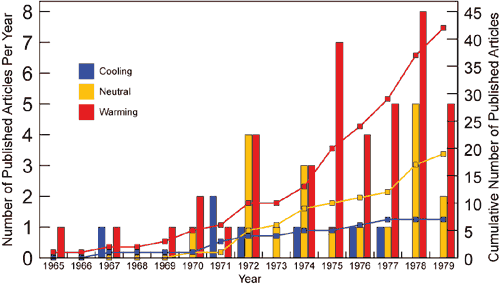
You're regurgitating complete nonsense. Once again, here’s figure 1 from Peterson et al. 2008. Notice that papers predicting warming vastly outnumbered those predicting cooling, even in the 1970s. Ironically:
- The term “global warming” was first used in a 1975 Science article by Wally Broecker called “Are we on the brink of a pronounced global warming?”.
- Sawyer 1972 estimated climate sensitivity as 2.4C, and Schneider 1975 gave a preliminary range of 1.5C to 3.0C.
- Manabe and Wetherald, 1975: “The Effects of Doubling the CO2 Concentration on the climate of a General Circulation Model.”
- In 1977, Freeman Dyson wrote that the “prevailing opinion is that the dangers [of the rise in CO2] greatly outweigh the benefits.”
- In 1977, Robert M. White, the head of the National Oceanic and Atmospheric Administration, wrote a report for the National Academy of Sciences that said “We now understand that industrial wastes, such as the carbon dioxide released in the burning of fossil fuels, can have consequences for climate that pose a considerable risk to future society.” [White, Robert, 1978, Oceans and Climate Introduction, Oceanus, 21:2-3]
- The 1979 JASON report “The long-term impact of atmospheric carbon dioxide on climate” estimated climate sensitivity as 2.4C to 2.8C.
- The National Academy of Science’s 1979 Charney report estimated climate sensitivity as 1.5C to 4.5C and said “If carbon dioxide continues to increase, [we] find no reason to doubt that climate changes will result, and no reason to believe that these changes will be negligible.”
While Jane is reading those papers, he should also consider addressing this issue with his basic thermodynamics:
Your own insistence that power in = power out (assuming perfect conversion and no entropic losses) belies this argument. You are arguing against yourself and you refuse to see that. If power in = power out (your own stipulation)
I'm not the only one insisting that power in = power out through any boundary where nothing inside is changing. Once again, that's a fundamental principle called "conservation of energy". Here are some introductions: example (backup), example (backup), example
-
Re: What the hell is wrong with Millennials?!
By the way: the "Greatest Generation" (which nobody but themselves call them) were the first generation in the history of the U.S. to leave their children with less than they themselves had. "Greatest Generation" my ass. [Lonny Eachus, 2012-11-01]
... I have problems with the whole "Greatest Generation" thing.
What they achieved was naming themselves "The Greatest Generation". Nobody else did it; they decided to call themselves that. And of course, that doesn't make it so. [Jane Q. Public, 2014-12-13]
Who said it first is irrelevant. I could have found that on Wikipedia too. [Jane Q. Public, 2014-12-14]
We either disagree about the definition of the word "irrelevant" or the phrase "nobody else".
-
Re: What the hell is wrong with Millennials?!
By the way: the "Greatest Generation" (which nobody but themselves call them) were the first generation in the history of the U.S. to leave their children with less than they themselves had. "Greatest Generation" my ass. [Lonny Eachus, 2012-11-01]
... I have problems with the whole "Greatest Generation" thing.
What they achieved was naming themselves "The Greatest Generation". Nobody else did it; they decided to call themselves that. And of course, that doesn't make it so. [Jane Q. Public, 2014-12-13]
Who said it first is irrelevant. I could have found that on Wikipedia too. [Jane Q. Public, 2014-12-14]
We either disagree about the definition of the word "irrelevant" or the phrase "nobody else".
-
Re: What the hell is wrong with Millennials?!
By the way: the "Greatest Generation" (which nobody but themselves call them) were the first generation in the history of the U.S. to leave their children with less than they themselves had. "Greatest Generation" my ass. [Lonny Eachus, 2012-11-01]
... I have problems with the whole "Greatest Generation" thing.
What they achieved was naming themselves "The Greatest Generation". Nobody else did it; they decided to call themselves that. And of course, that doesn't make it so. [Jane Q. Public, 2014-12-13]
Who said it first is irrelevant. I could have found that on Wikipedia too. [Jane Q. Public, 2014-12-14]
We either disagree about the definition of the word "irrelevant" or the phrase "nobody else".
-
Re: What the hell is wrong with Millennials?!
By the way: the "Greatest Generation" (which nobody but themselves call them) were the first generation in the history of the U.S. to leave their children with less than they themselves had. "Greatest Generation" my ass. [Lonny Eachus, 2012-11-01]
... I have problems with the whole "Greatest Generation" thing.
What they achieved was naming themselves "The Greatest Generation". Nobody else did it; they decided to call themselves that. And of course, that doesn't make it so. [Jane Q. Public, 2014-12-13]
Who said it first is irrelevant. I could have found that on Wikipedia too. [Jane Q. Public, 2014-12-14]
We either disagree about the definition of the word "irrelevant" or the phrase "nobody else".
-
Re: What the hell is wrong with Millennials?!
By the way: the "Greatest Generation" (which nobody but themselves call them) were the first generation in the history of the U.S. to leave their children with less than they themselves had. "Greatest Generation" my ass. [Lonny Eachus, 2012-11-01]
... I have problems with the whole "Greatest Generation" thing.
What they achieved was naming themselves "The Greatest Generation". Nobody else did it; they decided to call themselves that. And of course, that doesn't make it so. [Jane Q. Public, 2014-12-13]
Who said it first is irrelevant. I could have found that on Wikipedia too. [Jane Q. Public, 2014-12-14]
We either disagree about the definition of the word "irrelevant" or the phrase "nobody else".
-
Re: What the hell is wrong with Millennials?!
By the way: the "Greatest Generation" (which nobody but themselves call them) were the first generation in the history of the U.S. to leave their children with less than they themselves had. "Greatest Generation" my ass. [Lonny Eachus, 2012-11-01]
... I have problems with the whole "Greatest Generation" thing.
What they achieved was naming themselves "The Greatest Generation". Nobody else did it; they decided to call themselves that. And of course, that doesn't make it so. [Jane Q. Public, 2014-12-13]
Who said it first is irrelevant. I could have found that on Wikipedia too. [Jane Q. Public, 2014-12-14]
We either disagree about the definition of the word "irrelevant" or the phrase "nobody else".
-
Re: What the hell is wrong with Millennials?!
By the way: the "Greatest Generation" (which nobody but themselves call them) were the first generation in the history of the U.S. to leave their children with less than they themselves had. "Greatest Generation" my ass. [Lonny Eachus, 2012-11-01]
... I have problems with the whole "Greatest Generation" thing.
What they achieved was naming themselves "The Greatest Generation". Nobody else did it; they decided to call themselves that. And of course, that doesn't make it so. [Jane Q. Public, 2014-12-13]
Who said it first is irrelevant. I could have found that on Wikipedia too. [Jane Q. Public, 2014-12-14]
We either disagree about the definition of the word "irrelevant" or the phrase "nobody else".
-
Jane/Lonny Eachus goes Sky Dragon Slayer
If you have actual, direct evidence, why did you not link to THAT, rather than somebody else's claim? [Jane Q. Public, 2014-12-14]
I linked to reviews of actual, direct evidence by the U.S. National Academy of Sciences and The Royal Society (U.K.) in their joint publication (PDF), and another review of evidence by the American Association for the Advancement of Science, which publishes the journal Science.
While Jane is reading those reviews, he should also consider addressing this issue with his basic thermodynamics:
Your own insistence that power in = power out (assuming perfect conversion and no entropic losses) belies this argument. You are arguing against yourself and you refuse to see that. If power in = power out (your own stipulation)
I'm not the only one insisting that power in = power out through any boundary where nothing inside is changing. Once again, that's a fundamental principle called "conservation of energy". Here are some introductions: example (backup), example (backup), example (backup).
As you can tell, conservation of energy is a fundamental physics principle. Assumptions of "perfect conversion and no entropic losses" aren't applicable, and anyone who mistakenly thinks they are should read through those examples to learn about conservation of energy.
If power in = power out (your own stipulation), and the only NET power INTO a defined spherical region is electrical, and the only NET power OUT of that region is radiative, then net radiative power out at steady-state must therefore be equal to the net electrical power consumed. [Jane Q. Public, 2014-12-14]
Jane seems to be saying that at steady-state:
net electrical power consumed = net radiative power out
But net radiative power out of a boundary around the source = "radiative power out" minus "radiative power in", so the equation Jane just described also says:
net electrical power consumed = "radiative power out" minus "radiative power in"
However, this new equation doesn't match Jane's earlier equation:
My energy conservation equation is this: electrical power in = (epsilon * sigma) * T^4 * area = radiant power out [Jane Q. Public, 2014-10-08]
Notice that Jane's earlier equation doesn't describe net radiative power out, which is why it violates conservation of energy. Is Jane retracting his earlier incorrect equation, or does Jane dispute the definition of the word "net"?
-
Jane/Lonny Eachus goes Sky Dragon Slayer
Your own insistence that power in = power out (assuming perfect conversion and no entropic losses) belies this argument. You are arguing against yourself and you refuse to see that. If power in = power out (your own stipulation)
I'm not the only one insisting that power in = power out through any boundary where nothing inside is changing. Once again, that's a fundamental principle called "conservation of energy". Here are some introductions: example (backup), example (backup), example (backup).
As you can tell, conservation of energy is a fundamental physics principle. Assumptions of "perfect conversion and no entropic losses" aren't applicable, and anyone who mistakenly thinks they are should read through those examples to learn about conservation of energy.
If power in = power out (your own stipulation), and the only NET power INTO a defined spherical region is electrical, and the only NET power OUT of that region is radiative, then net radiative power out at steady-state must therefore be equal to the net electrical power consumed. [Jane Q. Public, 2014-12-14]
Jane seems to be saying that at steady-state:
net electrical power consumed = net radiative power out
But net radiative power out of a boundary around the source = "radiative power out" minus "radiative power in", so the equation Jane just described also says:
net electrical power consumed = "radiative power out" minus "radiative power in"
However, this new equation doesn't match Jane's earlier equation:
My energy conservation equation is this: electrical power in = (epsilon * sigma) * T^4 * area = radiant power out [Jane Q. Public, 2014-10-08]
Notice that Jane's earlier equation doesn't describe net radiative power out, which is why it violates conservation of energy. Is Jane retracting his earlier incorrect equation, or does Jane dispute the definition of the word "net"?
-
Re: What the hell is wrong with Millennials?!
By the way: the "Greatest Generation" (which nobody but themselves call them) were the first generation in the history of the U.S. to leave their children with less than they themselves had. "Greatest Generation" my ass. [Lonny Eachus, 2012-11-01]
... I have problems with the whole "Greatest Generation" thing.
What they achieved was naming themselves "The Greatest Generation". Nobody else did it; they decided to call themselves that. And of course, that doesn't make it so. [Jane Q. Public, 2014-12-13]
As usual, Jane/Lonny Eachus is wrong: "'The Greatest Generation' is a term coined by journalist Tom Brokaw to describe the generation who grew up in the United States during the deprivation of the Great Depression, and then went on to fight in World War II, as well as those whose productivity within the war's home front made a decisive material contribution to the war effort, for which the generation is also termed the G.I. Generation."
Members of the "Greatest Generation" were born from 1901 to 1924, but Tom Brokaw was born in 1940.
So Jane/Lonny Eachus is wrong. Again. The "Greatest Generation" isn't a self-designation.
-
Re: What the hell is wrong with Millennials?!
By the way: the "Greatest Generation" (which nobody but themselves call them) were the first generation in the history of the U.S. to leave their children with less than they themselves had. "Greatest Generation" my ass. [Lonny Eachus, 2012-11-01]
... I have problems with the whole "Greatest Generation" thing.
What they achieved was naming themselves "The Greatest Generation". Nobody else did it; they decided to call themselves that. And of course, that doesn't make it so. [Jane Q. Public, 2014-12-13]
As usual, Jane/Lonny Eachus is wrong: "'The Greatest Generation' is a term coined by journalist Tom Brokaw to describe the generation who grew up in the United States during the deprivation of the Great Depression, and then went on to fight in World War II, as well as those whose productivity within the war's home front made a decisive material contribution to the war effort, for which the generation is also termed the G.I. Generation."
Members of the "Greatest Generation" were born from 1901 to 1924, but Tom Brokaw was born in 1940.
So Jane/Lonny Eachus is wrong. Again. The "Greatest Generation" isn't a self-designation.
-
Re: What the hell is wrong with Millennials?!
By the way: the "Greatest Generation" (which nobody but themselves call them) were the first generation in the history of the U.S. to leave their children with less than they themselves had. "Greatest Generation" my ass. [Lonny Eachus, 2012-11-01]
... I have problems with the whole "Greatest Generation" thing.
What they achieved was naming themselves "The Greatest Generation". Nobody else did it; they decided to call themselves that. And of course, that doesn't make it so. [Jane Q. Public, 2014-12-13]
As usual, Jane/Lonny Eachus is wrong: "'The Greatest Generation' is a term coined by journalist Tom Brokaw to describe the generation who grew up in the United States during the deprivation of the Great Depression, and then went on to fight in World War II, as well as those whose productivity within the war's home front made a decisive material contribution to the war effort, for which the generation is also termed the G.I. Generation."
Members of the "Greatest Generation" were born from 1901 to 1924, but Tom Brokaw was born in 1940.
So Jane/Lonny Eachus is wrong. Again. The "Greatest Generation" isn't a self-designation.
-
Re: What the hell is wrong with Millennials?!
By the way: the "Greatest Generation" (which nobody but themselves call them) were the first generation in the history of the U.S. to leave their children with less than they themselves had. "Greatest Generation" my ass. [Lonny Eachus, 2012-11-01]
... I have problems with the whole "Greatest Generation" thing.
What they achieved was naming themselves "The Greatest Generation". Nobody else did it; they decided to call themselves that. And of course, that doesn't make it so. [Jane Q. Public, 2014-12-13]
As usual, Jane/Lonny Eachus is wrong: "'The Greatest Generation' is a term coined by journalist Tom Brokaw to describe the generation who grew up in the United States during the deprivation of the Great Depression, and then went on to fight in World War II, as well as those whose productivity within the war's home front made a decisive material contribution to the war effort, for which the generation is also termed the G.I. Generation."
Members of the "Greatest Generation" were born from 1901 to 1924, but Tom Brokaw was born in 1940.
So Jane/Lonny Eachus is wrong. Again. The "Greatest Generation" isn't a self-designation.
-
Re: What the hell is wrong with Millennials?!
By the way: the "Greatest Generation" (which nobody but themselves call them) were the first generation in the history of the U.S. to leave their children with less than they themselves had. "Greatest Generation" my ass. [Lonny Eachus, 2012-11-01]
... I have problems with the whole "Greatest Generation" thing.
What they achieved was naming themselves "The Greatest Generation". Nobody else did it; they decided to call themselves that. And of course, that doesn't make it so. [Jane Q. Public, 2014-12-13]
As usual, Jane/Lonny Eachus is wrong: "'The Greatest Generation' is a term coined by journalist Tom Brokaw to describe the generation who grew up in the United States during the deprivation of the Great Depression, and then went on to fight in World War II, as well as those whose productivity within the war's home front made a decisive material contribution to the war effort, for which the generation is also termed the G.I. Generation."
Members of the "Greatest Generation" were born from 1901 to 1924, but Tom Brokaw was born in 1940.
So Jane/Lonny Eachus is wrong. Again. The "Greatest Generation" isn't a self-designation.
-
Re: What the hell is wrong with Millennials?!
By the way: the "Greatest Generation" (which nobody but themselves call them) were the first generation in the history of the U.S. to leave their children with less than they themselves had. "Greatest Generation" my ass. [Lonny Eachus, 2012-11-01]
... I have problems with the whole "Greatest Generation" thing.
What they achieved was naming themselves "The Greatest Generation". Nobody else did it; they decided to call themselves that. And of course, that doesn't make it so. [Jane Q. Public, 2014-12-13]
As usual, Jane/Lonny Eachus is wrong: "'The Greatest Generation' is a term coined by journalist Tom Brokaw to describe the generation who grew up in the United States during the deprivation of the Great Depression, and then went on to fight in World War II, as well as those whose productivity within the war's home front made a decisive material contribution to the war effort, for which the generation is also termed the G.I. Generation."
Members of the "Greatest Generation" were born from 1901 to 1924, but Tom Brokaw was born in 1940.
So Jane/Lonny Eachus is wrong. Again. The "Greatest Generation" isn't a self-designation.
-
Re: What the hell is wrong with Millennials?!
By the way: the "Greatest Generation" (which nobody but themselves call them) were the first generation in the history of the U.S. to leave their children with less than they themselves had. "Greatest Generation" my ass. [Lonny Eachus, 2012-11-01]
... I have problems with the whole "Greatest Generation" thing.
What they achieved was naming themselves "The Greatest Generation". Nobody else did it; they decided to call themselves that. And of course, that doesn't make it so. [Jane Q. Public, 2014-12-13]
As usual, Jane/Lonny Eachus is wrong: "'The Greatest Generation' is a term coined by journalist Tom Brokaw to describe the generation who grew up in the United States during the deprivation of the Great Depression, and then went on to fight in World War II, as well as those whose productivity within the war's home front made a decisive material contribution to the war effort, for which the generation is also termed the G.I. Generation."
Members of the "Greatest Generation" were born from 1901 to 1924, but Tom Brokaw was born in 1940.
So Jane/Lonny Eachus is wrong. Again. The "Greatest Generation" isn't a self-designation.
-
Re:XOXO huh?
Yes, and apparently this Andy Baio is a proponent of the viewpoint that "it's not racist when it's against white people".
-
Re:Only CO2 matters
... if your gas absorbs radiation, and becomes hotter, what happens to it? At the risk of oversimplifying things myself, it expands, and rises in the atmosphere. There, it radiates its heat out to space.
Without gases which absorb IR, your hot gas would have been able to radiate its heat out to space even without rising in the atmosphere. In that case, even the surface would be able to radiate its heat directly to space.
But in the presence of gases which absorb IR, the surface can't radiate directly to the frigid 2.7K cosmic microwave background radiation. That's because radiating gases have raised Earth's effective radiating level to ~7 km above sea level.
... Simple radiative heating of an already-warmer surface by cooler gases is a physical impossibility.
Nonsense. Without radiating gases, net radiative heat transfer happens directly between the surface and the 2.7K CMBR. Jane seems to understand that net radiative heat transfer is proportional to (Ta^4 - Tb^4), where Ta is the surface temperature and Tb is the frigid 2.7K CMBR. Conservation of energy means that power in = power out through any boundary where nothing inside is changing, and a quick calculation yields an equilibrium surface temperature for Earth of -17C.
That's much colder than Earth's actual average surface temperature of +15C because net heat transfer to the frigid 2.7K CMBR is very rapid due to the fact that Tb is a tiny 2.7K. Very rapid net heat transfer means an Earth without radiating gases in the atmosphere could lose heat very rapidly, which would make it very cold.
Adding radiating gases just raises the effective radiating level above the surface. Conservation of energy forces the effective radiating level to have that temperature of -17C, otherwise heat would be building up (or down) below that level, which would cause warming (or cooling).
But in the presence of radiating gases, the surface can't radiate directly to the frigid 2.7K CMBR. Instead, it radiates (and convects) to the effective radiating level. Net radiative heat transfer is proportional to (Ta^4 - Tb^4), where Ta is the surface temperature and Tb is now the -17C effective radiating level. But this means Tb = 256K, which is much larger than 2.7K. Therefore net radiative heat transfer from the surface is much slower than without radiating gases. Reducing radiative heat transfer while keeping sunlight constant results in surface warming.
I've just described the radiative component, but I've also described the convective component, which doesn't alter the basic fact that adding radiating gases to an atmosphere raises the effective radiating level and warms the surface. That's because the Earth can't convect heat to the near-vacuum of space, it can only radiate heat away. That's why radiative heat transfer dominates Earth's top of the atmosphere energy balance.
-
Re:Only CO2 matters
... if your gas absorbs radiation, and becomes hotter, what happens to it? At the risk of oversimplifying things myself, it expands, and rises in the atmosphere. There, it radiates its heat out to space.
Without gases which absorb IR, your hot gas would have been able to radiate its heat out to space even without rising in the atmosphere. In that case, even the surface would be able to radiate its heat directly to space.
But in the presence of gases which absorb IR, the surface can't radiate directly to the frigid 2.7K cosmic microwave background radiation. That's because radiating gases have raised Earth's effective radiating level to ~7 km above sea level.
... Simple radiative heating of an already-warmer surface by cooler gases is a physical impossibility.
Nonsense. Without radiating gases, net radiative heat transfer happens directly between the surface and the 2.7K CMBR. Jane seems to understand that net radiative heat transfer is proportional to (Ta^4 - Tb^4), where Ta is the surface temperature and Tb is the frigid 2.7K CMBR. Conservation of energy means that power in = power out through any boundary where nothing inside is changing, and a quick calculation yields an equilibrium surface temperature for Earth of -17C.
That's much colder than Earth's actual average surface temperature of +15C because net heat transfer to the frigid 2.7K CMBR is very rapid due to the fact that Tb is a tiny 2.7K. Very rapid net heat transfer means an Earth without radiating gases in the atmosphere could lose heat very rapidly, which would make it very cold.
Adding radiating gases just raises the effective radiating level above the surface. Conservation of energy forces the effective radiating level to have that temperature of -17C, otherwise heat would be building up (or down) below that level, which would cause warming (or cooling).
But in the presence of radiating gases, the surface can't radiate directly to the frigid 2.7K CMBR. Instead, it radiates (and convects) to the effective radiating level. Net radiative heat transfer is proportional to (Ta^4 - Tb^4), where Ta is the surface temperature and Tb is now the -17C effective radiating level. But this means Tb = 256K, which is much larger than 2.7K. Therefore net radiative heat transfer from the surface is much slower than without radiating gases. Reducing radiative heat transfer while keeping sunlight constant results in surface warming.
I've just described the radiative component, but I've also described the convective component, which doesn't alter the basic fact that adding radiating gases to an atmosphere raises the effective radiating level and warms the surface. That's because the Earth can't convect heat to the near-vacuum of space, it can only radiate heat away. That's why radiative heat transfer dominates Earth's top of the atmosphere energy balance.
-
Jane/Lonny Eachus goes Sky Dragon Slayer
Sadly, lgw still hasn't objected to Jane's Slayer misinformation even though I gave lgw a generous two days to show that he's a true skeptic. So let's review the basic physics in this thought experiment. A source is heated by constant electrical power inside a vacuum chamber with cooler walls.
Here's how to use the principle of conservation of energy. Draw a boundary around the heat source:
power in = electrical heating power + radiative power in from the chamber walls
power out = radiative power out from the heat sourceSince power in = power out through any boundary where nothing inside is changing:
electrical heating power + radiative power in from the chamber walls = radiative power out from the heat source
For a simple example, blackbody cold walls are at 0F (T_c = 255K) and the heated blackbody source is at 150F (T_h = 339K). Using irradiance (power/m^2) simplifies the equation:
electricity + sigma*T_c^4 = sigma*T_h^4 (Eq. 1)
See? Applying conservation of energy isn't that complicated. In contrast, Jane's incorrect Sky Dragon Slayer equation violates conservation of energy:
My energy conservation equation is this: electrical power in = (epsilon * sigma) * T^4 * area = radiant power out [Jane Q. Public, 2014-10-08]
Jane got the very first equation wrong, because Jane refuses to write down an energy conservation equation for a boundary around the source without wrongly "cancelling" terms.
... pick up a textbook on heat transfer, and see what the accepted, textbook, "consensus" science says about it. Hint: they don't agree with you. [Jane Q. Public, 2014-10-05]
Once again, mainstream physics is based on conservation of energy. That means power in = power out through any boundary where nothing inside is changing.
... I have no obligation -- or reason -- to engage in your game of "No, but you HAVE TO do it this way...". Especially when "mainstream physicists" and textbooks on the subject say I don't. No, I don't have to do it according to your own ill-conceived notions. I already did it, my way... that is to say, the "mainstream physics" way.
... My textbooks do agree with Latour about his main point, which is that direct warming of a surface via back-radiation from a cooler atmosphere is impossible, just as Spencer's warming of the only heat source by a cooler passive plate is impossible.
Once again, I'm trying to point out that you and the other Slayers misunderstood your textbooks. Electrical heating power depends on the cooler chamber wall temperature. "Radiant power output" doesn't. Sky Dragon Slayers have confused two completely different fundamental concepts.
... When I showed him that the mainstream physics, textbook solutions to the temperatures in Spencer's experiment disagreed with his (and Spencer's) conclusions, he hasn't ceased demanding that I solve it a different way of his own devising, which doesn't appear in any textbook on radiative heat transfer, anywhere.
-
Re: Are they really that scared?
You simply aren't reading my posts. It's not "CO2 emissions aren't a concern"; it's "CO2 emissions aren't a concern if all you use is high school physics". It's all explained above.
Nobody here is only using high school physics. I just showed that my explanations of the greenhouse effect match that of Ray Pierrehumbert, author of Principles of Planetary Climate. (Just in case you've never heard of this textbook, it isn't a high school textbook.)
It's disappointing (but sadly not surprising after meeting Sky Dragon Slayers like Jane) to find that lgw can't or won't cite even a single peer-reviewed study of equilibrium CO2 climate sensitivities that he actually accepts. And, frankly, ocean acidification is pretty close to being high school chemistry. Does lgw dismiss ocean acidification like Jane and the Sky Dragon Slayers do?
At combustion-chamber temperatures, CO2 actually reflects infrared, vs absorbing it, which is a much more dramatic effect.
There are two way in which CO2 interacts with IR radiation:
1) It can absorb IR, becoming warmer, and in turn emit IR as a blackbody.
2) It can reflect IR.
The energy transferred by effect 1 depends on the temp of the CO2. The energy transferred by effect 2 depends instead on the temp of what's being reflected. As these are "4th power of temp" effects, the difference is critical.If this is such a critical and dramatic effect, you should easily be able to cite peer-reviewed articles (other than G&T) supporting and quantifying it. Right?
Saying "but what about Venus" gets the physics wrong (and also implies that the Earth could somehow one day become like Venus, when there's no mechanism for that).
No, I've actually emphasized that:
"I'm not saying that the Earth will turn into Venus. That would be absurd. We have no reason to think that the 'runaway greenhouse' on Venus is even possible on Earth."
Rasmus Benestad and Ray Pierrehumbert agree:
"The Earth may well succumb to a runaway greenhouse as the Sun continues to brighten over the next billion years or so, but the amount of CO2 we could add to the atmosphere by burning all available fossil fuel reserves would not move us significantly closer to the runaway greenhouse threshold. There are plenty of nightmares lurking in anthropogenic global warming, but the runaway greenhouse is not among them."
CO2 plays a role in absorbing a small percentage of the IR that is not reflected (which is itself a small percentage of the heat loss from the surface), and becoming warmer. The increase in blackbody radiation from the warmer CO2 is trivial. Thinking of this as "look, simple physics at work here" gets it wrong.
I've already explained complex factors like pressure broadening, which don't change the fact that CO2 warms the surface. For instance, how would surface temperatures change if all the CO2 in the atmosphere suddenly vanished? Sky Dragon Slayers have a simple (and wrong) answer: it wouldn't. What's yours?
Most of the heat transfer away from the surface of the Earth is by convection - radiative heat loss is a small effect by comparison.
I've explained that to a first approximation, convection establishes the lapse rate (the rate at which temperature drops with altitude in the troposphere). That estab