Slashdot Mirror
Domain: arxiv.org
Stories and comments across the archive that link to arxiv.org.
Stories · 808
-
Humans Choose Friends With Similar DNA
KentuckyFC writes "The study of social networks has long shown that people tend to pick friends who are similar to them — birds of a feather stick together (PDF). Now a study of the genomes of almost 2000 Americans has found that those who are friends also share remarkable genetic similarities. 'Pairs of friends are, on average, as genetically similar to one another as fourth cousins,' the study concludes. By contrast, strangers share few genetic similarities. The result seems to confirm a 30-year-old theory that a person's genes causes them to seek out circumstances that are compatible with their phenotype. If that's the case, then people with similar genes should end up in similar environments and so be more likely to become friends." -
Quantum Cryptography Is Safe Again
sciencehabit writes "In theory, so-called quantum cryptography provides a totally secure way of sending information. In practice, maybe not. But now physicists have demonstrated how to close a technological loophole that could have left secrets open to eavesdroppers. '[I]n 2010, an international team of researchers showed that [an attacker] could hack the system by exploiting a weakness in the so-called avalanche photodiodes (APDs) used to detect the individual photons. The problem is that APDs react differently to intense pulses of light than they do to single photons, so that the energy of the pulse must exceed a threshold to register a hit. As a result, all [the attacker] has to do is intercept the single photons, make her best-guess measurements of their polarizations, and send her answers off to Bob as new, brighter pulses. ... Last year, physicist Hoi-Kwong Lo at the University of Toronto and colleagues claimed to find a way around the problem. In the new protocol, Alice and Bob would begin the creation of a quantum key by sending randomly polarized signals to Charlie, a third party. Charlie would measure the signals to determine not their actual polarization, but only whether the polarizations were at right angles. ... Now, in papers in press at Physical Review Letters, two independent groups of physicists have shown that the new protocol works.'" -
Quantum Cryptography Is Safe Again
sciencehabit writes "In theory, so-called quantum cryptography provides a totally secure way of sending information. In practice, maybe not. But now physicists have demonstrated how to close a technological loophole that could have left secrets open to eavesdroppers. '[I]n 2010, an international team of researchers showed that [an attacker] could hack the system by exploiting a weakness in the so-called avalanche photodiodes (APDs) used to detect the individual photons. The problem is that APDs react differently to intense pulses of light than they do to single photons, so that the energy of the pulse must exceed a threshold to register a hit. As a result, all [the attacker] has to do is intercept the single photons, make her best-guess measurements of their polarizations, and send her answers off to Bob as new, brighter pulses. ... Last year, physicist Hoi-Kwong Lo at the University of Toronto and colleagues claimed to find a way around the problem. In the new protocol, Alice and Bob would begin the creation of a quantum key by sending randomly polarized signals to Charlie, a third party. Charlie would measure the signals to determine not their actual polarization, but only whether the polarizations were at right angles. ... Now, in papers in press at Physical Review Letters, two independent groups of physicists have shown that the new protocol works.'" -
MIT Reports 400 GHz Graphene Transistor Possible With 'Negative Resistance'
An anonymous reader writes "The idea is to take a standard graphene field-effect transistor and find the circumstances in which it demonstrates negative resistance (or negative differential resistance, as they call it). They then use the dip in voltage, like a kind of switch, to perform logic. They show how several graphene field-effect transistors can be combined and manipulated in a way that produces conventional logic gates. Graphene-based circuit can match patterns and it has several important advantages over silicon-based versions. Liu and co can build elementary XOR gates out of only three graphene field-effect transistors compared to the eight or more required using silicon. That translates into a significantly smaller area on a chip. What's more, graphene transistors can operate at speeds of over 400 GHz." -
Carbyne: a Form of Carbon Even Stronger Than Graphene
New submitter Dialecticus writes "Sebastian Anthony at ExtremeTech has written an article about research into the physical properties of carbyne, an elusive form of carbon. A new mathematical analysis by Mingjie Liu and others at Rice University suggests that carbyne may achieve double the strength of graphene, stealing its crown and becoming the strongest material known to man. 'While carbyne cannot be stretched, it can be bent into an arc or circle — and by doing so, the additional strain between the carbon atoms alters the electrical bandgap. This property could lead to some interesting uses in microelectromechanical systems (MEMS). By adding different molecules to the end of a carbyne chain, such as a methylene (CH2) group, carbyne can also be twisted — much like a strand of DNA — again adding strain and modifying the electrical bandgap. By "decorating" carbyne chains with different molecules, other properties can be added, too: Tack some calcium atoms on the end, which like to mop up spare hydrogen molecules, and suddenly you have a high-density, reversible hydrogen storage sponge. It’s also important to note that, just like graphene, carbyne is just one atom thick. This means that, for a given mass of carbyne, its surface area is relatively massive. A single gram of graphene, for example, has a surface area of about five tennis courts. This could be very important in areas such as energy storage (batteries, supercapacitors), where the surface area of the electrode is directly proportional to the energy density of the device.'" -
MIT Research: Encryption Less Secure Than We Thought
A group of researchers from MIT and the University of Ireland has presented a paper (PDF) showing that one of the most important assumptions behind cryptographic security is wrong. As a result, certain encryption-breaking methods will work better than previously thought. "The problem, Médard explains, is that information-theoretic analyses of secure systems have generally used the wrong notion of entropy. They relied on so-called Shannon entropy, named after the founder of information theory, Claude Shannon, who taught at MIT from 1956 to 1978. Shannon entropy is based on the average probability that a given string of bits will occur in a particular type of digital file. In a general-purpose communications system, that’s the right type of entropy to use, because the characteristics of the data traffic will quickly converge to the statistical averages. ... But in cryptography, the real concern isn't with the average case but with the worst case. A codebreaker needs only one reliable correlation between the encrypted and unencrypted versions of a file in order to begin to deduce further correlations. ... In the years since Shannon’s paper, information theorists have developed other notions of entropy, some of which give greater weight to improbable outcomes. Those, it turns out, offer a more accurate picture of the problem of codebreaking. When Médard, Duffy and their students used these alternate measures of entropy, they found that slight deviations from perfect uniformity in source files, which seemed trivial in the light of Shannon entropy, suddenly loomed much larger. The upshot is that a computer turned loose to simply guess correlations between the encrypted and unencrypted versions of a file would make headway much faster than previously expected. 'It’s still exponentially hard, but it’s exponentially easier than we thought,' Duffy says." -
Easily-Captured Asteroids Identified
Hugh Pickens DOT Com writes "Long overlooked as mere rocky chunks leftover from the formation of the solar system, asteroids have recently gotten a lot more scrutiny as NASA moves forward with plans to capture, tow, and place a small asteroid somewhere near our planet. Two different private space companies, Planetary Resources and Deep Space Industries, plan to seek out and mine precious metals and water from near-Earth asteroids. Now Adam Mann reports that astronomers have identified 12 candidate Easily Retrievable Objects (EROs) ranging in size from approximately 2 meters to 60 meters in diameter that already come (cosmically) close enough to our planet — close enough that it would take a relatively small push to put them into orbits at Lagrange points near Earth using existing rocket technology. For example, 2006 RH120 could be sent into orbit at L2 by changing its velocity by just 58 meters per second with a single burn on 1 February 2021. Moving one of these EROs would be a 'logical stepping stone towards more ambitious scenarios of asteroid exploration and exploitation, and possibly the easiest feasible attempt for humans to modify the Solar System environment outside of Earth (PDF),' write the authors in Celestial Mechanics and Dynamical Astronomy. None of the 12 ERO asteroids are new to astronomers; in fact, one of them became briefly famous when it was found to be temporarily orbiting the Earth until 2007. But until now nobody had realized just how easily these bodies could be captured." -
Proof Mooted For Heisenberg's Uncertainty Principle
ananyo writes "Encapsulating the strangeness of quantum mechanics is a single mathematical expression. According to every undergraduate physics textbook, the uncertainty principle states that it is impossible to simultaneously know the exact position and momentum of a subatomic particle — the more precisely one knows the particle's position at a given moment, the less precisely one can know the value of its momentum. But the original version of the principle, put forward by physicist Werner Heisenberg in 1927, couches quantum indeterminism in a different way — as a fundamental limit to how well a detector can measure quantum properties. Heisenberg offered no direct proof for this version of his principle. Now researchers say they have such a proof. (Pre-print available at the arXiv.) If they're right, it would put the measurement aspect of the uncertainty principle on solid ground — something that researchers had started to question — but it would also suggest that quantum-encrypted messages can be transmitted securely." -
A Cold Look at Cold Fusion Claims: Why E-Cat Looks Like a Hoax
In the past few days, several readers have submitted word of a paper published on Arxiv allegedly confirming the efficacy of Andrea Rossi's "E-Cat," a device Rossi says transmutes nickel into copper, producing cheap energy in the process. (Mentioned before on Slashdot.) Ethan Siegel of ScienceBlogs takes a skeptical look at the buzz surrounding this paper, and asks some seemingly obvious questions, pointing out various ways in which the cold-fusion / cheap-energy claims could be either confirmed or debunked. First time accepted submitter CdXiminez writes with a capsule of Siegel's points: "What would it take to convince a reasonable observer that you've got a controlled nuclear reaction going on here? Things not shown in the earlier report: Show that nuclear transmutation has in fact taken place; Start the device operating by whatever means you want, then disconnect all external power to it, and allow it to run; Place a gamma-ray detector around the device; Accurately monitor the power drawn from all sources to the device at all times, while also monitoring the energy output from the device at all times." -
One-Time Pad From Caltech Offers Uncrackable Cryptography
zrbyte writes "One-time pads are the holy grail of cryptography — they are impossible to crack, even in principle. However, the ability to copy electronic code makes one-time pads vulnerable to hackers. Now engineers at the California Institute of Technology in Pasadena, have found a way around this to create a system of cryptography that is invulnerable to electronic attack. Their solution is based on a special kind of one-time pad that generates a random key through the complexity of its physical structure, namely shining a light through a diffusive glass plate." -
'Einstein's Planet' Becomes First Exoplanet Discovered Using New Method
cylonlover writes "Due to their relative faintness compared to their parent stars, most known exoplanets have been discovered using indirect detection methods – that is, detecting the effects they have rather than observing them directly. There are numerous indirect methods that have proven useful in the detection of exoplanets and now yet another, which relies on Einstein's special theory of relativity (abstract), has joined the list with the discovery of an exoplanet known as Kepler-76b." -
Los Alamos National Labs Has Working Hub-and-Spoke Quantum Network
New submitter hutsell writes with this excerpt from MIT's Technology Review: "Richard Hughes and his associates at the Los Alamos National Laboratory in New Mexico announced today that they have been sending perfectly secure messages with their Quantum Internet that has been in operation for the last two and a half years." Original paper. Unlike current quantum networks that only allow point-to-point networking, the system at Los Alamos combines traditional and quantum links to route messages through a hub while retaining the security advantages of quantum networking. -
Physicists Attempting To Test 'Time Crystals'
ceview writes "This story at Wired seems to have lots of people a bit confused: 'In February 2012, the Nobel Prize-winning physicist Frank Wilczek decided to go public with a strange and, he worried, somewhat embarrassing idea. Impossible as it seemed, Wilczek had developed an apparent proof of "time crystals" — physical structures that move in a repeating pattern, like minute hands rounding clocks, without expending energy or ever winding down. ... [A] Berkeley-led team will attempt to build a time crystal by injecting 100 calcium ions into a small chamber surrounded by electrodes. The electric field generated by the electrodes will corral the ions in a "trap" 100 microns wide, or roughly the width of a human hair. The scientists must precisely calibrate the electrodes to smooth out the field. Because like charges repel, the ions will space themselves evenly around the outer edge of the trap, forming a crystalline ring.' The experimental set up is incredibly delicate (Bose Einstein Condensate), so it implies this perpetual motion effect can't really be used to extract energy. What is your take on it? It's unlike to upend anything, as the article suggests, because at a quantum level things behave weirdly at the best of times. The heavy details are available at the arXiv." -
Physicists Attempting To Test 'Time Crystals'
ceview writes "This story at Wired seems to have lots of people a bit confused: 'In February 2012, the Nobel Prize-winning physicist Frank Wilczek decided to go public with a strange and, he worried, somewhat embarrassing idea. Impossible as it seemed, Wilczek had developed an apparent proof of "time crystals" — physical structures that move in a repeating pattern, like minute hands rounding clocks, without expending energy or ever winding down. ... [A] Berkeley-led team will attempt to build a time crystal by injecting 100 calcium ions into a small chamber surrounded by electrodes. The electric field generated by the electrodes will corral the ions in a "trap" 100 microns wide, or roughly the width of a human hair. The scientists must precisely calibrate the electrodes to smooth out the field. Because like charges repel, the ions will space themselves evenly around the outer edge of the trap, forming a crystalline ring.' The experimental set up is incredibly delicate (Bose Einstein Condensate), so it implies this perpetual motion effect can't really be used to extract energy. What is your take on it? It's unlike to upend anything, as the article suggests, because at a quantum level things behave weirdly at the best of times. The heavy details are available at the arXiv." -
LHCb Experiment Observes New Matter-Antimatter Difference
An anonymous reader writes "Matter and antimatter are thought to have existed in equal amounts at the beginning of the Universe, but today the Universe appears to be composed essentially of matter. By studying subtle differences in the behavior of particles and antiparticles, experiments at the LHC are seeking to cast light on this dominance of matter over antimatter. Now the LHCb experiment has observed a preference for matter over antimatter known as CP-violation in the decay of neutral B0s particles. The results are based on the analysis of data collected by the experiment in 2011." -
Cause of LED Efficiency Droop Finally Revealed
An anonymous reader writes "Researchers from the University of California, Santa Barbara, in collaboration with colleagues at the École Polytechnique in France, have been able to prove the theory behind LED 'droop.' LED droop is the term for how LEDs emit less light when the amount of current being pushed through them goes above a certain level. 'The cost per lumen of LEDs has held the technology back as a viable replacement for incandescent bulbs for all-purpose commercial and residential lighting.' Now that we understand what causes this, we should start to see research go into technology to circumvent LED Droop. 'LEDs have enormous potential for providing long-lived high quality efficient sources of lighting for residential and commercial applications. The U.S. Department of Energy recently estimated that the widespread replacement of incandescent and fluorescent lights by LEDs in the U.S. could save electricity equal to the total output of fifty 1 GW power plants.'" A pre-print of the team's paper is available at the arXiv. -
Higgs Data Could Spell Trouble For Leading Big Bang Theory
ananyo writes "Paul Steinhardt, an astrophysicist at Princeton University in New Jersey, and colleagues have posted a controversial paper on ArXiv arguing, based on the latest Higgs data and the cosmic microwave background map from the Planck mission, that the leading theory explaining the first moments of the Big Bang ('inflation') is fatally flawed. In short, Steinhardt says that the models that best fit the Planck data — known as 'plateau models' because their potential-energy profiles level off at relatively low energies — are far less likely to occur naturally than the models that Planck ruled out. Secondly, he says, the news for these plateau models gets dramatically worse when the results are analyzed in conjunction with the latest results about the Higgs field coming from CERN's Large Hadron Collider. Particle physicists working at the LHC have calculated that the Higgs field is likely to have started out in a high-energy, 'metastable' state rather than in a stable, low-energy configuration. Steinhardt likens the odds of the Higgs field initially being perched in the precarious metastable state as to those of dropping out of the sky over the Matterhorn and conveniently landing in a 'dimple near the top,' rather than crashing down to the mountain's base." -
Moore's Law and the Origin of Life
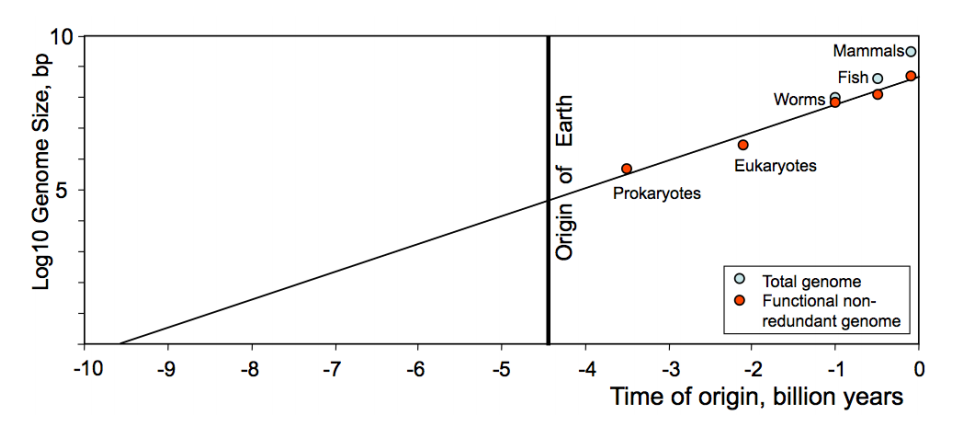
DoctorBit writes "MIT Technology Review is running a story about an arXiv paper in which geneticists Alexei A. Sharov and Richard Gordon propose that life as we know it originated 9.7 billion years ago. The researchers estimated the genetic complexity of phyla in the paleontological record by counting the number of non-redundant functional nucleotides in typical genomes of modern day descendants of each phylum. When plotting genetic complexity against time, the researchers found that genetic complexity increases exponentially, just as with Moore's law, but with a doubling rate of about once every 376 million years. Extrapolating backwards, the researchers estimate that life began about 4 billion years after the universe formed and evolved the first bacteria just before the Earth was formed. One might image that the supernova debris that formed the early solar system could have included bacteria-bearing chunks of rock from doomed planets circling supernova progenitor stars. If true, this retro-prediction has some interesting consequences in partly resolving the Fermi Paradox. Another interesting consequence for those attempting to recreate life's origins in a lab: bacteria may have evolved under conditions very different from those on earth." -
Evidence For Comet-Borne Microfossils Supports Panspermia
New submitter onyxruby writes "On December 29th of last year a comet exploded over Sri Lanka. When examined by Cardiff University one of the comet samples was found to contain micro-fossils akin to plankton. NASA's Marshall Space Flight Center tested additional samples with similar results. The research paper was published in the Journal of Cosmology. In practice this means that the argument that life did not start on Earth has gained additional evidence." Update: 03/12 16:59 GMT by S : On the other hand, Phil Plait says the paper is very flawed; the sample rocks the researchers tested may not even be meteorites. -
Physicists Discover 13 New Solutions To Three-Body Problem
sciencehabit writes "It's the sort of abstract puzzle that keeps a scientist awake at night: Can you predict how three objects will orbit each other in a repeating pattern? In the 300 years since this 'three-body problem' was first recognized, just three families of solutions have been found. Now, two physicists have discovered 13 new families. It's quite a feat in mathematical physics, and it could conceivably help astrophysicists understand new planetary systems." The paper is available at arxiv. -
The Manti Te'o of Physics
theodp writes "When it comes to tales of fake girlfriends, Manti Te'o can't hold a candle to theoretical particle physicist Paul Frampton. In November 2011, writes the NY Times' Maxine Swann in 'The Professor, the Bikini Model and the Suitcase Full of Trouble,' Frampton met who he says he thought was Czech bikini model Denise Milani on Mate1.com. A Yahoo Messenger romance bloomed, at least in the 68-year-old Frampton's mind (Frampton's ex-wife was a self-described 'physics groupie'). But before starting their perfect life together, fake Denise asked Frampton for one little favor — would he be so kind as to bring her a bag that she had left in La Paz, Bolivia? Yep, bad idea. The UNC Louis D. Rubin, Jr. Distinguished Professor of Physics and Astronomy soon found himself in a Buenos Aries prison, charged with transporting two kilos of cocaine into Argentina. Currently serving a four years and eight months sentence under house arrest, Frampton reportedly continues to supervise his two current PhD students by phone, and still finds time to post to the Physics archive." -
Researchers Put Numbers On China's Microblog Censorship
eldavojohn writes "One of China's main microblogging services used by 30% of all Chinese internet users is called Sina Weibo (weibo is the Chinese word for 'microblog') and something that is quite different from the West's twitter is, of course, the enforced censorship. Researchers at Rice University in Houston have estimated numbers for how censorship works and identifies the 'velocity of censorship' in China's microblogging censorship. Most of the posts are marked as 'permission denied' between the five minute and ten minute marks after posting. Their research shows that 'If an average censor can scan around 50 posts a minute, that would require some 1400 censors at any instant to handle the 70,000 posts pouring in. And if they work 8 hour shifts, that's a total of 4200 censors on the payroll each day.' The research indicates you would need a small army to meet stringent censorship policies when servicing China and to avoid being shutdown like Fanfou (another weibo). Keep in mind that this is not simply identifying keywords and blocking the post based on those words. The researchers noted that a phrase like 'Secretary of the Political and Legislative Committee' will result in you being unable to submit your post to Sina Weibo. So the research examines the speed of ex post facto censorship which presumably requires an employee or perhaps government employee to identify 'non-harmonious' posts based on their intrinsic content." -
Russian Meteor Likely an Apollo Asteroid Chunk
astroengine writes "Helped by the extensive coverage of eyewitness cameras, CCTV footage and a fortuitous observation made by the Meteosat-9 weather satellite, Jorge Zuluaga and Ignacio Ferrin of the University of Antioquia in Medellin, Colombia, have been able to reconstruct the most likely orbit of the meteoroid that slammed into the atmosphere over the Russian Urals region on Feb. 15. What's more, they know what type of space rock it was — the Chelyabinsk-bound meteoroid originated from an Apollo-class asteroid (PDF). Apollo asteroids are well-known near-Earth asteroids that cross the orbit of Earth. Around 5,200 Apollo asteroids are currently known, the largest being 1866 Sisyphus — a 10 kilometer-wide monster that was discovered in 1972." -
Researchers Analyze Twitter To Find Happiest Parts of the United States
Nerval's Lobster writes "If you live in Hawaii, congratulations: according to a new study (PDF) by researchers at the University of Vermont, you live in the happiest state in the union — at least as far as Twitter sentiment is concerned. (Hat tip to The Atlantic for posting about the research.) The researchers — affiliated with the University's Department of Mathematics & Statistics, Complex Systems Center, Computational Story Lab, and Advanced Computing Core — collected 10 million geo-tagged Tweets from 373 urban areas across the United States in 2011 and ran them through a system designed to tag each on a scale from 1 (sad) to 9 (happy). According to the study, the five happiest states include Hawaii, Maine, Nevada, Utah and Vermont; the five saddest are Louisiana, Mississippi, Maryland, Delaware and Georgia. In general, the West and Northeast seemed much happier than the Mid-Atlantic and South—with the exception of Florida, which shaded 'happier' than many of the surrounding states. While the researchers admitted their study's limitations, there are certainly a lot of opportunities for refining the model: for example, if Hawaii's status as a vacation state affects its rate of 'happy' Tweets, or if incorporating languages other than English into the dataset would affect the ultimate results." -
Heavy Metal and Emergent Behavior
You may think that moshing and disordered 2D gases don't have much in common but Jesse Silverberg of Cornell University contends otherwise. He says that mosh pits act just like disordered gases and people in circle pits act in an ordered vortex-like state. From the article: "Silverberg and co gathered their data by examining videos of mosh pits on You Tube... These crowds contain anything from 100 to 100,000 people. After correcting for camera shake and distortions in perspective, they used particle image velicometry techniques to measure the collective motion of moshers. What they discovered was that the speed distribution of moshers closely matches that of molecules in a 2D gas at equilibrium." -
Updated Model Puts Earth On the Edge of the Habitable Zone
cylonlover writes with news of an update to the model used for calculating the habitable zone around stars shifting things out a bit. From the article: "Researchers at Penn state have developed a new method for calculating the habitable zone (original paper, PDF) around stars. The computer model based on new greenhouse gas databases provides a tool to better estimate which extrasolar planets with sufficient atmospheric pressure might be able to maintain liquid water on their surface. The new model indicates that some of the nearly 300 possible Earth-like planets previously identified might be too close to their stars to to be habitable. It also places the Solar System's habitable zone between 0.99 AU (92 million mi, 148 million km) and 1.70 AU (158 million mi, 254 million km) from the Sun. Since the Earth orbits the Sun at an average distance of one AU, this puts us at the very edge of the habitable zone." -
Racism In Online Ad Targeting
An anonymous reader writes "Most of us are familiar with advertisements in online web searching, and by now we've grown accustomed to scrolling past the 'sponsored' results to get to the real responses to our query. And we know the ads are context-sensitive; for example, searching for our favorite Federation Starship will bring up ads for a similarly-named car-rental agency. But now a Harvard University professor has found a more disturbing trend in those contextual ads: racism. 'Sweeney says she has evidence that black identifying names are up to 25 per cent more likely to be served with an arrest-related ad. "There is discrimination in delivery of these ads," she concludes. Sweeney gathered this evidence by collecting over 2000 names that were suggestive of race. For example, first names such as Trevon, Lakisha and Darnell suggest the owner is black while names like Laurie, Brendan and Katie suggest the owner is white. She then entered these plus surnames into Google.com and Reuters.com and examined the ads they returned. Most names generated ads for public records. However, black-identifying names turned out to be much more likely than white-identifying names to generate ads that including the word "arrest" (60 per cent versus 48 per cent).'" -
Scientists Take Most Accurate Reading Yet of Universe's Cooling
angry tapir writes "An international team of astronomers has used the CSIRO-run Australia Telescope Compact Array to measure the cooling of the universe since the Big Bang. According to the CSIRO, it is the most accurate reading yet of how hot the universe used to be. When the universe was half its current age its temperature was -267.92 degrees Celsius (5.08 Kelvin), the team found, which is warmer than today's universe (-270.27 degrees Celsius)." -
Mathematical Breakthrough Sets Out Rules For More Effective Teleportation
dsinc sends this news from the University of Cambridge: "For the last ten years, theoretical physicists have shown that the intense connections generated between particles as established in the quantum law of ‘entanglement’ may hold the key to eventual teleportation of information. Now, for the first time, researchers have worked out how entanglement could be 'recycled' to increase the efficiency of these connections. Published in the journal Physical Review Letters, the result could conceivably take us a step closer to sci-fi style teleportation in the future, although this research is purely theoretical in nature. ... Previous teleportation protocols have fallen into one of two camps, those that could only send scrambled information requiring correction by the receiver or, more recently, "port-based" teleportation that doesn't require a correction, but needs an impractical amount of entanglement – as each object sent would destroy the entangled state. Now, physicists from Cambridge, University College London, and the University of Gdansk have developed a protocol to provide an optimal solution in which the entangled state is 'recycled,' so that the gateway between particles holds for the teleportation of multiple objects. They have even devised a protocol in which multiple qubits can be teleported simultaneously, although the entangled state degrades proportionally to the amount of qubits sent in both cases." -
Mathematicians Aim To Take Publishers Out of Publishing
ananyo writes "Mathematicians plan to launch a series of free open-access journals that will host their peer-reviewed articles on the preprint server arXiv. The project was publicly revealed in a blog post by Tim Gowers, a Fields Medal winner and mathematician at the University of Cambridge, UK. The initiative, called the Episciences Project, hopes to show that researchers can organize the peer review and publication of their work at minimal cost, without involving commercial publishers. 'It’s a global vision of how the research community should work: we want to offer an alternative to traditional mathematics journals,' says Jean-Pierre Demailly, a mathematician at the University of Grenoble, France, who is a leader in the effort. Backed by funding from the French government, the initiative may launch as early as April, he says." -
Study Estimates 100 Billion Planets In the Milky Way Galaxy
The Bad Astronomer writes "A new study finds that there may be 100 billion alien planets in the Milky Way alone, with 17 billion of them the size of Earth. Announcements like this have been made before, but this new research is more robust than previous studies, using data from the Kepler planet-hunting spacecraft over a longer period and analyzing it in a more statistically solid way (PDF). They also found that smaller planets are not as picky about their host stars, with terrestrial planets forming around stars like the Sun or as small as tiny, cool red dwarfs with equal ease." -
Possible Habitable Planet Just 12 Light Years Away
sciencehabit writes "Astronomers have discovered what may be five planets orbiting Tau Ceti, the closest single star beyond our solar system whose temperature and luminosity nearly match the sun's. If the planets are there, one of them is about the right distance from the star to sport mild temperatures, oceans of liquid water, and even life (paper)." -
Has the Mythical Unicorn of Materials Science Finally Been Found?
gbrumfiel writes "For years, physicists have been on the hunt for a material so weird, it might as well be what unicorn horns are made of. Topological insulators are special types of material that conduct electricity, but only on their outermost surface. If they exist, and that's a real IF, then they would play host to all sorts of bizarre phenomenon: virtual particles that are their own anti-particles, strange quantum effects, dogs and cats living together, that sort of thing. Now three independent teams think they've finally found the stuff that the dreams of theoretical physicists are made of: samarium hexaboride." -
Has the Mythical Unicorn of Materials Science Finally Been Found?
gbrumfiel writes "For years, physicists have been on the hunt for a material so weird, it might as well be what unicorn horns are made of. Topological insulators are special types of material that conduct electricity, but only on their outermost surface. If they exist, and that's a real IF, then they would play host to all sorts of bizarre phenomenon: virtual particles that are their own anti-particles, strange quantum effects, dogs and cats living together, that sort of thing. Now three independent teams think they've finally found the stuff that the dreams of theoretical physicists are made of: samarium hexaboride." -
Has the Mythical Unicorn of Materials Science Finally Been Found?
gbrumfiel writes "For years, physicists have been on the hunt for a material so weird, it might as well be what unicorn horns are made of. Topological insulators are special types of material that conduct electricity, but only on their outermost surface. If they exist, and that's a real IF, then they would play host to all sorts of bizarre phenomenon: virtual particles that are their own anti-particles, strange quantum effects, dogs and cats living together, that sort of thing. Now three independent teams think they've finally found the stuff that the dreams of theoretical physicists are made of: samarium hexaboride." -
Astronomers Detect and 'Weigh' Very Young Solar System
ogre7299 writes "Astronomers have found direct evidence of a forming proto-solar system and 'weighed' the forming star for the first time The results were reported in Nature (abstract) and the pre-print is available at the arXiv. 'The star, called L1527 IRS, is only one-fifth the mass of the sun, and is expected to keep growing as the swirling disk of matter surrounding it falls into its surface. Astronomers estimated the star formed around the same time that Neanderthals evolved on Earth: just 300,000 years ago. ... Generally, a star forms from a cloud of gas that collapses into itself. Material streams inward from the cloud and forms a protostar in the center of a disk of gas and dust. Over millions of years, material falls on the protostar and releases quite a bit of energy. In L1527, 90 percent of its energy comes from material landing on the surface of the protostar. The remaining 10 percent comes from the star itself.' Measurements for the research came from the Submillimeter Array and the Combined Array for Research in Millimeter-wave Astronomy." -
Vega Older Than Thought: Mature Enough To Nurture Life
sciencehabit writes about new estimates of Vega's age giving hope that any planets it might have are old enough to harbor life. From the article: "Shining just 25 light-years from Earth in the constellation Lyra, Vega is the fifth brightest star in the night sky. In 1983, astronomers discovered dust orbiting the star, suggesting it had a solar system, and Carl Sagan chose to make Vega the source of a SETI signal in his 1985 novel Contact. At the time, Vega was thought to be only about a couple hundred million years old, probably too young for any planets to have spawned life. Since then, however, estimates of Vega's age have increased to between 625 million and 850 million years old. So suitable planets have probably had sufficient time to develop primitive life." With improvements in telescopes allowing detection of the rough atmospheric composition of exoplanets on the way, this could be pretty exciting. -
Black Hole Found That Takes Up 14% of Its Galaxy's Mass
An anonymous reader sent word that astronomers have discovered an absolutely enormous black hole residing in a galaxy that seems too small for it. In a new study (PDF), researchers looked at galaxy NGC 1277 and found that its central black hole weighed in at roughly 17 billion solar masses. Quoting Phil Plait: "The problem is, that’s far more massive than the central bulge of NGC 1277 would suggest the black hole should be. It’s well over half the total mass of the bulge! In fact, the entire mass of the galaxy is about 120 billion solar masses, which means the black hole at its heart is 14 percent of the total galaxy’s mass; compare that to the Milky Way’s black hole mass of 0.01 percent and you’ll see why astronomers were shocked." -
The Downside of Warp Drives: Annihilating Whole Star Systems When You Arrive
MrSeb writes "The dream of faster-than-light travel has been on the mind of humanity for generations. Until recently, though, it was restricted to the realm of pure science fiction. Theoretical mechanisms for warp drives have been posited by science, some of which actually jive quite nicely with what we know of physics. Of course, that doesn't mean they're actually going to work, though. NASA researchers recently revisited the Alcubierre warp drive and concluded that its power requirements were not as impossible as once thought. However, a new analysis from the University of Sydney claims that using a warp drive of this design comes with a drawback. Specifically, it could cause cataclysmic explosions at your destination." -
Probable Rogue Planet Spotted
Maow writes with news of a sighting of a rogue gas giant: "'This object was discovered during a scan that covered the equivalent of 1,000 times the [area] of the full moon,' said study co-author Etienne Artigau of the University of Montreal. 'We observed hundreds of millions of stars and planets, but we only found one homeless planet in our neighborhood.' This planet appears to be an astonishingly young 50-120 million years old. The original paper is on the arXiv. Here's hoping the Mayan End-of-World-2012 people don't seize upon this as some kind of impending rogue planet on a collision course with Earth, but one can expect it'll be bantered about on such forums." From the article: "The team believe it has a temperature of about 400C and a mass between four and seven times that of Jupiter - well short of the mass limit that would make it a likely brown dwarf." -
Physicists Devise Test For Whether the Universe Is a Simulation
olsmeister writes "Ever wonder if the universe is really a simulation? Well, physicists do too. Recently, a group of physicists have devised a way that could conceivably figure out one way or the other whether that is the case. There is a paper describing their work on arXiv. Some other physicists propose that the universe is actually a giant hologram with all the action actually occurring on a two-dimensional boundary region." -
Kepler Sees Partial Exoplanetary Eclipse
New submitter CelestialScience writes "The heavens have aligned in a way never seen before, with two exoplanets overlapping as they cross their star. Teruyuki Hirano of the University of Tokyo, Japan, and colleagues used data from the Kepler space telescope to probe KOI-94, a star seemingly orbited by four planets. It seems that one planet candidate, KOI-94.03, passed in front of the star and then the innermost candidate, KOI-94.01, passed between the two. The phenomenon is so new it doesn't yet have a name, though suggestions include 'planet-planet eclipse,' 'double transit,' 'syzygy' and 'exosyzygy.'" -
PlaceRaider Builds a Model of Your World With Smartphone Photos
Hugh Pickens writes "Neal Ungerleider writes about PlaceRaider, a trojan that can run in the background of any phone running Android 2.3 or above, and is hidden in a photography app that gives PlaceRaider the necessary permissions to access the camera and upload images. Once installed, PlaceRaider quietly takes pictures at random that are tagged with the time, location, and orientation of the phone while muting the phone's shutter sound. Once pictures are taken, PlaceRaider uploads them to a central server where they are knitted together into a 3D model of the indoor location where the pics were taken. A malicious user can then browse this space looking for objects worth stealing and sensitive data such as credit card details, identity data or calender details that reveal when the user might be away. If a user's credit card, bank information, or personal information happen to be out in the open — all the better. — the software can identify financial data, bar codes, and QR codes. End users will also be able to get the full layout of a victim's office or room. The good news? PlaceRaider isn't out in the wild yet. The malware was built as an academic exercise by a team at Indiana University as a proof of concept to show the invasive potential of visual malware beyond simple photo or video uploads and demonstrate how to turn an individual's mobile device against himself (PDF), creating an advanced surveillance platform capable of reconstructing the user's physical environment for exploration and exploitation. 'The message is clear — this kind of malware is a clear and present danger. It's only a matter of time before this game of cat and mouse becomes more serious.'" As malware, it's spooky. But merely as software, this kind of intelligent 3-D imaging is something I'd like to be able to do with my phone. -
Nearly All Particle Physics Research To Be Open Access
ananyo writes with great news for particle physicists and those interested in the field everywhere: "The entire field of particle physics is set to switch to open-access publishing, a milestone in the push to make research results freely available to readers. Particle physics is already a paragon of openness, with most papers posted on the preprint server arXiv. But peer-reviewed versions are still published in subscription journals, and publishers and research consortia at facilities such as the Large Hadron Collider have previously had to strike piecemeal deals to free up a few hundred articles. After six years of negotiation, the Sponsoring Consortium for Open Access Publishing in Particle Physics is now close to ensuring that nearly all particle-physics articles — about 7,000 publications last year — are made immediately free on journal websites. Upfront payments from libraries will fund the access and the contracts will be renegotiated in 2016. The idea of all this maneuvering is to minimize the hassle for the scientists themselves and ensure that every paper is open access. The alternative is the 'author pays' model, where the researchers pay to publish. But that would require all authors to comply — a difficult rule to enforce. The new deal, however, also preserves publishers' profits — for now." -
Complex Systems Theorists Predict We're About One Year From Global Food Riots
pigrabbitbear writes with conjecture on what triggers global unrest. Quoting the article: "In a 2011 paper, researchers at the Complex Systems Institute unveiled a model that accurately explained why the waves of unrest that swept the world in 2008 and 2011 crashed when they did. The number one determinant was soaring food prices. Their model identified a precise threshold for global food prices that, if breached, would lead to worldwide unrest." -
Violation of Heisenberg's Uncertainty Principle
mbone writes "A very interesting paper (PDF) has just hit the streets (or, at least, Physics Review Letters) about the Heisenberg uncertainty relationship as it was originally formulated about measurements. The researchers find that they can exceed the uncertainty limit in measurements (although the uncertainty limit in quantum states is still followed, so the foundations of quantum mechanics still appear to be sound.) This is really an attack on quantum entanglement (the correlations imposed between two related particles), and so may have immediate applications in cracking quantum cryptography systems. It may also be easier to read quantum communications without being detected than people originally thought." -
Gamma-Ray Photon Observations Indicate Space-Time Is Smooth
eldavojohn writes "Seven billion light years away (seven billion years ago), a gamma-ray burst occurred. The observation of four Fermi-detected gamma-ray bursts (GRBs) has led physicists to speculate that space-time is indeed smooth (abstract and a pre-publication PDF both available). A trio of photons were observed to arrive very close together, and the observers believe that these are from the same burst, which means there was nothing diffracting their paths from the gamma-ray burst to Earth. This observation doesn't prove that space-time is infinitesimally smooth like Einstein predicted, but does indicate it's smooth for a range of parameters. Before we can totally discount the theory that space-time is comprised of Planck-scale pixels, we must now establish that the proposed pixels don't disrupt the photons in ways independent of their wavelengths. For example, this observation did not disprove the possibility that the pixels exert a subtler 'quadratic' influence over the photons, nor could it determine the presence of birefringence — an effect that depends on the polarization of the light particles." -
Earth's Corner of the Galaxy Just Got a Little Lonelier
Hugh Pickens writes "Only four stars, including Barnard's Star, are within six light-years of the Sun, and only 11 are within 10 light-years. That's why Barnard's star, popularized in Robert Forward's hard-SF novel Flight of the Dragonfly, is often short-listed as a target for humanity's first interstellar probe. Astronomers have long hoped to find a habitable planet around it, an alien Earth that might someday bear the boot prints of a future Neil Armstrong, or the tire tracks of a souped-up 25th-century Curiosity rover. But now Ross Anderson reports that a group of researchers led by UC Berkeley's Jieun Choi have delivered the fatal blow to those hopes when they revealed the results of 248 precise Doppler measurements that were designed to examine the star for wobbles indicative of planets around it. The measurements, taken over a period of 25 years, led to a depressing conclusion: 'the habitable zone around Barnard's star appears to be devoid of roughly Earth-mass planets or larger ... [p]revious claims of planets around the star by van de Kamp are strongly refuted.' NASA's Kepler space telescope, which studies a group of distant Milky Way stars, has found more than 2,000 exoplanet candidates in just the past two years, leading many to suspect that our galaxy is home to billions of planets, a sizable portion of which could be habitable. 'This non-detection of nearly Earth-mass planets around Barnard's Star is surely unfortunate, as its distance of only 1.8 parsecs would render any Earth-size planets valuable targets for imaging and spectroscopy, as well as compelling destinations for robotic probes by the end of the century.'" -
Astronomers Watch Star Devouring Planet
jamstar7 writes "According to Universe Today, 'Astronomers have witnessed the first evidence of a planet's destruction by its aging star as it expands into a red giant. "A similar fate may await the inner planets in our solar system, when the Sun becomes a red giant and expands all the way out to Earth's orbit some five-billion years from now," said Alex Wolszczan, from Penn State, University, who led a team which found evidence of a missing planet having been devoured by its parent star (abstract, pre-print). Wolszczan also is the discoverer of the first planet ever found outside our solar system. The planet-eating culprit, a red-giant star named BD+48 740, is older than the Sun and now has a radius about eleven times bigger than our Sun. The evidence the astronomers found was a massive planet in a surprising and highly elliptical orbit around the star — indicating a missing planet — plus the star's wacky chemical composition.' Five billion years or so is a long way off, so it's likely none of us has to worry about it. But still, watching a star eating its own planets is not only cool in its own right, but also provides food for thought as to how to keep the human species going long after the Sun starts going off the main sequence into red giant-hood. And, of course, putting more funding into astronomers' and physicists' hands now can give us a closer estimate of when it'll happen. It's all in the math..." -
The Chaos Within Sudoku - a Richter Scale of Difficulty
mikejuk writes "A pair of computer scientists from the Babes-Bolyai University (Romania) and the University of Notre Dame (USA) have made some remarkable connections between Sudoku, the classic k-SAT problem, and the even more classic non-linear continuous dynamics. But before we go into the detail let's look at what this means for Sudoku enthusiasts. Maria Ercsey-Ravasz and Zoltan Toroczkai have devised a scale that provides an accurate determination of a Sudoku puzzle's hardness. So when you encounter a puzzle labelled hard and you find it easy, all you need to do is to compute a co-efficient that measures the hardness of the problem. An easy puzzle should fall in the range 0-1, medium ones in 1-2, hard ones in 2-3, and for ultra-hard puzzles, 3+, with the hardest puzzle, the notorious Platinum Blond, being top of the scale at 3.6. We will have to wait to see if newspapers and websites start to use this measure of difficulty. The difficulty is measured by the time it takes the classical dynamics corresponding to the problem to settle in the ground state and this depends on the degree of chaos in the search for a solution (PDF)."