 Slashdot Mirror
Moore's Law and the Origin of Life
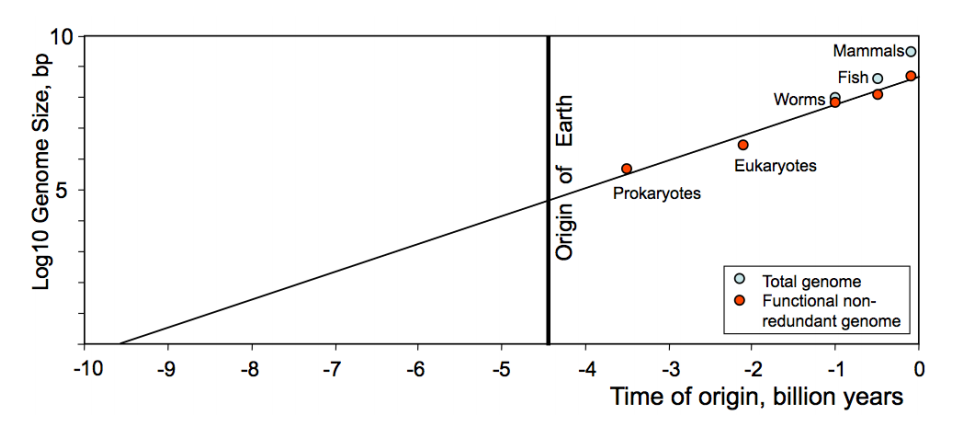
DoctorBit writes "MIT Technology Review is running a story about an arXiv paper in which geneticists Alexei A. Sharov and Richard Gordon propose that life as we know it originated 9.7 billion years ago. The researchers estimated the genetic complexity of phyla in the paleontological record by counting the number of non-redundant functional nucleotides in typical genomes of modern day descendants of each phylum. When plotting genetic complexity against time, the researchers found that genetic complexity increases exponentially, just as with Moore's law, but with a doubling rate of about once every 376 million years. Extrapolating backwards, the researchers estimate that life began about 4 billion years after the universe formed and evolved the first bacteria just before the Earth was formed. One might image that the supernova debris that formed the early solar system could have included bacteria-bearing chunks of rock from doomed planets circling supernova progenitor stars. If true, this retro-prediction has some interesting consequences in partly resolving the Fermi Paradox. Another interesting consequence for those attempting to recreate life's origins in a lab: bacteria may have evolved under conditions very different from those on earth."
So, bacteria came for space, but that doesn't mean God didn't create life before the Earth was formed.
A single base pair is not alive, not even in a primitive way. The extrapolation is invalid. A more interesting statement would be the minimum complexity of the first living things 3.5-4.0 billion years ago.
This is a fine example of how not to use arXiv as a news source. This old yarn has been trotted out before, and it is based on bad assumptions about complexity and offers a handy False Dilemma Fallacy.
Either
1+1=6 or
1+1=8.
1+1=6 is disproved, so 1+1 =8!
Or your math is wrong.
Complexity != genome size.
See c-value enigma.
Earth 1.0 could have been teaming with life before it was struck by a Mars sized object, creating Earth 2.0 (current version) and our moon.
All we have is a few samples if the first crystals formed after the completely liquid rock Earth 2.0 started cooling down, a few hundred thousand years after the big collision.
As far as we know, life on Earth 1.0 survived on rocks hurled out into space to land a few million years later on Earth 2.0 when it was ready to support life again.
http://xkcd.com/605/
All of this assumes that the complexity of life, as he defines it, increases at a relatively constant rate. There is no reason that this has to be true. Environmental effects on organisms increases selective pressure and causes evolution to progress at a faster rate. Cataclysmic events happen every now and then and causes extinctions and hardship on surviving organisms. Seems pretty uneven to me...
"Here Lies Philip J. Fry, named for his uncle, to carry on his spirit"
How about a label for the supposed graph points before Prokaryotes?
Otherwise one might conclude that they are simply assuming these "precursors" in the absence of even enough evidence such that they have a name--because that's what "must" have been the case per the assumed paradigm.
~ Whence do you come, slayer of men, or where are you going, conqueror of space?
This is just talking about exponential growth rates and using that to estimate the start of life. Apparently, the editors of /. can't understand exponential growth without thinking of Moore's law.
So, bacteria came for space, but that doesn't mean God didn't create life before the Earth was formed.
I can't argue that from a logical point of view. Does anyone else have a better argument?
BUT...
So, bacteria came for space, but that doesn't mean The Tooth Fairy didn't create life before the Earth was formed.
I have a Book that says that the Tooth Fairy can do ANYTHING. Those are MY beliefs.
I fight fire with fire, Troll with ...
really? exponentially?
And Fermi's paradox isn't. It's should be call Fermi's ignorance. Or Fermi's wacky assumptions.
The Kruger Dunning explains most post on
Look, we already know that genetic diversity doesn't increase at any predictable rare. For most pf life's existence on earth it was limited to anaerobic bacteria and that there was very little genetic diversity. Then the oxygen levels in the oceans and atmosphere reached saturation levels and aerobic live took over. And with the higher complexity of possible life forms, the increase in reproductive frequency, and the over-all speedup of this rocket-fueled form of life genetic diversity exploded.
Boobies never hurt anyone. - Sherry Glaser.
"SARS and the Origin of Life"
"Horny Rabbits and the Origin of Life"
"Rice on a chess board and the Origin of Life"
PROTIP: Just because there is exponential growth doesn't mean a subject has anything to do with Moore's "Law".
Uhmmm.... "life as we know it" happens to be limited to life that originated on Earth. Earth isn't 9.7 billion years old. I trust you can see the problem with this notion.
Certainly the possibility exists that life on earth actually originated elsewhere and happened to land here after the earth was formed, this is far from an actual testable scientific theory until at least we find any evidence of life outside of this planet that we can verifiable say did not come from here.
File under 'M' for 'Manic ranting'
The assumptions in the article are especially suspect, given the large number of quite well documented "explosions" of genetic diversity in Earth's history (see, e.g., the Cambrian Explosion for the biggest example, though there are plenty of lesser events), where gigantic leaps in genetic diversity appeared over (geologically) short timescales. An extrapolation assuming a generally smooth growth rate is simply untenable.
The summary proposes that the timescale for life in other parts of the universe is about the same as it is here.
(On an age of the universe time scale.)
If you look at how much we have advanced in the last 100k years. and guess were we might be if we survive for the next 100k.
That's quite a difference in capability, but not much in terms of age of the universe.
If some aliens showed you that were only a miniscule 100K years ahead, we probably wouldn't notice unless they wished it so.
Nor is a single transistor a computer, but the first one had to happen someplace. Nor does your statement negate the Fermi Paradox resolution as implied, which is "it takes this long for life to evolve so that's why there aren't galaxy-wide advanced civilizations."
As anyone who is familiar with interpolation knows, extrapolation is a very risky business that provides little statistical confidence and error bounds in the prediction.
Of course, that doesn't prevents some from trying to use it to win the lottery anyway. Sure you get a prediction, but there is virtually no way to assign useful error bounds to the prediction.
what could possibly go wrong, particularly when you extrapolate twice as far as you actually have data for.
What I'm interested in is how MIT came to be in possession of a Cornell paper. Were they strictly authorized to use the paper in such a manner? Did they actually use their proper login credientials? Did they tell Cornell in advance of the fact they wished to cross state lines with it? If the answer to any of the above is "no" can we hound them to death about it like they did to Swartz?
Just because you're paranoid doesn't mean they aren't out to get you
... Cataclysmic events happen every now and then and causes extinctions and hardship on surviving organisms
Indeed, it appears that periodic cataclysmic events are required in order to keep evolution going.
We've seen several eras in Earth's history where life appears to "stagnate" at some level, proceeding with little-or-no change for long periods. The last of which was the "age of dinosaurs", which lasted 170 million years or so, depending on how you define the starting point. It ended with the Chicxulub impact.
We also see numerous examples of species which are largely unevolved; for example, ants have been around for 120 million years and one species of prehistoric ant is apparently still living in the Amazon. Coelacanths have been around in their present form for about 400 million years.
The overall impression is that life tends to "stagnate": once life evolves into an efficient survival mechanism, there's no pressure to evolve further. Evolution aims at being a better "fit" for the unchanging environment, but more complexity is simply not needed.
This is why I believe the Drake equation is overly optimistic. I think it omits the factor "fraction of star systems that experience occasional planetary meteor strikes". If we ever travel to another star, we're likely to find it teeming with life, but stagnated at some level.
This may be one factor (of possibly several) that explains the Fermi paradox.
The "doubling rate" identified in the article may be an artifact of Earth, and that's only if Genome complexity is even a reasonable measure to make. Lilies have 30x the genome size of humans - another explanation might be that genome complexity is related to genome size, which does not have much selection pressure. It's not a peer-reviewed paper.
This is clearly a solid comparison since I found a related correlation between Moore's law and humanity. Having met humanity, I can definitively say that the software doesn't take full advantage of the hardware's advances.
...another explanation might be that genome complexity is related to genome size, which does not have much selection pressure. It's not a peer-reviewed paper.
To be clear, I mean to say "genome size is not related to species complexity". Genomic data may be complex simply because it's large and presents a large target for evolutionary change, but a large genome doesn't necessarily result in a complex organism.
Not true. Histones, the proteins that keep DNA ordered, are some of the earliest proteins. They provide an extremely accurate clock for when species diverged.
While on a short term, a few million years, you are right when you say the rate of genetic drift is not predictable. However, over a longer period of time the rate SEEMS to be fairly consistent. That is the point of the article.
You seem to be confusing genetic diversity with Phylogenetic diversity. Phylogenetic diversity describes how genes change physical differences while genetic diversity talks about the complexity of the genes themselves.
You can have genetic diversification without the physical structure of the organism changing, especially if there are environmental restrictions.
#605, of course
The industry that has formed around highly speculative science and mysteriology is alive, well, and thriving.
This nicely explains where missing mass of the universe went - Dyson Spheres. I always thought "dark matter" suffered from Occam's Razor.
The critical "plot" in the article from which the age estimate is derived has 6 data points: "prokaryotes," "eukaryotes," "worms," "fish," and "mammals." Nowhere in the article is the selection criteria for these 6 particular categories explained. In other words, out of the hundreds of major categories of life which the authors might have chosen to plot, they arbitrarily pick 6 that vaguely fall on a log-linear line (with a bit of fudging for "functional, non-redundant genome"). Give me a big scattery cloud of hundreds of potential data points, and I can reach whatever conclusion you want with the proper selection of a half dozen.
The article really is not convincing, for several reasons:
Their graph, the one that supports the whole enchilada, has five data points. Color me unimpressed that they were able to fit a function to five data points. Furthermore, the specificity of classification even within the graph varies a lot- prokaryotes are a much broader classification than worms, fish, or mammals. Is there variance in the amount of functional base pairs within the prokaryotes? I don't know- I'm not a biologist. Their paper doesn't clarify this point at all. How do I know that they are not cherry-picking their organisms to fit an exponential curve?
They're extrapolating backwards without good justification. Even if the growth is exponential, what affects the time constant? Some organisms reproduce slower than others, which surely affects the exponential rate of growth. If bacteria existed on space-bound pieces of rock, would they be able to reproduce at the same rate as a bacterium in a pond? Surely the microbiology of the "first organism" would be very different than that of organisms many billions of years following? Would mutations occur more rapidly in space, increasing the rate at which function base pairs would grow?
They assume the origin of life had one base pair. I'm not a microbiologist- does it make sense for the DNA of the first organism to have one base pair? If the organism instead had 10 base pairs, their estimate for the origin of life is knocked forward by a billion years or so. Even without that, the error bars on their analysis are +/- 2.5 billion years, just due to statistical uncertainty.
They reference a "Another complexity measure yielded an estimate for the origin of life date about 5 to 6 billion years ago." Why are the results so different? What were the error bars on their data? They claim that those results are incompatible with an origin on Earth, but if the error bars are similar to those on their claims, then that statement doesn't hold water.
Not to mention Mars, which used to have pretty good conditions for life as well, and wasn't smacked by a Mars sized object as far as we can tell.
A transistor isn't much of a computer, but it is a switch, and three of them is a logic gate. 3 nucleotides is not a genome of a living thing. There's no point in extrapolating the length of a genome below the minimum length of a viable genome if the question you're trying to ask is "when was the first genome?" The graph shows billions of years of very short genomes starting at 9 BCE.I don't know what the minimum genome is, but I'm sure it's not 1 pair, or 3 pairs. A good guess would be the 4 BCE mark on the graph, though.
There isn't one. Physics, chemistry and engineering show that we'll never go there, and they'll never get here. Just getting a signal across the gulf of space is hard enough.
and man will never land on the moon
---Saying gnome 3 is better than windows 8 not so much a compliment as it is damning with light praise.
and wasn't smacked by a Mars sized object as far as we can tell.
The real original Mars was a lovely Volkswagen-bug-sized iron-nickel meteor shaped like a potato shaped like Tycho Brahe's nose, before that bullying big red rock glommed onto its side.
LOL, the Moon is our living room. Seriously, think it over.
Well, I guess that means we are universal excrement. That explains alot.
Actually factor of 2 is 376mln.
Yet still going from 2^1 to 2^14 which should take 5bln years but sheer numbers
of simple pairs etc. might speed it up a lot.
So are Kilby and Noyce the two competing gods in the Zorastrian religious system?
Article says predecessors may have evolved around the predecessor star to our Sun, but given the time spans involved why just our sun? If early bacteria were ejected into space by vulcanism, solar wind would accelerate them outwards to ~400km/s, or about .1% speed of light. At that speed, you could cross the galaxy in a scant 100 million years.
Depends on what happens to low-weight particles at the heliopause though, especially if they've become ionized during travel.
Touches on the tendency for systems to be inherently more complex as time goes on http://www.ted.com/talks/david_christian_big_history.html
You could argue that:
1. Sufficiently advanced = self exterminated; or
2. Sufficiently advanced = doesn't want to talk to us; or
3. Sufficiently advanced = went somewhere else and see 2 above ( so long and thanks for the fish comes to mind ;-)
For interstellar or intergalactic migration of life there should be some type of transportation that we cannot presently think of. For all practical means, propulsion based on mechanical momentum exchange is limited to a few tens of kilometers per second. This hold true even if one can unlock energy sources of nuclear fission, fusion or anti-mater. Unless we can find some king of symmetry allowing teleportation, it's gonna be each species with it's own star system.
interstellar travel at slower-than-light speed is possible with either huge slow "arks" or with either nuclear powered craft going at a few percent of light speed. Even right now we have the technology to build a fission powered robotic probe to Alpha Centauri system, for a wicked price tag of amount that we'd rather spend on war and military power projection.
There still is no evidence for evolution.
No missing link has ever been found. It is claimed that there are many missing links, but all of them are miss-classifications, extinct species, or frauds.
Comets are continually losing mass, if the universe were billions of years old they would have disappeared by now. The earths rotation is slowing down, the moon is getting farther away, saturn's rings are disappearing, jupiter is cooling, earth's magnetic field is decreasing, galaxies still have spiral arms, take these facts and rewind billions of years and you have impossible scenarios. The population curve matches a start of a few people 4 thousand years ago, about the time of the flood. The oldest coral reef is 4 thousand years old, the oldest desert is 4 thousand years old. The earth is 6 thousand years not billions of years old.
Evolution has no scientific evidence. Science only applies to things you can observe and demonstrate, evolution is not a part of science. Evolution is a belief. Evolution is entirely speculation. Even though science does disprove evolution, the tale of evolution has been repeated so many times that many people assume it is true. Some people want evolution to be true so they won't have to be accountable to a righteous God. The Bible documents the creation. It is the final authority.
4000 transistors per IC in 1975, 2000 in 1973...
The integrated circuit was invented in 1951.
I'm sure this is scientifically sound.
There isn't one. Physics, chemistry and engineering show that we'll never go there, and they'll never get here. Just getting a signal across the gulf of space is hard enough.
and man will never land on the moon
No offence, but the argument that, because some things in the past have been perceived as impossible but were achieved, so therefore anything is possible, is just magical thinking.
Will we ever travel faster than light and solve time travel? Discover a free infinite energy source? Be able to reanimate long dead historical figures? Prove the existence of gods?
To have a right to do a thing is not at all the same as to be right in doing it
Having read the article partially (it was just too shitty to read all the way through) I have to ask, are the authors really geneticists? For example, they claim that very early life must have evolved very slowly because DNA/RNA replication wasn't so accurate. What a bunch of bullshit. The effect of inaccurate replication would be hugely accelerated change rate..
A viroid comes in at around 0.3Kb, a mycoplasma, which is one of the smallest free-living genomic systems comes in around 0.5*Mb. Extrapolate from viroids and we will fit nicely into the 3.5 billion year range currently representing life on earth.
http://users.rcn.com/jkimball.ma.ultranet/BiologyPages/G/GenomeSizes.html
This doesn't take into account the time that the precursors to life may have floated about the universe not evolving or doing anything, could be billions of years. I suspect near the galactic core evolution took place a lot faster where stars are a lot closer etc. I suspect the answer to Fermi's paradox is the bell curve and we are out on the galactic arm and evolved much slower. Terra is basically an outlier on that curve, most of the other intelligent life forms have destroyed each other and are now extinct. I think we are the luck ones in that case.
like Diana said I didn't know that a mom can earn $9802 in 4 weeks on the internet. did you look at this link FAB33.COM
I predict that the Fermi Paradox will be resolved not (necessarily) ten years from now, but rather about the same time that a practical nuclear fusion reactor is invented.
We may do project often, but that doesn't mean it's reliable. I recall reading in the 1960s that by projecting the speed that mankind had been able to travel from ancient times (~8 mph running) through the domestication of the horse, the invention of the automobile, the airplane, jet airplanes, and finally space travel (IIRC, the article was written around the time of Gagarin), we could predict that we would invent faster-than-light travel sometime soon. I forget what the exact predicted date was, but it is now long past. And yet we still await Zefram Cochrane.