Slashdot Mirror
Domain: askamathematician.com
Stories and comments across the archive that link to askamathematician.com.
Comments · 14
-
Re:No
In the example I gave, Alice sent a message to Bob, who passed it to Carol, who then sent it back to Alice. Alice received the message before she sent it. She sent the message, and her perception says that she did indeed receive it before she sent it.
Her perception is that the message traveled instantaneously to Bob, and was subsequently sent back in time by Carol.
Carol's perception is that the message traveled back in time from Alice to Bob, then traveled instantaneously back to Alice.
As usual with relativistic paradoxes, different observers describe the same events in a different way but confirm the same actually observable result: Alice receives the message before she sent it.
The question about why instantaneous transmission enables messages to travel back in time is described here as well.
-
Re:Yes... Vwery interesting...
There might also be strange coincidences, like a bunch of universal constants that just happen to create a stable universe instead of one that collapses or explodes before anything interesting happens. Or seemingly arbitrary rules such as a constant speed of propagation for light.
-
Re:Relativity
From the descriptions of that kind of paradox I've seen, yes, essentially. http://www.askamathematician.c...
-
Re:Inaccurate Summary
The universe probably does not have an edge, though there is no way to know for sure because the vast majority of the universe is beyond our reach, expanding away from us faster than we could get there at the speed of light.
-
Why 0/0 = 0^0 = 1 in practice
The fact remains, however, that defining 0/0 or 0^0 as 1 is useful in more cases than not 1. See the short explanation or the long explanation.
-
Re:How are they rocky?
Depends on the composition of your "rocky" planet. Fusion reagents are energy-positive up to iron. So basically, elements heavier than iron requires multiple supernovae to generate a substantial quantity. Elements lighter than iron can be released in just 1-2 supernovae.
The elements which make up most of the "rock" on our rocky planet are oxygen, silicon, calcium, iron, potassium, aluminum, and sodium. Of these, oxygen, silicon, and iron are a regular product of stellar fusion, and can be distributed from a single supernova. -
Re:Failhttp://www.askamathematician.c...
"The nearest known, reasonable, candidates for being an Earth-like planet (as of April 2013) are about 20 light years away (HD 20794 d, Gliese 581 c, and Gliese 667C c). Spotting dudes and ladies on one of these worlds requires, at minimum, a telescope array that’s at least 100 million km across. That’s an array more than half the size of Earth’s orbit. The good news is that an array like that (under absolutely ideal circumstances) isn’t that difficult to create. Setting aside that the telescopes would each need to be essentially perfect for their size (Hubble-quality), all we’d need to do is set them up in solar orbits about the size of Earth’s orbit. This is a lot easier than sending them to another planet, and about as hard as sending them to crash on the Moon."
"to get a picture of an alien that’s person-sized, standing on a world 20 light years away, so that it takes up one pixel in the image, using an exposure time of about one second, would require an array of telescopes with exposed mirrors and lenses with an area totaling more than several thousand times the Earth’s surface area and spread out over a region about the size of Earth’s orbit. This isn’t technically impossible, but it would be “expensive”, and would require substantially more materials than are likely to be reasonably found in our solar system. It probably isn’t worth it to get a blurry, tiny picture of some alien picking it’s nose 20 light years away and 20 years ago."
-
Re:Gibbs Free Energy
Where is the waste heat, or change in internal energy, in a magnifying glass system, used to focus the sun's rays to produce a concentrated, high-temperature Airy disk?
U = Q - W
The U (internal energy) of a magnifying glass does not change appreciably during use. Q is heat added to the system; it is much less than the W, or heat produced by the focused rays, which do the work of lighting a fire.
U is small, Q is small, W is large. In theory, U should be large and negative. But it's not...
http://www.askamathematician.c... says: 'A good rule of thumb for entropy is, "if you can reverse it, then the entropy is constant".'
But a zipped file has lower (information) entropy than the same file uncompressed, and the process is reversible. So that rule of thumb doesn't hold for information entropy?
The other question I have about the "ask a mathematician" response is: it assumes the energy input to the magnifying glass system is the temperature of the sun. That is not true: the atmosphere, at least, reduces the sun's irradiance. The input to the system should be the temperature on the sun's side of the glass, which can be less than zero since you can light fires on cold or windy days when the sun is out.
-
Re:Sure
I am willing to believe in this so called "gravity" when it can be succesfully modelled over a long period for more than 2 bodies, until then I will continue to believe in the firm hand of the FSM. http://www.askamathematician.com/2011/10/q-what-is-the-three-body-problem/
-
Re:massless photons vs black hole
Wow! Linking to a slashdot comment to prove a point? What? Is Wikipedia too good for you?
Photons have no "rest mass".
But as every photon is moving it has 'kinetic' mass, h*v / (c^2).Also, the slashdot comment indicates 'kinetic mass', but doesn't survive a unit check... Wherever this equation came from, its wrong.
Here are some resources for you:
http://www.askamathematician.com/2010/09/q-how-can-photons-have-energy-and-momentum-but-no-mass/
http://pveducation.org/pvcdrom/properties-of-sunlight/energy-of-photon
http://web.utk.edu/~cnattras/Phys250Fall2012/modules/module%201/photons.htm
http://math.ucr.edu/home/baez/physics/ParticleAndNuclear/photon_mass.html -
Re: The summary
In Coursera's recent "Exploring Quantum Physics" class, Ian Applebaum talked about spin. If electrons spin like tops spin, you can calculate the minimum speed it must be spinning from the electron's charge, size, and magnetic field. The problem is that the minimum speed exceeds the speed of light.
-
Re:Might be fast but
It's perfectly obvious that this is true. However, it actually isn't true at all.
Relativity is a mind fuck.
Maybe I'm punting the brain fuck, but this makes time a weakly-ordered sequence. For instance, a 100ms ping means that "now" lasts 100ms. If I get an answer after 50ms, we say that it has travelled back in time.
Or maybe it's the theory of relativity that says that, in the same way that a binomial equation might have a negative impossible solution. Now is that theory valid outside its scope? Was Newton's?
If we manage to get 10c FTL, then our definition of "now" will become 10x shorter and nothing more will come off it. If we manage to get -1c FTL, our definition of "now" becomes a recursive "always" and we'll get some Steins;Gate snafu.
tl;dr
Instantaneous communication can means different things because "now" has a duration. For your martian pal, "now" means 10 minutes ago, but "now" also means 10 minutes in the future. You can play games with those extremes.
-
Re:Might be fast but
While you might contemplate that something can be sent with a nearly infinite speed, no speed will be so great that the time since transmission is a negative number.
It's perfectly obvious that this is true. However, it actually isn't true at all.
Relativity is a mind fuck.
-
Nice and all
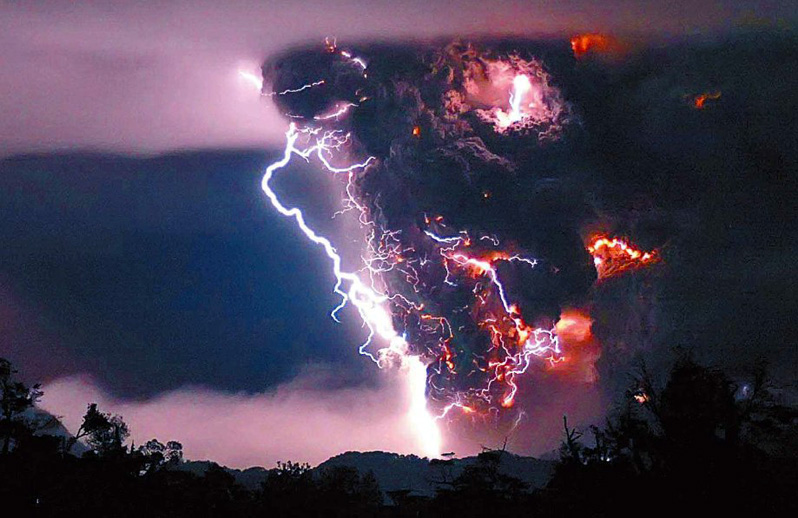
But I think for sheer apocalyptitude it doesn't beat the fire and lightning volcanic ash cloud