Slashdot Mirror
Domain: autospies.com
Stories and comments across the archive that link to autospies.com.
Comments · 12
-
Re:Tech Companies have become warring fiefdoms
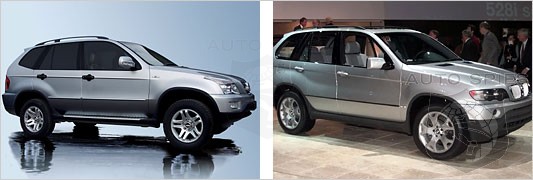
until you go round the back you would swear that their BMW X5 clone was actually a BMW X5. In 2008, BMW actually lost a court case against the company that built the clone (believe it or not, that is the CLONE on the left, built by Shuanghuan and dubbed the "CEO", revealed in a side by side comparison against the BMW stand at the 2007 Frankfurt Motor Show!) simply on the grounds that the company used a Mazda chassis and sidestep! Their "Genesis" model (from 2006?) uses their own chassis with coachwork reminiscent of the S Class (right down to the grille).
-
Re:No, but stoners THINK it doesMarijuana AND Driving, Not SO Bad After All?
On the heels of a Ben Gurion University study showing that drivers under the influence of marijuana are less dangerous than drunk drivers, comes yet another study indicating that driving stoned might not be quite as bad as some think. Published in the Journal of Psychoactive Drugs, the Hartford Hospital/University of Iowa study titled “Sex differences in the effects of marijuana on simulated driving performance,” concludes that:
Under the influence of marijuana, participants decreased their speed and failed to show expected practice effects during a distracted drive. No differences were found during the baseline driving segment or collision avoidance scenarios. No differences attributable to sex were observed. This study enhances the current literature by identifying distracted driving and the integration of prior experience as particularly problematic under the influence of marijuana....
There was also an interesting experiment in the UK on Top Gear where they had similiar findings.
-
Re:Not the first air powered car!
Anyone who's seen the sort of crazy stuff cutting edge RC hobbyists are doing with rapid charging/discharging li-ion packs knows that these things can take some serious abuse!
That's for their hobby though - an actual EV/Hybrid battery is big enough that economics take over; you can't abuse the battery and just eat the shortened life.
Ironically, one of the best buffers could be used EV battery packs, bought on the cheap because of their reduced capacity, and strung together.
Interesting.
Assumptions:
EV battery, new 53kwh (Using the Roadster as a model): Cost isn't good at $36k, but I've said 'there's nothing wrong with EVs that a battery that lasts twice as long for half the price wouldn't fix'. So let's say that 'futuretech' and economy of scale has reduced the price to $9k.
Recycle value: 50%; Most car batteries are retired at 80% capacity(42 kwh).
Power: 'Demand' is 20c/kwh. 'time of use' is 40c/kwh peak, 10c for lowest demand load balancing.
Statistics: Average power usage per household is ~1k kwh/month. Average car miles 12k. Average of
Charge efficiency: 90%At 20 cents a kwh(expensive, but green!) you're looking at $1333/year(it'd be $1200, but charging isn't 100% efficient) for your fuel bill(2 vehicles, 12k miles each). Compare this to an estimated $3,200/year for 30 mpg gasoline vehicles @$4/gallon. Savings: $1.9k/year. Not bad. If my thus far theoretical $9k battery lasts 5 years, its' worth it. Minus the battery, electric cars are as cheap/cheaper than an equivalent gasoline burner, and will probably last longer.
If you're charging overnight, every night, on average you'll need to transfer 18 kwh to recharge from the average 66 miles driven that day(actual results WILL vary, these are household averages!). At 240V, that's 75 Amp-Hours needed. If we figure you need to do that in 5 hours(remember load balancing), that's 15A.
On to the battery at home:
Let's say that you drive DOUBLE the average(IE it's a good case). You'd need 30A for 5 hours to, or 15 for 10, and the power company isn't happy about it. You'd like to save more money as well. You use an average of 36kwh a night charging your cars.You buy a used 42kwh 80% battery for $7.2k and install it. Let's say the fancier system raises the total cost to $10k*. However, you sign up for the time of use charge system and thus, if you can shape your electricity use well enough they only charge you 10c/kwh. If all electricity for charging the car goes through it, it should drop your bill from $2666 to $1480($1333*2/(2*.9)). Remember the extra efficiency loss! Save $1.2k/year. Little over a 10 year payoff. At this point, not worth it.
However, odds are that not ALL of the charge for your cars will come from the battery(saving some of that
Conclusion: If we can get the batteries and other components cheap enough, it's certainly an interesting option.
*IE it switches to battery when the power company sends the 'time of use' cost of electricity above 20c/kwh.
-
Re:Use a Lupo engine
Please Google for at least two seconds before assuming something is obvious.
Mythbusters actually tested this, instead of just guessing at a result like you did. For some pollutants, the ratios were eight to eighty times as much between cars and motorcycles. That easily cancels out the fuel consumption difference.
One link (you can find others): http://www.autospies.com/news/MythBusters-Episode-Reveals-The-Dirty-Secrets-About-Motorcycle-Pollution-67013/
-
Re:55 miles is pretty good, and not the point
Yeah, okay. The Tesla would be horrible if you're going to do a road trip in excess of its range. You're right, Tesla has no defense for that.
The thing is, you just don't need that sort of range for everyday use. According to the Bureau of Transportation Statistics, the average American travels only 29 miles a day. Even at the 55 mile range, that's almost twice as much as is needed.
One of my good friends (and a lot of his friends) are really, really into cars. He's barely 30 and he's been through almost 20 cars - buying, building, rebuilding, tuning, trading, etc. At any one point, he has always owned two cars. No racer or car enthusiast worth their salt would take a drift car, rally car, or racing car out on the street for every day use. Hell, on a drift car alone, you have (expensive) custom suspension work, high quality tires, and perhaps even a custom ECU. Right now, my buddy owns a Skyline R32 and a '86 Corolla. The R32 is on the road maybe an hour a week at most. The '86 is his Daily (the term they use for their everyday use cars).
Would it be a good idea to take a Viper or a Ferrari grocery shopping? Come on now.
Electric cars will not be the be-all, end-all for at least 10 years. However, they will make fantastic daily cars. If you want to take a long-term trip, then you could rent or borrow a regular gasoline-powered vehicle. Actually, that might not even be necessary, considering a study shows that the average American household owns 2.28 cars. You could very easily have one electric and one gasoline car and you'd still be doing a lot to help the environment.
How many road trips or long car drives have involved both cars the average family owns? Typically they'd take the minivan or van or what have you for maximum passenger capacity and cargo storage. Ditto on grocery shopping.
If Tesla had the money to advertise, I think perhaps they should go with an appeal to the facts. After all I've said here, can anyone give me a good reason why owning an electric car with at least a 50 mile range on a day's charge would be a bad idea?
-
Re:...but Life Expectancy is better in UK
Actually, it's more of the dangers of the lifestyle in general. More people are killed from more reckless behavior in the US then in the UK. We do more stupid shit on a regular basis like give some types of guns to anyone over 18 based on nothing more then their desire to have them. We allow juveniles to handle loaded firearms and other weapons (Bow and Arrows) unsupervised for extended lengths of time (while hunting) and so on. We have one of the largest recreational boating populations in the western world, some of the largest lands allotted to motorcycle, quad-atv, and other recreational uses.
But probably the number one risk that would alter the life expectancy quite a bit would be cars. In the US, there is/was about 2.28 cars per household (in 2008) while only about 1.1 cars per household in the UK (at about the time- from 2008 to 2009). This means that more people are driving in the US then in the UK. Gas is also cheaper which generally means that more people are driving for recreational uses verses more restrictive usage like necessities and so on. But something that probably would make this skewed even more would be that in the UK, you typically have to be 17 to get a drivers license and even then, you are restricted to what types of cars you can drive until your 18 or 21. In the US, it differs from state to state, but in most cases, you can start driving at 16 years of age, there is no limits on the types of cars (or non-commercial trucks) and in some areas, with certain hardships you can get a drivers license at age 14 (Ohio is one).
A reflection of this is strongly shown in the UK traffic death statistics in which they listed that in 2006, there were 5.4 road accident deaths per 100,000 population in the UK compared to 14.3 per 100,000 populations in the US. I don't car where you are, if you have almost three times as many people dieing from more or less random occurrences, the life expectancy will be lower and it won't be much on the grounds of health care provided Health care provided is equal in traffic fatalities because it's all either not in the equation (dead on the scene) or life threatening injuries in which not only does car insurance cover, it's illegal in the US for a hospital open to the public to refuse or limit emergency medical treatment based around the ability to pay.
-
Re:Well.....
I guess that's why all those taxi drivers in Vancouver have swapped out to Priuses (my last visit, I swear I didn't see a single non-Prius taxi).
http://www.autospies.com/news/Prius-taxi-paid-for-itself-in-no-time-17638/
I think you might be overestimating the traction battery issue.
Or maybe it is me living in denial about our 7-year old 120,000 km Prius being about to fall apart.
-
Re:Build it... and they will come.
I'm undoing some moderation, but whatever.
This is the freedom that people have with gasoline cars today and it is nothing more than delusion to expect that, on a large scale, people would ever willingly give that up.
But I think it's also crazy to say that electric vehicles becoming popular means that we are give that up. How many households with two vehicles can you think of? Granted, there are plenty with only one (including myself; I live alone), but at the same time, according to this, the most common number of cars to have is three, and 2/3 of the US has either two or three vehicles.
That site puts the average number of cars per household at 2.28 (this may exclude households that have none); this 2001 DOT study puts the average number at 1.9. According to it, the average number of cars in households with only two people is still 2.0.
Does every one of those cars have to have the freedom to take substantial road trips? No way. Probably a majority of 2-car households could change one for an electric and basically never notice that they can't take long road trips using both cars at the same time. One electric car for going around town and one gas car for long distances would probably cover the usage needs of 2/3 of 2-car families. And that's not even considering ones with more cars. The only thing that gives me pause there is families with, say, a pickup truck for hauling around town and a standard sedan for longer trips -- neither of those roles would be easily taken by an electric vehicle.
-
Re:Beauty of Capitalism
the Toyota Prius is hardly fundamental research or cutting-edge technology. however, the Japanese government did invest in Toyota's hybrid gas-electric technology, purportedly subsidizing 100% of its development cost.
so while there's no Toyota Government Agency, Japan does however have:
- MEXT (the Ministry of Education, Culture, Sports, Science and Technology)
- METI (the Ministry of Economy, Trade and Industry)
and their government actively funds science and public research through these organizations. the Japanese government also owns a large (1/3rd) share of their national ISP/telecom, NTT (Nippon Telegraph and Telephone). and this kind of active support and funding of technology is why Japan has become a global technology leader. it's also why Japan is leading the world in FttH deployment and its citizens have access to 1 Gbps symmetric broadband connections for $0.057 per Mbps, whereas Comcast is charging $3.00 per Mbps for asymmetric "wideband" connections.
-
Re:Hard Numbers
Why just five years? The average life of a car is around 9 years now.
http://www.autospies.com/news/Can-You-Guess-the-Average-Life-Of-Vehicle-12646/
I thought they usually ran longer than that, but there it is.
-
Re:WTF
Apparently, Bill has a soft spot for exotic Porsches.
-
Re:The robot
A robot running a Microsoft OS? Is that safe?
It's not safe in cars iDrive uses Win CE.
a self-charging robot...
AIBOs do this now. It's smart enough to read its battery level, walk to the charger and put itself on the charger.