Slashdot Mirror
Domain: azom.com
Stories and comments across the archive that link to azom.com.
Comments · 22
-
Re:Rip VanWinkle called
Now where's the transparent aluminum I was promised? Hello Computer!
-
Synergies with printable technologies
It is possible to print solar cells, electronic circuits, capacitors, batteries, and antennas on flat flexible sheets. It seems to me that if you combined those technologies with this you'd be able to make completely functional robots.
-
Re:And this couldn't be done with copper because
...
Just wondering why superconductors suddenly make this feasable. 20 square miles just doesn't resolve to a very big number when looking at the length of the wire.
"The HTS cable system installed in LIPA’s power grid contains hair-thin, ribbon-shaped HTS wires that conduct 150 times the electricity of similar sized copper wires. This power density advantage enables transmission-voltage HTS cables to utilize far less wire and yet conduct up to five times more power – in a smaller right of way – than traditional copper-based cables."
quoted from this article
-
That's an incredibly good dielectric plastic
Back to basics. A capacitor is an insulator between two conductors. The key concept here is that their insulator has an insanely high breakdown voltage, which is why they can supposedly make an ultracapacitor that operates around 500V instead of the usual 5V or so.
The patent says "The alumina-coated calcined CMBT powder and the poly(ethylene terephthalate) plastic have exceptional high-voltage breakdown and when used as a composite with the plastic as the matrix the average voltage breakdown was 5.57 * 10^6 V/cm or higher. The voltage breakdown of the poly(ethylene terephthalate) plastic is 580 V/micrometer at 23 degrees C. and the voltage breakdown of the alumina-coated CMBT powders is 610 V/micrometer at 85 degrees C."
Note how many different units they use. Conventionally, dielectric strength is quoted as KV/mm. So we have
- Their new composite: 5.57 * 10^6 V/cm = 5.57 * 10 ^ 3 KV/cm = 5.57 * 10 ^ 2 KV/mm = 557 KV/mm
- PET: 580 V/micrometer = 580 KV/mm
- Alumina-coated CMBT powders: 610 V/micrometer = 610 KV/mm
First, why did they make a composite that's worse than either of its components? This would be obvious if they used the same units for all their breakdown voltages in the patent.
Second, those are unreasonably good numbers. The usual breakdown voltage for PET as used in Mylar capacitors is only 17 KV/mm. Why is their PET 35 times as good as everybody else's?
(Check this, please. Look at the actual patent image. The searchable text version at the USPTO doesn't show math symbols very well.)
-
Re:Transmission?The raft wont be floating freely, it will be anchored to a specific spot
Thanks.
I found a better article that explains the concept with better pictures.
-
Re:Mistake in Article?
Pure aluminum is soft, aircraft grade aluminum (and virtually all aluminum used in the real world) is alloyed with other elements, greatly increasing its strength.
Here's a breakdown of the composition of Aluminum Alloy 6061 to give you an idea... -
Re:Wasn't that the whole point
Hydrazine has an auto ignition temperature "on iron rust surface" of 24 deg C. My suspicion(well it's not really a suspicion because IAARS) is that they probably didn't use steel. Maybe something like titanium which melts closer to 1700 deg C. You also forget that you can put a paper cup full of water next to a fire and it won't burn till the water boils off. Anyway, fuel tanks surviving are a real problem when things reenter.
-
Re:Ok, someone explain it to me
Actually, carbon nanotubes ("buckytubes") are quite good conductors of electricity.
So that problem's solved...leaving only the original problem of manufacturing enough defect-free tubes in enough industrially-significant quantities to make the skyhook in the first place... -
Re:E=m.c^2
I didn't make it clear that my comment was in the context of counting atoms as a mass standard, not in relation to the fifty microgram change in the current kilogram. For example, take the mass of "n" isolated silicon atoms. Now form chemical bonds between them. How much energy is in those bonds, and what is the mass equivalent of that energy? Is it comparable to the precision of the standard? If so it will have to be accounted for.
The latent heat of vapourisation of Si is 13700J/g
Thus at a rough guess the energy in the bonds for 1kg of solid Si is 13.7MJ
Now m = E/c^2 = 13.7MJ/(3*10^8m/s)^2 = 1.52*10^-10kg. = 0.15ug.
So the mass equivalent of the bonds in 1kg of Si around 0.15ug.
It seems reasonable that a kilogram could be measured with a precision of ten decimal places, so in the worst case of no bonds vs. bonds the energy of the bonds would seem to be significant in a mass definition. In practise it might be a more subtle rearrangement of the bonds, with a lower energy differential, but for high precision comparisons it might still be a significant contributor to the the mass of 1kg of silicon. -
Re:They wont like this...
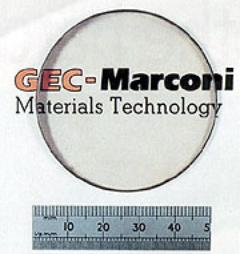
There are basically two types of diamond generating processes. The GE process from the 1960's, and variations of that process using high pressure and high temperature, and Chemical Vapor Deposition. CVD is different. It's low pressure and basically builds diamond as if you were making frost (hot carbon rich gas or plasma condenses on a cold substrate). With CVD you can grow REALLY BIG (really big meaning relative to typical gem sizes) diamond windows and wafers. Indeed, here's a 50 mm white diamond wafer:
http://www.azom.com/work/8EKVsENqBEG491jQw24l_file s/image004.jpg
That impresses me.
--
BMO -
Re:Solar Future
Your information is way out of date (if it ever was true). PV is relatively clean and cost effective now, and per unit these advantages will only improve with increasing volume. We just don't need centralized nukes in the next few decades, propping up a nuclear industry with a history of lies, murder (Silkwood), and pollution, built on government subsidies for R&D and insurance, and initmately associated with WMD production.
On scalability, PV solar systems work well especially when integrated with a system that gets some of its energy during cloudy or nighttime from cogeneration, which could be fueled using hydrogen made elsewhere by solar panels, or by biodiesel fuelds derived from farms, or from synthetic carbon based fuels (like synthetic propane) created from power from solar panels deployed in equatorial areas or the ocean. To see such an solar and cogeneration system working cost effectively in a major northern city, consider:
http://www.cmhc-schl.gc.ca/popup/hhtoronto/works.h tm
"What is truly amazing is that CMHC's Healthy House in Toronto provides all the comforts of home - without using municipal services. It has been designed to rely on sun and precipitation as the basis of its heating, electrical, water and waste water management systems. And right from the start, the way it is built and the materials used in construction mean more comfort, less maintenance and lower operating costs. That goes for the landscaping, too. CMHC's Healthy House in Toronto is located near public transportation, and is designed to provide maximum usable space on a minimum amount of land, to limit air and water pollution, and to use locally available materials and durable renewable resources wherever possible. It is an affordable solution to housing now that will keep on working for many years to come."
On pollution:
http://greennature.com/article641.html
"These differences, however, may not be particularly meaningful, according to Vasilis Fthenakis, a senior chemical engineer at Brookhaven National Laboratory who specializes in the potential environmental impacts of solar cells. "There are no significant environmental and safety hazards with any of [the types of solar cells] to the scale that they are manufactured today," he explains. And although there are some hazardous materials used, such as silane gas, cadmium, carbon tetrafluoride, and lead, he says, "if you look at the quantities in relation to their use in other industries, they are very, very small." But these risks will become more significant as the industry grows, he adds."
Still, the fact remains that either we clean up all manufacturing towards zero emissions, or we will be burried in waste and pollution no matter what our energy source. R&D into all forms of low pollution manufacuring in the future will benefit PV.
Overall they make sense right now compare to what we have:
http://www.azom.com/details.asp?ArticleID=1119
"An average U.S. household uses 830 kilowatt-hours of electricity per month. On average, producing 1000 kWh of electricity with solar power reduces emissions by nearly 8 pounds of sulfur dioxide, 5 pounds of nitrogen oxides, and more than 1,400 pounds of carbon dioxide. During its projected 28 years of clean energy production, a rooftop system with 2-year payback and meeting half of a household's electricity use would avoid conventional electrical plant emissions of more than half a ton of sulfur dioxide, one-third a ton of nitrogen oxides, and 100 tons of carbon dioxide. PV is clearly a wise energy investment with great environmental benefits!"
And consider innovative approaches towards lifetime recycling of PV products:
http://www.renewableenergyacc -
Old news
-
Re:New Digital Camera Lens Made of Liquid?
I stand corrected.
Thank you. -
Re:Slicon Shortage
Yes, actually. This isn't just some sand scooped off a beach. Solar panel grade silicon comes from the leftovers after semiconductor grade silicon users have picked through their crystal wafers, which is why there is a shortage in the first place, since there is a narrow range of quality ("almost" good enough for semiconductors). As for titanium, my 30 year old encyclopeda says its one of the 10 most common metals on the planet. Titanium Oxide is cheaply produced and used liberally in paint.
Titanium is malleable when hot (meaning you can flatten it into foil). So producing titanium foil is probably not a difficult task, depending on how hot "hot" is. (Though the article mentions that the titanium foil used is thinner than household aluminum foil. The process looks like it would be easy anyway, but time consuming.)
As for your post on waste products, the most common smelting procedure in use works without catalyst or flux to produce pig-iron and Titanium Oxide, though this process is common because of its use in paint. This process was recently developed for producing metallic titanium, its outputs are salt (NaCl), titanium, and whatever impurities get washed into the liquid sodium stream and removed later. -
Re:Other green energy sources
I call bullshit on this - otherwise you would never have been clueless enough to made the concrete and steel comment. Exotic, expensive, and very interesting materials are used in areas exposed to radiation. Please ask your science teacher to post here, they may say something useful.
Believe me, or don't... it doesn't matter. However, you may be interested in the following web pages, which will tell you a little bit more about the materials used in nuclear reactors. By and large, fairly common steels and concretes are used. The "exotic" materials are generally found in fuel (uranium, gadolinium, erbium), control rods (boron carbide, silver, indium, cadmium, hafnium), and detectors (too many to list here).
- http://www.world-nuclear.org/info/inf32.htm
- http://www.nucleartourist.com/areas/cntm-ovu.htm
- http://www.azom.com/details.asp?ArticleID=2139#_M
a terials_For_Light
Anything else?
-
Your data is WAY out of date
Odum's "ENVIRONMENTAL ACCOUNTING" is out of date (1995), if it took him 2-3 years to write, his numbers have come from older published works, which themselves old by publication, would make the data from the mid-80s. Also, he gets only 9 periodical references in the last 15 years on Compendex & Nexus Lexus Environmental. Vaclav Smil gets only 3. BOTH HAVE ZERO PUBLICATIONS on photovoltaics or solar energy, let alone PV EROEI. They do not appear to be experts in this area AT ALL. They themselves have never done an indepth study of solar EROEI, or it would be published (they are siteing others work that is very out of date, read references please!).His 'worse case' scenarios are always current technology - and even his base cases are a *lot* more optimistic than his worse case scenarios.
The PV market is expanding at 45% per year, the technology at least as fast. If you publish a study, and you see what is being done, and phased out, versus and what is being done on pilot plants and will hit commericalization in 1-2 years, which would you pick as your base case? If you pick the former you study is out of date by publication time. Remember that study was published in '96, the data was coming from 94-95, we are now in 2004. The decade has been good to PV. Read his more current stuff if you are interested.Alsema (Professor in the Dept. of science technology and society at Utrecht University, Naterlands) has 13 peer reviewed papers published on PV all relating in some way to EROEI or environmental impact. In his most recent publication (2004) in Refocus he says:
"Recent studies give the impression of photovoltaics having considerable environmental impact. Looking closer at the data however, it is clear that these studies are based on photovoltaic systems of the late eighties, with only minor recalculations. Since the photovoltaic market has increased rapidly, a lot of progress has been made regarding the environmental profile of photovoltaics." He goes on to show, for example how current production ribbon silicon panels have a payback period of 1.2 years (and that is silicon, not even thin flims like CIS).I favor Odum's numbers (from 'Environmental Accounting'), which include...
Read Alsemas numbers, he does too. He breaks it down for you though. Thin films have a EPBP of ~.5 (~60 EROEI @30 years) for frameless panels such as these roof shingles. With poles, mounts, concrete, yada, yada the EPBP is 1-2 years (or a 15-30 year EROEI).If you don't like Alsema cause he blows your outdated arguement read Kato. Kato (prof. Japan agriculture university) has 25 publication all dealing with photovoltaics. He has several publications dealing with EROEI.
Or read this (note this is dated and the 2 and 1 modules are already on the market).
-
Confirmation?
I can't find anything about this in the main stream media, the only story Google News finds (at least at the moment) is this which is talking about NASA and a recent on-the-ground test deployment.
Anyone actually got any more hard facts about this one?
Al. -
Re:This is *great* news!Um, Tantalum and Africa (The Congo, specifically). Tantalum is critical for miniaturization, since it creates a higher-efficiency capacitor than ceramics, so we're using a lot for cell phones and other microcircuitry. Here's a couple docs on Tantalum:
http://www.agitprop.org.au/nowar/20031023_ww_cong
o _africa_imperialism.htmhttp://www.azom.com/details.asp?ArticleID=1715
I don't know a lot about Tantalum, but mention it as an example because it's entirely plausible that we'll repeatedly run into some substance that comes cheaply from a foreign land, and which we've got a voracious demand for. I like your argument mostly (it was an intriguing twist), but it oversimplifies when you start implying we'll always be able to find alternatives. Oil's maybe another good example. We're not apparently going to find sufficient oil reserves here in the US. Even if we do, we'll still exceed demand eventually. In a parallel with your fiber optic example, we'll be forced to shift to alternatives, eventually. And there are some global economic powers who will ALWAYS be forced to import stuff. Japan, for example.
Oh, and a key disincentive to wars is loss of life. If cheap machines do the ugly work, maybe we'll accept the conquer-n-pillage (a.k.a. Borg) way of expansion as cheaper than buying the needed stuff. The human costs and the robotics costs keep us noble now, but would we be so noble if extraction via war was a fraction of the cost of buying the goods?
-
Rapid prototyping
-
a cunning plan..
..what if they could combine superconducting motors and hydrogen fuel cells to make some kind of superefficient tank thingy?
Use the liquid H to cool the motors AND generate the electricity needed to run them... -
Re:Acid Rain and Stupid People Like the Author of.
You could reasonably call me a green (I hope to be doing my graduate study next year developing neural-network style electrical micro-grids to integrate renewable wind, solar, and biomass power with large-scale power plants) and yes, I do believe in global warming. At least, I'd rather spend more and end up with "overly clean" air/water than guess wrong and be fsked and be unable to go outside (a la Jetsons). That all said, nuclear is pretty decent. Small, safe, reactors can work great, and the key thing is the localization of waste as the parent mentioned. Even though nuclear waste is really nasty, it is (compared to smoke) really easy to keep track of.
The parent was a bit off on the viability of wind and solar however. The chemical waste associated with photovoltaics is in the form of solvants used in manufacturing and isn't all that bad. Not perfect, but we're not dumping tons of waste into rivers to make PV cells. If you live in an area with decent sun, a household solar array can repay its cost by reduced electric bills in about 7 years. After that, electricity IS free.
-
Energy storage/regulation applications..
Perhaps, after the recent power outages in the US, the most important application of supercoducting magnets could be power storage. There seem to be 2 ways they are used - either to make friction-free magnetic bearings for traditional flywheel systems, or (more interesting) direct short-term storage of power. For situations where you need to temporarily store a *lot* of power this is an interesting technology alternative to batteries/hydro/etc.. Current devices seem to cover mainly very short term variations, but what about covering longer term regulation (hours/days) of variable power from a wind-farm, or solar, for example?
Anyone got more gen on this?
Try Superconducting Magnetic Energy Storage (SMES) Systems
This link describes a commercial device that stores 3 megawatt-seconds..