Slashdot Mirror
Domain: brouhaha.com
Stories and comments across the archive that link to brouhaha.com.
Comments · 81
-
Re:There are 250 Million blank CDRs250 million seems awfully low to me.
Perhaps that's only in Germany or Europe?
Perhaps that's only Audio CD-Rs?
Yes, there are Audio CD-Rs and Data CD-Rs. Audio ones cost a lot more, because they have a bit set that lets them work in non-computer burners. (also, part of their cost goes to the recording industry, part of the DAT TAX.) (Yes, I'm being US-Specific here.)
Every time I see somebody buying Audio CD-Rs, I ask them if they're going to burn them with a computer or a stereo component. They always say computer, and then I tell them to go buy the cheaper data CD-Rs, because they'll work too. And they usually thank me
In any event, assuming that every blank CD created is used to pirate their music is incredibly incorrect. 1) in the US, we can make copies of music that we have purchased, for our own use 2) people do record computer files on these as well and 3) people also record music that they've made on them. Some small bands even sell CD-Rs with their own music on them (it costs a lot of money to make CDs `professionally'.) (These people have had problems with selling them on Ebay, however -- Ebay assumes that if it's a CD-R, it must be pirated.)
-
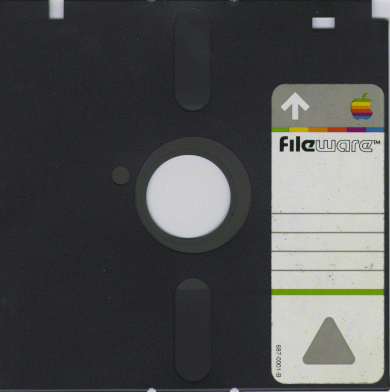
Where's the Twiggy support?
Supposing I want to get those direly important files off my Apple Lisa 1's Twiggy disks!
I mean, with just a little hardware hacking, I can get at the files on my ProFile hard drive, but how am I to read from the two-windowed Twiggy floppies?
-
Where's the Twiggy support?
Supposing I want to get those direly important files off my Apple Lisa 1's Twiggy disks!
I mean, with just a little hardware hacking, I can get at the files on my ProFile hard drive, but how am I to read from the two-windowed Twiggy floppies?
-
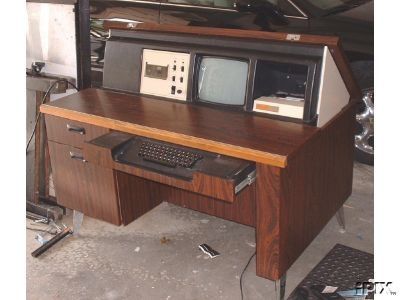
Microcomputers have been in desks since 1976!
For example, the Noval 760, a Z-80 system with monitor, tape drive, and printer, built into a desk. The peripherals are in a hinged portion so they can be kept out of the way when you're not computing. The Noval was reviewed in Byte magazine in 1977.
-
Some Sony player can be modified
Some sony players can be flased with a modified firmware that disables region coding and the UOPs.
Here is a page with a patch for the firmware of the Sony DVP-S7000 DVD Player. -
Re:Simple Virus Protection Schemes
I believe the correct terminology is "reverse defenestration", which as far as I know was coined by the beautiful people at brouhaha.com (though they are just as likely to credit someone else, instead).
-
Re:Their future
Because it's just like making copies for friends and family. It's fair use. No it damn well isn't. If I hear one more Slashdotter claim that personal/friends/family copies are "fair use", I will quite seriously bust a gut. Here are the allowable purposes for making a copy of a copyrighted work: (1) criticism and comment, (2) parody and satire, (3) scholarship and research, (4) news reporting and (5) teaching [publaw.com]. Don't argue this with me, quote a specific case of a court saying that copies for friends and family are OK.
Not to mention the technicalities (already covered by other
You see, when the RIAA was upset about Digital Audio Tapes being used to pilfer their music, they came to an agreement with the consumer electronics industry. The RIAA agreed to make noncommercial copying a non-infringing act (not exactly, but we'll get into that a bit later) in exchange for royalty payments and limits on serial copying.
Now the bit about non infringement, section 1008. You see, it wasn't actually made non-infringing explicitly, as in the original copyright law language for fair use. It, instead, says that "...no action may be brought under this [Copyright] title alleging infringement of copyright based on...the noncommercial use by a consumer...making digital music recordings...". A might bit different, and good arguing point for high paid lawyers.
Now, the arguing points. For one, Section 1001 defines a "digital audio recording device" as:
"...any machine or device of a type commonly distributed to individuals for use by individuals, whether or not included with or as part of some other machine or device, the digital recording function of which is designed or marketed for the primary purpose of, and that is capable of, making a digital audio copied recording for private use, except for--
(A) professional model products, and
(B) dictation machines, answering machines, and other audio recording equipment that is designed and marketed primarily for the creation of sound recordings resulting from the fixation of nonmusical sounds."Whether a P2P program falls under that category, I leave as an exercise to the reader, lawyers, and judges.
A more damning definition comes in subsection (4B). A digital audio recording medium..."...does not include any material object that is primarily marketed and most commonly used by consumers either for the purpose of making copies of motion pictures or other audiovisual works or for the purpose of making copies of nonmusical literary works, including computer programs or data bases." That's a tough one to argue against.
There's many other arguments that can be made both for and against Napster clones for falling under the AHRA. Napster, eveidently, failed to convince their judge of the applicability. IANAL, and therefore do not get paid to research this, so I'll leave it to interested parties to delve further.
But, to get back on point, the RIAA can't sue for noncommercial copying of analog or digital music, as defined by the AHRA. So you can add that to your list of fair use items...and have publaw.com update their section if they don't mention the AHRA.
-
Re:suprised.Are you referring to the DAT Tax that adds a tax to audio DATs and CDRs?
If so, as much as I dislike this tax, then this isn't much of an argument. Very few mp3s end up on Audio CDRs, and even fewer on Audio DATs (unfortunately, as good as DATs are, they never really took off.) Why? Because, IF it's burned onto a CD at all, it's burned to Data CDs, which have no such tax. Audio CDRs cost several times as much as Data CDRs exactly because of this tax, therefore the only people who use them are typically those who must -- those who have audio burners (NOT computers!) that require them.
I imagine that there's a few people who downloaded music with Napster and then played it via their sound card and then recorded that with an Audio CDR device, but this number is almost certainly dwarfed by those who burned it directly on their computer -- it's cheaper, uses more common hardware, and delivers better quality.
-
Resumable Pre-emtable OS callsThe ITS operating system (the world's second timesharing system, and the system for which RMS and others first developed EMACS) had a concept of state checkpoints in OS calls, called PCLSRing.
Alan Bawden wrote a paper on it, and it's quite a good read. His web site has a compressed
Under any timesharing operating system there will be occasions when a process must access the state of another process. A process may need to start, stop, debug, load, dump, create, or destroy another process. There is also one occasion when a process must access its own state: an interrupt handler needs access to the state of the running process prior to the arrival of the interrupt, so that the process may continue after the interrupt has been dealt with.
"PCLSRing" is a mechanism the ITS operating system uses to enforce a kind of modularity when a process must access the state of another process. The modularity principle is very simple: no process ever catches another process (including itself) in the act of executing a system call. System calls thus behave as if they were directly implemented in hardware. A process can no more catch another process in the middle of deleting a file than it can catch another process in the middle of a multiply instruction.
There was also a way to put the system into a PCLSR test mode that exercised all these control points within the system calls, to help debug them. See SYSDOC TEST documentation extracted from the now decomissioned AI PDP-10 that originally served it up as ftp://ftp.ai.mit.edu/pub/alan/its/sysdoc.tgz (yes, ITS was on the Arpanet and the Internet and ran TCP/IP as well).
-
What do you mean "Canadian-style"
I wonder if they'll eventually push through a Canadian-style tax on anything that can carry data.
Ever heard of the DAT Tax? In 1992, the US Congress passed a law taxing media for use in digital recorders.
The Audio Home Recording act of 1992 mandated that consumers pay a royalty on each tape sold for DAT drives.
This contributed to the death of a market for the promising technology. And assumed that everyone who owns such technology would use it for theft. I have not made any illegal copies of music or software using the CD recorder that I own. This sort of levy assumes that I will, and I don't care for that.
I remember waiting for DAT technology to catch on for music - and waiting, and waiting, and waiting..... -
What do you mean "Canadian-style"
I wonder if they'll eventually push through a Canadian-style tax on anything that can carry data.
Ever heard of the DAT Tax? In 1992, the US Congress passed a law taxing media for use in digital recorders.
The Audio Home Recording act of 1992 mandated that consumers pay a royalty on each tape sold for DAT drives.
This contributed to the death of a market for the promising technology. And assumed that everyone who owns such technology would use it for theft. I have not made any illegal copies of music or software using the CD recorder that I own. This sort of levy assumes that I will, and I don't care for that.
I remember waiting for DAT technology to catch on for music - and waiting, and waiting, and waiting..... -
Re:A noble era which passed us long ago.
I really miss the days where software development and hardware engineering was really about being clever.
And it's not even just clever in retrospect. The engineers knew that they had to be clever. Some of my favorite quotes:And in those days, many a clever programmer derived an immense satisfaction from the cunning tricks by means of which he contrived to squeeze the impossible into the constraints of the equipment.
-- Edsger W. Dijkstra, "The Humble Programmer", 1972 ACM Turing Award Lecture
Not written about software (or computers), but equally applicable:
Perfection is achieved, not when there is nothing more to add, but when there is nothing left to take away.
-- Antoine de Saint Exupery
That explains why Microsoft software (and indeed most software) will never reach perfection. It's not even their objective.
Today the art of making every byte of memory (and every gate of hardware) is nearly lost. It's still sometimes seen in very cost-sensitive embedded systems. But even there, in recent years there's been a tendency in recent years to say "screw it, let's just put in another 128K of flash memory and a faster processor."
My day job involves embedded systems with fast RISC processors and hundreds of megabytes of RAM. There are occasional challenges, and I do take pride in my work, but when there are no resource limits it's just not fundamentally that interesting.
In my spare time, I prefer to try to wring the "impossible" out of tiny microcontrollers:
- Closed-caption decoder with serial output, using only a microcontroller, comparator, and sync separator - the latest version uses a newer microcontroller with the comparator built in
- Serial video display generating video entirely in software - the only active electronic component is the microcontroller
- DES and SKIPJACK crypto routines for PIC microcontrollers - here I needed to shave every byte in order to leave the maximum resources free for the user application
To someone who doesn't understand the concept of doing the most work with the least resources, none of these projects probably seem exceptional. But they were much more satisfying to develop than anything I ever do at a day job.
In the old days, the only alternative to doing things cleverly was not to do them at all. If the engineers at Draper had been less clever in how they designed the AGC, the Apollo program might have had to be delayed by several years. The AGC is one of the finest examples of computer engineering (both hardware and software) ever. I imagine that some of the disparaging comments about how primitive it was (i.e., that it was obsolete at launch) were from people who either were trying to be funny, or have no conception of system design.
-
Re:A noble era which passed us long ago.
I really miss the days where software development and hardware engineering was really about being clever.
And it's not even just clever in retrospect. The engineers knew that they had to be clever. Some of my favorite quotes:And in those days, many a clever programmer derived an immense satisfaction from the cunning tricks by means of which he contrived to squeeze the impossible into the constraints of the equipment.
-- Edsger W. Dijkstra, "The Humble Programmer", 1972 ACM Turing Award Lecture
Not written about software (or computers), but equally applicable:
Perfection is achieved, not when there is nothing more to add, but when there is nothing left to take away.
-- Antoine de Saint Exupery
That explains why Microsoft software (and indeed most software) will never reach perfection. It's not even their objective.
Today the art of making every byte of memory (and every gate of hardware) is nearly lost. It's still sometimes seen in very cost-sensitive embedded systems. But even there, in recent years there's been a tendency in recent years to say "screw it, let's just put in another 128K of flash memory and a faster processor."
My day job involves embedded systems with fast RISC processors and hundreds of megabytes of RAM. There are occasional challenges, and I do take pride in my work, but when there are no resource limits it's just not fundamentally that interesting.
In my spare time, I prefer to try to wring the "impossible" out of tiny microcontrollers:
- Closed-caption decoder with serial output, using only a microcontroller, comparator, and sync separator - the latest version uses a newer microcontroller with the comparator built in
- Serial video display generating video entirely in software - the only active electronic component is the microcontroller
- DES and SKIPJACK crypto routines for PIC microcontrollers - here I needed to shave every byte in order to leave the maximum resources free for the user application
To someone who doesn't understand the concept of doing the most work with the least resources, none of these projects probably seem exceptional. But they were much more satisfying to develop than anything I ever do at a day job.
In the old days, the only alternative to doing things cleverly was not to do them at all. If the engineers at Draper had been less clever in how they designed the AGC, the Apollo program might have had to be delayed by several years. The AGC is one of the finest examples of computer engineering (both hardware and software) ever. I imagine that some of the disparaging comments about how primitive it was (i.e., that it was obsolete at launch) were from people who either were trying to be funny, or have no conception of system design.
-
Re:A noble era which passed us long ago.
I really miss the days where software development and hardware engineering was really about being clever.
And it's not even just clever in retrospect. The engineers knew that they had to be clever. Some of my favorite quotes:And in those days, many a clever programmer derived an immense satisfaction from the cunning tricks by means of which he contrived to squeeze the impossible into the constraints of the equipment.
-- Edsger W. Dijkstra, "The Humble Programmer", 1972 ACM Turing Award Lecture
Not written about software (or computers), but equally applicable:
Perfection is achieved, not when there is nothing more to add, but when there is nothing left to take away.
-- Antoine de Saint Exupery
That explains why Microsoft software (and indeed most software) will never reach perfection. It's not even their objective.
Today the art of making every byte of memory (and every gate of hardware) is nearly lost. It's still sometimes seen in very cost-sensitive embedded systems. But even there, in recent years there's been a tendency in recent years to say "screw it, let's just put in another 128K of flash memory and a faster processor."
My day job involves embedded systems with fast RISC processors and hundreds of megabytes of RAM. There are occasional challenges, and I do take pride in my work, but when there are no resource limits it's just not fundamentally that interesting.
In my spare time, I prefer to try to wring the "impossible" out of tiny microcontrollers:
- Closed-caption decoder with serial output, using only a microcontroller, comparator, and sync separator - the latest version uses a newer microcontroller with the comparator built in
- Serial video display generating video entirely in software - the only active electronic component is the microcontroller
- DES and SKIPJACK crypto routines for PIC microcontrollers - here I needed to shave every byte in order to leave the maximum resources free for the user application
To someone who doesn't understand the concept of doing the most work with the least resources, none of these projects probably seem exceptional. But they were much more satisfying to develop than anything I ever do at a day job.
In the old days, the only alternative to doing things cleverly was not to do them at all. If the engineers at Draper had been less clever in how they designed the AGC, the Apollo program might have had to be delayed by several years. The AGC is one of the finest examples of computer engineering (both hardware and software) ever. I imagine that some of the disparaging comments about how primitive it was (i.e., that it was obsolete at launch) were from people who either were trying to be funny, or have no conception of system design.
-
Re:what's the point?
The last PDP10 that was actually being used was removed from service 3 years ago.
False. Al Kossow and I *personally* deinstalled one last October, which had been in active use in for school district administration until September. It's currently patiently waiting for me to win the IPO lottery so I can run it again.When we unloaded the machine we were somewhat pressed for time, but Mike Cheponis managed to take a few photos.
There's apparently another 2065 still running in a school district in or around Boston.
-
Re:how fast were these things?
An quick list of various PDP-10 capabilities is here
-
Re:Great Thinker's work released on draconian form
And 99% of the people out there buying DVD players are going down to Best Buy and picking up their encryption keys for $129.99. It's still Cosmos coming out of the back of your Macrovision-scrambled player, and you've still lost another home to the CSS-adoption war.
My DVD player has no region protection and no macrovision generation, and it came from the factory with those abilities waiting to be enabled. Must be some unknown Chinese brand, you say? No, it's a Sony DVP-S7000. The MPAA can shove its Orwellian shit right back up its ass from whence it came. (Sorry, that just slipped out.)
-- -
Re:You do not understandYeah, the law does exist. See here for commentary.
For the actual law, see the Audio Home Recording Act of 1992, Chapter 10, Section 1004(b).
-- -
Re:You do not understandYeah, the law does exist. See here for commentary.
For the actual law, see the Audio Home Recording Act of 1992, Chapter 10, Section 1004(b).
-- -
The DAT Taxthe US has been taxing DATs since 1992. Read all about it here. CD-Rs that are sold for home music recording are also taxed.
The whole thing is pretty stupid, because you can buy computer grade DATs and use them as audio DATs . The computer DATs are actually better quality tape, and cost much less (tax not included).
The money collected goes into some giant fund, but has yet to be paid out to any artists, and when it is paid out only the artists that have sold the most units will be paid.
- daniel -
Here comes the ISP tax
just like the DAT TAX, I'll betcha pretty soon everyone with an internet connection will be charged a special fee, just like anyone with a phone pays the Gore Tax to pay off the phone companies for all the local calls which go on for hours - the ISP tax will go toward placating the RIAA, MPAA, and anybody else who can scream bloody murder the loudest over Inet media and lines up for a piece of the action. It's the perfect solution, a no brainer - it's quick, easy to institute, and assumes everybody is guilty of making illegal copies. Of course the people who do respect copyrights will get shafted, but that's their punishment for being honest in the first place.
-
Re:FAQ from 1996 about X
sorry, here are some additional links I had intended to included above (anyone else getting a lot of 500 errors today?)
http://slashdot.org/articles/99
http://www.brouhaha.com/~eric/retroco mputing/ (just some cool old stuff, not really about X)
as usual, the
"And what the people but a herd confus'd,
A miscellaneous rabble, who extol -
Intel's 432
The 8086 was a hack. Intel knew it was a hack. The chip they really wanted to define their future was the 432
Unfortunately, the 432 was rediculously big, complex, and slow. It failed misserably in the marketplace. -
Speaking as someone who actually *owns* two..
Whatchew talkin' bout, Willis?I own two Lisas, a 2/10 and an original Lisa 1. I have never experienced an operating system crash, and the only time I have seen the office system tank (office system = finder and integrated office apps) was when a bug in one of my programs started eating up too much memory. When this occured, the Lisa put up a polite dialog box, saved everything in running apps, and rebooted itself. Beats a BSOD any day.
<OSFLAME>Yes, the Lisa was a doomed project, but it wasn't poor design that made Apple take it off the market - not by a long shot. Here were the strikes against Lisa in 1984:
- Cost. The Lisa started out costing $9,995 US, and prices never really dipped beneath $4,000 in later models. It should be noted that this price does not include the $3,000 ProFile external hard drive (5 MB!) for the Lisa 1 and Lisa 2/5.
- Macintosh. Apple was making a cheaper, yet incompatible machine that was perceived as a 'baby Lisa' by many onlookers - and even Apple said that it had 'Lisa Technology' (i.e. a WIMP interface and 'Visual Fidelity' - IMHO a much better term for WYSIWYG). It was hard for buyers to justify the extra $3,000 or so.
- Poor developer support. Apple sold Lisa language Workshops, where language includes Pascal, Clascal, C, BASIC, and COBOL. Unfortunately, the Workshops did not initially have support for Lisa Office System apps - their programs would have to be run from the Workshop or as their own shells (a shell is an operating environment run on startup - the Office System was a shell, as was the Workshop). Thus no office app integration or standard GUI for anything but Apple programs. Apple never did quite get around to finishing up the Lisa Toolkit, the programmers' library of standard Office System routines.
- Speed. The Lisa was slow - it ran at only 5 MHz so that video accesses to memory could be interleaved with CPU accesses; it used a subset of the 68K instruction set to facilitate virtual memory and multitasking; and the OS and Office System (i.e. almost everything but the ROMs) was written in Pascal. Even writing a letter with a Lisa requires patience.
- Memory protection/preemptive multitasking/virtual memory. These are exciting new technologies that will finally reach mainstream Mac users in sum with the release of MacOS X. See http://www.apple.com/macosx/inside.html
- Robust file system. Inspired by the one at Xerox PARC, the Scavenger program automatically detects FS damage and fscks the disk. This may be part of the reason that my Lisa media has lasted so long.
- Data sharing between Office System apps. By later versions of the Office System, graphs could be placed in text documents, terminal data could be pasted into spreadsheets, flowcharts could be copied into draw documents, etc. This is not news now, but in 1984...
- Modular construction - all the low-voltage components of a Lisa (well, except for the speaker) can be accessed without a screwdriver.
- Other niceties - soft power off, software contrast control, privacy dimmer (hit option-shift-keypad 0 to blank the screen), screen dimming after a preset time, session management (all open windows are noted at power off and restored at power on), and more.
Some sites for learning more about Lisa:
- My always unfinished Apple Lisa Web Pages:
http://galena.tjs.org/tom/
http://galena.tjs.org/lisa/ (many screenshots here, and tour of the Lisa's guts). - http://www.semaphorecorp.com/ss/ Archives of Semaphore Signal, which started out as as a mag for Lisa owners. Track the surging importance of the Macintosh over the months of 1984...
- http://www.brouhaha.com/~eric/retrocomputing/lisa
/ twiggy.html Learn about Apple's truly bizarre Twiggy disk technology, which premiered (and died) with the Lisa 1. - And many others.
--Tom Stepleton
-
Re:Interesting Posters
The government is good enough to provide everything you will ever need to live, including the protected ability to post on
IMNSHO you're the one that doesn't get it, not "us". To the extent that the government does protect our rights, it's precisely because people like us raise hell whenever well-meaning (or even ill-meaning) bureaucrats and government agents trample on those rights.And it's not in any way inconsistent to be an advocate of reducing the size of the federal government and at the same time an advocate of protecting the civil liberties of individuals. In fact, this position is very defensible, as those very civil liberties tend to be more commonly disregarded by the US government than by any other organization. Of course, when the US government does trample our rights, it's generally claimed to be necessary in order to protect us from terrorists and child pornographers.
The price of liberty is eternal vigilance.
So, is this guy guilty of treason? I don't know, but somebody smarter than all of us obviously does.
I think you're confusing authority (which is granted essentially arbitrarily) with smarts.Even assuming that they are smart, I never gave my consent to be governed by a secret organization of smart people without due process of law or judicial oversight, which is what you seem to be advocating.
In case you've forgotten, the government similarly abused their authority and power to harrass the hell out of Phil Zimmerman (author of PGP), but ultimately didn't press any charges. Despite not pressing charges, they succeeded in making his life a living hell for several years and making him spend a huge amount of money on legal fees. This is likely what they intend to do to Bill Simpson if they choose to pursue it.
That the FBI considers the mere advocacy of the deployment of strong cryptography to be treasonous scares the shit out of me. We seem to be well on our way to Perry Metzger's Ruritania.
-
Terrorist Militia Group?The Wired article quotes Jim Margolin of the FBI as saying
What if the video had been the work of some rogue government agency or a terrorist militia group? We certainly would be remiss if we get one or more reports and did nothing about it
I'm confused. Is the FBI claiming that if I was a member of a terrorist militia group (which I'm not, although I am a member of the United States Militia), I would not have the right to peaceably distribute a video over the Internet? And furthermore, that anyone else that distributed that video was subject to prosecution?And what's the crap about a "rogue government agency"??? If such an agency existed and produced a video, why shouldn't it be put on web sites?
As usual, it seems like the FBI is going way overboard in their zeal to "protect" us. Welcome to the police state.
-
Re:This implementation is much less than what BSDEven simple microcontroller-based devices that I've personally hacked together very quickly usually end up taking more than a day. Only the most trivial ones were finished in a period of hours.
For some examples, see my PIC page.
-
Government "rights"
The US government should have no right to wiretap.
The US government has no rights of any kind. They only have limited powers granted to them by the people in the Constitution.This may seem like nitpicking, but it's actually a very important distinction, because forgetting it leads people down the path where they believe that the government is in the position to grant certain rights to the people, and nothing could be further from the truth.
The people have rights, and the most that the government is supposed to have power to do is to place certain minimal limits on those rights.
One of the major reasons the Bill of Rights was controversial was not because anyone thought that the ideas therein were bad, but because they were afraid that if they enumerated certain rights of the people, that the people (and government) would start to believe that the people had only those rights, and that they were somehow granted by the government. In order to placate those concerns, the Tenth Amendment was added, but unfortunately despite that people (and government) have in fact fallen into exactly that trap.
Here's a brief article I recently wrote about this subject.
-
Re:Ad BasedI forgot to mention a few things.
The Multia also has built-in 10 Mbps Ethernet, with 10-base-T (twisted pair), 10-base-2 (thin coax), and AUI connectors.
Some Multia owners have experience reliability problems which can be solved by replacing a chip and/or the fan. Details are in the Net/BSD alpha Multia Frequently Asked Questions.
Since I used to use my Multias pretty heavily as web/mail/etc. servers, I collected a bunch of info about them here, including the service manual in PDF form.
Oh yeah, and if you don't think that $30 is a good deal for one of these, bear in mind that I paid an average of $1250 for mine.
-
URLsYour comments led me to the following URLs. Funny how Multia returned zero hits at Compaq, though.
-
Re:Rdist is under BSD license
RedHat 6.0 includes rdist 6.1.5 with a couple patches. The license says no use for "commercial gain" without written consent. He can sell code that is his or that he is licensed to sell. However he obviously can't change the license on code that he previously released.
You should note though even with a GPL license, the author(s) could sell their current code rights. They have always owned the code and have chosen in the past to allow others to use under the GPL (which they can't take back). It gets a little tricky if they used any previous GPL'ed code or used patches from an outside source. This reminded me of the Mocha (a java decompiler) where the author released a public domain version but later sold his code to Borland for their JBuilder product. That page has some more info and the letter from Borland trying to remove the software (which is still there) if anyone is interested.