Slashdot Mirror
Domain: businessballs.com
Stories and comments across the archive that link to businessballs.com.
Comments · 9
-
Re:Android
You are 100% correct about the age:
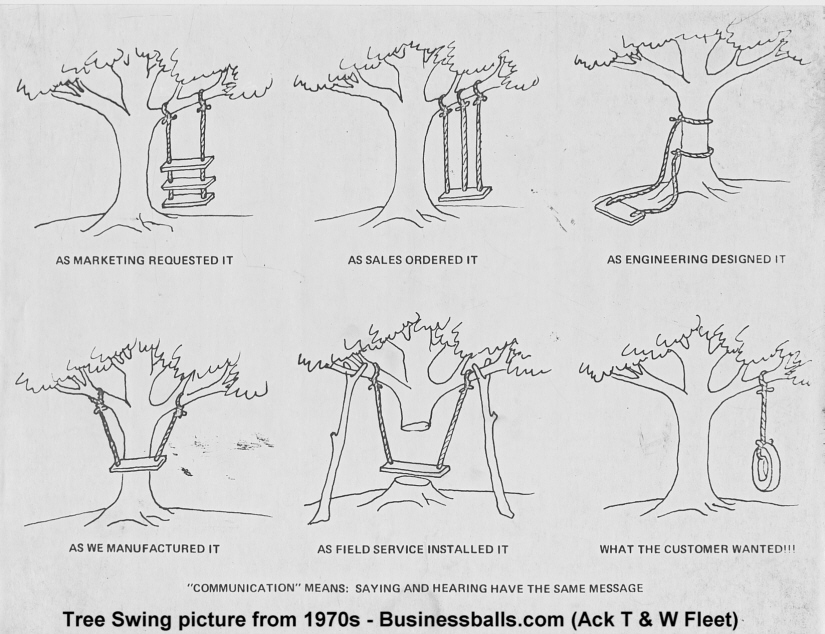
http://www.businessballs.com/treeswing.htm
Have yourself a cookie!
-
Didn't preview
The first "this" in the prior post is supposed to be this link:
http://www.businessballs.com/airtrafficcontrollersfunnyquotes.htmNext time, I shall use the 'preview' button to actually preview.
-
Re:"Designers" are taking over. That's the problem
This comes to mind. http://www.businessballs.com/images/treeswing/tree_swing_70s.jpeg
-
Death of the sience of graphology
i suppose the graphologists willsoon bee reporting their findings on how the choice of font type,font size,use of bold and italics,the use of i instead of I and dozens of other typing choice we make tells us all sorts thing about a person's personality which we could use for counseling,crime investigationand recruitment purposes...
I see a whole new field of pseudoscience just waiting to be brought to the forefront of public imagination by a CSI episode.
Typology and typography are already taken, what shall we call this new science?
-
Re:Why not
Why? Because the US and England had the first major commercial air industries.
or, alternatively (quoting from: http://www.businessballs.com/airtrafficcontrollersfunnyquotes.htm)
Allegedly, a Pan Am 727 flight waiting for start clearance in Munich overheard the following:
Lufthansa (in German): "Ground, what is our start clearance time?"
Ground (in English): "If you want an answer you must speak in English."
Lufthansa (in English): "I am a German, flying a German airplane, in Germany. Why must I speak English?"
Unknown voice from another plane (in a beautiful British accent): "Because you lost the bloody war." -
Re:Don't be so crass
[1] I'm sorry, but if long experience developing has taught me anything, it's this: If you don't know how to code, and have no experience of coding, you have no idea what you want.
I have to disagree here, if only about the way you express this. It's not that you don't know what you want it's just that you don't know how to express it in a way that a developer will understand. Customers talk in vague high-level terms and we talk in terms of testable cases and conditions. It is such a terrible terrible mistake to think you know better than them what they want because you will often be wrong - badly wrong - and have to spend a great deal of time and money fixing it (then blame them for changing their mind). This is not a new concept but a well understood principle of engineering. It is important not to try to interpret someone else's first expression of their idea into workable software. You have to discuss it with them. Find a common ground in which to communicate (this is where languages like UML come in because they can be used at all levels of development for different purposes). Tell them what is and isn't feasible and find solutions. Don't just dismiss what you have been asked to as impossible or unreasonable because you are the 'expert'. You may be the expert coder but you aren't the expert in someone else's business or in their idea. -
Re:ScenarioI figure if I'm a good enough employee then they should offer it
Maybe they should. But they won't. As far as most management are concerned, their job is to pay you as little as they can get away with.
But if you are going to ask for a raise, make a good case. This website has some good advice.
-
Re:Here we go again...
People in general want the same basic things because the list of basic needs is the same for everyone.
http://en.wikipedia.org/wiki/Maslow's_hierarchy_of _needs
http://www.businessballs.com/maslowhierarchyofneed s5.pdf
The idea of the "better world" in many religions is belief that their world will and must come about and will exclude all persons of any other belief system. And the problem is with those that believe they must take a hand in making that world come about through force of law or violence.
-
Re:heh, way to go
You're assuming that the opportunity to work on the plane hasn't been factored into the plan. In general, it has.
So it's planned to have someone doing important work in a crummy environment right up to the wire? That seems to violate what an ex-Navy friend called the 7P Principle ("Proper Prior Planning Prevents Piss-Poor Performance"). Seriously, fly over a day or two early and work from your hotel room. Or better yet... (see next block).
An example of last-minute figures might be a company's quarterly statement filed with the SEC. The client needs the analysis as quickly as possible in order to make a decision. Or maybe the figures are delayed until the last possible moment so they can be error checked more thoroughly. Maybe a competitor has just made an announcement and you need to arrive at head office the next day with a response. These are all very common scenarios.
In the case of SEC filings, I'm assuming that your organization has business staff on both sides of the pond (becuase you probably wouldn't be worrying about American paper shuffling if yourWhat matters in business is not just accuracy, but speed. The best analysis in the world is useless if events overtake it.
I'm well aware of that fact, which is one of the reasons why I think air travel for business purpases in an age of a globe spanning, nearly zero-lag telecommunications network is singularly paleolitihic thought. Last time I checked, electrons traveled faster than planes.
So you haven't, then. [business traveled]
Thus far I've structured my business transactions to never require the horrid stop-gap measure you seem to hold as the definition of "business travel". The way I see it, if I'm working on a project on the way to delivering it, somebody screwed up. It's a profligurately wasteful use of resources to ferry all 1.85 meters/100 kilos of me around when the important part of me (my mind, my thought) is cheaper and faster to transmit over an electronic medium. Are there times when, pardon the crude language, shit happens and as the one holding the bag you get to hop the plane? Yeah, sure. That doesn't mean it's a good idea or something you'd want to plan for.It's not the same thing at all.
It was an allegorical statement. I see that you disagree with my premise, that's ok. You people also eat things called "spotted dick", so obviously we're going to diverge in spots...
The material you work on onboard a plane often doesn't exist in a usable form beforehand.
Where you see efficient working, I see incredibly poor planning. Again, I maintain that if you're patching things together on the way to a deliverable, odds are the final result is going to be crap, steaming and cubed on a silver platter.
Really, let's get to the heart of the matter, the core of my objection to "business travel." I see it as inefficient expenditure of resources. The central thought behind it seems to be that the person traveling is so important that only they can do something, and only in person. It seems to be a very "Theory X" management theory sort of conjecture, that if some random C-level employee isn't personally there to get his/her hands on something, it won't turn out right. More corporate warriorism, rather pointless self-importance displayed in the war-paint of "The company must spend Lots of Money to get me to the action, becuase only I can Save The Day!!! Bow before m3, for I am B1FF, the Super-CEO!!1!" More, to be blunt, bullshit the corporate suits and shiny shoes set thinks smells like roses.
At this point in time, I see no real technical barriers to telecommuting for white-collar jobs. It's all social. And I don't think that telecommuting will be common until today's teenagers and Gen-X-ers are grey haired executives becuase nobody older than them has grown up with near-infinite permiability of the infosphere they (we) have. They see loss of self, loss of importance, with the lack of need for any one person to be in a particular geophysical place at a particular time. I'll draw an analogy back to the world of physical travel: CEO A takes a private jet and a helicopter to arrive at an event. CEO B flies coach and takes a cab or rents a car. If they both arrive on time, who is the better CEO? I'd argue that CEO B is a better CEO becuase they have been better stewards of their stockholder's money by planning better to acheive the same result at lower cost. But people, sadly, rely on symbols for too much of their self-worth. This is why, I feel, most of the orignial responses to my post were very emotions-based (one fool going so far as to label it the stupidest thing they'd read on slashdot, an allegation with the punch of a feather coming from an Anonymous Coward).
But hey, if you're convinced business travel as you define it is a good thing, have at it and good luck. Maybe I'll feel the same way when I've established my globe-spanning liberal army of darkness (oops, did I say that out loud? lies, all of it, i'm as meek as a church mouse! 0:-]).