Slashdot Mirror
Domain: candu.org
Stories and comments across the archive that link to candu.org.
Comments · 13
-
Low pressure by design
A CANDU reactor still has a large steel Calandria surrounding the pressure tubes....the reason why the CANDU was designed was because it runs on natural, unenriched uranium. It had nothing to do with the design of the pressure vessel.
From the Wikipedia article on CANDUs:At the time of its design, Canada lacked the heavy industry to cast and machine the large, heavy steel pressure vessel used in most light water reactors. Instead, the pressure is contained in much smaller tubes, 10 cm diameter, that contain the fuel bundles. These smaller tubes are easier to fabricate than a large pressure vessel. In order to allow the neutrons to flow freely between the bundles, the tubes are made of zircaloy, which is highly transparent to neutrons. The zircaloy tubes are surrounded by a much larger low-pressure tank known as a "calandria", which contains the majority of the moderator.
So posters are quite right that plenty of reactor designs are unaffected by the capacity problems at this steel plant. Indeed, the only effect on CANDU reactors is likely to be a potential increase in customers.
Also:When the first CANDU's were being built, the US was still manufacturing PWR pressure vessels and there was no problem in that area.
The CANDU design had started by 1958, and the first commercial PWR in the US was opened in 1957 - and was just 60MW - making it somewhat unlikely that Canada could have simply purchased PWRs even if it had chosen to. Work started on the first CANDU in 1960, the same year the US started operating only its third nuclear power plant. It appears unlikely that US-built nuclear plants would have been highly available outside the US at that point. -
Re:Wikipedia has more info about itIt is interesting to note that some of the design (not the neutron absorber Lithium-6) reminds me of the Canadian SLOWPOKE reactor, first built in the 1960's.
More about SLOWPOKE:
Damn those safe, smart Canadians. They might quietly run the world, or at least keep it running. -
Re:Reading the artcle......
I'm afraid you are wrong about the neutron cross section absorption of deuterium and its transmutation into tritium. page 5.
-
On hand.
If we use our heads, there is much better than a 50 year supply.
http://www.world-nuclear.org/sym/1999/adamov.htm
http://canteach.candu.org/library/20054702.pdf - PDF Warning!
http://en.wikipedia.org/wiki/Thorium_fuel_cycle#Th e_Thorium_fuel_cycle -
CANDU
That CANDU link is quite interesting
http://canteach.candu.org/library/20000101.pdf
Existing reactors work by using an expensive fuel (enriched uranium) and a cheap moderator (graphite or water).
CANDU's idea is relatively safer. Instead of enriched uranium, CANDU reactors use natural uranium (which is cheap) along with an expensive moderator (heavy water). The design is a bit safer too.
OTOH, heavy water is still a part of the nucleur weapons making process & is export controlled. -
GE ESBWR
As far as the next generation of "traditional" fission reactors, I guess I've been more impressed with GE's ESBWR , than Westinghouse's APxxx
IANANE (I am not a Nuclear Engineer), but BWRs seem to have fewer problems (no steam gnerators to leak/plug up, no vessle head degradation) and are theroetically more efficent (single cycle)...
I wonder if anyone is going to make a bid for GENE (General Electric Nuclear Energy)...
I also wonder why we dont hear more about CANDU reactors . They use natural uranium instead of enriched uranium, which could provide more peaceful energy in unstable areas of the worls -
Re:Nuclear Power
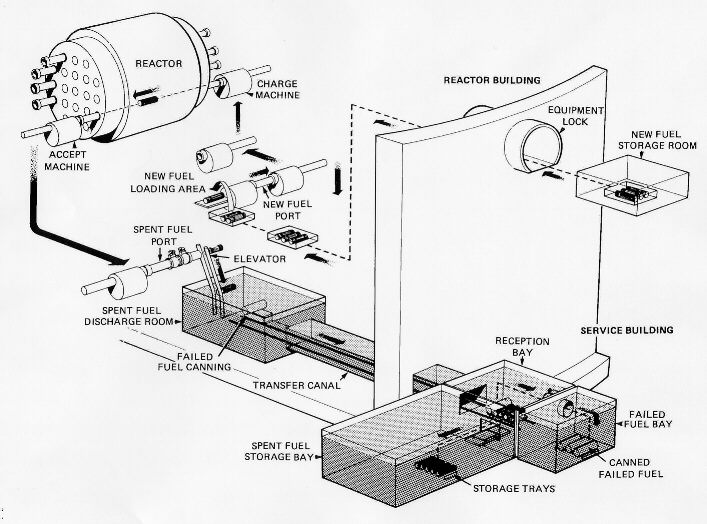
For CANDU nuclear power plants http://www.candu.org/ , we use robotics to handle all the fuel that goes in or out of the reactor http://www.nuclearfaq.ca/refuel.jpg, http://canteach.candu.org/imagelib/00000-General/
N PD_Reactor_Cutaway.pdf. Reliability and robustness are very important, which is why we eliminate most of the electronics on the fuelling machine itself. For instance, the fuelling machines are powered by two identical drives (which are therefore redundant) that control the different mechanisms through a gearbox and a series of electric clutches. The drive amplifiers are located far away out of the radiation fields.
To ensure that the fuelling machines will work correctly and reliably is simple in concept--don't use electronics if you can help it, buy radiation-resistant components if you can't, and design with failures in mind. For example, pressure transmitters at http://www.emersonprocess.com/rosemount/nuclear/. Calculate the dose that each component will receive (most electronics can take about 10 000 rads, plastics vary a lot, and most metals are decent. Zirconium is the best) to determine if it will have a good enough lifespan. Therefore, motors themselves are good to go, conductive level probes are fine, limit switches are fine, etc. It's the semiconductor components that get damaged, but apparently you can design around it, because there are radiation-resistant cameras available. Shielding works but it's like using a bigger hammer--probably not the only or the best way to solve the problem. It's also heavy, making it harder to seismically qualify things.
As an example of the sorts of design decisions made, gap sensing is done using pneumatics with remote electronics instead of proximity sensors, as might be used in a different industry.
Even with careful design, the fuelling machines still get stuck from time to time, but there are many well-thought-out recovery methods. If worse comes to worst, you have to shut down the reactor to get the fuelling machine off the channel. -
Re:Nuclear Power
For CANDU nuclear power plants http://www.candu.org/ , we use robotics to handle all the fuel that goes in or out of the reactor http://www.nuclearfaq.ca/refuel.jpg, http://canteach.candu.org/imagelib/00000-General/
N PD_Reactor_Cutaway.pdf. Reliability and robustness are very important, which is why we eliminate most of the electronics on the fuelling machine itself. For instance, the fuelling machines are powered by two identical drives (which are therefore redundant) that control the different mechanisms through a gearbox and a series of electric clutches. The drive amplifiers are located far away out of the radiation fields.
To ensure that the fuelling machines will work correctly and reliably is simple in concept--don't use electronics if you can help it, buy radiation-resistant components if you can't, and design with failures in mind. For example, pressure transmitters at http://www.emersonprocess.com/rosemount/nuclear/. Calculate the dose that each component will receive (most electronics can take about 10 000 rads, plastics vary a lot, and most metals are decent. Zirconium is the best) to determine if it will have a good enough lifespan. Therefore, motors themselves are good to go, conductive level probes are fine, limit switches are fine, etc. It's the semiconductor components that get damaged, but apparently you can design around it, because there are radiation-resistant cameras available. Shielding works but it's like using a bigger hammer--probably not the only or the best way to solve the problem. It's also heavy, making it harder to seismically qualify things.
As an example of the sorts of design decisions made, gap sensing is done using pneumatics with remote electronics instead of proximity sensors, as might be used in a different industry.
Even with careful design, the fuelling machines still get stuck from time to time, but there are many well-thought-out recovery methods. If worse comes to worst, you have to shut down the reactor to get the fuelling machine off the channel. -
Re:$100 CN
Unfortunately though, since the U.S. is our largest trading partner, a low USD means bad news for the CAD. We really need to do more to diversify in the world markets. People screamed bloody murder about how much Cretien's trade missions cost, but with China talking about building so many reactors now is the time we should be pushing Candu. The Americans are going to keep doing things to protect their markets as their dollar slides. That's how they operate. We need to look elsewhere when this happens. Look at this mad cow situation, the whole thing is rediculous yet the ban on Canadian cattle continues. Does anyone really believe it has anything to do with the safety of the American consumer?
-
Re:I had predicted 2050, actuallyWhat do you think happens to the Neutron bombarded materials? (Hint: They can become radioactive.) Fusion produces a tremendously strong neutron flux.
Isn't this the entire point? Neutrons get absorbed by Li blanket and heat it up. You also get tritium this way which you put back into the reactor.
So, you need the neutron flux. It is only between the neutron source (plasma) and the lithium blanket.
Furthermore, Chernobyl was not caused by a boiler or whatever. It was caused by a design flaw in the graphite control rods - Chernobyl was used to make plutonium. Well, same thing for most of the reactors in US. Frankly speaking, the only fission reactor that has only peaceful applications is the CANDU reactor design (Canada). All other reactors (US, USSR, France, etc..) are used to create plutonium for more nukes. Now that is "peaceful", eh?
Count the number of CANDU reactors as compared to graphite or light water design and you'll see why most coutries don't give a crap about fusion - fusion CANNOT be used to make nukes! Just like a CANDU reactor can't (and the design it has been around since the 50s)
-
Re:No need to oversell it
CANDU reactors (http://www.candu.org) do not produce plutonium. In fact they can be used to convert plutonium to thorium
-
Russian Nuclear Reactors? Ouch
Maybe it's Chernobyl, but somehow I still don't trust Russian nuclear reactor designs.
If you're gonna put a nuclear reactor on Mars, ferchrissake, make it a CANDU. Not only was the CANDU designed in Canada (w00t!), but it's also really, really safe. -
Re:arrogance
>"Modern" nuclear energy is too risky, period.
Risky? Hardly. I can't think of a single fatality resulting from a CANDU reactor, apart from those not related to the fact the plant is nuclear.
Or did you mean "OLD" nuclear energy, like Windscale and Chernobyl? These poor designs should never have been put into production, and people have suffered as a result.
Nuclear energy, done right, is far more safe than any other energy production method. The risks for an installer of solar panels are likely higher than the risks of working at a CANDU reactor. Certainly more people have died as a result of energy dam accidents, and I can't even imagine the numbers that die as a result of toxic smoke spewed from coal and gas fired energy generators.
In fact, CANDU Nuclear Reactors are so safe that even this anti-nuclear article, try as it might, can't find a single death resulting from any accident at a CANDU reactor. Not one. Nada. Zip. Zero.
I'd feel safer working there than programming. Programmers get RSI. I think I'll move to Pickering and see if I can get a job at the reactor. That way I don't have to worry about on the job lethal accidents.
IIRC, there was a posting some time ago that added up the entire waste output from all nuclear reactors since day one. They estimated it would fit in three football fields. At that rate, we'll be able to perform cold fusion before waste management becomes a problem.