Slashdot Mirror
Domain: censorware.net
Stories and comments across the archive that link to censorware.net.
Stories · 26
-
From Bess to Worse
Frequent Slashdot contributor Bennett Haselton writes " From about 1996 to 2003, there were regular reports listing examples of sites stupidly blocked by blocking software. The genre has tapered off recently, probably as a result of the Supreme Court ruling in 2003 that the Children's Internet Protection Act (CIPA) was constitutional, requiring blocking software in schools and libraries that receive federal funds, despite all the evidence of over-blocking presented at the trial. The last high-profile story about a site blocked by blocking software was about the blocking of BoingBoing almost a year ago. But the lack of recent reports on blocking software errors doesn't mean that the software has gotten better." The rest of his essay follows.One product that generated several reports over the years was "Bess, the Internet Retriever" from N2H2, which has since been bought out by Secure Computing, which also makes a blocking program called SmartFilter (the one that blocked BoingBoing) and now sells "SmartFilter, Bess Edition" which uses the same database as Bess. Different organizations and individuals published a series of investigative reports about Bess from 1997 until 2002, listing sites about gay rights, eating disorders, and other subjects that were blocked as "pornography". In Ben Edelman's supplemental report, submitted as testimony in the CIPA trial, he listed examples of erroneously blocked sites that he had reported to N2H2 in his first expert report, and which were still being blocked five months later.
Since Bess represents a set of data points showing how the accuracy of a blocking program can change, or not change, over the years, recently I began testing it again. I didn't know whether to expect it to be better or worse. On the one hand, advances in technology and greater revenue to censorware companies could have caused the software to improve. On the other hand, the number of Web pages, and the rate at which dynamic sites like blogs change content every day, has exploded. The result? I'm still tabulating data, but it looks as if the accuracy rate is roughly the same as it was in 2000, when about 30% of blocked sites were obvious errors. Then and now, I found most of the errors by starting with a large list of URLs culled from search engines and other sources, and simply running them through the software to see what was blocked.
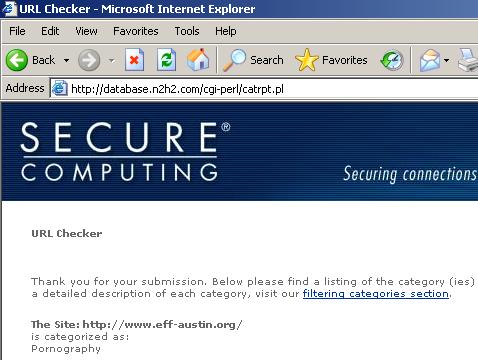
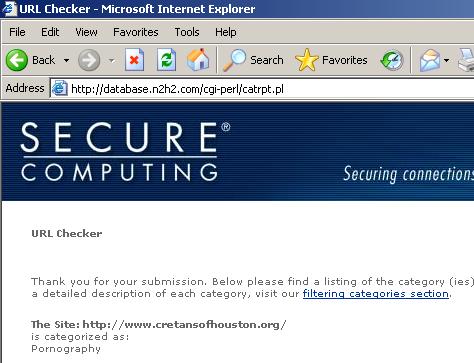
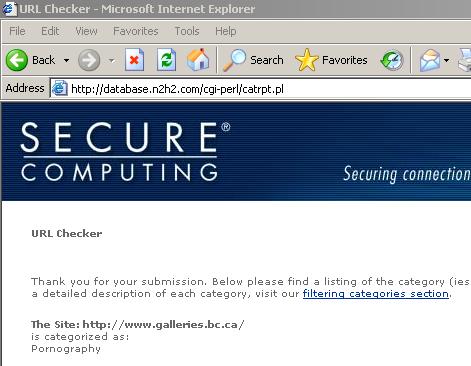
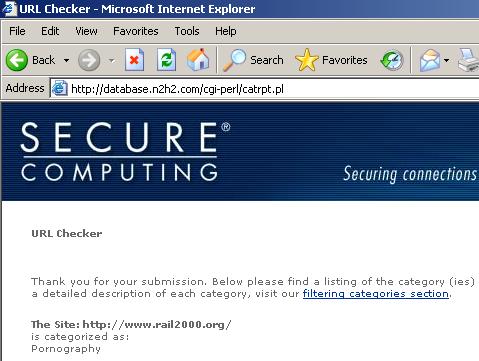
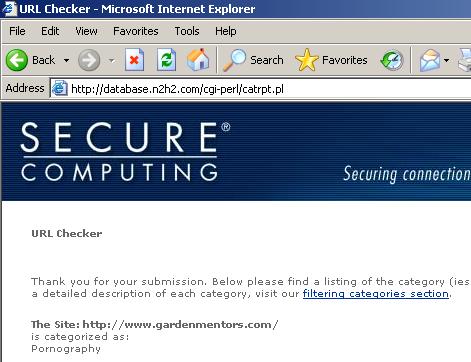
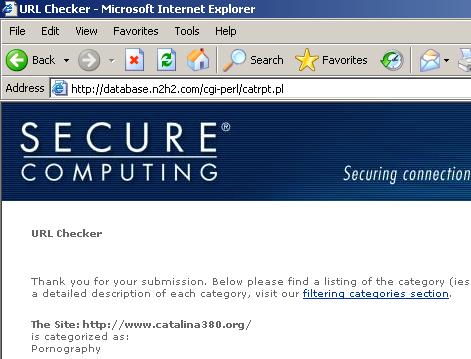
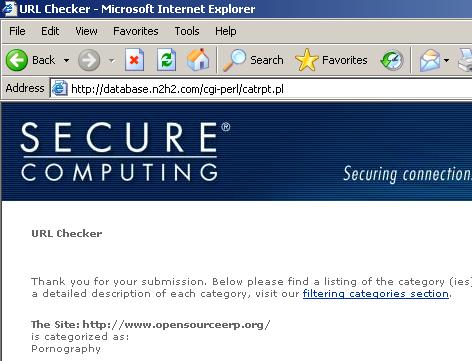
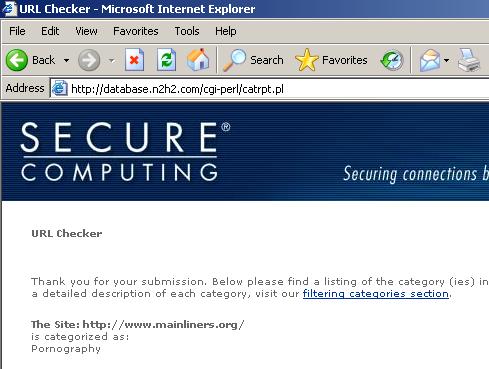
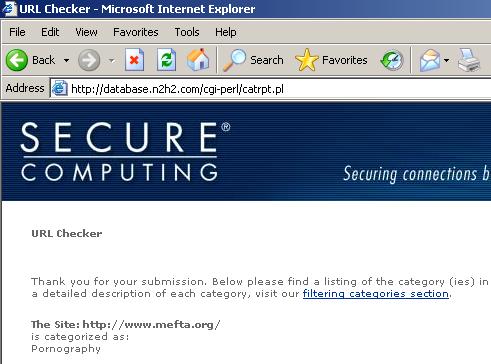
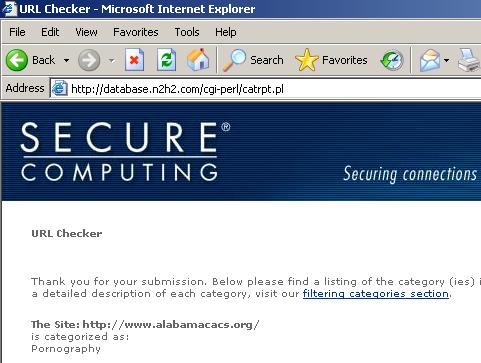
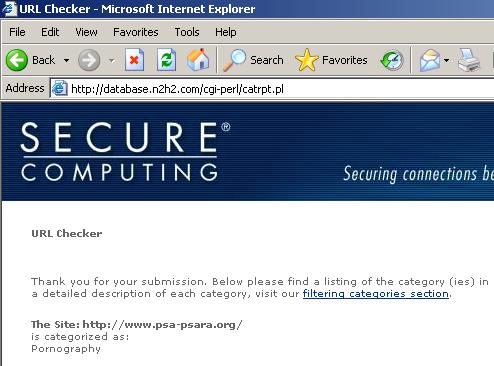
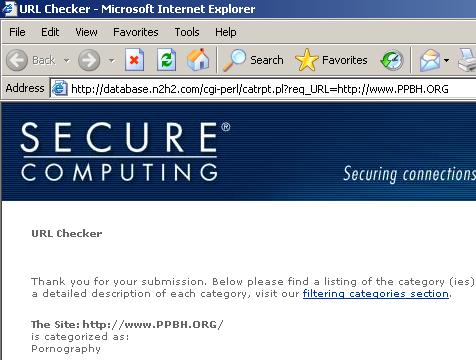
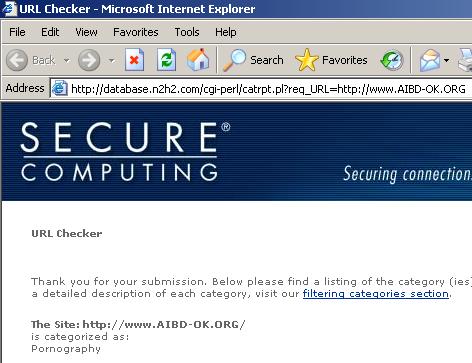
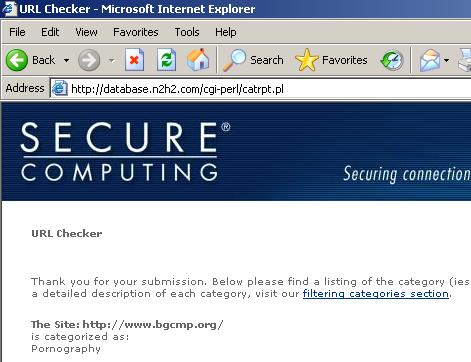
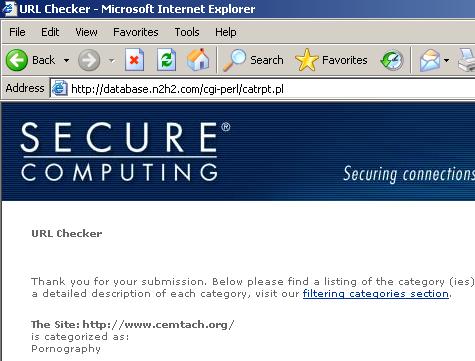
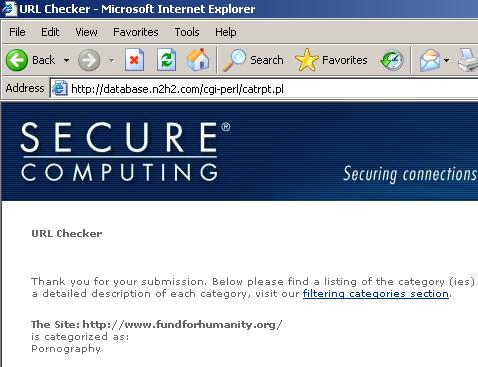
Here is a partial list of some of the questionable categorizations made by Bess; as of this writing, all of the following sites are listed as "Pornography" when you look them up on Secure Computing's Bess lookup form. (This is not just a fluke of the lookup tool; I tested against a copy of the software that all of these sites really were blocked.) The "screen cap" link next to each site links to a snapshot of the results taken from the lookup form (you can check on http://database.n2h2.com/ to see if the page is still returning the same results, although the more obvious errors will probably be fixed after this article is published):
- The Electronic Frontier Foundation, Austin chapter (screen cap)
- Cretans of Houston (screen cap). That's Cretans, as in "people from the island of Crete". Not to be confused with the Cretins of Houston, located here.
- The Rhode Island Coalition Against Domestic Violence (screen cap)
- The website of the public art galleries of British Columbia, Canada (screen cap)
- Rail2000, now the Bay Rail Alliance, a consumer group lobbying for a San Francisco regional rail system (screen cap)
- Rainbow Service Organization, a gay rights advocacy group (screen cap)
- GardenMentors.com, a custom gardening services company in Seattle (screen cap)
- A web site for Catalina 380 series boats (screen cap)
- Open Source ERP, a site promoting open source software for enterprise resource planning and customer relationship management (screen cap)
- The Bryn Mawr Mainliners, a barbershop harmony group (screen cap)
- Timber Trails, an outdoor recreation site (screen cap)
- The MEFTA Institute: "Middle East Free Trade Areas for Business Peace" -- world peace through cheap oil! (screen cap)
- Topple Rummy, a (somewhat out-of-date) site calling for the ouster of Donald Rumsfeld (screen cap)
- The Alabama Network of Children's Advocacy Centers (screen cap)
- PSARA, a non-profit organization for training cruise travel agents (screen cap)
- Park Place Behavioral Health Care, a non-profit mental health care agency (screen cap)
- The Oklahoma chapter of the American Institute of Building Design (screen cap)
- The Boys & Girls Clubs of Metropolitan Phoenix (screen cap)
- CEMTACH -- Computational ElectroMagnetics Theory-Algorithm-Code-Hardware. "Our goal is to develop systems simulations capabilities based on time-domain computational electromagnetics methods." Thanks for clearing that up. (screen cap)
- Fund for Humanity, a San Francisco non-profit supporting environmental organizations and organizations that assist the poor. (screen cap)
A long-standing point of contention while earlier reports about Bess were coming out, was whether every site on their blacklist had been reviewed by a human before being blocked. In 1998 the CEO testified before Congress that "All sites that are blocked are reviewed by N2H2 staff before being added to the block lists." However in their 2002 annual report the company finally admitted that not all sites were reviewed before being blocked: "Through automated categorization or human review, Web sites are identified as fitting into one or more of our categories". At one point an N2H2 employee also told me that when one site is blocked, they will often block all sites hosted on that machine or at that IP -- which of course means that those sites are also not reviewed before being blocked. In any case, it's possible to access some of these sites by IP address, such as the BC Art Galleries site via this link, or the or the Rhode Island Coalition Against Domestic Violence via this link -- so if they're not sharing their IP with other sites, that wouldn't explain how they got blocked either. Smartfilter spokesperson Tomo Foote-Lennox said that one other blocked URL that I found, http://www.arbiol.org/, was the result of an experiment N2H2 once did with fully automated website ratings.
Foote-Lennox added, "In general, we find that schools are VERY sensitive to under-blocking. The would rather block a whole lot of useful reference sites to avoid exposing one porn site." Probably true, although keep in mind we're talking about liability issues, not actual moral outrage. (If they were really morally outraged, they'd be trying to keep kids away from uncensored Internet access everywhere, not just in school! That is in fact the approach that schools take with things like drugs, which do inspire moral outrage because they really are harmful.) Perhaps what is needed is a law explicitly shielding schools from all liability for what students do or see on the Internet at school, if the faculty had no knowledge of it.
(Obligatory interstitial advertisement for common sense: I still don't see what the big deal is about porn anyway. Ask yourself: Why is it harmful to see a picture of a naked person, or even a picture of people having sex? And try to find an answer to that question that doesn't involve, "Lots of other people think so." That includes all variations like "Our society has determined...", "We as a people have decided...", which are just re-phrasings of "Lots of other people think so." I submit that if you disallow those variations of grownup-peer-pressure as an excuse, most people can't really come up with any reason at all.)
OK, flame-retardant suit off, lab coat back on. Previous reports have listed absurd examples of sites blocked by Bess, and looking at any one of those examples or the ones listed here, I'd say that in terms of public policy discussions -- specifically, whether a blocking software company should be trusted to decide what students can look at -- any one of these blocked sites would be more significant than, say, the blocking of BoingBoing which got so much attention. BoingBoing got blocked because of a non-sexual picture of a bare breast on the cover of one of the books they reviewed -- and in fact they were blocked only in the "nudity" category, which includes only "non-pornographic images of the bare human body". So the block on BoingBoing really only revealed that Secure Computing was a bit heavy-handed. (The real problem is that SmartFilter has the category for non-pornographic nudity blocked by default, even though the CIPA filtering law certainly doesn't require schools to block non-pornographic artistic images!) On the other hand, the fact that EFF Austin and the Rhode Island Coalition Against Domestic Violence are currently blocked as "Pornography", suggests that in many instances the blocking companies have nobody at the controls at all. To focus on stupid-but-not-completely-insane blocks like BoingBoing is letting them off easy.
So why did the laundry lists of blocked sites released over the years never become as widely known as BoingBoing, or the guffaw-inducing examples like "Beaver College", which had to change their name in part because of students reportedly being blocked from accessing their website? I think it's because the news favors a good "punch line" -- a fact that anybody can understand that makes us feel smarter than the computers making these dumb mistakes. "Oh, I get it, it was blocked because it was called Beaver College!" But the "punch line" anecdotes are precisely the ones that let the blocking companies off lightly, because it gives them a plausible-sounding excuse for making an error. On the other hand, when the Rhode Island Coalition Against Domestic Violence gets blocked as "Pornography", that could probably force the blocking company to answer some tough questions if it got more press, but there's no good punch line there, so the story just fizzles.
So, while I'm looking through the rest of the data, let me try and come up with some punch lines for reporters to make these blocked sites newsworthy. OK: Why was GardenMentor.com blocked? To keep kids away from all the dirty bitches and hoes! Get it? Ha ha! Why was the Catalina 380 yachting site blocked from kids? Because teens are too vulnerable to pier pressure! Hey, where are you going?
-
From Bess to Worse
Frequent Slashdot contributor Bennett Haselton writes " From about 1996 to 2003, there were regular reports listing examples of sites stupidly blocked by blocking software. The genre has tapered off recently, probably as a result of the Supreme Court ruling in 2003 that the Children's Internet Protection Act (CIPA) was constitutional, requiring blocking software in schools and libraries that receive federal funds, despite all the evidence of over-blocking presented at the trial. The last high-profile story about a site blocked by blocking software was about the blocking of BoingBoing almost a year ago. But the lack of recent reports on blocking software errors doesn't mean that the software has gotten better." The rest of his essay follows.One product that generated several reports over the years was "Bess, the Internet Retriever" from N2H2, which has since been bought out by Secure Computing, which also makes a blocking program called SmartFilter (the one that blocked BoingBoing) and now sells "SmartFilter, Bess Edition" which uses the same database as Bess. Different organizations and individuals published a series of investigative reports about Bess from 1997 until 2002, listing sites about gay rights, eating disorders, and other subjects that were blocked as "pornography". In Ben Edelman's supplemental report, submitted as testimony in the CIPA trial, he listed examples of erroneously blocked sites that he had reported to N2H2 in his first expert report, and which were still being blocked five months later.
Since Bess represents a set of data points showing how the accuracy of a blocking program can change, or not change, over the years, recently I began testing it again. I didn't know whether to expect it to be better or worse. On the one hand, advances in technology and greater revenue to censorware companies could have caused the software to improve. On the other hand, the number of Web pages, and the rate at which dynamic sites like blogs change content every day, has exploded. The result? I'm still tabulating data, but it looks as if the accuracy rate is roughly the same as it was in 2000, when about 30% of blocked sites were obvious errors. Then and now, I found most of the errors by starting with a large list of URLs culled from search engines and other sources, and simply running them through the software to see what was blocked.
Here is a partial list of some of the questionable categorizations made by Bess; as of this writing, all of the following sites are listed as "Pornography" when you look them up on Secure Computing's Bess lookup form. (This is not just a fluke of the lookup tool; I tested against a copy of the software that all of these sites really were blocked.) The "screen cap" link next to each site links to a snapshot of the results taken from the lookup form (you can check on http://database.n2h2.com/ to see if the page is still returning the same results, although the more obvious errors will probably be fixed after this article is published):
- The Electronic Frontier Foundation, Austin chapter (screen cap)
- Cretans of Houston (screen cap). That's Cretans, as in "people from the island of Crete". Not to be confused with the Cretins of Houston, located here.
- The Rhode Island Coalition Against Domestic Violence (screen cap)
- The website of the public art galleries of British Columbia, Canada (screen cap)
- Rail2000, now the Bay Rail Alliance, a consumer group lobbying for a San Francisco regional rail system (screen cap)
- Rainbow Service Organization, a gay rights advocacy group (screen cap)
- GardenMentors.com, a custom gardening services company in Seattle (screen cap)
- A web site for Catalina 380 series boats (screen cap)
- Open Source ERP, a site promoting open source software for enterprise resource planning and customer relationship management (screen cap)
- The Bryn Mawr Mainliners, a barbershop harmony group (screen cap)
- Timber Trails, an outdoor recreation site (screen cap)
- The MEFTA Institute: "Middle East Free Trade Areas for Business Peace" -- world peace through cheap oil! (screen cap)
- Topple Rummy, a (somewhat out-of-date) site calling for the ouster of Donald Rumsfeld (screen cap)
- The Alabama Network of Children's Advocacy Centers (screen cap)
- PSARA, a non-profit organization for training cruise travel agents (screen cap)
- Park Place Behavioral Health Care, a non-profit mental health care agency (screen cap)
- The Oklahoma chapter of the American Institute of Building Design (screen cap)
- The Boys & Girls Clubs of Metropolitan Phoenix (screen cap)
- CEMTACH -- Computational ElectroMagnetics Theory-Algorithm-Code-Hardware. "Our goal is to develop systems simulations capabilities based on time-domain computational electromagnetics methods." Thanks for clearing that up. (screen cap)
- Fund for Humanity, a San Francisco non-profit supporting environmental organizations and organizations that assist the poor. (screen cap)
A long-standing point of contention while earlier reports about Bess were coming out, was whether every site on their blacklist had been reviewed by a human before being blocked. In 1998 the CEO testified before Congress that "All sites that are blocked are reviewed by N2H2 staff before being added to the block lists." However in their 2002 annual report the company finally admitted that not all sites were reviewed before being blocked: "Through automated categorization or human review, Web sites are identified as fitting into one or more of our categories". At one point an N2H2 employee also told me that when one site is blocked, they will often block all sites hosted on that machine or at that IP -- which of course means that those sites are also not reviewed before being blocked. In any case, it's possible to access some of these sites by IP address, such as the BC Art Galleries site via this link, or the or the Rhode Island Coalition Against Domestic Violence via this link -- so if they're not sharing their IP with other sites, that wouldn't explain how they got blocked either. Smartfilter spokesperson Tomo Foote-Lennox said that one other blocked URL that I found, http://www.arbiol.org/, was the result of an experiment N2H2 once did with fully automated website ratings.
Foote-Lennox added, "In general, we find that schools are VERY sensitive to under-blocking. The would rather block a whole lot of useful reference sites to avoid exposing one porn site." Probably true, although keep in mind we're talking about liability issues, not actual moral outrage. (If they were really morally outraged, they'd be trying to keep kids away from uncensored Internet access everywhere, not just in school! That is in fact the approach that schools take with things like drugs, which do inspire moral outrage because they really are harmful.) Perhaps what is needed is a law explicitly shielding schools from all liability for what students do or see on the Internet at school, if the faculty had no knowledge of it.
(Obligatory interstitial advertisement for common sense: I still don't see what the big deal is about porn anyway. Ask yourself: Why is it harmful to see a picture of a naked person, or even a picture of people having sex? And try to find an answer to that question that doesn't involve, "Lots of other people think so." That includes all variations like "Our society has determined...", "We as a people have decided...", which are just re-phrasings of "Lots of other people think so." I submit that if you disallow those variations of grownup-peer-pressure as an excuse, most people can't really come up with any reason at all.)
OK, flame-retardant suit off, lab coat back on. Previous reports have listed absurd examples of sites blocked by Bess, and looking at any one of those examples or the ones listed here, I'd say that in terms of public policy discussions -- specifically, whether a blocking software company should be trusted to decide what students can look at -- any one of these blocked sites would be more significant than, say, the blocking of BoingBoing which got so much attention. BoingBoing got blocked because of a non-sexual picture of a bare breast on the cover of one of the books they reviewed -- and in fact they were blocked only in the "nudity" category, which includes only "non-pornographic images of the bare human body". So the block on BoingBoing really only revealed that Secure Computing was a bit heavy-handed. (The real problem is that SmartFilter has the category for non-pornographic nudity blocked by default, even though the CIPA filtering law certainly doesn't require schools to block non-pornographic artistic images!) On the other hand, the fact that EFF Austin and the Rhode Island Coalition Against Domestic Violence are currently blocked as "Pornography", suggests that in many instances the blocking companies have nobody at the controls at all. To focus on stupid-but-not-completely-insane blocks like BoingBoing is letting them off easy.
So why did the laundry lists of blocked sites released over the years never become as widely known as BoingBoing, or the guffaw-inducing examples like "Beaver College", which had to change their name in part because of students reportedly being blocked from accessing their website? I think it's because the news favors a good "punch line" -- a fact that anybody can understand that makes us feel smarter than the computers making these dumb mistakes. "Oh, I get it, it was blocked because it was called Beaver College!" But the "punch line" anecdotes are precisely the ones that let the blocking companies off lightly, because it gives them a plausible-sounding excuse for making an error. On the other hand, when the Rhode Island Coalition Against Domestic Violence gets blocked as "Pornography", that could probably force the blocking company to answer some tough questions if it got more press, but there's no good punch line there, so the story just fizzles.
So, while I'm looking through the rest of the data, let me try and come up with some punch lines for reporters to make these blocked sites newsworthy. OK: Why was GardenMentor.com blocked? To keep kids away from all the dirty bitches and hoes! Get it? Ha ha! Why was the Catalina 380 yachting site blocked from kids? Because teens are too vulnerable to pier pressure! Hey, where are you going?
-
Slashback: OSX Security, DoD Filtering, Anonymous Posting
Slashdot tonight brings some corrections, clarifications, and updates to previous Slashdot stories, including some favorable results from the University of Wisconsin's Mac OS X Challenge, skeptics investigate cold fusion claims, more on DoD web filtering, AT&T cuts 10,000 jobs after BellSouth merger, more child-proofing efforts for MySpace, Why Windows Vista Will Suck: a rebuttal, Harvard Professor punished for reporting bugs, Assemblyman Biondi backpedals on NJ anonymous posting bill, and a followup on Chinese TLDs -- Read on for details.University of Wisconsin's Mac OS X Challenge. HABITcky writes "The University of Wisconsin Security Challenge has ended after 38 hours, intermittent DoS attacks, 4000 ssh login attempts, a bandwidth spike of 30 Mbps, and 6 million logged ipfw events. During this time there were 'no successful access attempts, nor any claims of a successful attempt.' You may remember this challenge was proposed in response to the 'woefully misleading' ZDnet article, Mac OS X hacked under 30 minutes, which was previously discussed here on Slashdot."
Skeptics investigate cold fusion.smooth wombat writes "As a follow-up to a previous Slashdot posting, Purdue University is investigating the claims of Rusi Taleyarkhan who claimed in 2004 to have created nuclear fusion at room temperature. The investigation came about from complaints from colleagues who suspect something is amiss. Taleyarkhan, who used to work at Oak Ridge National Laboratory, has, since working at Perdue, removed the equipment the co-workers were using to try and replicate the results, claimed results for experimental runs were positive for fusion despite the co-workers never seeing the raw data and opposed the publication of results which contradicted his findings."
More on DoD web filtering. timetrap writes "I work in a mobile combat communications unit, while I'm not in the sandbox right now, I can attest to the DoD policy on blocking web access. First of all when you are down range don't expect to even get DSL speeds from a satellite, we usually roll with about 256kbs for the data side of our trunk. So blocking sites is very important, otherwise 4 or 5 people could start streaming audio and pretty much knock down any legitimate use of the network. We filter websites with smartfilter and yes the military system admins in the IPO office will unblock any web site that isn't blocked by local policy (no pr0n, no streaming audio, no civilian web mail: both the hot and the g varieties, and no chat programs; although irc is used by the DoD) This is no Orwellian conspiracy, but quick and easy system administration; apply smartfilter: check! If you want to check the current smartfilter blocked sites goto: securecomputing and submit some sites to check." Slashdot's own Jamie took a look at Smartfilter back in '99 as a part of the Censorware project and it still remains a mysterious black box to this day. While some would advocate full disclosure using censorware still appears to be merely passing the buck.
AT&T cuts 10,000 jobs after BellSouth merger. mytrip writes to tell us that immediately following their $67 billion acquisition of BellSouth, AT&T plans on cutting about 10,000 jobs.
More child-proofing efforts for MySpace. conq writes "BusinessWeek has an interview with Connecticut Attorney General Richard Blumenthalin in which he describes measures MySpace and other similar sites should take to protect children. From the article: 'We're going to be suggesting some very specific measures that MySpace can take based on our conversations with MySpace as well as with other law enforcement authorities at the state and local levels. We've received hundreds of complaints from parents who are concerned about these issues, and we want to be sure that the measures we propose are technologically feasible and financially viable.'"
Why Windows Vista will Suck: a rebuttal. shrapnull writes "Hot on the heels of Extreme Tech's 'Why Windows Vista Won't Suck', Steven J. Vaughan-Nichols has an alternate position posted on DesktopLinux, and sent to subscribers of Novell's 'Suse Linux Cool Solutions' newsletter."
Harvard researcher punished for reporting bugs. Guillermito writes "A story previously discussed came to a sad conclusion two weeks ago. The bottom line is this means that it is forbidden to use reverse engineering tools to find bugs in a software. You also have to prove that you own a valid license for each version of the tested software. To publish a proof of concept that contains a few dozens of copyrighted bytes is also forbidden. It's a nice precedent for any company selling a defective product."
Assemblyman Biondi backpedals on NJ anonymous posting bill. Quadraginta writes "Earlier, denizens of Slashdot reacted to a story about a bill to be introduced to the New Jersey legislature that would require hosts of forums, bulletin boards and the like to keep track of the real identity of anonymous posters. Seems like there was a strong reaction all over. Assemblyman Biondi now appears to be backpedalling furiously. From a letter quoted after the link: 'I am getting inundated with responses which I will review and use to better educate myself on the implications of this bill. If, after reviewing all of the correspondence and the opinion of OLS, it turns out that the bill is, in fact, unworkable, I will certainly reconsider and withdraw it.'"
A followup on Chinese TLDs. nqz writes "In this story on ComputerWorld, ICANN and the China Internet Network Information Center (CNNIC) both dispute a previous story discussing China's new top-level domains containing Chinese characters."
-
Slashback: Privacy, Spectrum, Location
Slashback tonight brings you yet another handful of updates and amplifications to previously posted stories, including some naysaying to Lessig's idea of the spectrum as commons, more free books from Baen, and the European answer to GPS. Read on for the details.Sir, you just need to trust us. geekee writes "An article on CNN claims that the proposed passenger-screening system for air travelers is much more innocuous than previously claimed. Now it is claimed that the Transportation Security Administration "will not view credit records, traffic violations or other personal data", according to Admiral James Loy. He also claims records of travel will not be maintained. "Airline reservation agents would provide a traveler's name, address, phone number, date of birth, and travel plans to the TSA, which would then check that information against a variety of commercial databases and an FBI watch list.", according to TSA spokeperson Heather Rosenker."
Thinking of the children means more than hiding their eyes. Jim Tyre writes: "You pointed out that my censorware.net piece ["CIPA Before the Supreme Court"] provided a nifty link to where the official supreme court oral argument transcript would be when available online. It's now available."
What's good for the mercantilists ... wait, no doesn't have the same ring. Lawrence Lessig says that the current radio spectrum is vastly underutilized, and that new technology can extract much more use from it, creating a true radio commons. Zo writes to point out that many Salon readers disagree: "Radio waves, bandwidth, the spectrum. . .Don't we know *anything* for sure?
Sir, these books smell fine ... what's the catch? silentbozo writes "Avid Slashdotters will remember the Baen Free Library, which puts up free web versions of Baen titles for ANYONE to download and read without having to mess around with encryption and DRM. They went a step further with this experiment last fall with the release of David Weber's War of Honor which had a bunch of novels in html, rtf, doc, palmdoc, and othe formats on CD (bound into the hardcover), which you could copy and give away to anyone. Well, they're at it again. In May, they'll have another CD for those of you who didn't get War of Honor, bound into John Ringo's Hell's Faire.
I got hooked reading John Ringo's books after browsing through my copy of the War of Honor CD... and it's a great way of catching up on the previous books in the series. Hell's Faire looks really good - I personally am looking forward to finding out what happens to the O'Neals as they fight the Posleen on Earth, and to the crew of Bun-Bun... Eat anti-matter Posleen-boy!"As secure as ... well, you pick. Anthanos writes "pGina [http://pgina.xpasystems.com], a modular authentication framework for Windows, has come a long way since it was last noted on /. nearly a year ago. Since then a full-fledged LDAP plugin, PAM plugin, and chaining have all become part of the feature set. The kicker is the recently released Slashdot plugin, which allows authentication of Windows clients with... yup you guessed it, Slashdot Accounts! XPA Systems has even begun offering services revolving around this GPL product. Seems this may be the solution for people looking to merge authentication of Windows clients with MacOSX, Solaris, and other *nix boxen."
Let's see a handheld that uses both, please ... Mattias Östergren writes "Well aware of the risks with dependency of GPS the European Space Agency (ESA) have developed their own satellite navigation system, EGNOS. EGNOS is more accurate than GPS and the signal also tell you how much it could be off.
The first reference station have just been installed on the roof of the Land Survey in Gävle, Sweden. There is a Swedish press release about it."
-
CIPA Before The Supreme Court
Jim Tyre pointed out the excellent collection of links on censorware.net to coverage of yesterday's oral arguments before the U.S. Supreme Court about the Children's Internet Protection Act (CIPA), as promised by this story last month. There's also a link to the place where transcripts of the oral arguments will show up about three weeks from now. -
ACLU And Others Weigh In On CIPA Injunction
A report on censorware.net has an update on the legal fight over the Children's Internet Protection Act; yesterday the ACLU, ALA and others filed briefs supporting the injunction calling CIPA unconstitutional issued by a three-judge court last May. The Supreme Court will hear the case on March 5th. (A search on "CIPA" is a good way to catch up on this act, which is basically about installing mandatory censorware on child-accessable publicly funded computers.) -
The Great Firewall of China - Samples of Filtered Sites
Loligo writes "Harvard University's Berkman Center for Internet & Society has released a study listing some of the sites filtered by Chinese internet connections. Sites about Taiwan are maybe understandable, but Red Lobster?" We've mentioned the ongoing Berkman study before; one of their interesting findings is that the list of blocked sites is a moving target, and some sites are blocked only intermittently. Here are summaries from The New York Times and MSNBC, by way of The Censorware Project. Update: 12/04 21:03 GMT by T : Seth Finkelstein points to his report "Searching Through the Great Firewall of China," which "describes a simple technique which can be used with some search engines to bypass censorware bans on searching for forbidden words. Particular emphasis is placed on the situation of the Great Firewall Of China." -
U.S. Company Helps Saudi Arabia Censor The Net
John writes: "Saudi Arabia blocks its citizens' internet access to some sites on pornography, religious information (including some on the state religion: Islam) humor, music, movies, and homosexuality, and programs that translate web pages into Arabic, according to this Boston Globe article. (Secure Computing Corp.) provides the Saudis with Smartfilter to block network of proxy servers. The article does not describe the criteria used to block various cites. I wonder if Slashdot is one of them?" Update: 07/17 15:02 GMT by T : A brief mention ran yesterday at the Censorware Project as well, linking to the referenced report itself. -
All Sourceforge.net Being Blocked by SmartFilter
An unnamed reader writes: "I just noticed that all sites. '*.sourceforge.net' are being blocked by all corporations using SmartFilter including mine. SmartFilter lists all of them as 'MP3' sites. Below is the error I get. How come they do not block Microsoft? I can download an MP3 player from there, too (Media Player does play MP3s)." Here's the error: "Access is restricted to the site (http://www.sourceforge.net/) you requested. Per the firm's Information Security & Privacy Policy, all Internet browsing is monitored and logged. Please contact the Information Security Center at ext 7114 for more information. SmartFilter Control List category MP3 Sites is restricted. " The aptly named SmartFilterWhere tool shows which sites are painted over by SmartFilter's broad brush; in this case, software development site (and Slashdot sister site) SourceForge is blocked by the latest SmartFilter versions -- 3.0, 3.0.1 and 3.1 -- but not version 2. You might also be interested in The Censorware Project's analysis of the efficacy of SmartFilter as applied to Utah schools and libraries, or Peacefire's explanation of how and how well SmartFilter works. -
Big Brother Won't Watch Judges
The good guys win! You may remember Tuesday's story about whether internet surveillance should extend to judges and their staff. Good news. As James Tyre writes in a detailed summary over on our website at censorware.net, "How can we be at the end when today is September 7, but the Judicial Conference does not meet until September 11? Because the AO [the Administrative Office of the Courts] blinked, caved, gave up, threw in the towel, that's how." -
Above.net Blackholes, Unblackholes Macromedia
Last week, neonzebra wrote us: "In addition to peacefire.org, and thousands of other blacklisted sites (some unjustifiably), the SPAM nazis at Above.net have now added internet software giant Macromedia to the list. Anyone trying to access Macromedia's website through Above.net's backbone will get a 'site not responding' error." And around the same time, aangelis wrote: "It seems that for the last 4 days Macromedia's web servers give back to my browser not even a bit! Are they down? Maybe it is a DNS problem, but nearly twenty people located at Greece, EU told me the same thing!" It wasn't a DNS problem. Last week, in a high-profile example of stealth blocking, Macromedia's website vanished from a significant minority of the internet. The site reappeared Friday, but I think it's worth taking notice of what happened last week anyway. Details below...This is a sequel to last December's article, MAPS RBL is now Censorware. For the (very) long version of how the RBL works, and how it sometimes fills the same role as "filtering" software, go take a peek.
The short version is that a small group of anti-spam crusaders called MAPS publishes the RBL, which many ISPs subscribe to. Those ISPs block mail to and from addresses on the RBL list.
Some subscribers, notably the backbone provider Above.net, whose CTO is a MAPS co-founder, use the RBL to block not only mail but all internet traffic from IPs listed by RBL. Thus, to cleints of these providers, sites deemed to deliver spam -- or merely deemed spam-friendly -- just drop off the net.
That CTO/co-founder is Paul Vixie, author of Vixie cron and BIND and all kinds of good stuff. He makes some interesting observations about censorship in a 1997 SunWorld interview.
I checked the RBL's servers Thursday night and found that two of Macromedia's IPs were actually blocked.
postal.macromedia.comwas blocked, which makes sense for stopping spam; presumably that's where the spam emenates from.But the other IP blocked was
www.macromedia.com, which is of course their Web address. Blocking this address, I would assume, stops no spam from reaching anyone's inbox.What it does do is get Macromedia's attention. Because Above.net blocks all traffic and is a major backbone provider, being put on the RBL effectively takes a site off the net for many users. Taking down a big corporation's website is a good way to show you mean business.
(Above.net's abuse department said I would have to talk to public relations, but their PR contact did not return repeated phone calls.)
I spoke with a Macromedia spokesperson both last week and today. She confirmed that "there were two addresses blocked, one of which resulted in users worldwide not being able to access the website." She also repeated several times that they were on the RBL for their email newsletter "the Edge," saying it "does have an opt-in model, that does not spam."
She also pointed out that "worldwide access to macromedia.com has been restored." That access happened sometime Thursday night or Friday morning. Our Slashdot submissions about the downed site came in on Thursday, and I confirmed the IP numbers' presence on the RBL Thursday during the day.
I've contacted several people at MAPS, but they had no comment and (per their policy) refused to tell me how long those IPs had been on the RBL.
The rationale for the RBL is that it tries to "prevent ... our paying, in money and resources and our own time, to receive and process, or relay, traffic which is nonconsensual in nature." (Their emphasis.) What is "nonconsensual" about reading Macromedia's website? Why was
www.macromedia.comon the list?I'm only running this story because it's Macromedia. After all, one it's of the larger sites on the net, home of Flash animation among other things. If it can be quietly removed from a chunk of the net, who can't? (If you noticed Macromedia missing last week, post a comment!)
Take a moment to go read that stealth blocking statement, issued last week. I signed as a member of the Censorware Project; other signatories were the ACLU, CPSR, EFF, and EPIC. We're concerned that, as the statement says:
ISPs that practice "stealth blocking" are violating consumer protection principles and restricting user choice and freedom in cyberspace.
What do you think?
-
Getting Tech Law Info Past Filters The Eezy Way
geekotourist writes: " The NYTimes reports that the Tech Law Journal's emailed newsletter started misspelling words to get around filters at "law firms, universities or government agencies." Good to know that this well-informed audience (given the newsletter's content) knows the best reaction to mindless censorship: "...accepted the misspellings as a necessary evil." In future news on how to live with badly designed filters, identity theft victims will be asked to adopt new names ('cause it's a little too hard for credit card reporting agencies to provide authentication and privacy. Just ask Oprah.) And people who can't handle being pulled over for looking different will now be given blond wigs and white makeup to prevent it." (And censorware.net scooped The Times, too.) -
Getting Tech Law Info Past Filters The Eezy Way
geekotourist writes: " The NYTimes reports that the Tech Law Journal's emailed newsletter started misspelling words to get around filters at "law firms, universities or government agencies." Good to know that this well-informed audience (given the newsletter's content) knows the best reaction to mindless censorship: "...accepted the misspellings as a necessary evil." In future news on how to live with badly designed filters, identity theft victims will be asked to adopt new names ('cause it's a little too hard for credit card reporting agencies to provide authentication and privacy. Just ask Oprah.) And people who can't handle being pulled over for looking different will now be given blond wigs and white makeup to prevent it." (And censorware.net scooped The Times, too.) -
Report On The Texas Censorware Bill
www.sorehands.com writes that yesterday, "in Texas, the Committee on Business and Industry heard testimony on HB1295. HB1295 is a bill which, if passed, would require PC sellers in Texas to include censorware on the machines they sell. Under this bill, if a "personal computer" incudes an operating system, the manufacturer would be required to provide fitering software. There are no exceptions for personal computers used for business, or for computers operating systems for which there is no censorware. This bill was prompted by SPAM to the author's, Garcia, AOL account popping up porn before being caught by the AOL parental controls. Garcia also said that downloading and installing the software over the net is too difficult for anyone over 30 years old to install. The committee seemed leary of the bill given that Texas B & C Code Sec 35.101 et seq requires that ISPs provide links to censorware." This lowers Texas on the list of "states to move to" when my lease runs out. Update: 03/21 06:10 PM by T : Jamie points to this earlier post at censorware.net as well. -
Lightning Crashes, An Old Freedom Dies (Updated)
Last week, I gave a presentation on SurfWatch, and blocking software in general, in downtown Holland, Mich. Preparing for it was an interesting experience, mostly in annoyance, hard work, and dealing with getting seriously sick two days before. Read on for the story of recovering, preparing, talking, giving away $100, a bolt of lightning, and why nothing anyone does is going to stop fundamentalists from bringing issues like this to America's ballots.I'm not a public speaker, and I hadn't stood before an audience in quite a while. The feedback I'd gotten from my first presentation on SurfWatch was that I talked too fast and too much. At the time, I'd wanted to communicate as much as possible of what the Censorware Project had learned over the last two years, in a half hour. An impossible task, and I shouldn't have tried.
But I felt I could do better, so I wanted to try again. That's the effort that ended up becoming Thursday's presentation.
My main problem is that the subject is complicated. Many computer professionals have this problem when trying to communicate computer-related ideas to nonprofessionals. If these things were simple, we wouldn't need computers. But trying to get across too much information in a half hour didn't work.
The other thing I'd tried that didn't work was borrowing the computers of the Family Research Council. The FRC had two computers set up, one filtered and one not, run by two volunteers. I'd thought it would be a clever coup to use their own computers to show their software failing.
But it wasn't impressive for one reason: when I showed an innocent Web site blocked, all that showed up was the "Blocked by SurfWatch" screen. I was using the FRC's filtered computer and their other one was turned off. Nobody had any idea that valuable information was being blocked, except me.
Kind of the way the censorship works in the library. But not an effective demo.
For my second go at it, I rented a ballroom in downtown Holland, advertised it in the paper, and brought my own computers. I purchased SurfWatch and installed it on one of them. And I spent some time thinking over which issues were important enough to hit and which were just too technical to mention.
Setting up was great fun, if by "fun" I mean wrestling with a network under a deadline. The 10baseT jack didn't seem to be connected, one of the extension cords didn't work, a projector wouldn't turn on, and finally I was faced with Windows' endless dialog boxes of options just to use DHCP. But it all worked out with time to spare.
I began my talk by explaining out why I was there and why blocking software was wrong. Currently, Holland's opposition to the software is being waged largely on political issues: chiefly, the fact that three-fourths of library taxpayers cannot vote on the ballot. To many, what the blocking software actually does is a non-issue.
But these are mere procedural concerns. Every community is going to have to face the core problem squarely, sooner or later; it might as well be now. So I began my talk by laying out, from the beginning, my belief that blocking software inherently violates the First Amendment.
After talking about some of the myths put forth in the community's debate, my next step was to display some pornography on the big screens. The local Family Research Council has been trotting out a presentation that focuses on some of the most graphic stuff available on the web: bestiality, fisting, etc. I'd decided to try not offending my audience quite as much. I chose some milder Web pages, mostly softcore, though several of the sites I chose also contained harder material.
And, of course, unlike the Family Research Council's, my demonstration showed the pornography appearing on both screens: filtered and un-.
I think I'll not reveal here which porn sites I showed. I want to see how long SurfWatch goes without finding them. So far it's been about two weeks, but of course revealing them here would get them blocked immediately for PR purposes.
I will say that I chose six sites that all begin with the letter "A". This was to make the point that there is plenty of unblocked pornography - there being 25 other letters in the alphabet. As if to make my point, a Tennessee paper ran that same day a story about a schoolteacher who was fired for accessing over a hundred porn sites - right through the school's "filter."
After all, if the software fails only a tiny fraction of the time, it still allows through - dozens? hundreds? thousands? - of porn sites. How many porn sites does the average person need? What's the point in blocking 99% of it, if the remaining sites are more than enough to keep anyone busy?
The next step in my talk was the flip side: showing protected Web pages unfairly blocked. Finding a plethora of wrongly-blocked pages was easy. SurfWatch uses URL keyword blocking, so, for example, the complete text of the classic book Of Human Bondage is blocked because of "bondage" in the URL. The hard part was narrowing the list down to 10 to demonstrate.
(If you're interested, here are the ten blocked pages I used: 1, 2, 3, 4, 5, 6, 7, 8, 9, 10.)
Next, I pointed out that these sorts of errors were not often corrected. What data there is suggests that most errors go unfixed. In our analysis of Web logs in the State of Utah, we found about 300 wrongly blocked sites, of which only six were overridden. Also, in the Family Research Council's $7,000 canned demo, they tried to show how easy it was to fix errors by unblocking The Onion. Since they couldn't even do their prepared site correctly (they left graphics.theonion.com blocked), how could the staff be expected to do the job on real sites, in a busy library?
I explained that the errors I'd found were intrinsic to blocking software, because of the growth of the Web. In my first talk, I spent 10 minutes talking about exponential growth; this time, I just gave the impressive figure that, during just the course of my talk, a million Web pages were created or changed. Much quicker and I'm sure it made the same point.
There seemed to be concern, in Holland, that pornography just "popsup" at any time, for no reason. I debunked that myth by pointing out that typos almost never lead to offensive Web sites. I read this quote from the Supreme Court's ruling on the Communications Decency Act, where they affirmed a lower court's conclusions:
"Communications over the Internet do not 'invade' an individual's home or appear on one's computer screen unbidden. Users seldom encounter content 'by accident.' ... Almost all sexually explicit images are preceded by warnings as to the content. Even the Government's witness ... testified that the 'odds are slim' that a user would come across a sexually explicit site by accident."
All the incidents of "verified pornography" in the Holland press seem to boil down to the same two cases over and over. In the first, a woman was reading Hotmail and, when she was done, closed the browser window. Behind it was porn that another user had left up as a prank.
There are programs that can be run between users' sessions to shut down Netscape and clear its history - my local library is using one with much success - so blocking software isn't necessary to solve this problem. I've explained this to the woman, but she continues to use her incident as an argument for blocking software.
The second incident involved a teenage girl. It seems she was at the library computer and stumbled across naked women purely by accident while doing an innocent search for chocolate chip cookie recipes. Interestingly, she didn't report this to her mother, apparently out of embarrassment, until weeks later. I'd like to speak with her as well but the local pro-filtering groups refuse to put her in touch with me.
I haven't been able to replicate this event, and neither have other people who have tried. And I know a lot about search engines. Now, I'm not saying it didn't happen. Maybe it was a misunderstanding.
What I did in my speech was hold up a $100 bill and offer it to the first person who could show me how it was done. I'll make the same offer to Slashdot readers. Let's see whether this is an urban legend or not. See the bottom of this story for the rules.
I spoke briefly about the legal issues. The Holland area has been hearing suggestions that it will be legally safer to use blocking software. In fact, though the case law is by no means definitive, the experiences of Livermore and Loudoun point toward the opposite conclusion.
Next was the fun part, where I brought up some quotes from the two organizations pushing filters in Holland to illustrate the folly of relying on unaccountable third parties for censorship. In a 1996 legal brief, the Family Research Council had mentioned Cyber Patrol by name as a product that families and libraries "should make use of." But just two years later, in a bulletin called "Filtering Out Decency," they were warning parents away from using the same software.
Why? Because Cyber Patrol had stuck to its guidelines for what constituted hate speech. They had reviewed the American Family Association, the other organization pushing filters in Holland, and found them to be espousing intolerance of homosexuals. The entire AFA site now found itself censored, by the same type of software it had been pushing. In a bulletin called "Filtering Out Morality," the AFA warned parents to think twice before using any blocking software:
"In a secularist culture, both filtering software and federal regulations may well be used to filter out Christianity along with other undesirable elements.
"Another kind of software simply informs parents what sites their children have visited. Instead of making it impossible for children to see certain sites, this approach puts parental discipline at the center. Children, realizing that their parents are looking over their shoulders, are thus taught to internalize the restraints and to develop a conscience of their own.
"As Christians get involved in these debates - before they get filtered altogether - they should keep in mind the warning of the great Puritan poet John Milton ... 'If it come to prohibiting, there is not aught more likely to be prohibited than truth itself.'"
Teaching children to develop a moral conscience of their own? There's a radical idea. Why did it take censorship backfiring before anyone thought of that?
I wrapped things up by talking for a bit about the importance of teaching these moral lessons to children. The children of today are growing up in the 21st century. The Internet will be available to them on every street corner and desk, and mostly unfiltered. What they need is not a temporary and leaky set of blinders strapped on. They need to be given an ethical foundation and the self-reliance to make good decisions about their own lives.
Somewhere in there I called up the AFA's Web site and showed that their discussion about pornography was blocked by SurfWatch as if it were pornography. That got a chuckle from the audience and made the point: it isn't just one product that backfires. The very product that has been pushed in their community blocks the very organization that has spent $35,000 pushing it.
As I wrote in an earlier article, I'm not sure any of this will make any difference to most people. For most, the issue is and will always be pornography: to be against pornography is to support filters.
And the opposition to sexually explicit material is, at heart, an emotional one. It's a primal one. Sex and fear are two of the gut instincts that we humans carry with us from our earliest days.
The day after my talk, the Holland Sentinel carried a powerfulinterview with the man who is behind the city's ballot initiative. IrvBos is the head of the Holland Area Family Association, a branch of the American Family Association.
It seems his aversion to pornography began when he was a boy, in a dramatic incident. At the age of 12, he found a book by the side of the road - a book with stories about "pretty graphic things," a book that the young boy secreted away in his parents' barn.
When "lightning struck the barn, burning it to the ground," it must have been a frightening demonstration of God's power to the guilty child, the child who associated that barn with sneaking behind his parents' back to do evil things, to read evil words.
I think I put together a pretty good presentation Thursday night, but it couldn't have compared to a bolt from the sky striking down a house of evil - like "Sodom and Gomorra," according to Mr.Bos's recollections.
That's hard to top. I can talk about the Internet equivalents of electrons and lightning rods all I want. But I don't think anyone can get through to people who believe this battle to be an epic one, a battle of good and evil. There is something primal there.
We'll see Tuesday night how the vote comes out.
Rules for the $100 offer are as follows. Find a search result URL that shows naked people, for a search on "chocolate chip cookies" or "chocolate chip cookie recipes." I'll accept any variant that an inexperienced Web-surfer might search for. Your result must appear on one of the first five pages of results returned (typically the first 50 results). I'll accept any major search engine. Send me the exact query you used; I will only accept queries I can verify to work as claimed. You aren't allowed to put up a cookie page, submit it, then change its content; to prevent this, you have until 11:59PMEST, Wednesday the 23rd. Only the first person gets the money; order is determined by timestamp of Received: headers at my server. I'll mail you a check or donate it to your favorite charity. This offer is made by me personally, not Slashdot, Andover.net, or VALinux. Notify me at jamie@mccarthy.org.
Update: 02/22 9:30 PM EST by J : I'm getting a lot of submissions that underscore the importance of properly spelling queries. Since I said I'd allow variants, I'll allow these and pick the most reasonable-sounding to give the $100 to. Some of the better ones so far: "chocchipcooky," "chocolateecipe," and the amusing "chocolatecoochie." If you can't beat those, don't bother emailing me.
But what I'm really looking for is a search engine result that looks innocent - that a 16-year-old girl might click on without suspecting pornography at the other end. See the CNN story:
"She typed in 'Chocolate Chip Cookies,' hit the search button and immediately there appeared before her eyes a picture of a nude woman."
The issue is whether pornography appears unexpectedly, from clicking on an innocent-looking link. If no one finds one of those, the other Slashdot authors and I will just decide on the most reasonable-sounding of the other submissions (first entries win ties).
-
Lightning Crashes, An Old Freedom Dies (Updated)
Last week, I gave a presentation on SurfWatch, and blocking software in general, in downtown Holland, Mich. Preparing for it was an interesting experience, mostly in annoyance, hard work, and dealing with getting seriously sick two days before. Read on for the story of recovering, preparing, talking, giving away $100, a bolt of lightning, and why nothing anyone does is going to stop fundamentalists from bringing issues like this to America's ballots.I'm not a public speaker, and I hadn't stood before an audience in quite a while. The feedback I'd gotten from my first presentation on SurfWatch was that I talked too fast and too much. At the time, I'd wanted to communicate as much as possible of what the Censorware Project had learned over the last two years, in a half hour. An impossible task, and I shouldn't have tried.
But I felt I could do better, so I wanted to try again. That's the effort that ended up becoming Thursday's presentation.
My main problem is that the subject is complicated. Many computer professionals have this problem when trying to communicate computer-related ideas to nonprofessionals. If these things were simple, we wouldn't need computers. But trying to get across too much information in a half hour didn't work.
The other thing I'd tried that didn't work was borrowing the computers of the Family Research Council. The FRC had two computers set up, one filtered and one not, run by two volunteers. I'd thought it would be a clever coup to use their own computers to show their software failing.
But it wasn't impressive for one reason: when I showed an innocent Web site blocked, all that showed up was the "Blocked by SurfWatch" screen. I was using the FRC's filtered computer and their other one was turned off. Nobody had any idea that valuable information was being blocked, except me.
Kind of the way the censorship works in the library. But not an effective demo.
For my second go at it, I rented a ballroom in downtown Holland, advertised it in the paper, and brought my own computers. I purchased SurfWatch and installed it on one of them. And I spent some time thinking over which issues were important enough to hit and which were just too technical to mention.
Setting up was great fun, if by "fun" I mean wrestling with a network under a deadline. The 10baseT jack didn't seem to be connected, one of the extension cords didn't work, a projector wouldn't turn on, and finally I was faced with Windows' endless dialog boxes of options just to use DHCP. But it all worked out with time to spare.
I began my talk by explaining out why I was there and why blocking software was wrong. Currently, Holland's opposition to the software is being waged largely on political issues: chiefly, the fact that three-fourths of library taxpayers cannot vote on the ballot. To many, what the blocking software actually does is a non-issue.
But these are mere procedural concerns. Every community is going to have to face the core problem squarely, sooner or later; it might as well be now. So I began my talk by laying out, from the beginning, my belief that blocking software inherently violates the First Amendment.
After talking about some of the myths put forth in the community's debate, my next step was to display some pornography on the big screens. The local Family Research Council has been trotting out a presentation that focuses on some of the most graphic stuff available on the web: bestiality, fisting, etc. I'd decided to try not offending my audience quite as much. I chose some milder Web pages, mostly softcore, though several of the sites I chose also contained harder material.
And, of course, unlike the Family Research Council's, my demonstration showed the pornography appearing on both screens: filtered and un-.
I think I'll not reveal here which porn sites I showed. I want to see how long SurfWatch goes without finding them. So far it's been about two weeks, but of course revealing them here would get them blocked immediately for PR purposes.
I will say that I chose six sites that all begin with the letter "A". This was to make the point that there is plenty of unblocked pornography - there being 25 other letters in the alphabet. As if to make my point, a Tennessee paper ran that same day a story about a schoolteacher who was fired for accessing over a hundred porn sites - right through the school's "filter."
After all, if the software fails only a tiny fraction of the time, it still allows through - dozens? hundreds? thousands? - of porn sites. How many porn sites does the average person need? What's the point in blocking 99% of it, if the remaining sites are more than enough to keep anyone busy?
The next step in my talk was the flip side: showing protected Web pages unfairly blocked. Finding a plethora of wrongly-blocked pages was easy. SurfWatch uses URL keyword blocking, so, for example, the complete text of the classic book Of Human Bondage is blocked because of "bondage" in the URL. The hard part was narrowing the list down to 10 to demonstrate.
(If you're interested, here are the ten blocked pages I used: 1, 2, 3, 4, 5, 6, 7, 8, 9, 10.)
Next, I pointed out that these sorts of errors were not often corrected. What data there is suggests that most errors go unfixed. In our analysis of Web logs in the State of Utah, we found about 300 wrongly blocked sites, of which only six were overridden. Also, in the Family Research Council's $7,000 canned demo, they tried to show how easy it was to fix errors by unblocking The Onion. Since they couldn't even do their prepared site correctly (they left graphics.theonion.com blocked), how could the staff be expected to do the job on real sites, in a busy library?
I explained that the errors I'd found were intrinsic to blocking software, because of the growth of the Web. In my first talk, I spent 10 minutes talking about exponential growth; this time, I just gave the impressive figure that, during just the course of my talk, a million Web pages were created or changed. Much quicker and I'm sure it made the same point.
There seemed to be concern, in Holland, that pornography just "popsup" at any time, for no reason. I debunked that myth by pointing out that typos almost never lead to offensive Web sites. I read this quote from the Supreme Court's ruling on the Communications Decency Act, where they affirmed a lower court's conclusions:
"Communications over the Internet do not 'invade' an individual's home or appear on one's computer screen unbidden. Users seldom encounter content 'by accident.' ... Almost all sexually explicit images are preceded by warnings as to the content. Even the Government's witness ... testified that the 'odds are slim' that a user would come across a sexually explicit site by accident."
All the incidents of "verified pornography" in the Holland press seem to boil down to the same two cases over and over. In the first, a woman was reading Hotmail and, when she was done, closed the browser window. Behind it was porn that another user had left up as a prank.
There are programs that can be run between users' sessions to shut down Netscape and clear its history - my local library is using one with much success - so blocking software isn't necessary to solve this problem. I've explained this to the woman, but she continues to use her incident as an argument for blocking software.
The second incident involved a teenage girl. It seems she was at the library computer and stumbled across naked women purely by accident while doing an innocent search for chocolate chip cookie recipes. Interestingly, she didn't report this to her mother, apparently out of embarrassment, until weeks later. I'd like to speak with her as well but the local pro-filtering groups refuse to put her in touch with me.
I haven't been able to replicate this event, and neither have other people who have tried. And I know a lot about search engines. Now, I'm not saying it didn't happen. Maybe it was a misunderstanding.
What I did in my speech was hold up a $100 bill and offer it to the first person who could show me how it was done. I'll make the same offer to Slashdot readers. Let's see whether this is an urban legend or not. See the bottom of this story for the rules.
I spoke briefly about the legal issues. The Holland area has been hearing suggestions that it will be legally safer to use blocking software. In fact, though the case law is by no means definitive, the experiences of Livermore and Loudoun point toward the opposite conclusion.
Next was the fun part, where I brought up some quotes from the two organizations pushing filters in Holland to illustrate the folly of relying on unaccountable third parties for censorship. In a 1996 legal brief, the Family Research Council had mentioned Cyber Patrol by name as a product that families and libraries "should make use of." But just two years later, in a bulletin called "Filtering Out Decency," they were warning parents away from using the same software.
Why? Because Cyber Patrol had stuck to its guidelines for what constituted hate speech. They had reviewed the American Family Association, the other organization pushing filters in Holland, and found them to be espousing intolerance of homosexuals. The entire AFA site now found itself censored, by the same type of software it had been pushing. In a bulletin called "Filtering Out Morality," the AFA warned parents to think twice before using any blocking software:
"In a secularist culture, both filtering software and federal regulations may well be used to filter out Christianity along with other undesirable elements.
"Another kind of software simply informs parents what sites their children have visited. Instead of making it impossible for children to see certain sites, this approach puts parental discipline at the center. Children, realizing that their parents are looking over their shoulders, are thus taught to internalize the restraints and to develop a conscience of their own.
"As Christians get involved in these debates - before they get filtered altogether - they should keep in mind the warning of the great Puritan poet John Milton ... 'If it come to prohibiting, there is not aught more likely to be prohibited than truth itself.'"
Teaching children to develop a moral conscience of their own? There's a radical idea. Why did it take censorship backfiring before anyone thought of that?
I wrapped things up by talking for a bit about the importance of teaching these moral lessons to children. The children of today are growing up in the 21st century. The Internet will be available to them on every street corner and desk, and mostly unfiltered. What they need is not a temporary and leaky set of blinders strapped on. They need to be given an ethical foundation and the self-reliance to make good decisions about their own lives.
Somewhere in there I called up the AFA's Web site and showed that their discussion about pornography was blocked by SurfWatch as if it were pornography. That got a chuckle from the audience and made the point: it isn't just one product that backfires. The very product that has been pushed in their community blocks the very organization that has spent $35,000 pushing it.
As I wrote in an earlier article, I'm not sure any of this will make any difference to most people. For most, the issue is and will always be pornography: to be against pornography is to support filters.
And the opposition to sexually explicit material is, at heart, an emotional one. It's a primal one. Sex and fear are two of the gut instincts that we humans carry with us from our earliest days.
The day after my talk, the Holland Sentinel carried a powerfulinterview with the man who is behind the city's ballot initiative. IrvBos is the head of the Holland Area Family Association, a branch of the American Family Association.
It seems his aversion to pornography began when he was a boy, in a dramatic incident. At the age of 12, he found a book by the side of the road - a book with stories about "pretty graphic things," a book that the young boy secreted away in his parents' barn.
When "lightning struck the barn, burning it to the ground," it must have been a frightening demonstration of God's power to the guilty child, the child who associated that barn with sneaking behind his parents' back to do evil things, to read evil words.
I think I put together a pretty good presentation Thursday night, but it couldn't have compared to a bolt from the sky striking down a house of evil - like "Sodom and Gomorra," according to Mr.Bos's recollections.
That's hard to top. I can talk about the Internet equivalents of electrons and lightning rods all I want. But I don't think anyone can get through to people who believe this battle to be an epic one, a battle of good and evil. There is something primal there.
We'll see Tuesday night how the vote comes out.
Rules for the $100 offer are as follows. Find a search result URL that shows naked people, for a search on "chocolate chip cookies" or "chocolate chip cookie recipes." I'll accept any variant that an inexperienced Web-surfer might search for. Your result must appear on one of the first five pages of results returned (typically the first 50 results). I'll accept any major search engine. Send me the exact query you used; I will only accept queries I can verify to work as claimed. You aren't allowed to put up a cookie page, submit it, then change its content; to prevent this, you have until 11:59PMEST, Wednesday the 23rd. Only the first person gets the money; order is determined by timestamp of Received: headers at my server. I'll mail you a check or donate it to your favorite charity. This offer is made by me personally, not Slashdot, Andover.net, or VALinux. Notify me at jamie@mccarthy.org.
Update: 02/22 9:30 PM EST by J : I'm getting a lot of submissions that underscore the importance of properly spelling queries. Since I said I'd allow variants, I'll allow these and pick the most reasonable-sounding to give the $100 to. Some of the better ones so far: "chocchipcooky," "chocolateecipe," and the amusing "chocolatecoochie." If you can't beat those, don't bother emailing me.
But what I'm really looking for is a search engine result that looks innocent - that a 16-year-old girl might click on without suspecting pornography at the other end. See the CNN story:
"She typed in 'Chocolate Chip Cookies,' hit the search button and immediately there appeared before her eyes a picture of a nude woman."
The issue is whether pornography appears unexpectedly, from clicking on an innocent-looking link. If no one finds one of those, the other Slashdot authors and I will just decide on the most reasonable-sounding of the other submissions (first entries win ties).
-
Lightning Crashes, An Old Freedom Dies (Updated)
Last week, I gave a presentation on SurfWatch, and blocking software in general, in downtown Holland, Mich. Preparing for it was an interesting experience, mostly in annoyance, hard work, and dealing with getting seriously sick two days before. Read on for the story of recovering, preparing, talking, giving away $100, a bolt of lightning, and why nothing anyone does is going to stop fundamentalists from bringing issues like this to America's ballots.I'm not a public speaker, and I hadn't stood before an audience in quite a while. The feedback I'd gotten from my first presentation on SurfWatch was that I talked too fast and too much. At the time, I'd wanted to communicate as much as possible of what the Censorware Project had learned over the last two years, in a half hour. An impossible task, and I shouldn't have tried.
But I felt I could do better, so I wanted to try again. That's the effort that ended up becoming Thursday's presentation.
My main problem is that the subject is complicated. Many computer professionals have this problem when trying to communicate computer-related ideas to nonprofessionals. If these things were simple, we wouldn't need computers. But trying to get across too much information in a half hour didn't work.
The other thing I'd tried that didn't work was borrowing the computers of the Family Research Council. The FRC had two computers set up, one filtered and one not, run by two volunteers. I'd thought it would be a clever coup to use their own computers to show their software failing.
But it wasn't impressive for one reason: when I showed an innocent Web site blocked, all that showed up was the "Blocked by SurfWatch" screen. I was using the FRC's filtered computer and their other one was turned off. Nobody had any idea that valuable information was being blocked, except me.
Kind of the way the censorship works in the library. But not an effective demo.
For my second go at it, I rented a ballroom in downtown Holland, advertised it in the paper, and brought my own computers. I purchased SurfWatch and installed it on one of them. And I spent some time thinking over which issues were important enough to hit and which were just too technical to mention.
Setting up was great fun, if by "fun" I mean wrestling with a network under a deadline. The 10baseT jack didn't seem to be connected, one of the extension cords didn't work, a projector wouldn't turn on, and finally I was faced with Windows' endless dialog boxes of options just to use DHCP. But it all worked out with time to spare.
I began my talk by explaining out why I was there and why blocking software was wrong. Currently, Holland's opposition to the software is being waged largely on political issues: chiefly, the fact that three-fourths of library taxpayers cannot vote on the ballot. To many, what the blocking software actually does is a non-issue.
But these are mere procedural concerns. Every community is going to have to face the core problem squarely, sooner or later; it might as well be now. So I began my talk by laying out, from the beginning, my belief that blocking software inherently violates the First Amendment.
After talking about some of the myths put forth in the community's debate, my next step was to display some pornography on the big screens. The local Family Research Council has been trotting out a presentation that focuses on some of the most graphic stuff available on the web: bestiality, fisting, etc. I'd decided to try not offending my audience quite as much. I chose some milder Web pages, mostly softcore, though several of the sites I chose also contained harder material.
And, of course, unlike the Family Research Council's, my demonstration showed the pornography appearing on both screens: filtered and un-.
I think I'll not reveal here which porn sites I showed. I want to see how long SurfWatch goes without finding them. So far it's been about two weeks, but of course revealing them here would get them blocked immediately for PR purposes.
I will say that I chose six sites that all begin with the letter "A". This was to make the point that there is plenty of unblocked pornography - there being 25 other letters in the alphabet. As if to make my point, a Tennessee paper ran that same day a story about a schoolteacher who was fired for accessing over a hundred porn sites - right through the school's "filter."
After all, if the software fails only a tiny fraction of the time, it still allows through - dozens? hundreds? thousands? - of porn sites. How many porn sites does the average person need? What's the point in blocking 99% of it, if the remaining sites are more than enough to keep anyone busy?
The next step in my talk was the flip side: showing protected Web pages unfairly blocked. Finding a plethora of wrongly-blocked pages was easy. SurfWatch uses URL keyword blocking, so, for example, the complete text of the classic book Of Human Bondage is blocked because of "bondage" in the URL. The hard part was narrowing the list down to 10 to demonstrate.
(If you're interested, here are the ten blocked pages I used: 1, 2, 3, 4, 5, 6, 7, 8, 9, 10.)
Next, I pointed out that these sorts of errors were not often corrected. What data there is suggests that most errors go unfixed. In our analysis of Web logs in the State of Utah, we found about 300 wrongly blocked sites, of which only six were overridden. Also, in the Family Research Council's $7,000 canned demo, they tried to show how easy it was to fix errors by unblocking The Onion. Since they couldn't even do their prepared site correctly (they left graphics.theonion.com blocked), how could the staff be expected to do the job on real sites, in a busy library?
I explained that the errors I'd found were intrinsic to blocking software, because of the growth of the Web. In my first talk, I spent 10 minutes talking about exponential growth; this time, I just gave the impressive figure that, during just the course of my talk, a million Web pages were created or changed. Much quicker and I'm sure it made the same point.
There seemed to be concern, in Holland, that pornography just "popsup" at any time, for no reason. I debunked that myth by pointing out that typos almost never lead to offensive Web sites. I read this quote from the Supreme Court's ruling on the Communications Decency Act, where they affirmed a lower court's conclusions:
"Communications over the Internet do not 'invade' an individual's home or appear on one's computer screen unbidden. Users seldom encounter content 'by accident.' ... Almost all sexually explicit images are preceded by warnings as to the content. Even the Government's witness ... testified that the 'odds are slim' that a user would come across a sexually explicit site by accident."
All the incidents of "verified pornography" in the Holland press seem to boil down to the same two cases over and over. In the first, a woman was reading Hotmail and, when she was done, closed the browser window. Behind it was porn that another user had left up as a prank.
There are programs that can be run between users' sessions to shut down Netscape and clear its history - my local library is using one with much success - so blocking software isn't necessary to solve this problem. I've explained this to the woman, but she continues to use her incident as an argument for blocking software.
The second incident involved a teenage girl. It seems she was at the library computer and stumbled across naked women purely by accident while doing an innocent search for chocolate chip cookie recipes. Interestingly, she didn't report this to her mother, apparently out of embarrassment, until weeks later. I'd like to speak with her as well but the local pro-filtering groups refuse to put her in touch with me.
I haven't been able to replicate this event, and neither have other people who have tried. And I know a lot about search engines. Now, I'm not saying it didn't happen. Maybe it was a misunderstanding.
What I did in my speech was hold up a $100 bill and offer it to the first person who could show me how it was done. I'll make the same offer to Slashdot readers. Let's see whether this is an urban legend or not. See the bottom of this story for the rules.
I spoke briefly about the legal issues. The Holland area has been hearing suggestions that it will be legally safer to use blocking software. In fact, though the case law is by no means definitive, the experiences of Livermore and Loudoun point toward the opposite conclusion.
Next was the fun part, where I brought up some quotes from the two organizations pushing filters in Holland to illustrate the folly of relying on unaccountable third parties for censorship. In a 1996 legal brief, the Family Research Council had mentioned Cyber Patrol by name as a product that families and libraries "should make use of." But just two years later, in a bulletin called "Filtering Out Decency," they were warning parents away from using the same software.
Why? Because Cyber Patrol had stuck to its guidelines for what constituted hate speech. They had reviewed the American Family Association, the other organization pushing filters in Holland, and found them to be espousing intolerance of homosexuals. The entire AFA site now found itself censored, by the same type of software it had been pushing. In a bulletin called "Filtering Out Morality," the AFA warned parents to think twice before using any blocking software:
"In a secularist culture, both filtering software and federal regulations may well be used to filter out Christianity along with other undesirable elements.
"Another kind of software simply informs parents what sites their children have visited. Instead of making it impossible for children to see certain sites, this approach puts parental discipline at the center. Children, realizing that their parents are looking over their shoulders, are thus taught to internalize the restraints and to develop a conscience of their own.
"As Christians get involved in these debates - before they get filtered altogether - they should keep in mind the warning of the great Puritan poet John Milton ... 'If it come to prohibiting, there is not aught more likely to be prohibited than truth itself.'"
Teaching children to develop a moral conscience of their own? There's a radical idea. Why did it take censorship backfiring before anyone thought of that?
I wrapped things up by talking for a bit about the importance of teaching these moral lessons to children. The children of today are growing up in the 21st century. The Internet will be available to them on every street corner and desk, and mostly unfiltered. What they need is not a temporary and leaky set of blinders strapped on. They need to be given an ethical foundation and the self-reliance to make good decisions about their own lives.
Somewhere in there I called up the AFA's Web site and showed that their discussion about pornography was blocked by SurfWatch as if it were pornography. That got a chuckle from the audience and made the point: it isn't just one product that backfires. The very product that has been pushed in their community blocks the very organization that has spent $35,000 pushing it.
As I wrote in an earlier article, I'm not sure any of this will make any difference to most people. For most, the issue is and will always be pornography: to be against pornography is to support filters.
And the opposition to sexually explicit material is, at heart, an emotional one. It's a primal one. Sex and fear are two of the gut instincts that we humans carry with us from our earliest days.
The day after my talk, the Holland Sentinel carried a powerfulinterview with the man who is behind the city's ballot initiative. IrvBos is the head of the Holland Area Family Association, a branch of the American Family Association.
It seems his aversion to pornography began when he was a boy, in a dramatic incident. At the age of 12, he found a book by the side of the road - a book with stories about "pretty graphic things," a book that the young boy secreted away in his parents' barn.
When "lightning struck the barn, burning it to the ground," it must have been a frightening demonstration of God's power to the guilty child, the child who associated that barn with sneaking behind his parents' back to do evil things, to read evil words.
I think I put together a pretty good presentation Thursday night, but it couldn't have compared to a bolt from the sky striking down a house of evil - like "Sodom and Gomorra," according to Mr.Bos's recollections.
That's hard to top. I can talk about the Internet equivalents of electrons and lightning rods all I want. But I don't think anyone can get through to people who believe this battle to be an epic one, a battle of good and evil. There is something primal there.
We'll see Tuesday night how the vote comes out.
Rules for the $100 offer are as follows. Find a search result URL that shows naked people, for a search on "chocolate chip cookies" or "chocolate chip cookie recipes." I'll accept any variant that an inexperienced Web-surfer might search for. Your result must appear on one of the first five pages of results returned (typically the first 50 results). I'll accept any major search engine. Send me the exact query you used; I will only accept queries I can verify to work as claimed. You aren't allowed to put up a cookie page, submit it, then change its content; to prevent this, you have until 11:59PMEST, Wednesday the 23rd. Only the first person gets the money; order is determined by timestamp of Received: headers at my server. I'll mail you a check or donate it to your favorite charity. This offer is made by me personally, not Slashdot, Andover.net, or VALinux. Notify me at jamie@mccarthy.org.
Update: 02/22 9:30 PM EST by J : I'm getting a lot of submissions that underscore the importance of properly spelling queries. Since I said I'd allow variants, I'll allow these and pick the most reasonable-sounding to give the $100 to. Some of the better ones so far: "chocchipcooky," "chocolateecipe," and the amusing "chocolatecoochie." If you can't beat those, don't bother emailing me.
But what I'm really looking for is a search engine result that looks innocent - that a 16-year-old girl might click on without suspecting pornography at the other end. See the CNN story:
"She typed in 'Chocolate Chip Cookies,' hit the search button and immediately there appeared before her eyes a picture of a nude woman."
The issue is whether pornography appears unexpectedly, from clicking on an innocent-looking link. If no one finds one of those, the other Slashdot authors and I will just decide on the most reasonable-sounding of the other submissions (first entries win ties).
-
Lightning Crashes, An Old Freedom Dies (Updated)
Last week, I gave a presentation on SurfWatch, and blocking software in general, in downtown Holland, Mich. Preparing for it was an interesting experience, mostly in annoyance, hard work, and dealing with getting seriously sick two days before. Read on for the story of recovering, preparing, talking, giving away $100, a bolt of lightning, and why nothing anyone does is going to stop fundamentalists from bringing issues like this to America's ballots.I'm not a public speaker, and I hadn't stood before an audience in quite a while. The feedback I'd gotten from my first presentation on SurfWatch was that I talked too fast and too much. At the time, I'd wanted to communicate as much as possible of what the Censorware Project had learned over the last two years, in a half hour. An impossible task, and I shouldn't have tried.
But I felt I could do better, so I wanted to try again. That's the effort that ended up becoming Thursday's presentation.
My main problem is that the subject is complicated. Many computer professionals have this problem when trying to communicate computer-related ideas to nonprofessionals. If these things were simple, we wouldn't need computers. But trying to get across too much information in a half hour didn't work.
The other thing I'd tried that didn't work was borrowing the computers of the Family Research Council. The FRC had two computers set up, one filtered and one not, run by two volunteers. I'd thought it would be a clever coup to use their own computers to show their software failing.
But it wasn't impressive for one reason: when I showed an innocent Web site blocked, all that showed up was the "Blocked by SurfWatch" screen. I was using the FRC's filtered computer and their other one was turned off. Nobody had any idea that valuable information was being blocked, except me.
Kind of the way the censorship works in the library. But not an effective demo.
For my second go at it, I rented a ballroom in downtown Holland, advertised it in the paper, and brought my own computers. I purchased SurfWatch and installed it on one of them. And I spent some time thinking over which issues were important enough to hit and which were just too technical to mention.
Setting up was great fun, if by "fun" I mean wrestling with a network under a deadline. The 10baseT jack didn't seem to be connected, one of the extension cords didn't work, a projector wouldn't turn on, and finally I was faced with Windows' endless dialog boxes of options just to use DHCP. But it all worked out with time to spare.
I began my talk by explaining out why I was there and why blocking software was wrong. Currently, Holland's opposition to the software is being waged largely on political issues: chiefly, the fact that three-fourths of library taxpayers cannot vote on the ballot. To many, what the blocking software actually does is a non-issue.
But these are mere procedural concerns. Every community is going to have to face the core problem squarely, sooner or later; it might as well be now. So I began my talk by laying out, from the beginning, my belief that blocking software inherently violates the First Amendment.
After talking about some of the myths put forth in the community's debate, my next step was to display some pornography on the big screens. The local Family Research Council has been trotting out a presentation that focuses on some of the most graphic stuff available on the web: bestiality, fisting, etc. I'd decided to try not offending my audience quite as much. I chose some milder Web pages, mostly softcore, though several of the sites I chose also contained harder material.
And, of course, unlike the Family Research Council's, my demonstration showed the pornography appearing on both screens: filtered and un-.
I think I'll not reveal here which porn sites I showed. I want to see how long SurfWatch goes without finding them. So far it's been about two weeks, but of course revealing them here would get them blocked immediately for PR purposes.
I will say that I chose six sites that all begin with the letter "A". This was to make the point that there is plenty of unblocked pornography - there being 25 other letters in the alphabet. As if to make my point, a Tennessee paper ran that same day a story about a schoolteacher who was fired for accessing over a hundred porn sites - right through the school's "filter."
After all, if the software fails only a tiny fraction of the time, it still allows through - dozens? hundreds? thousands? - of porn sites. How many porn sites does the average person need? What's the point in blocking 99% of it, if the remaining sites are more than enough to keep anyone busy?
The next step in my talk was the flip side: showing protected Web pages unfairly blocked. Finding a plethora of wrongly-blocked pages was easy. SurfWatch uses URL keyword blocking, so, for example, the complete text of the classic book Of Human Bondage is blocked because of "bondage" in the URL. The hard part was narrowing the list down to 10 to demonstrate.
(If you're interested, here are the ten blocked pages I used: 1, 2, 3, 4, 5, 6, 7, 8, 9, 10.)
Next, I pointed out that these sorts of errors were not often corrected. What data there is suggests that most errors go unfixed. In our analysis of Web logs in the State of Utah, we found about 300 wrongly blocked sites, of which only six were overridden. Also, in the Family Research Council's $7,000 canned demo, they tried to show how easy it was to fix errors by unblocking The Onion. Since they couldn't even do their prepared site correctly (they left graphics.theonion.com blocked), how could the staff be expected to do the job on real sites, in a busy library?
I explained that the errors I'd found were intrinsic to blocking software, because of the growth of the Web. In my first talk, I spent 10 minutes talking about exponential growth; this time, I just gave the impressive figure that, during just the course of my talk, a million Web pages were created or changed. Much quicker and I'm sure it made the same point.
There seemed to be concern, in Holland, that pornography just "popsup" at any time, for no reason. I debunked that myth by pointing out that typos almost never lead to offensive Web sites. I read this quote from the Supreme Court's ruling on the Communications Decency Act, where they affirmed a lower court's conclusions:
"Communications over the Internet do not 'invade' an individual's home or appear on one's computer screen unbidden. Users seldom encounter content 'by accident.' ... Almost all sexually explicit images are preceded by warnings as to the content. Even the Government's witness ... testified that the 'odds are slim' that a user would come across a sexually explicit site by accident."
All the incidents of "verified pornography" in the Holland press seem to boil down to the same two cases over and over. In the first, a woman was reading Hotmail and, when she was done, closed the browser window. Behind it was porn that another user had left up as a prank.
There are programs that can be run between users' sessions to shut down Netscape and clear its history - my local library is using one with much success - so blocking software isn't necessary to solve this problem. I've explained this to the woman, but she continues to use her incident as an argument for blocking software.
The second incident involved a teenage girl. It seems she was at the library computer and stumbled across naked women purely by accident while doing an innocent search for chocolate chip cookie recipes. Interestingly, she didn't report this to her mother, apparently out of embarrassment, until weeks later. I'd like to speak with her as well but the local pro-filtering groups refuse to put her in touch with me.
I haven't been able to replicate this event, and neither have other people who have tried. And I know a lot about search engines. Now, I'm not saying it didn't happen. Maybe it was a misunderstanding.
What I did in my speech was hold up a $100 bill and offer it to the first person who could show me how it was done. I'll make the same offer to Slashdot readers. Let's see whether this is an urban legend or not. See the bottom of this story for the rules.
I spoke briefly about the legal issues. The Holland area has been hearing suggestions that it will be legally safer to use blocking software. In fact, though the case law is by no means definitive, the experiences of Livermore and Loudoun point toward the opposite conclusion.
Next was the fun part, where I brought up some quotes from the two organizations pushing filters in Holland to illustrate the folly of relying on unaccountable third parties for censorship. In a 1996 legal brief, the Family Research Council had mentioned Cyber Patrol by name as a product that families and libraries "should make use of." But just two years later, in a bulletin called "Filtering Out Decency," they were warning parents away from using the same software.
Why? Because Cyber Patrol had stuck to its guidelines for what constituted hate speech. They had reviewed the American Family Association, the other organization pushing filters in Holland, and found them to be espousing intolerance of homosexuals. The entire AFA site now found itself censored, by the same type of software it had been pushing. In a bulletin called "Filtering Out Morality," the AFA warned parents to think twice before using any blocking software:
"In a secularist culture, both filtering software and federal regulations may well be used to filter out Christianity along with other undesirable elements.
"Another kind of software simply informs parents what sites their children have visited. Instead of making it impossible for children to see certain sites, this approach puts parental discipline at the center. Children, realizing that their parents are looking over their shoulders, are thus taught to internalize the restraints and to develop a conscience of their own.
"As Christians get involved in these debates - before they get filtered altogether - they should keep in mind the warning of the great Puritan poet John Milton ... 'If it come to prohibiting, there is not aught more likely to be prohibited than truth itself.'"
Teaching children to develop a moral conscience of their own? There's a radical idea. Why did it take censorship backfiring before anyone thought of that?
I wrapped things up by talking for a bit about the importance of teaching these moral lessons to children. The children of today are growing up in the 21st century. The Internet will be available to them on every street corner and desk, and mostly unfiltered. What they need is not a temporary and leaky set of blinders strapped on. They need to be given an ethical foundation and the self-reliance to make good decisions about their own lives.
Somewhere in there I called up the AFA's Web site and showed that their discussion about pornography was blocked by SurfWatch as if it were pornography. That got a chuckle from the audience and made the point: it isn't just one product that backfires. The very product that has been pushed in their community blocks the very organization that has spent $35,000 pushing it.
As I wrote in an earlier article, I'm not sure any of this will make any difference to most people. For most, the issue is and will always be pornography: to be against pornography is to support filters.
And the opposition to sexually explicit material is, at heart, an emotional one. It's a primal one. Sex and fear are two of the gut instincts that we humans carry with us from our earliest days.
The day after my talk, the Holland Sentinel carried a powerfulinterview with the man who is behind the city's ballot initiative. IrvBos is the head of the Holland Area Family Association, a branch of the American Family Association.
It seems his aversion to pornography began when he was a boy, in a dramatic incident. At the age of 12, he found a book by the side of the road - a book with stories about "pretty graphic things," a book that the young boy secreted away in his parents' barn.
When "lightning struck the barn, burning it to the ground," it must have been a frightening demonstration of God's power to the guilty child, the child who associated that barn with sneaking behind his parents' back to do evil things, to read evil words.
I think I put together a pretty good presentation Thursday night, but it couldn't have compared to a bolt from the sky striking down a house of evil - like "Sodom and Gomorra," according to Mr.Bos's recollections.
That's hard to top. I can talk about the Internet equivalents of electrons and lightning rods all I want. But I don't think anyone can get through to people who believe this battle to be an epic one, a battle of good and evil. There is something primal there.
We'll see Tuesday night how the vote comes out.
Rules for the $100 offer are as follows. Find a search result URL that shows naked people, for a search on "chocolate chip cookies" or "chocolate chip cookie recipes." I'll accept any variant that an inexperienced Web-surfer might search for. Your result must appear on one of the first five pages of results returned (typically the first 50 results). I'll accept any major search engine. Send me the exact query you used; I will only accept queries I can verify to work as claimed. You aren't allowed to put up a cookie page, submit it, then change its content; to prevent this, you have until 11:59PMEST, Wednesday the 23rd. Only the first person gets the money; order is determined by timestamp of Received: headers at my server. I'll mail you a check or donate it to your favorite charity. This offer is made by me personally, not Slashdot, Andover.net, or VALinux. Notify me at jamie@mccarthy.org.
Update: 02/22 9:30 PM EST by J : I'm getting a lot of submissions that underscore the importance of properly spelling queries. Since I said I'd allow variants, I'll allow these and pick the most reasonable-sounding to give the $100 to. Some of the better ones so far: "chocchipcooky," "chocolateecipe," and the amusing "chocolatecoochie." If you can't beat those, don't bother emailing me.
But what I'm really looking for is a search engine result that looks innocent - that a 16-year-old girl might click on without suspecting pornography at the other end. See the CNN story:
"She typed in 'Chocolate Chip Cookies,' hit the search button and immediately there appeared before her eyes a picture of a nude woman."
The issue is whether pornography appears unexpectedly, from clicking on an innocent-looking link. If no one finds one of those, the other Slashdot authors and I will just decide on the most reasonable-sounding of the other submissions (first entries win ties).
-
Lightning Crashes, An Old Freedom Dies (Updated)
Last week, I gave a presentation on SurfWatch, and blocking software in general, in downtown Holland, Mich. Preparing for it was an interesting experience, mostly in annoyance, hard work, and dealing with getting seriously sick two days before. Read on for the story of recovering, preparing, talking, giving away $100, a bolt of lightning, and why nothing anyone does is going to stop fundamentalists from bringing issues like this to America's ballots.I'm not a public speaker, and I hadn't stood before an audience in quite a while. The feedback I'd gotten from my first presentation on SurfWatch was that I talked too fast and too much. At the time, I'd wanted to communicate as much as possible of what the Censorware Project had learned over the last two years, in a half hour. An impossible task, and I shouldn't have tried.
But I felt I could do better, so I wanted to try again. That's the effort that ended up becoming Thursday's presentation.
My main problem is that the subject is complicated. Many computer professionals have this problem when trying to communicate computer-related ideas to nonprofessionals. If these things were simple, we wouldn't need computers. But trying to get across too much information in a half hour didn't work.
The other thing I'd tried that didn't work was borrowing the computers of the Family Research Council. The FRC had two computers set up, one filtered and one not, run by two volunteers. I'd thought it would be a clever coup to use their own computers to show their software failing.
But it wasn't impressive for one reason: when I showed an innocent Web site blocked, all that showed up was the "Blocked by SurfWatch" screen. I was using the FRC's filtered computer and their other one was turned off. Nobody had any idea that valuable information was being blocked, except me.
Kind of the way the censorship works in the library. But not an effective demo.
For my second go at it, I rented a ballroom in downtown Holland, advertised it in the paper, and brought my own computers. I purchased SurfWatch and installed it on one of them. And I spent some time thinking over which issues were important enough to hit and which were just too technical to mention.
Setting up was great fun, if by "fun" I mean wrestling with a network under a deadline. The 10baseT jack didn't seem to be connected, one of the extension cords didn't work, a projector wouldn't turn on, and finally I was faced with Windows' endless dialog boxes of options just to use DHCP. But it all worked out with time to spare.
I began my talk by explaining out why I was there and why blocking software was wrong. Currently, Holland's opposition to the software is being waged largely on political issues: chiefly, the fact that three-fourths of library taxpayers cannot vote on the ballot. To many, what the blocking software actually does is a non-issue.
But these are mere procedural concerns. Every community is going to have to face the core problem squarely, sooner or later; it might as well be now. So I began my talk by laying out, from the beginning, my belief that blocking software inherently violates the First Amendment.
After talking about some of the myths put forth in the community's debate, my next step was to display some pornography on the big screens. The local Family Research Council has been trotting out a presentation that focuses on some of the most graphic stuff available on the web: bestiality, fisting, etc. I'd decided to try not offending my audience quite as much. I chose some milder Web pages, mostly softcore, though several of the sites I chose also contained harder material.
And, of course, unlike the Family Research Council's, my demonstration showed the pornography appearing on both screens: filtered and un-.
I think I'll not reveal here which porn sites I showed. I want to see how long SurfWatch goes without finding them. So far it's been about two weeks, but of course revealing them here would get them blocked immediately for PR purposes.
I will say that I chose six sites that all begin with the letter "A". This was to make the point that there is plenty of unblocked pornography - there being 25 other letters in the alphabet. As if to make my point, a Tennessee paper ran that same day a story about a schoolteacher who was fired for accessing over a hundred porn sites - right through the school's "filter."
After all, if the software fails only a tiny fraction of the time, it still allows through - dozens? hundreds? thousands? - of porn sites. How many porn sites does the average person need? What's the point in blocking 99% of it, if the remaining sites are more than enough to keep anyone busy?
The next step in my talk was the flip side: showing protected Web pages unfairly blocked. Finding a plethora of wrongly-blocked pages was easy. SurfWatch uses URL keyword blocking, so, for example, the complete text of the classic book Of Human Bondage is blocked because of "bondage" in the URL. The hard part was narrowing the list down to 10 to demonstrate.
(If you're interested, here are the ten blocked pages I used: 1, 2, 3, 4, 5, 6, 7, 8, 9, 10.)
Next, I pointed out that these sorts of errors were not often corrected. What data there is suggests that most errors go unfixed. In our analysis of Web logs in the State of Utah, we found about 300 wrongly blocked sites, of which only six were overridden. Also, in the Family Research Council's $7,000 canned demo, they tried to show how easy it was to fix errors by unblocking The Onion. Since they couldn't even do their prepared site correctly (they left graphics.theonion.com blocked), how could the staff be expected to do the job on real sites, in a busy library?
I explained that the errors I'd found were intrinsic to blocking software, because of the growth of the Web. In my first talk, I spent 10 minutes talking about exponential growth; this time, I just gave the impressive figure that, during just the course of my talk, a million Web pages were created or changed. Much quicker and I'm sure it made the same point.
There seemed to be concern, in Holland, that pornography just "popsup" at any time, for no reason. I debunked that myth by pointing out that typos almost never lead to offensive Web sites. I read this quote from the Supreme Court's ruling on the Communications Decency Act, where they affirmed a lower court's conclusions:
"Communications over the Internet do not 'invade' an individual's home or appear on one's computer screen unbidden. Users seldom encounter content 'by accident.' ... Almost all sexually explicit images are preceded by warnings as to the content. Even the Government's witness ... testified that the 'odds are slim' that a user would come across a sexually explicit site by accident."
All the incidents of "verified pornography" in the Holland press seem to boil down to the same two cases over and over. In the first, a woman was reading Hotmail and, when she was done, closed the browser window. Behind it was porn that another user had left up as a prank.
There are programs that can be run between users' sessions to shut down Netscape and clear its history - my local library is using one with much success - so blocking software isn't necessary to solve this problem. I've explained this to the woman, but she continues to use her incident as an argument for blocking software.
The second incident involved a teenage girl. It seems she was at the library computer and stumbled across naked women purely by accident while doing an innocent search for chocolate chip cookie recipes. Interestingly, she didn't report this to her mother, apparently out of embarrassment, until weeks later. I'd like to speak with her as well but the local pro-filtering groups refuse to put her in touch with me.
I haven't been able to replicate this event, and neither have other people who have tried. And I know a lot about search engines. Now, I'm not saying it didn't happen. Maybe it was a misunderstanding.
What I did in my speech was hold up a $100 bill and offer it to the first person who could show me how it was done. I'll make the same offer to Slashdot readers. Let's see whether this is an urban legend or not. See the bottom of this story for the rules.
I spoke briefly about the legal issues. The Holland area has been hearing suggestions that it will be legally safer to use blocking software. In fact, though the case law is by no means definitive, the experiences of Livermore and Loudoun point toward the opposite conclusion.
Next was the fun part, where I brought up some quotes from the two organizations pushing filters in Holland to illustrate the folly of relying on unaccountable third parties for censorship. In a 1996 legal brief, the Family Research Council had mentioned Cyber Patrol by name as a product that families and libraries "should make use of." But just two years later, in a bulletin called "Filtering Out Decency," they were warning parents away from using the same software.
Why? Because Cyber Patrol had stuck to its guidelines for what constituted hate speech. They had reviewed the American Family Association, the other organization pushing filters in Holland, and found them to be espousing intolerance of homosexuals. The entire AFA site now found itself censored, by the same type of software it had been pushing. In a bulletin called "Filtering Out Morality," the AFA warned parents to think twice before using any blocking software:
"In a secularist culture, both filtering software and federal regulations may well be used to filter out Christianity along with other undesirable elements.
"Another kind of software simply informs parents what sites their children have visited. Instead of making it impossible for children to see certain sites, this approach puts parental discipline at the center. Children, realizing that their parents are looking over their shoulders, are thus taught to internalize the restraints and to develop a conscience of their own.
"As Christians get involved in these debates - before they get filtered altogether - they should keep in mind the warning of the great Puritan poet John Milton ... 'If it come to prohibiting, there is not aught more likely to be prohibited than truth itself.'"
Teaching children to develop a moral conscience of their own? There's a radical idea. Why did it take censorship backfiring before anyone thought of that?
I wrapped things up by talking for a bit about the importance of teaching these moral lessons to children. The children of today are growing up in the 21st century. The Internet will be available to them on every street corner and desk, and mostly unfiltered. What they need is not a temporary and leaky set of blinders strapped on. They need to be given an ethical foundation and the self-reliance to make good decisions about their own lives.
Somewhere in there I called up the AFA's Web site and showed that their discussion about pornography was blocked by SurfWatch as if it were pornography. That got a chuckle from the audience and made the point: it isn't just one product that backfires. The very product that has been pushed in their community blocks the very organization that has spent $35,000 pushing it.
As I wrote in an earlier article, I'm not sure any of this will make any difference to most people. For most, the issue is and will always be pornography: to be against pornography is to support filters.
And the opposition to sexually explicit material is, at heart, an emotional one. It's a primal one. Sex and fear are two of the gut instincts that we humans carry with us from our earliest days.
The day after my talk, the Holland Sentinel carried a powerfulinterview with the man who is behind the city's ballot initiative. IrvBos is the head of the Holland Area Family Association, a branch of the American Family Association.
It seems his aversion to pornography began when he was a boy, in a dramatic incident. At the age of 12, he found a book by the side of the road - a book with stories about "pretty graphic things," a book that the young boy secreted away in his parents' barn.
When "lightning struck the barn, burning it to the ground," it must have been a frightening demonstration of God's power to the guilty child, the child who associated that barn with sneaking behind his parents' back to do evil things, to read evil words.
I think I put together a pretty good presentation Thursday night, but it couldn't have compared to a bolt from the sky striking down a house of evil - like "Sodom and Gomorra," according to Mr.Bos's recollections.
That's hard to top. I can talk about the Internet equivalents of electrons and lightning rods all I want. But I don't think anyone can get through to people who believe this battle to be an epic one, a battle of good and evil. There is something primal there.
We'll see Tuesday night how the vote comes out.
Rules for the $100 offer are as follows. Find a search result URL that shows naked people, for a search on "chocolate chip cookies" or "chocolate chip cookie recipes." I'll accept any variant that an inexperienced Web-surfer might search for. Your result must appear on one of the first five pages of results returned (typically the first 50 results). I'll accept any major search engine. Send me the exact query you used; I will only accept queries I can verify to work as claimed. You aren't allowed to put up a cookie page, submit it, then change its content; to prevent this, you have until 11:59PMEST, Wednesday the 23rd. Only the first person gets the money; order is determined by timestamp of Received: headers at my server. I'll mail you a check or donate it to your favorite charity. This offer is made by me personally, not Slashdot, Andover.net, or VALinux. Notify me at jamie@mccarthy.org.
Update: 02/22 9:30 PM EST by J : I'm getting a lot of submissions that underscore the importance of properly spelling queries. Since I said I'd allow variants, I'll allow these and pick the most reasonable-sounding to give the $100 to. Some of the better ones so far: "chocchipcooky," "chocolateecipe," and the amusing "chocolatecoochie." If you can't beat those, don't bother emailing me.
But what I'm really looking for is a search engine result that looks innocent - that a 16-year-old girl might click on without suspecting pornography at the other end. See the CNN story:
"She typed in 'Chocolate Chip Cookies,' hit the search button and immediately there appeared before her eyes a picture of a nude woman."
The issue is whether pornography appears unexpectedly, from clicking on an innocent-looking link. If no one finds one of those, the other Slashdot authors and I will just decide on the most reasonable-sounding of the other submissions (first entries win ties).
-
"I Would Strongly Advocate Full Disclosure"
Senator and GOP presidential frontrunner of the week John McCain (R-Ariz.) gave a little talk this afternoon practically in the Geek Compound's back yard. Billed by a local group as a town meeting on censorware, with handouts on "Internet porn filters" passed around beforehand, this roving reporter was dying to find out what would be said. Click for more..."The internet is going to provide knowledge, information and freedom to people all over the world." - Sen. John McCain
The world-famous Geek Compound is located in Ottawa County, Michigan, not exactly known as a hotbed of controversy and intrigue. But for whatever reason, we are now one of the areas whose libraries are being targeted by would-be censors. Uncaring of a federal court decision declaring censorware in public libraries unconstitutional, the American Family Association and other "pro-family" groups have declared the area a battleground. A small library in a small nearby town has become the first in our fair state to install mandatory censorware on all its internet terminals. And now, the home of Slashdot itself, Holland, is being pressured to do the same at its public library.
Politics is of course a war of ideas, and in any war there is the inevitable arms race. Sen. McCain was possibly the first to bring the issue directly to the Congress, with his S.97 introduced a year ago. But Elizabeth Dole was the first to make the subject a campaign issue, as is illustrated by the pro-censorware pamphlet:
"...libraries should install computer software that blocks access to pornographic sites on the Internet...the measure also should apply to computers used by adults." - ABC NEWS, June 28, 1999
After Dole dropped out, the issue languished for a while until, in a campaign hard-pressed for issues of substance, it was revived. Steve Forbes is quoted:
"I proudly support AFA-Michigan and the citizens of Holland in seeking a reasonable, common sense standard to what children have the opportunity to view in a public library." - Dec. 20, 1999
And McCain's latest quote came while stumping in South Carolina:
"Every school and library should be required to buy filters...to keep out materials that are not suitable for children the same way in which the library board filters printed materials for the library." - Dec. 22, 1999
It's a no-lose issue for politicians. In the race to see who can come out more in favor of children, facts get left by the side of the road.
Here's the strange thing: this open forum meeting, which the AFA hoped would be about internet porn, ended up being about everything except internet porn. McCain spoke briefly, and only for a few minutes did he discuss blocking technology. In the lengthy question-and-answer period, there were only two questions about censorware. One of them was mine, and neither was in support of his position.
My question was about blocking software and openness. I stopped short of grabbing the mike and shouting "open-source the censors!" but that was the general idea.
One of the major concerns that free-speech advocates have about censorware is that its blacklists, or blocking lists, are hidden. The list of URLs and such that are actually blocked by their software is protected by copyright law and by encryption.
It's an end-run around the First Amendment. The government could never step into a library and censor information from the National Academy of Clinical Biochemistry. Or GayDaze, a non-pornographic online soap opera about gay men and a lesbian. Or any of the thousands of unfairly blocked sites that have been uncovered.
The end-run is to allow an unaccountable third party to put these blocks in place - hidden - and then for the government to mandate their use.
I briefly set up this paradox for Sen. McCain and then asked: "Do you believe that software installed in public schools and libraries should be open to public scrutiny?"
I didn't set it up quite as well as I just have; I figured that since he was the sponsor of S.97, "a bill to require the installation and use by schools and libraries of a technology for filtering or blocking," he might quickly grasp my point. But he didn't appear to be familiar with the fact that the blacklists are encrypted, and answered a different question.
But when I rephrased the question, his answer was that he "would strongly advocate full disclosure."
If the Senator - or anyone else in a policymaking position - is reading this, I would follow that up by saying:
Great!
But the software we're talking about doesn't do this. There is only one commercial package on the market that has an open blacklist. It is not popular and is almost never given as a preferred option for libraries and schools. The software that the AFA wants to install in Holland's libraries has a carefully-encrypted blacklist.
It's only because of the (arguably illegal) efforts of muckrakers that we know anything at all about this software. The AFA, Filtering Facts, and other pro-censorware groups endorsed a product called X-Stop in August 1997. Family Friendly Libraries called it "technology that will block ALL porn sights and ONLY porn sights" [sic], and rejoiced that a technology had "achieved 100% success." But their encrypted blacklist was decrypted and exposed shortly thereafter. Unsurprisingly, the product did not live up to its marketing hyperbole. In October 1997, the endorsements shriveled and disappeared as quickly as they'd come.
The product was the same. Only our knowledge about it had changed.
McCain calls for "community standards" to be applied to each public library. But no censorware offers checkboxes for "rural Kansas" vs. "New York City" blocking. They are all one-size-fits-all. And because we can't look under the hood, nobody has any idea what size that is.
If we're going to use third parties to censor our public libraries, let's make sure they let us see what they're doing.
That's what I would have said to the Senator if I'd had a microphone of my own.
Finally, I have to say that I was impressed by the student in the balcony, a high-school student at my guess, who - after listening to the standard recap of Columbine and the standard attack on the media for giving the murderers Doom and the internet - stood up to state his case. He said that he looked at how the Columbine murderers were being described by the media and by McCain, and the description sounded a lot like himself. He played violent video games and spent time on the internet and he wasn't afraid to say so. That took guts.
McCain's plan for kids like this is twofold: first, to fund a study of "very intelligent people" to determine once and for all whether there is a link between media violence and real violence. And second, to protect parents' rights: "your parents need to know what you're doing on the internet," he told the high-school student, so that they could all sit down as a family and discuss whether it was appropriate.
I hope that kid knows about Peacefire.
Tonight, there will be a meeting on censorware at the Holland library which we hope will include both sides of this issue. Watch for a report tomorrow.
[An unfinished version of this story was accidentally posted Monday evening, and several Slashdot reader comments were lost. I apologize for the mistake. -Jamie]
-
"I Would Strongly Advocate Full Disclosure"
Senator and GOP presidential frontrunner of the week John McCain (R-Ariz.) gave a little talk this afternoon practically in the Geek Compound's back yard. Billed by a local group as a town meeting on censorware, with handouts on "Internet porn filters" passed around beforehand, this roving reporter was dying to find out what would be said. Click for more..."The internet is going to provide knowledge, information and freedom to people all over the world." - Sen. John McCain
The world-famous Geek Compound is located in Ottawa County, Michigan, not exactly known as a hotbed of controversy and intrigue. But for whatever reason, we are now one of the areas whose libraries are being targeted by would-be censors. Uncaring of a federal court decision declaring censorware in public libraries unconstitutional, the American Family Association and other "pro-family" groups have declared the area a battleground. A small library in a small nearby town has become the first in our fair state to install mandatory censorware on all its internet terminals. And now, the home of Slashdot itself, Holland, is being pressured to do the same at its public library.
Politics is of course a war of ideas, and in any war there is the inevitable arms race. Sen. McCain was possibly the first to bring the issue directly to the Congress, with his S.97 introduced a year ago. But Elizabeth Dole was the first to make the subject a campaign issue, as is illustrated by the pro-censorware pamphlet:
"...libraries should install computer software that blocks access to pornographic sites on the Internet...the measure also should apply to computers used by adults." - ABC NEWS, June 28, 1999
After Dole dropped out, the issue languished for a while until, in a campaign hard-pressed for issues of substance, it was revived. Steve Forbes is quoted:
"I proudly support AFA-Michigan and the citizens of Holland in seeking a reasonable, common sense standard to what children have the opportunity to view in a public library." - Dec. 20, 1999
And McCain's latest quote came while stumping in South Carolina:
"Every school and library should be required to buy filters...to keep out materials that are not suitable for children the same way in which the library board filters printed materials for the library." - Dec. 22, 1999
It's a no-lose issue for politicians. In the race to see who can come out more in favor of children, facts get left by the side of the road.
Here's the strange thing: this open forum meeting, which the AFA hoped would be about internet porn, ended up being about everything except internet porn. McCain spoke briefly, and only for a few minutes did he discuss blocking technology. In the lengthy question-and-answer period, there were only two questions about censorware. One of them was mine, and neither was in support of his position.
My question was about blocking software and openness. I stopped short of grabbing the mike and shouting "open-source the censors!" but that was the general idea.
One of the major concerns that free-speech advocates have about censorware is that its blacklists, or blocking lists, are hidden. The list of URLs and such that are actually blocked by their software is protected by copyright law and by encryption.
It's an end-run around the First Amendment. The government could never step into a library and censor information from the National Academy of Clinical Biochemistry. Or GayDaze, a non-pornographic online soap opera about gay men and a lesbian. Or any of the thousands of unfairly blocked sites that have been uncovered.
The end-run is to allow an unaccountable third party to put these blocks in place - hidden - and then for the government to mandate their use.
I briefly set up this paradox for Sen. McCain and then asked: "Do you believe that software installed in public schools and libraries should be open to public scrutiny?"
I didn't set it up quite as well as I just have; I figured that since he was the sponsor of S.97, "a bill to require the installation and use by schools and libraries of a technology for filtering or blocking," he might quickly grasp my point. But he didn't appear to be familiar with the fact that the blacklists are encrypted, and answered a different question.
But when I rephrased the question, his answer was that he "would strongly advocate full disclosure."
If the Senator - or anyone else in a policymaking position - is reading this, I would follow that up by saying:
Great!
But the software we're talking about doesn't do this. There is only one commercial package on the market that has an open blacklist. It is not popular and is almost never given as a preferred option for libraries and schools. The software that the AFA wants to install in Holland's libraries has a carefully-encrypted blacklist.
It's only because of the (arguably illegal) efforts of muckrakers that we know anything at all about this software. The AFA, Filtering Facts, and other pro-censorware groups endorsed a product called X-Stop in August 1997. Family Friendly Libraries called it "technology that will block ALL porn sights and ONLY porn sights" [sic], and rejoiced that a technology had "achieved 100% success." But their encrypted blacklist was decrypted and exposed shortly thereafter. Unsurprisingly, the product did not live up to its marketing hyperbole. In October 1997, the endorsements shriveled and disappeared as quickly as they'd come.
The product was the same. Only our knowledge about it had changed.
McCain calls for "community standards" to be applied to each public library. But no censorware offers checkboxes for "rural Kansas" vs. "New York City" blocking. They are all one-size-fits-all. And because we can't look under the hood, nobody has any idea what size that is.
If we're going to use third parties to censor our public libraries, let's make sure they let us see what they're doing.
That's what I would have said to the Senator if I'd had a microphone of my own.
Finally, I have to say that I was impressed by the student in the balcony, a high-school student at my guess, who - after listening to the standard recap of Columbine and the standard attack on the media for giving the murderers Doom and the internet - stood up to state his case. He said that he looked at how the Columbine murderers were being described by the media and by McCain, and the description sounded a lot like himself. He played violent video games and spent time on the internet and he wasn't afraid to say so. That took guts.
McCain's plan for kids like this is twofold: first, to fund a study of "very intelligent people" to determine once and for all whether there is a link between media violence and real violence. And second, to protect parents' rights: "your parents need to know what you're doing on the internet," he told the high-school student, so that they could all sit down as a family and discuss whether it was appropriate.
I hope that kid knows about Peacefire.
Tonight, there will be a meeting on censorware at the Holland library which we hope will include both sides of this issue. Watch for a report tomorrow.
[An unfinished version of this story was accidentally posted Monday evening, and several Slashdot reader comments were lost. I apologize for the mistake. -Jamie]
-
"I Would Strongly Advocate Full Disclosure"
Senator and GOP presidential frontrunner of the week John McCain (R-Ariz.) gave a little talk this afternoon practically in the Geek Compound's back yard. Billed by a local group as a town meeting on censorware, with handouts on "Internet porn filters" passed around beforehand, this roving reporter was dying to find out what would be said. Click for more..."The internet is going to provide knowledge, information and freedom to people all over the world." - Sen. John McCain
The world-famous Geek Compound is located in Ottawa County, Michigan, not exactly known as a hotbed of controversy and intrigue. But for whatever reason, we are now one of the areas whose libraries are being targeted by would-be censors. Uncaring of a federal court decision declaring censorware in public libraries unconstitutional, the American Family Association and other "pro-family" groups have declared the area a battleground. A small library in a small nearby town has become the first in our fair state to install mandatory censorware on all its internet terminals. And now, the home of Slashdot itself, Holland, is being pressured to do the same at its public library.
Politics is of course a war of ideas, and in any war there is the inevitable arms race. Sen. McCain was possibly the first to bring the issue directly to the Congress, with his S.97 introduced a year ago. But Elizabeth Dole was the first to make the subject a campaign issue, as is illustrated by the pro-censorware pamphlet:
"...libraries should install computer software that blocks access to pornographic sites on the Internet...the measure also should apply to computers used by adults." - ABC NEWS, June 28, 1999
After Dole dropped out, the issue languished for a while until, in a campaign hard-pressed for issues of substance, it was revived. Steve Forbes is quoted:
"I proudly support AFA-Michigan and the citizens of Holland in seeking a reasonable, common sense standard to what children have the opportunity to view in a public library." - Dec. 20, 1999
And McCain's latest quote came while stumping in South Carolina:
"Every school and library should be required to buy filters...to keep out materials that are not suitable for children the same way in which the library board filters printed materials for the library." - Dec. 22, 1999
It's a no-lose issue for politicians. In the race to see who can come out more in favor of children, facts get left by the side of the road.
Here's the strange thing: this open forum meeting, which the AFA hoped would be about internet porn, ended up being about everything except internet porn. McCain spoke briefly, and only for a few minutes did he discuss blocking technology. In the lengthy question-and-answer period, there were only two questions about censorware. One of them was mine, and neither was in support of his position.
My question was about blocking software and openness. I stopped short of grabbing the mike and shouting "open-source the censors!" but that was the general idea.
One of the major concerns that free-speech advocates have about censorware is that its blacklists, or blocking lists, are hidden. The list of URLs and such that are actually blocked by their software is protected by copyright law and by encryption.
It's an end-run around the First Amendment. The government could never step into a library and censor information from the National Academy of Clinical Biochemistry. Or GayDaze, a non-pornographic online soap opera about gay men and a lesbian. Or any of the thousands of unfairly blocked sites that have been uncovered.
The end-run is to allow an unaccountable third party to put these blocks in place - hidden - and then for the government to mandate their use.
I briefly set up this paradox for Sen. McCain and then asked: "Do you believe that software installed in public schools and libraries should be open to public scrutiny?"
I didn't set it up quite as well as I just have; I figured that since he was the sponsor of S.97, "a bill to require the installation and use by schools and libraries of a technology for filtering or blocking," he might quickly grasp my point. But he didn't appear to be familiar with the fact that the blacklists are encrypted, and answered a different question.
But when I rephrased the question, his answer was that he "would strongly advocate full disclosure."
If the Senator - or anyone else in a policymaking position - is reading this, I would follow that up by saying:
Great!
But the software we're talking about doesn't do this. There is only one commercial package on the market that has an open blacklist. It is not popular and is almost never given as a preferred option for libraries and schools. The software that the AFA wants to install in Holland's libraries has a carefully-encrypted blacklist.
It's only because of the (arguably illegal) efforts of muckrakers that we know anything at all about this software. The AFA, Filtering Facts, and other pro-censorware groups endorsed a product called X-Stop in August 1997. Family Friendly Libraries called it "technology that will block ALL porn sights and ONLY porn sights" [sic], and rejoiced that a technology had "achieved 100% success." But their encrypted blacklist was decrypted and exposed shortly thereafter. Unsurprisingly, the product did not live up to its marketing hyperbole. In October 1997, the endorsements shriveled and disappeared as quickly as they'd come.
The product was the same. Only our knowledge about it had changed.
McCain calls for "community standards" to be applied to each public library. But no censorware offers checkboxes for "rural Kansas" vs. "New York City" blocking. They are all one-size-fits-all. And because we can't look under the hood, nobody has any idea what size that is.
If we're going to use third parties to censor our public libraries, let's make sure they let us see what they're doing.
That's what I would have said to the Senator if I'd had a microphone of my own.
Finally, I have to say that I was impressed by the student in the balcony, a high-school student at my guess, who - after listening to the standard recap of Columbine and the standard attack on the media for giving the murderers Doom and the internet - stood up to state his case. He said that he looked at how the Columbine murderers were being described by the media and by McCain, and the description sounded a lot like himself. He played violent video games and spent time on the internet and he wasn't afraid to say so. That took guts.
McCain's plan for kids like this is twofold: first, to fund a study of "very intelligent people" to determine once and for all whether there is a link between media violence and real violence. And second, to protect parents' rights: "your parents need to know what you're doing on the internet," he told the high-school student, so that they could all sit down as a family and discuss whether it was appropriate.
I hope that kid knows about Peacefire.
Tonight, there will be a meeting on censorware at the Holland library which we hope will include both sides of this issue. Watch for a report tomorrow.
[An unfinished version of this story was accidentally posted Monday evening, and several Slashdot reader comments were lost. I apologize for the mistake. -Jamie]
-
"I Would Strongly Advocate Full Disclosure"
Senator and GOP presidential frontrunner of the week John McCain (R-Ariz.) gave a little talk this afternoon practically in the Geek Compound's back yard. Billed by a local group as a town meeting on censorware, with handouts on "Internet porn filters" passed around beforehand, this roving reporter was dying to find out what would be said. Click for more..."The internet is going to provide knowledge, information and freedom to people all over the world." - Sen. John McCain
The world-famous Geek Compound is located in Ottawa County, Michigan, not exactly known as a hotbed of controversy and intrigue. But for whatever reason, we are now one of the areas whose libraries are being targeted by would-be censors. Uncaring of a federal court decision declaring censorware in public libraries unconstitutional, the American Family Association and other "pro-family" groups have declared the area a battleground. A small library in a small nearby town has become the first in our fair state to install mandatory censorware on all its internet terminals. And now, the home of Slashdot itself, Holland, is being pressured to do the same at its public library.
Politics is of course a war of ideas, and in any war there is the inevitable arms race. Sen. McCain was possibly the first to bring the issue directly to the Congress, with his S.97 introduced a year ago. But Elizabeth Dole was the first to make the subject a campaign issue, as is illustrated by the pro-censorware pamphlet:
"...libraries should install computer software that blocks access to pornographic sites on the Internet...the measure also should apply to computers used by adults." - ABC NEWS, June 28, 1999
After Dole dropped out, the issue languished for a while until, in a campaign hard-pressed for issues of substance, it was revived. Steve Forbes is quoted:
"I proudly support AFA-Michigan and the citizens of Holland in seeking a reasonable, common sense standard to what children have the opportunity to view in a public library." - Dec. 20, 1999
And McCain's latest quote came while stumping in South Carolina:
"Every school and library should be required to buy filters...to keep out materials that are not suitable for children the same way in which the library board filters printed materials for the library." - Dec. 22, 1999
It's a no-lose issue for politicians. In the race to see who can come out more in favor of children, facts get left by the side of the road.
Here's the strange thing: this open forum meeting, which the AFA hoped would be about internet porn, ended up being about everything except internet porn. McCain spoke briefly, and only for a few minutes did he discuss blocking technology. In the lengthy question-and-answer period, there were only two questions about censorware. One of them was mine, and neither was in support of his position.
My question was about blocking software and openness. I stopped short of grabbing the mike and shouting "open-source the censors!" but that was the general idea.
One of the major concerns that free-speech advocates have about censorware is that its blacklists, or blocking lists, are hidden. The list of URLs and such that are actually blocked by their software is protected by copyright law and by encryption.
It's an end-run around the First Amendment. The government could never step into a library and censor information from the National Academy of Clinical Biochemistry. Or GayDaze, a non-pornographic online soap opera about gay men and a lesbian. Or any of the thousands of unfairly blocked sites that have been uncovered.
The end-run is to allow an unaccountable third party to put these blocks in place - hidden - and then for the government to mandate their use.
I briefly set up this paradox for Sen. McCain and then asked: "Do you believe that software installed in public schools and libraries should be open to public scrutiny?"
I didn't set it up quite as well as I just have; I figured that since he was the sponsor of S.97, "a bill to require the installation and use by schools and libraries of a technology for filtering or blocking," he might quickly grasp my point. But he didn't appear to be familiar with the fact that the blacklists are encrypted, and answered a different question.
But when I rephrased the question, his answer was that he "would strongly advocate full disclosure."
If the Senator - or anyone else in a policymaking position - is reading this, I would follow that up by saying:
Great!
But the software we're talking about doesn't do this. There is only one commercial package on the market that has an open blacklist. It is not popular and is almost never given as a preferred option for libraries and schools. The software that the AFA wants to install in Holland's libraries has a carefully-encrypted blacklist.
It's only because of the (arguably illegal) efforts of muckrakers that we know anything at all about this software. The AFA, Filtering Facts, and other pro-censorware groups endorsed a product called X-Stop in August 1997. Family Friendly Libraries called it "technology that will block ALL porn sights and ONLY porn sights" [sic], and rejoiced that a technology had "achieved 100% success." But their encrypted blacklist was decrypted and exposed shortly thereafter. Unsurprisingly, the product did not live up to its marketing hyperbole. In October 1997, the endorsements shriveled and disappeared as quickly as they'd come.
The product was the same. Only our knowledge about it had changed.
McCain calls for "community standards" to be applied to each public library. But no censorware offers checkboxes for "rural Kansas" vs. "New York City" blocking. They are all one-size-fits-all. And because we can't look under the hood, nobody has any idea what size that is.
If we're going to use third parties to censor our public libraries, let's make sure they let us see what they're doing.
That's what I would have said to the Senator if I'd had a microphone of my own.
Finally, I have to say that I was impressed by the student in the balcony, a high-school student at my guess, who - after listening to the standard recap of Columbine and the standard attack on the media for giving the murderers Doom and the internet - stood up to state his case. He said that he looked at how the Columbine murderers were being described by the media and by McCain, and the description sounded a lot like himself. He played violent video games and spent time on the internet and he wasn't afraid to say so. That took guts.
McCain's plan for kids like this is twofold: first, to fund a study of "very intelligent people" to determine once and for all whether there is a link between media violence and real violence. And second, to protect parents' rights: "your parents need to know what you're doing on the internet," he told the high-school student, so that they could all sit down as a family and discuss whether it was appropriate.
I hope that kid knows about Peacefire.
Tonight, there will be a meeting on censorware at the Holland library which we hope will include both sides of this issue. Watch for a report tomorrow.
[An unfinished version of this story was accidentally posted Monday evening, and several Slashdot reader comments were lost. I apologize for the mistake. -Jamie]
-
"I Would Strongly Advocate Full Disclosure"
Senator and GOP presidential frontrunner of the week John McCain (R-Ariz.) gave a little talk this afternoon practically in the Geek Compound's back yard. Billed by a local group as a town meeting on censorware, with handouts on "Internet porn filters" passed around beforehand, this roving reporter was dying to find out what would be said. Click for more..."The internet is going to provide knowledge, information and freedom to people all over the world." - Sen. John McCain
The world-famous Geek Compound is located in Ottawa County, Michigan, not exactly known as a hotbed of controversy and intrigue. But for whatever reason, we are now one of the areas whose libraries are being targeted by would-be censors. Uncaring of a federal court decision declaring censorware in public libraries unconstitutional, the American Family Association and other "pro-family" groups have declared the area a battleground. A small library in a small nearby town has become the first in our fair state to install mandatory censorware on all its internet terminals. And now, the home of Slashdot itself, Holland, is being pressured to do the same at its public library.
Politics is of course a war of ideas, and in any war there is the inevitable arms race. Sen. McCain was possibly the first to bring the issue directly to the Congress, with his S.97 introduced a year ago. But Elizabeth Dole was the first to make the subject a campaign issue, as is illustrated by the pro-censorware pamphlet:
"...libraries should install computer software that blocks access to pornographic sites on the Internet...the measure also should apply to computers used by adults." - ABC NEWS, June 28, 1999
After Dole dropped out, the issue languished for a while until, in a campaign hard-pressed for issues of substance, it was revived. Steve Forbes is quoted:
"I proudly support AFA-Michigan and the citizens of Holland in seeking a reasonable, common sense standard to what children have the opportunity to view in a public library." - Dec. 20, 1999
And McCain's latest quote came while stumping in South Carolina:
"Every school and library should be required to buy filters...to keep out materials that are not suitable for children the same way in which the library board filters printed materials for the library." - Dec. 22, 1999
It's a no-lose issue for politicians. In the race to see who can come out more in favor of children, facts get left by the side of the road.
Here's the strange thing: this open forum meeting, which the AFA hoped would be about internet porn, ended up being about everything except internet porn. McCain spoke briefly, and only for a few minutes did he discuss blocking technology. In the lengthy question-and-answer period, there were only two questions about censorware. One of them was mine, and neither was in support of his position.
My question was about blocking software and openness. I stopped short of grabbing the mike and shouting "open-source the censors!" but that was the general idea.
One of the major concerns that free-speech advocates have about censorware is that its blacklists, or blocking lists, are hidden. The list of URLs and such that are actually blocked by their software is protected by copyright law and by encryption.
It's an end-run around the First Amendment. The government could never step into a library and censor information from the National Academy of Clinical Biochemistry. Or GayDaze, a non-pornographic online soap opera about gay men and a lesbian. Or any of the thousands of unfairly blocked sites that have been uncovered.
The end-run is to allow an unaccountable third party to put these blocks in place - hidden - and then for the government to mandate their use.
I briefly set up this paradox for Sen. McCain and then asked: "Do you believe that software installed in public schools and libraries should be open to public scrutiny?"
I didn't set it up quite as well as I just have; I figured that since he was the sponsor of S.97, "a bill to require the installation and use by schools and libraries of a technology for filtering or blocking," he might quickly grasp my point. But he didn't appear to be familiar with the fact that the blacklists are encrypted, and answered a different question.
But when I rephrased the question, his answer was that he "would strongly advocate full disclosure."
If the Senator - or anyone else in a policymaking position - is reading this, I would follow that up by saying:
Great!
But the software we're talking about doesn't do this. There is only one commercial package on the market that has an open blacklist. It is not popular and is almost never given as a preferred option for libraries and schools. The software that the AFA wants to install in Holland's libraries has a carefully-encrypted blacklist.
It's only because of the (arguably illegal) efforts of muckrakers that we know anything at all about this software. The AFA, Filtering Facts, and other pro-censorware groups endorsed a product called X-Stop in August 1997. Family Friendly Libraries called it "technology that will block ALL porn sights and ONLY porn sights" [sic], and rejoiced that a technology had "achieved 100% success." But their encrypted blacklist was decrypted and exposed shortly thereafter. Unsurprisingly, the product did not live up to its marketing hyperbole. In October 1997, the endorsements shriveled and disappeared as quickly as they'd come.
The product was the same. Only our knowledge about it had changed.
McCain calls for "community standards" to be applied to each public library. But no censorware offers checkboxes for "rural Kansas" vs. "New York City" blocking. They are all one-size-fits-all. And because we can't look under the hood, nobody has any idea what size that is.
If we're going to use third parties to censor our public libraries, let's make sure they let us see what they're doing.
That's what I would have said to the Senator if I'd had a microphone of my own.
Finally, I have to say that I was impressed by the student in the balcony, a high-school student at my guess, who - after listening to the standard recap of Columbine and the standard attack on the media for giving the murderers Doom and the internet - stood up to state his case. He said that he looked at how the Columbine murderers were being described by the media and by McCain, and the description sounded a lot like himself. He played violent video games and spent time on the internet and he wasn't afraid to say so. That took guts.
McCain's plan for kids like this is twofold: first, to fund a study of "very intelligent people" to determine once and for all whether there is a link between media violence and real violence. And second, to protect parents' rights: "your parents need to know what you're doing on the internet," he told the high-school student, so that they could all sit down as a family and discuss whether it was appropriate.
I hope that kid knows about Peacefire.
Tonight, there will be a meeting on censorware at the Holland library which we hope will include both sides of this issue. Watch for a report tomorrow.
[An unfinished version of this story was accidentally posted Monday evening, and several Slashdot reader comments were lost. I apologize for the mistake. -Jamie]
-
"I Would Strongly Advocate Full Disclosure"
Senator and GOP presidential frontrunner of the week John McCain (R-Ariz.) gave a little talk this afternoon practically in the Geek Compound's back yard. Billed by a local group as a town meeting on censorware, with handouts on "Internet porn filters" passed around beforehand, this roving reporter was dying to find out what would be said. Click for more..."The internet is going to provide knowledge, information and freedom to people all over the world." - Sen. John McCain
The world-famous Geek Compound is located in Ottawa County, Michigan, not exactly known as a hotbed of controversy and intrigue. But for whatever reason, we are now one of the areas whose libraries are being targeted by would-be censors. Uncaring of a federal court decision declaring censorware in public libraries unconstitutional, the American Family Association and other "pro-family" groups have declared the area a battleground. A small library in a small nearby town has become the first in our fair state to install mandatory censorware on all its internet terminals. And now, the home of Slashdot itself, Holland, is being pressured to do the same at its public library.
Politics is of course a war of ideas, and in any war there is the inevitable arms race. Sen. McCain was possibly the first to bring the issue directly to the Congress, with his S.97 introduced a year ago. But Elizabeth Dole was the first to make the subject a campaign issue, as is illustrated by the pro-censorware pamphlet:
"...libraries should install computer software that blocks access to pornographic sites on the Internet...the measure also should apply to computers used by adults." - ABC NEWS, June 28, 1999
After Dole dropped out, the issue languished for a while until, in a campaign hard-pressed for issues of substance, it was revived. Steve Forbes is quoted:
"I proudly support AFA-Michigan and the citizens of Holland in seeking a reasonable, common sense standard to what children have the opportunity to view in a public library." - Dec. 20, 1999
And McCain's latest quote came while stumping in South Carolina:
"Every school and library should be required to buy filters...to keep out materials that are not suitable for children the same way in which the library board filters printed materials for the library." - Dec. 22, 1999
It's a no-lose issue for politicians. In the race to see who can come out more in favor of children, facts get left by the side of the road.
Here's the strange thing: this open forum meeting, which the AFA hoped would be about internet porn, ended up being about everything except internet porn. McCain spoke briefly, and only for a few minutes did he discuss blocking technology. In the lengthy question-and-answer period, there were only two questions about censorware. One of them was mine, and neither was in support of his position.
My question was about blocking software and openness. I stopped short of grabbing the mike and shouting "open-source the censors!" but that was the general idea.
One of the major concerns that free-speech advocates have about censorware is that its blacklists, or blocking lists, are hidden. The list of URLs and such that are actually blocked by their software is protected by copyright law and by encryption.
It's an end-run around the First Amendment. The government could never step into a library and censor information from the National Academy of Clinical Biochemistry. Or GayDaze, a non-pornographic online soap opera about gay men and a lesbian. Or any of the thousands of unfairly blocked sites that have been uncovered.
The end-run is to allow an unaccountable third party to put these blocks in place - hidden - and then for the government to mandate their use.
I briefly set up this paradox for Sen. McCain and then asked: "Do you believe that software installed in public schools and libraries should be open to public scrutiny?"
I didn't set it up quite as well as I just have; I figured that since he was the sponsor of S.97, "a bill to require the installation and use by schools and libraries of a technology for filtering or blocking," he might quickly grasp my point. But he didn't appear to be familiar with the fact that the blacklists are encrypted, and answered a different question.
But when I rephrased the question, his answer was that he "would strongly advocate full disclosure."
If the Senator - or anyone else in a policymaking position - is reading this, I would follow that up by saying:
Great!
But the software we're talking about doesn't do this. There is only one commercial package on the market that has an open blacklist. It is not popular and is almost never given as a preferred option for libraries and schools. The software that the AFA wants to install in Holland's libraries has a carefully-encrypted blacklist.
It's only because of the (arguably illegal) efforts of muckrakers that we know anything at all about this software. The AFA, Filtering Facts, and other pro-censorware groups endorsed a product called X-Stop in August 1997. Family Friendly Libraries called it "technology that will block ALL porn sights and ONLY porn sights" [sic], and rejoiced that a technology had "achieved 100% success." But their encrypted blacklist was decrypted and exposed shortly thereafter. Unsurprisingly, the product did not live up to its marketing hyperbole. In October 1997, the endorsements shriveled and disappeared as quickly as they'd come.
The product was the same. Only our knowledge about it had changed.
McCain calls for "community standards" to be applied to each public library. But no censorware offers checkboxes for "rural Kansas" vs. "New York City" blocking. They are all one-size-fits-all. And because we can't look under the hood, nobody has any idea what size that is.
If we're going to use third parties to censor our public libraries, let's make sure they let us see what they're doing.
That's what I would have said to the Senator if I'd had a microphone of my own.
Finally, I have to say that I was impressed by the student in the balcony, a high-school student at my guess, who - after listening to the standard recap of Columbine and the standard attack on the media for giving the murderers Doom and the internet - stood up to state his case. He said that he looked at how the Columbine murderers were being described by the media and by McCain, and the description sounded a lot like himself. He played violent video games and spent time on the internet and he wasn't afraid to say so. That took guts.
McCain's plan for kids like this is twofold: first, to fund a study of "very intelligent people" to determine once and for all whether there is a link between media violence and real violence. And second, to protect parents' rights: "your parents need to know what you're doing on the internet," he told the high-school student, so that they could all sit down as a family and discuss whether it was appropriate.
I hope that kid knows about Peacefire.
Tonight, there will be a meeting on censorware at the Holland library which we hope will include both sides of this issue. Watch for a report tomorrow.
[An unfinished version of this story was accidentally posted Monday evening, and several Slashdot reader comments were lost. I apologize for the mistake. -Jamie]
-
"I Would Strongly Advocate Full Disclosure"
Senator and GOP presidential frontrunner of the week John McCain (R-Ariz.) gave a little talk this afternoon practically in the Geek Compound's back yard. Billed by a local group as a town meeting on censorware, with handouts on "Internet porn filters" passed around beforehand, this roving reporter was dying to find out what would be said. Click for more..."The internet is going to provide knowledge, information and freedom to people all over the world." - Sen. John McCain
The world-famous Geek Compound is located in Ottawa County, Michigan, not exactly known as a hotbed of controversy and intrigue. But for whatever reason, we are now one of the areas whose libraries are being targeted by would-be censors. Uncaring of a federal court decision declaring censorware in public libraries unconstitutional, the American Family Association and other "pro-family" groups have declared the area a battleground. A small library in a small nearby town has become the first in our fair state to install mandatory censorware on all its internet terminals. And now, the home of Slashdot itself, Holland, is being pressured to do the same at its public library.
Politics is of course a war of ideas, and in any war there is the inevitable arms race. Sen. McCain was possibly the first to bring the issue directly to the Congress, with his S.97 introduced a year ago. But Elizabeth Dole was the first to make the subject a campaign issue, as is illustrated by the pro-censorware pamphlet:
"...libraries should install computer software that blocks access to pornographic sites on the Internet...the measure also should apply to computers used by adults." - ABC NEWS, June 28, 1999
After Dole dropped out, the issue languished for a while until, in a campaign hard-pressed for issues of substance, it was revived. Steve Forbes is quoted:
"I proudly support AFA-Michigan and the citizens of Holland in seeking a reasonable, common sense standard to what children have the opportunity to view in a public library." - Dec. 20, 1999
And McCain's latest quote came while stumping in South Carolina:
"Every school and library should be required to buy filters...to keep out materials that are not suitable for children the same way in which the library board filters printed materials for the library." - Dec. 22, 1999
It's a no-lose issue for politicians. In the race to see who can come out more in favor of children, facts get left by the side of the road.
Here's the strange thing: this open forum meeting, which the AFA hoped would be about internet porn, ended up being about everything except internet porn. McCain spoke briefly, and only for a few minutes did he discuss blocking technology. In the lengthy question-and-answer period, there were only two questions about censorware. One of them was mine, and neither was in support of his position.
My question was about blocking software and openness. I stopped short of grabbing the mike and shouting "open-source the censors!" but that was the general idea.
One of the major concerns that free-speech advocates have about censorware is that its blacklists, or blocking lists, are hidden. The list of URLs and such that are actually blocked by their software is protected by copyright law and by encryption.
It's an end-run around the First Amendment. The government could never step into a library and censor information from the National Academy of Clinical Biochemistry. Or GayDaze, a non-pornographic online soap opera about gay men and a lesbian. Or any of the thousands of unfairly blocked sites that have been uncovered.
The end-run is to allow an unaccountable third party to put these blocks in place - hidden - and then for the government to mandate their use.
I briefly set up this paradox for Sen. McCain and then asked: "Do you believe that software installed in public schools and libraries should be open to public scrutiny?"
I didn't set it up quite as well as I just have; I figured that since he was the sponsor of S.97, "a bill to require the installation and use by schools and libraries of a technology for filtering or blocking," he might quickly grasp my point. But he didn't appear to be familiar with the fact that the blacklists are encrypted, and answered a different question.
But when I rephrased the question, his answer was that he "would strongly advocate full disclosure."
If the Senator - or anyone else in a policymaking position - is reading this, I would follow that up by saying:
Great!
But the software we're talking about doesn't do this. There is only one commercial package on the market that has an open blacklist. It is not popular and is almost never given as a preferred option for libraries and schools. The software that the AFA wants to install in Holland's libraries has a carefully-encrypted blacklist.
It's only because of the (arguably illegal) efforts of muckrakers that we know anything at all about this software. The AFA, Filtering Facts, and other pro-censorware groups endorsed a product called X-Stop in August 1997. Family Friendly Libraries called it "technology that will block ALL porn sights and ONLY porn sights" [sic], and rejoiced that a technology had "achieved 100% success." But their encrypted blacklist was decrypted and exposed shortly thereafter. Unsurprisingly, the product did not live up to its marketing hyperbole. In October 1997, the endorsements shriveled and disappeared as quickly as they'd come.
The product was the same. Only our knowledge about it had changed.
McCain calls for "community standards" to be applied to each public library. But no censorware offers checkboxes for "rural Kansas" vs. "New York City" blocking. They are all one-size-fits-all. And because we can't look under the hood, nobody has any idea what size that is.
If we're going to use third parties to censor our public libraries, let's make sure they let us see what they're doing.
That's what I would have said to the Senator if I'd had a microphone of my own.
Finally, I have to say that I was impressed by the student in the balcony, a high-school student at my guess, who - after listening to the standard recap of Columbine and the standard attack on the media for giving the murderers Doom and the internet - stood up to state his case. He said that he looked at how the Columbine murderers were being described by the media and by McCain, and the description sounded a lot like himself. He played violent video games and spent time on the internet and he wasn't afraid to say so. That took guts.
McCain's plan for kids like this is twofold: first, to fund a study of "very intelligent people" to determine once and for all whether there is a link between media violence and real violence. And second, to protect parents' rights: "your parents need to know what you're doing on the internet," he told the high-school student, so that they could all sit down as a family and discuss whether it was appropriate.
I hope that kid knows about Peacefire.
Tonight, there will be a meeting on censorware at the Holland library which we hope will include both sides of this issue. Watch for a report tomorrow.
[An unfinished version of this story was accidentally posted Monday evening, and several Slashdot reader comments were lost. I apologize for the mistake. -Jamie]