Slashdot Mirror
Domain: chargedevs.com
Stories and comments across the archive that link to chargedevs.com.
Comments · 6
-
Re:Careful about proving my point?
I don't know why you have an issue with this.
I have an issues with this because, by all my research, you are wrong on this. You have failed to provide a citation proving this, I have failed to find a citation proving this. The math is NOT "right above". You have posted no math that I can see. Indeed, I keep encountering statements in documents that air core transformers can sometimes be preferred in order to prevent Hysteresis and Eddy loses, otherwise known as "iron losses". Air core works better at higher frequencies, Hmm.. I wonder what EV inductive chargers use... Ah yes, high frequencies. 85 kHz seems common, though some are much higher.
2. Coupling factor, as shown by my and your sources, is somewhat independent from the core material used. An iron core transformer CAN be less efficient than an air core transformer. YOUR citations show this.
You will never be as efficient when you terminate your charging system with a transformer (air core or iron core, although iron is more efficient) as compared to a hard-wired connector. Just not going to happen.
What do you meant terminate? The transformer is necessary regardless of connector -whether inductive or hard wired. You're going to need to match wall voltage to what the battery needs, and the best way to do that is with a transformer. It's also hardly the "end" of the circuit. You're still going to need to transform the power from AC to DC, for example, and likely are going to want to smooth it out.
Combined with your insistence that iron-core transformers are always more efficient than Air Core and other issues like seemingly being totally ignorant of the effects of frequency on transformer design, the general necessity to match wall voltage to battery voltage through the use of a transformer, etc... I don't believe that you are actually an EE. You're making too many basic mistakes about physics. If you are an EE, you're probably a very specialized one that doesn't deal with the same issues that will come up in designing an inductive charger for EVs.
I've also told you a couple times what you need to do to convince me.
1. Citations, Sources. I'm not taking your word on this stuff. Note that most of my posts are littered with citations. The one time you tried, you linked to sources that agreed with me!
2. Reasoning that goes beyond the transformer/inductive loop. As I've said, I'm looking at the complete system, not just the loop.For example, what is your response to this?
Vermont Energy Investment Corporation, Transportation Efficiency Group
Average efficiency, level 2(240V) charge: 86.4%, level 1(120V): 83.7%.
Interestingly, temperature can change the charge efficiency by more than 2%!
Then the DOE chimes in, with a wireless charging system that is 90% efficient.
Plugless power, is getting 84-90%The quoted official, Momentum Dynamics, it might be important to note that they've been targeting bus charging - 200kW. So, if the technology scales well, that could be part of their claiming high efficiency.
What's up with wireless EV charging - has an interesting writeup of what's going on under the hood. Though it mostly focuses on the cost, which can be cheaper for wireless? Interesting.
One reason f
-
Re:Will never replace F150 or Silverado
F150s are 85% American.
Teslas are about to hit 95%.
https://chargedevs.com/newswir... -
Re: I bet it's going to...
That may be "revolutionary" for small electronics, but waveform sculpting with IGBTs is standard for EV motors. Except with vastly higher powers. Nobody's using brushed PM motors for EVs, unless you're talking about something equivalent to a golf cart. And it's been that way since the EV1 days.
If you want to see the direction Tesla is headed nowadays, for example, here's an interview with their motor guy.
-
Re:Driving yes, but charging?
Note that a Model S goes a *lot* further than 100 miles; I just used that number because the GP did.
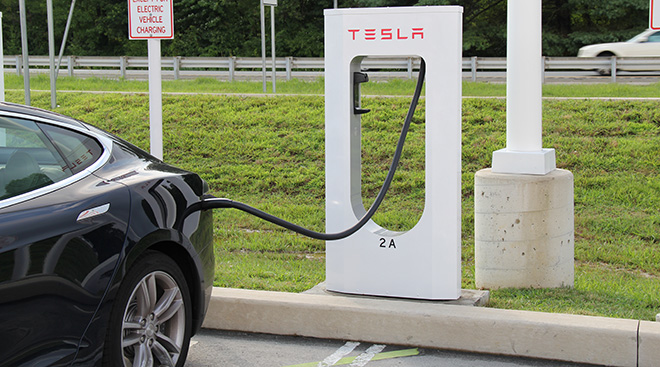
I live in Iceland. But since you live in New York, here's the map. The biggest gap on the road from Boston to Philadelphia is 92 miles (aka, the midpoint is 46 miles from a supercharger). I can't find a single location within 100 miles of New York City that's more than about 60 miles from a supercharger (and I'm trying to find the most out-in-the boonies, no-direct-route place I can). If we go much further away, the middle of the triangle between Albany, Binghamton and Newburg is about 90 miles. North-central PA can be upwards of 150 miles. Just west of Charleston, WV is about 160. Little Rock, AR is about 210. But to beat that you have to go all the way out to far southwest Texas. Remember that the ranges on the Model S are 240, 265, and 310 miles, depending on the version. And also remember that: 1) these locations being picked to be in the "middle of nowhere", there's charges in all directions from them; 2) unlike European range estimates, US range estimates generally match real-world driving; and 3) I'm only listing superchargers; there's far more slower "top it up" chargers in-between the superchargers. Superchargers tend to be primarily located along interstates, which is generally the only place that you actually need them.
As for "having seen them": unlike gas stations which are big hulking affairs, superchargers are rather small and not very standoutish (although some stations have multiple, awnings, etc... depends on the site).
-
Re:It's not that hard
Not according to Musk:
-
Who is Ian Wright?
A really helpful article on how this technology came about