Slashdot Mirror
Domain: chrismckinstry.com
Stories and comments across the archive that link to chrismckinstry.com.
Stories · 12
-
First Science From A Virtual Observatory
mindpixel writes "I first mentioned Virtual Observatories in my July 2000 Slashdot interview. Now, nearly four years later, Spacetelescope.org is reporting a European team has used the Astrophysical Virtual Observatory (AVO) to find 30 supermassive black holes that had previously escaped detection behind masking dust clouds. The identification of this large population of long-sought 'hidden' black holes is the first scientific discovery to emerge from a Virtual Observatory. The result suggests that astronomers may have underestimated the number of powerful supermassive black holes by as much as a factor of five." -
Slashback: Australia, Nomenclature, Books
Slashback tonight brings a few updates on topics ranging from linux.conf.au and free books online to how you can help pay off Dan Peng's legal debt to the RIAA. Read on below for the details. Since you can never hear enough about linux.conf.au Kimberly Shelt writes: "Actually I wrote a whole article about it this month. Complete with hype about Kfishes, miniconf etc :) It included the direct link to the current LCA2004 pages :) and a tiny pic of scrubby :) what more can you want :)"Please, no more name changing. suqur writes "As a follow-up to many stories previously posted, News.com reports that the recently renamed Mozilla Firebird browser (previously known as Phoenix) has finally given up on its new name, and relinquished the name. The new names for the Mozilla Firebird and Mozilla Thunderbird will be Mozilla Browser and Mozilla Mail, respectively. Looks like they're right back where they started, eh?"
Whatever the name, Mozilla is still only almost perfect: GeekLife.com writes "An old Mozilla exploit continues to crash almost any version/flavor of Mozilla with just 5 lines of plain HTML code (no JavaScript, ActiveX, etc.). If you're very brave, you can test/crash your Mozilla by going here.
It's important to report fairly on issues like this, or people will come to think of the Open Source journals as biased, uninformative, irresponsible propaganda machines, which will greatly harm any legitimate cause that the OS folks are promoting."Books to download, at varying prices. Scott Pendergrast writes "We're working here at Fictionwise to convince publishers to release Neal Stephenson's works as eBooks. Recently his Cryptonomicon work finally became available in Secure Microsoft and Palm Reader formats (yes, the irony of this title being sold in an encrypted format is not missed ;-)
To encourage sales of this title, which hopefully will result in more of his works becoming ebooks, we're offering a 50% micropay rebate on it (so we're actually losing a bit on each sale)."
If you like your books free and non-fiction, though, mindpixel writes "I am not lying. The National Academies Press which was created by the National Academies to publish the reports issued by the National Academy of Sciences, the National Academy of Engineering, the Institute of Medicine, and the National Research Council, all operating under a charter granted by the Congress of the United States, has more than 2,500 free, searchable, high quality books online. Some random examples:
- The Genomic Revolution: Unveiling the Unity of Life
- Strange Matters: Undiscovered Ideas at the Frontiers of Space and Time
- Who Goes There?: Authentication Through the Lens of Privacy
- Microbial Threats to Health: Emergence, Detection, and Response"
This ought to be tax-deductable, too! ThreeToe writes "Recently the RIAA settled a lawsuit with four college students; one of them was Daniel Peng of Princeton University. Daniel is accepting donations to help pay his $15,000 settlement fee along with related legal fees. You can send money via paypal by clicking here. Remember that Daniel simply wrote an MP3 search engine; he didn't distribute MP3s himself. Those who share my belief that this lawsuit was wrong-headed should make a statement by assisting Daniel."
- The Genomic Revolution: Unveiling the Unity of Life
-
Interview With Planet Hunter, Geoff Marcy
mindpixel writes "I was told as a child we'd never 'see' atoms or planets of other stars. Now with atomic force microscopes we 'see' atoms and with almost any telescope and statistics we 'see' planets. In the amazing online journal - Astrobiology - Planet-finding scientist, Geoff Marcy, describes just how it feels to find a new world." -
Space Pictures From Near and Far
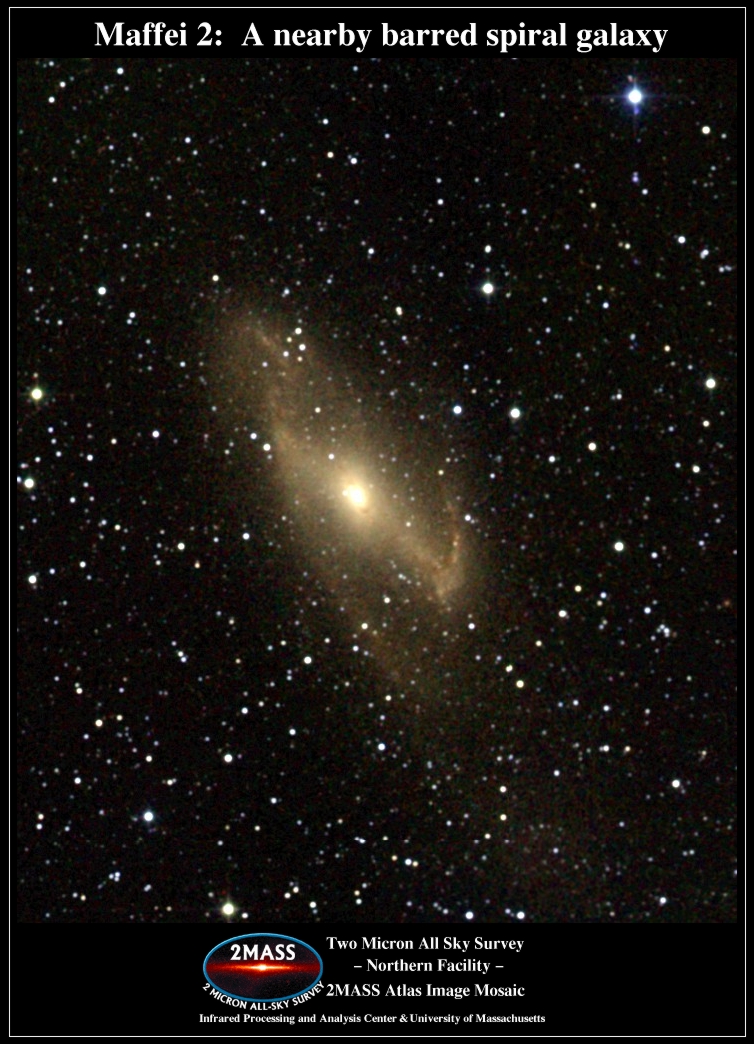
Buran writes: "The BBC News has a fine story about the how our galaxy looks from the outside according to the 2-Micron All-Sky Survey (2MASS). The article describes the shape of our galaxy (a barred spiral; all those books showing concept paintings of a regular spiral galaxy will be out of date now) and how the survey was done (near-infrared measurements of 500 million carbon stars). For the first time, we can see the center of our own Milky Way. All our worldly troubles seem so small..." That takes care of the big picture; Chris McKinstry has submitted news of much closer but just as exciting shots of Saturn -- read below for more on those.mindpixel writes: "I was very excited when I saw this amazing shot of Saturn come up on the control room monitors of the VLT in November, and I'm even more excited that as of today the image is finally public. It is possibly the sharpest view of Saturn's ring system ever achieved from a ground-based observatory. All of us here at the observatory are quite proud of it, especially the NAOS-CONICA team."
-
Giant Telescopes Of The Future
mindpixel writes: "Mindjack just published my article about the the future of very large telescopes, such as the VLT and the OWL which I talked about in my /. interview. In addition, I talk about a future space-based telescope that would use the Sun's gravity to 'image large surface features,' of extrasolar planets, which telescpes like the VLT can just detect, 'such as oceans, continents or ice caps, or even the impact of civilization on such features.'" -
Scientists Build Microscope Onto The Head Of A Rat
mindpixel writes: "Unisci is reporting: 'The ability to see individual neurons in detail in the brains of conscious, behaving animals seems like the stuff of science fiction. But in the current issue of Neuron, Professor Winfried Denk and colleagues report that they have done just that. In a stunning technical achievement, they have built a tiny, powerful microscope onto the head of a rat.'" This might be technically stunning, but I wonder how much the rat likes it. -
100 Meter OWL Telescope Project
mindpixel writes: "The European South Observatory (my employer) is getting VERY serious about building the OWL (OverWhelmingly Large) 100 meter telescope. Check out this new site dedicated to the project. You can see some cool diagrams of what the OWL telescope will look like and some simulated images here." For more about telescopes of unusual size, you might read McKinstry's interview last year. -
Vinge and the Singularity
mindpixel writes: "Dr. Vinge is the Hugo award winning author of the 1992 novel "Fire Upon the Deep" and the 1981 novella "True Names." This New York Times piece (registration required) does a good job of profiling him and his ideas about the coming "technological singularity," where machines suddenly exceed human intelligence and the future becomes completely unpredictable. " Nice story. And if you haven't read True Names, get a hold of a copy, plenty of used ones out there. -
Text to Speech Software Copies Any Human Voice
mindpixel writes " A New York Times Report (registration required) states that AT&T Labs will start selling speech software that it says is so good at reproducing the sounds, inflections and intonations of a human voice that it can recreate voices and even bring the voices of long-dead celebrities back to life. The software, which turns printed text into synthesized speech, makes it possible for a company to use recordings of a person's voice to utter things that the person never actually said." -
Nanopore DNA Sequencing
mindpixel writes: "Harvard scientists have concieved a revolutionary technology for probing, and eventually sequencing, individual DNA molecules using single-channel recording techniques. The technique essentially pulls a single strand of DNA through a nanopore, reading off the individual bases electrically. The technique could allow for decoding of a person's genome in hours instead of years." While the sequencing in hours instead of years is something that's pretty darn cool, our holdup in using this data is actually now what the genes are, and how they interact. That will still take years for us to figure out. -
Is Brownian Motion The Secret Of Life After All?
mindpixel writes: "unisci is reporting research from Georga Tech that suggest the the key motor protein ATP works by 'rectified browian motion' as a kind of thermally driven nano-ratchet. The researchers said "We're arguing that Brown really had discovered the secret of life ... When you get into this sub-cellular level on the nanometer scale, the dynamics and vitality of protein molecules is really due to thermal motion." The implications for nanotech are obvious." -
Comet Hale-Bopp
mindpixel writes "When Comet Hale-Bopp passed through the inner solar system in early 1997, it was admired in the sky by a substantial fraction of the world's population. Now ESO (European Southern Observatory) has imaged the comet at 2 billion kilometers." Hale-Bopp has a 4000-year period, so savor it while you can. :)