Slashdot Mirror
Domain: cmu.edu
Stories and comments across the archive that link to cmu.edu.
Comments · 2,977
-
CAGW once ran a hit piece on me
Citizens Against Government Waste once ran a hit piece on me, prompted by the Church of Scientology. (What I don't know is whether the Scientologists actually paid them cash to do it, or merely supplied the material.) They ran this piece without ever attempting to contact me or Carnegie Mellon University to verify their facts, or ask for a comment. They also didn't have the guts to post the URL for the web site they were complaining about, which concerned the Sherman Austin free speech case. As far as I can tell,they're just a bunch of clowns pretending to guard the people's interests while cynically pursuing their own -- much like the rest of Washington.
-
Re:And the Ever Popular...
And I really love this one: i=i++
Then you'll love this even more:pmessage(messages[i++], recipients[j], groups[j]);
for (zz=0;zz<4000;zz++) {int i=i++;};
According to Google, from bronco.final/tools/mess.c (how appropriate) at http://www.cs.cmu.edu/afs/cs.cmu.edu/usr/jch/netre k/code/bronco.final.tar.gz -
A complete book online for free
Purely Functional Datastructures by Okasaki.
-
Re:Wrong enlightenment
Discordia comes in many flavors, but in some that taste slightly purple you may find a story of zen from which the word enlightened might be linked to a page which does not exist fnord. And if you seek but no not find what does not exist, have you not, in fact, found exactly what you were looking for?
-
Anti-copyright and free book
Hey, it's a free book and funny as hell. http://www.cs.cmu.edu/~tilt/principia/
_Principia Discordia_ was published under an anti-copyright. A few years ago, there weren't that many anti-copyrighted popular books out there. For more on his influence, check out the jargon file entry on _Principia Discordia_. Most of my High School friends read the Illuminatus Trilogy, and he also wrote for a number of magazines like Mondo2000 and other 'reality hacker' type stuff.
Robert Anton Wilson has always been entertaining, surreal and though provoking, although his philosophical ideas aren't exactly terribly sophisticated, they are fun. It's hilariously paranoid; and he introduced a lot of kooky ideas to the mainstream. I don't think the movie _National Treasure_ would exist without RAW's writings in Illuminatus. Too bad he got no cameo or piece of that.
His philosophy is solipsistic, and while I prefer to imagine a real external universe as it has more capacity to surprise and educate me, the flip side of his "you create the universe" attitude is personal empowerment and a real enthusiasm for spontaneity and disinhibition. This is the sort of thing Crowley meant when he said "Do What Thou Wilt shall be the whole of the law" except RAW had a sense of kindness and humor Crowley was sorely missing. With RAW, you could never be certain if he was serious or kidding, and he'd probably insist on both at all times.
He's a great kook, tremendously influential on our geek culutre, and now he is in difficult circumstances. -
Re:Nuclear fueled payloads...
Personally, I am not that sure I'd want anything with nuclear fuel (such as some satellites have these days) being accelerated to mach 23 on or near land, let alone trusting the casing to withstand 2000g.
This is merely an engineering question. Engineering something to stand 2000 g's is not difficult, it's just a matter of safety factors. We have developed shells and complex electronics which survive 20,000g's.
The energy use would also be far lower, since you don't have to lift the fuel into space along with the payload. -
Real mirror of videos (temporary)
The server is half dead now, so I put up a real mirror of the actual mpg files here. It will not be up permanently, so somebody should post these videos with bittorrent or put it on youtube. You've been warned
-
Re:I guess you should have read the other commentsAnd if you could be bothered to dig any deeper than slashdot and youtube, you might find that there is more going on here than you think: http://www.etc.cmu.edu/projects/ibi/platform_runt
i me.htm. If this were simply a "ventrilquist's dummy," there should be no need for software such as the following:The Babble application is a simple implementation of the open-source Sphinx voice recognition package developed at Carnegie Mellon University, enhanced with the capability to pass messages over IPC. Babble listens for and captures chunks of sound that are louder than base ambient noise, then runs an analysis on the captured waveforms to identify phonemes. The identified phonemes are then matched against a database of predefined words, and any matches are passed to CSCS over IPC for implementation. This system works fairly well for simple voice responses to Quasi's questions.
It would appear that what is shown on the Discovery episode was an earlier version of the platform. That is, unless CMU is trying to put a hoax over on us. -
Re:Yawn....
I think researchers need to stop this sort of research which is based on hollywood science craption and focus on creating things that are actually real...
What part of Entertainment Technology Center made you think it had any kind of strong AI? Words such as "animatronic character" and "armature" (from puppetry) are used to desctibe Quasi, and give it away immediately. The article doesn't claim it to be more (The summary does, perhaps, but that isn't the project's fault, is it?). It's a robot in the same sense as "robot wars", which IMO kind of diluted the word "robot", but that's what caused the word "autonomous robot" to be coined. This isn't being run out of the CS department nor the Robotics Institute, so I'm not at all suprised at the lack of autonomy.
If you want people at the same university working on modular robots, check out Claytronics and these snake robots. Let's let the different researchers do what they do best, okay? -
Re:Yawn....
I think researchers need to stop this sort of research which is based on hollywood science craption and focus on creating things that are actually real...
What part of Entertainment Technology Center made you think it had any kind of strong AI? Words such as "animatronic character" and "armature" (from puppetry) are used to desctibe Quasi, and give it away immediately. The article doesn't claim it to be more (The summary does, perhaps, but that isn't the project's fault, is it?). It's a robot in the same sense as "robot wars", which IMO kind of diluted the word "robot", but that's what caused the word "autonomous robot" to be coined. This isn't being run out of the CS department nor the Robotics Institute, so I'm not at all suprised at the lack of autonomy.
If you want people at the same university working on modular robots, check out Claytronics and these snake robots. Let's let the different researchers do what they do best, okay? -
Re:Yawn....
I think researchers need to stop this sort of research which is based on hollywood science craption and focus on creating things that are actually real...
What part of Entertainment Technology Center made you think it had any kind of strong AI? Words such as "animatronic character" and "armature" (from puppetry) are used to desctibe Quasi, and give it away immediately. The article doesn't claim it to be more (The summary does, perhaps, but that isn't the project's fault, is it?). It's a robot in the same sense as "robot wars", which IMO kind of diluted the word "robot", but that's what caused the word "autonomous robot" to be coined. This isn't being run out of the CS department nor the Robotics Institute, so I'm not at all suprised at the lack of autonomy.
If you want people at the same university working on modular robots, check out Claytronics and these snake robots. Let's let the different researchers do what they do best, okay? -
Re:Yawn....
I think researchers need to stop this sort of research which is based on hollywood science craption and focus on creating things that are actually real...
What part of Entertainment Technology Center made you think it had any kind of strong AI? Words such as "animatronic character" and "armature" (from puppetry) are used to desctibe Quasi, and give it away immediately. The article doesn't claim it to be more (The summary does, perhaps, but that isn't the project's fault, is it?). It's a robot in the same sense as "robot wars", which IMO kind of diluted the word "robot", but that's what caused the word "autonomous robot" to be coined. This isn't being run out of the CS department nor the Robotics Institute, so I'm not at all suprised at the lack of autonomy.
If you want people at the same university working on modular robots, check out Claytronics and these snake robots. Let's let the different researchers do what they do best, okay? -
Re:Yawn....
I think researchers need to stop this sort of research which is based on hollywood science craption and focus on creating things that are actually real...
What part of Entertainment Technology Center made you think it had any kind of strong AI? Words such as "animatronic character" and "armature" (from puppetry) are used to desctibe Quasi, and give it away immediately. The article doesn't claim it to be more (The summary does, perhaps, but that isn't the project's fault, is it?). It's a robot in the same sense as "robot wars", which IMO kind of diluted the word "robot", but that's what caused the word "autonomous robot" to be coined. This isn't being run out of the CS department nor the Robotics Institute, so I'm not at all suprised at the lack of autonomy.
If you want people at the same university working on modular robots, check out Claytronics and these snake robots. Let's let the different researchers do what they do best, okay? -
Nice try, but no
This is what you want:
http://www.etc.cmu.edu/projects/ibi/
http://www.interbots.com/
Short answers: They're not "researchers", but Entertainment Technology grad students designing an interactive experience. Quasi has an operator behind a curtain somewhere offscreen, using his microphone and camera to hear and see the audience, and controlling Quasi's responses with a voice-modulating microphone and custom software to handle emotive state and movement. Quasi is a very impressive feat of robotics, audience interaction, and development tools, but there's no AI involved. -
Gigapan
The Gigapan creates multi-gigapixel panoramas using an off-the-shelf digital camera. The downside is that many pictures are taken and then combined into a single panorama. The upside is that it's much higher-resolution and a lot cheaper than $36K. Check out the site -- if you zoom in on the Golden Gate bridge you can see the speed limit sign
-
Check out http://www.terk.ri.cmu.edu/
Their project lets you toy with robotics easily to start, doesn't require too much cash, and you can get as deep as you want. I'm thinking of jumping in. http://www.terk.ri.cmu.edu/
-
Check out open coursewareI feel for you, high schools are most not focused on this problem. Most of the classes you want are probably in college. Get good grades and high SAT score so you can get into the college of your choice, hopefully with a scholarship. This is really important.
Until then, several of the really good colleges have open courseware that you should start working with in your spare time:
-
Nice, but easier & cheaper is also possible
If you want a robot that's relatively cheap (~$500) and easy to build, check out TeRK (Telepresence Robot Kit). It's got easy step-by-step instructions and even pictures of all the tools you need, in case you don't know what a 3/32" Allen Wrench looks like. Pretty cool stuff.
-
Database BenefitsThere has been an example presented on this, already. A GPU can be useful for doing large sorts, which is something databases tend to do quite often in complex queries. It was a win if there was more than 1MB of data to sort.
The benefit comes in that the GPU is tightly connected to a bunch of fast RAM that isn't being competed over by the general purpose CPU(s).
So, you throw 128MB or such of data onto the GPU, and you can get it sorted several times faster than a regular CPU could do it. Presumably, more onboard memory could give even more of a win.
-
Re:Mindstorm
You'd be surprised at the amount of lego used by scientists in quick setups.
There's a surprising amount of things that can be done with Mindstorms. You can even use a wide variety of alternative programming languages such as robotC or leJos a form of Java. These are just two of many different projects.
Just have a look around and you'll find lots of different pages about modding, and making custom bricks. It's much more potent than any of the "build your own robot-arm" type of kits. (which you can also do with Mindstorms) -
Hail Eris! All Hail Discordia!Its good to know that we Discordians have the pull in the scientific community that one would exspect us to.
ON PRAYER
Mal-2 was once asked by one of his Disciples if he often prayed to Eris. He replied with these words:
No, we Erisians seldom pray, it is much too dangerous. Charles Fort has listed many factual incidences of ignorant people confronted with, say, a drought, and then praying fervently -- and then getting the entire village wiped out in a torrential flood.
"Of course I'm crazy, but that doesn't mean I'm wrong. I'm mad but not ill"
-
Re:I call bullshit
And if you would actually read the page I linked to you would see that even the latest improved CAPTCHA has a 33% success rate which is more than sufficient for most purposes.
And if you would actually look at the CAPTCHAs (even the "broken" ones as you call them) you would see that there are several which are damn hard to read for humans but the program doesn't seem to have any problems with them.
So I still say that you can call bullshit all you want but humans are not always better at these kind of things.
What we _are_ good at is cognizing all kinds of objects and even better, abstract notions, something that a computer would not easily copy, but if I see examples of this: http://gs264.sp.cs.cmu.edu/cgi-bin/esp-pix it's even damn hard for human beings! -
Podcasting my classes at CMU
Or take my answer: make them all available, freely and openly. I'm not having this semester's lectures videotaped, but I did three semesters ago. (The content hasn't changed that drastically, and the videotaping is a bit pricey.) I post the links to the video and the ppt/pdf/ps for the lecture notes immediately after class.
Why not? Your students are adults. I suspect I took a 10% attendance hit because of the videotaping, but the students were almost universal in saying that they liked having the videos around. Watching class at 2x speed is apparently a great trick.
Why bother restricting to just students in your class? Unless it's the cost of bandwidth, I don't get it. Perhaps there are students out there who'd really love to see the material, but wouldn't have the opportunity otherwise. Watching the video is not a substitute for the whole experience of the class (or for attending university); if MIT, CMU, and Stanford are all not worried about it, why should you be? -
Podcasting my classes at CMU
Or take my answer: make them all available, freely and openly. I'm not having this semester's lectures videotaped, but I did three semesters ago. (The content hasn't changed that drastically, and the videotaping is a bit pricey.) I post the links to the video and the ppt/pdf/ps for the lecture notes immediately after class.
Why not? Your students are adults. I suspect I took a 10% attendance hit because of the videotaping, but the students were almost universal in saying that they liked having the videos around. Watching class at 2x speed is apparently a great trick.
Why bother restricting to just students in your class? Unless it's the cost of bandwidth, I don't get it. Perhaps there are students out there who'd really love to see the material, but wouldn't have the opportunity otherwise. Watching the video is not a substitute for the whole experience of the class (or for attending university); if MIT, CMU, and Stanford are all not worried about it, why should you be? -
Old Dos Music Apps Can't Be Beat
The Linux Dos emulator Dosemu, uses FreeDos. Dosemu is extremely easy to install and use, and once you do, you have access to all the old Dos music applications that have now been released for free.
These include Sequencer Gold Plus, and, if you don't like the tracker interface, the CMU Midi Toolkit, which allows score info to be entered in a text file.
A lot of these original Dos programs really haven't been beat, and when combined with Linux and a modern soundcard and midi/soundfont instruments -- you can have a pretty robust home music setup.
-
Re:Geez that's addictive
The ESP game http://www.espgame.org/ was originally developed by Luis von Ahn http://www.cs.cmu.edu/~biglou/, and seems to be the basis of the Google product.
-
Re:Geez that's addictive
This was licensed from the Human Computation project, spearheaded by Luis von Ahn and Manuel Blum, at CMU. They also developed the CAPTCHA.
You can see a talk given at Google, and a summary of the research. -
Re:Geez that's addictive
I'm pretty sure I've seen some university project identical to this some time (1 year ?) ago. So it's definitely been done before. Although google does make a perfect (or at least a lot more suited) maintainer for such a project.
It's basically a licensed version of the work by Luis von Ahn, a grad student (and now professor) at Carnegie Mellon. It's pretty similar to his Peekaboom game. -
This is Luis Von Arn's Human computation work...
http://www.cs.cmu.edu/~biglou/research.html has the papers and http://www.peekaboom.org/ is the game implementation.
-
Re:Scientology and agnosticism
The psychological torture of Scientology is by no means satirical. Read for example this http://www.cs.cmu.edu/~dst/Library/Shelf/pignotti
/ and then call it satirical. There is nothing satirical about this however humor may help to soften the pain. You'll need that when you read the earlier mentioned page. These very same people raided my ISP (Xs4all) in 1996 because an important part of lecture of Scientology (Fisherman) was published and critized on their servers. No fun. They lost their case though. Also, mr. Hubbard is tied to the Illuminati as shortly shown in the documentary "Secret Lives - L Ron Hubbard". -
Re:kids programming languageWhile Alice may initially seem to provide a really nice graphical programming environment for beginners, it has, in my experience and that of some of my co-workers, a few limitations that will quickly stifle budding programmers:
- Using a variable as an array index instead of a constant causes the interpreter to fail mysteriously with a stack dump. Good luck using arrays for anything interesting.
- There doesn't seem to be any way for a program to dynamically create objects; you have to statically define them at startup.
- Debugging features seem to be limited to the 3D universe view and a crude print function (which is really odd considering that Andrew Ko at CMU has used Alice as a foundation for a ground-breaking debugging tool).
-
Ancient
This is so not-new it's not even funny. I've already seen FreeNet and MNet mentioned as precursors, which is appropriate. Dozens of other P2P "filesystems" (in quotes because I don't believe it's truly a filesystem unless it's fully integrated into the OS) and block-level data stores have done this. Probably the one that most thoroughly examined the inherent tradeoffs, and that's most directly based on Shamir's IDA work, is PASIS at CMU. Presenting Cleversafe as the first to move in this direction is an insult to those who have gone before.
-
Re:Legitimate question...
Agreed. In an ideal world, everything gets fixed that SHOULD be fixed. And nothing is impossible to fix. But fixes cost time and money and my choice is not quite as clear cut as you make it out to be. Believe me, if I thought I could push and make this software "perfect", then we would be pushing for that. Hell, I would LOVE to have an SEI/CMM level 5 operation. But there are only a few operations that can spend the money to acheive that level of quality -- NASA and Motorola being two of them that I know. I am certain that the software vendor we are using is not that tight.
And you don't have to pay for the poor implementation -- I do. You see, I don't design or implement software for a living. I used to. But those days are behind me and now I have a business to run that is dependent on other people's software. When you get your business up and running on a vendor's software and that software doesn't do exactly what you want it to do, then you have two choices:
a) Switch (with HUGE costs in both IT, training, business operations, etc)
b) Deal with it as best you can and hope that you can get it fixed at some point (and it IS a negotiation with the vendor).
The point of my previous post was that it's very easy to say "well, if your vendor isn't doing things right, then switch or push harder" -- but the reality is far different. Just look at any SAP implementation and you will see what I am talking about. The IT world is riddled with failed implementations. Some are due to technology. Many more are due to poor requirements, poor training, poor documentaiton, and an overall poor understanding of what it was supposed to do.
In sum, you have to pick your battles. And the caps-lock key is NOT a battle I am going to pick with my vendors. There are other, larger issues to worry about.
You said it yourself that you can re-map the caps-lock. So just go do that. And let the rest of us keep using the caps-lock since it's been there, well, since we started using keyboards.
(note: We certainly agree on detesting badly written software but my comments were more about -- what do you do when you already HAVE badly written software) -
Re:Question?
First off, you are completely wrong about why Newton used geometry instead of calculus. He used geometry, not because it was some mysteries science of alchemy, he used geometry to be RIGOROUS! It is true that he had invented calculus, and it was ingenious, but it was in no way solid mathematics. Indeed, it wouldn't be until the 18th century, with developments by Cachy and Riemann and others. Newton understood this. He knew very well, that it is mathematically dodgy to deal with infinitesimals, and you know what, he was right. So instead of using calculus, a very new, poorly understood and mathematically dodgy discipline, he used instead a branch of mathematics that was old and very well understood. He used the language of Euclid. And you critizise him for this?
And it's also completely wrong to say that he disregarded calculus completely. Just look at lemmas I-IV of book 1 (and yes, I have read it, you obviously haven't), where he places parralellograms under a curve and let their width diminish to zero and their number to infinity. Sound like any theorem you might recognize? Since you probably don't know enough math to figure it out, I'll just tell you, it's the fundamental theorem of calculus. Before spouting things like "Have you actually read the Principia?", make sure that the person you're speaking to actually haven't, and make sure that you have atleast opened the FIRST PAGE of book 1. The theorem is on THE FIRST FUCKING PAGE! Look and see for yourself. See that little image there? Compare that to this, which is how people prove the fundamental theorem of calculus nowadays, with Riemann integrals.
You're list of accomplishments from Hooke just proves my point. Did any of them even come close to being anywhere near Newtons accomplishments? He discovered craters on the moon. Meh. He discovered that Mars is really spinning. Dobule-meh. Wave theory of light? That wasn't him, that was Huygens, and nobody had proven it till Thoman Young. The only one that really comes anywhere near Newton is the inverse square law, and that claim is dubious at best. Even if he did think of it first, he just thought of it as a hypothesis, a "what-if". Newton took that law, and explained the world an how everything works.
And yes, to the 17th and 18th century mind, he did explain everything. Science was physics, it was astronomy, it was explaining why things moved the way they did. The rest of the stuff, biology, magnetism, optics, they were the small stuff that could be dealt with once you actually find out how the world works.
Also, while I don't dispute that Leibniz was Newtons intellectual equal, when it came to physics, Newton was a giant and Leibniz....well....not so much. His monadology was a nice philosophy, but can you honestly claim with a straight face that it had a millionth of the influence on the scientific world in comparison to Principia. Even Wikipedia which you quote so extensively, agrees with me. Quote, "While he may have been Newton's peer as co-discoverer of the calculus, he was not in Newton's league as a physicist and may even deserve to be ranked below his mentor Huygens". When it comes to physics, there are two giants. Einstein and Newton. They explained the world, no one else. There are a few that comes very close (most notably Maxwell and the quantum mechanics guys), but those two have no peer, and it's ridiculous to claim that Hooke and Leibniz were even close to them.
You're obviously a big Stephenson fan (obviously your main, if not only, source of information) and I like Quicksilver too. It's a good book. But even he admits that Newton and Leibniz were the best. Over and over again, he states (well, Daniel Waterhouse does) that Newton and Leibniz are the greatest. He portrays Ho
-
Link to videos
for the lazy:
response to a disturbance: http://www.msl.ri.cmu.edu/projects/ballbot/video/b allbot_push.mpg
point-to-point motion: http://www.msl.ri.cmu.edu/projects/ballbot/video/n sh3305short.mpg -
Link to videos
for the lazy:
response to a disturbance: http://www.msl.ri.cmu.edu/projects/ballbot/video/b allbot_push.mpg
point-to-point motion: http://www.msl.ri.cmu.edu/projects/ballbot/video/n sh3305short.mpg -
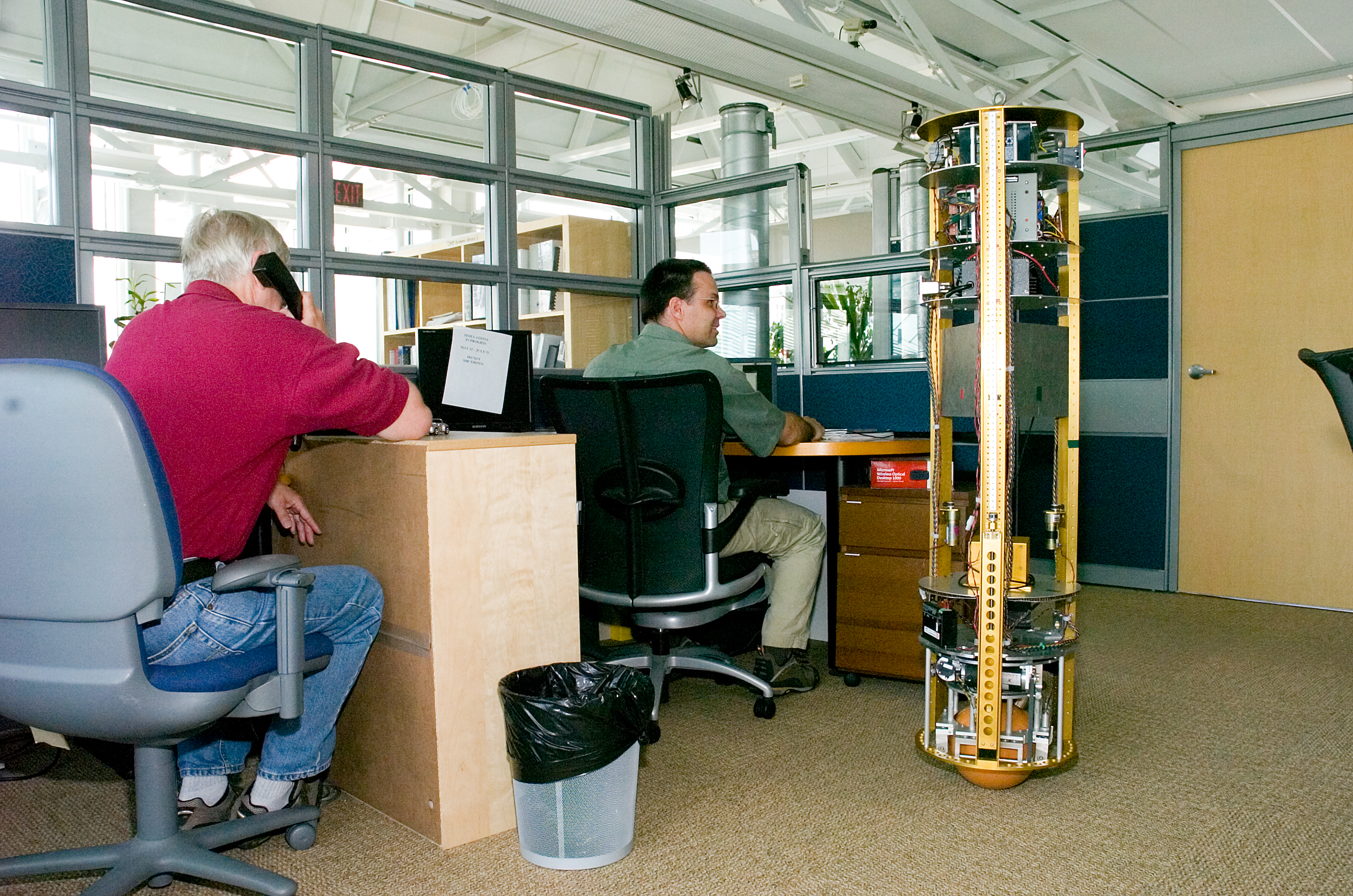
Note to guy in red shirt who works on robots
Clip your fingernails, man!
http://www.msl.ri.cmu.edu/projects/ballbot/images/ CMU_BallbotOffice.jpg -
Videos!
The first thing I wanted was video, so here ya go:
http://www.msl.ri.cmu.edu/projects/ballbot/video/b allbot_push.mpg
http://www.msl.ri.cmu.edu/projects/ballbot/video/n sh3305short.mpg -
Videos!
The first thing I wanted was video, so here ya go:
http://www.msl.ri.cmu.edu/projects/ballbot/video/b allbot_push.mpg
http://www.msl.ri.cmu.edu/projects/ballbot/video/n sh3305short.mpg -
A useful HTML article (better than 9999TB AVI)
-
Re:wikipedia link
This source about stack computing is better.
Sadly I actually still work on a stack computer, and I had to go look it up. -
Web games much better for collecting this info
I kind of feel bad for Cyc/OpenCyc... they've put so many years into this project, but using web-based games to collect and verify this common-sense data is much faster than using a few paid experts and can give much more data. For the curious, Luis von Ahn, a grad student (and now assistant professor) at Carnegie Mellon University gave a (rather entertaining) tech talk at Google about his work in this area.
He's recently been working on a project called Verbosity, which uses such games to collect the same sort of common-sense data that Cyc has been trying to collect all these years. Cyc's ontology apparently contains "hundreds of thousands of terms, along with millions of assertions relating the terms to each other." If Verbosity is as popular as von Ahn's ESP Game, the game could probably construct a better database in a matter of weeks.
Here's the abstract from a research paper on the topic:
Verbosity: a game for collecting common-sense facts
We address the problem of collecting a database of ""common-sense facts"" using a computer game. Informally, a common-sense fact is a true statement about the world that is known to most humans: ""milk is white,"" ""touching hot metal hurts,"" etc. Several efforts have been devoted to collecting common-sense knowledge for the purpose of making computer programs more intelligent. Such efforts, however, have not succeeded in amassing enough data because the manual process of entering these facts is tedious. We therefore introduce Verbosity, a novel interactive system in the form of an enjoyable game. People play Verbosity because it is fun, and as a side effect of them playing, we collect accurate common-sense knowledge. Verbosity is an example of a game that not only brings people together for leisure, but also collects useful data for computer science. -
Web games much better for collecting this info
I kind of feel bad for Cyc/OpenCyc... they've put so many years into this project, but using web-based games to collect and verify this common-sense data is much faster than using a few paid experts and can give much more data. For the curious, Luis von Ahn, a grad student (and now assistant professor) at Carnegie Mellon University gave a (rather entertaining) tech talk at Google about his work in this area.
He's recently been working on a project called Verbosity, which uses such games to collect the same sort of common-sense data that Cyc has been trying to collect all these years. Cyc's ontology apparently contains "hundreds of thousands of terms, along with millions of assertions relating the terms to each other." If Verbosity is as popular as von Ahn's ESP Game, the game could probably construct a better database in a matter of weeks.
Here's the abstract from a research paper on the topic:
Verbosity: a game for collecting common-sense facts
We address the problem of collecting a database of ""common-sense facts"" using a computer game. Informally, a common-sense fact is a true statement about the world that is known to most humans: ""milk is white,"" ""touching hot metal hurts,"" etc. Several efforts have been devoted to collecting common-sense knowledge for the purpose of making computer programs more intelligent. Such efforts, however, have not succeeded in amassing enough data because the manual process of entering these facts is tedious. We therefore introduce Verbosity, a novel interactive system in the form of an enjoyable game. People play Verbosity because it is fun, and as a side effect of them playing, we collect accurate common-sense knowledge. Verbosity is an example of a game that not only brings people together for leisure, but also collects useful data for computer science. -
Re:"Allows"? it's already possible
Every single school, from the community college on up, is going to do everything it can to convince its alumni, students, faculty, and benefactors that it's doing useful and important work. Even "MIT, CMU, Stanford, etc." issue the exact same kind of PR. It's necessary everywhere.
The Bad Thing is confusing the explanation in the PR with the real research or discovery, or assuming that it's actually important because the school PR office thought it sounded neat. Which is how Roland Piquepaille wound up propagating the PR writer's mistake on the terminology ("demultiplier"). -
Re:in related news...
When I read things like this, it makes me hang my head in shame.
Yeah, I agree - with your statement, about your statement.
What, do you think you're entitled to music?
What, do you think that companies are entitled to profit? It sure would be nice to get special laws to protect any old business model you can think of, even if you can't prove it's providing a net benefit to society.
Big hint: IP doesn't count as "free market". It's more of a socialist experiment than anything related to capitalism; it's a method of distorting normal market economics to try and encourage "innovation". (I've got major doubts about using a mechanism which prevents the free flow of ideas to encourage innovation, but I suppose it sounded reasonable when they were writing the legislation.)
Thomas Jefferson would have explained to you that in a free market...
You shouldn't use the quotes of people without making sure that you know what their true feelings are. Jefferson argued strongly against any intellectual property protection at all, since he felt that ideas of any kind should be free.
Even after he eventually went along with the Constitutional phrase about IP, he argued for a strong interpretation of the "limited time" part of the IP clause. Here's an interesting link to some quotes from Jefferson & Madison concerning this subject (found with a quick Google).
-
Didn't Carnegie Mellon U. do this already
Oh wait, a little different....
take a SINGLE photo and convert to 3d...
time to merge these two technologies together?
http://www.cs.cmu.edu/~dhoiem/projects/popup/index .html -
Re:Sounds like an alternative to cross-referencing
Already done. It's pretty cool to see how the psychology topic over time turns into the AI topic:
http://www.cs.cmu.edu/~lemur/science/ -
Re:"Complexity kills"
The problem with the concept of complexity based on program length, is that program length is highly dependent on the system of encoding used to represent the program. Short programs in functional languages can be quite long in imperative languages, and lamdba calculus functions for even simple things are sometimes so long as to be impossible to represent in a published paper.
I've yet to see any "cannnonical" representation that can be used for this purpose. "Kolmogorov complexity" is not useful for these things for that reason. A more interesting metric, often used in software engineering, is cyclomatic complexity. -
Re:Don't do it.
That all said, when NASA switched to the PSP and TSP, their bug rate dropped by almost 90%, and they had to generate far less documentation. Just because you have a team with an amazing record doesn't mean there isn't a better way. NASA has learned this several times.
-
Re:Customization is King
I read your entire comment and I explained why it couldn't be done. Now die thank
- Only an idiot states that something is impossible, especially when there is solid evidence that it is possible. QED, you are an idiot.
- There are numerous examples of deformable terrain in the wild. In fact, you could find them by googling for "deformable terrain" which is exactly what I did. Most of them are not ready for prime time, but if they almost work today, we'll have enough processing power tomorrow. Thus again, you are an idiot.
- Wishing death on someone for correcting your idiot ass makes you a little bitch, in the bargain.