Slashdot Mirror
Domain: decodesystems.com
Stories and comments across the archive that link to decodesystems.com.
Comments · 11
-
Re:9-1971
Starting in the 60's was harder, and is an actuarial question now. By the time of the early 70's, the PDP-8/e was on desktops and probably somewhat common. So was dial-up or even direct-connected terminals. (Both were available in high schools in central PA, which was NOT a high-tech area).
This https://en.wikipedia.org/wiki/... was "on desktops"
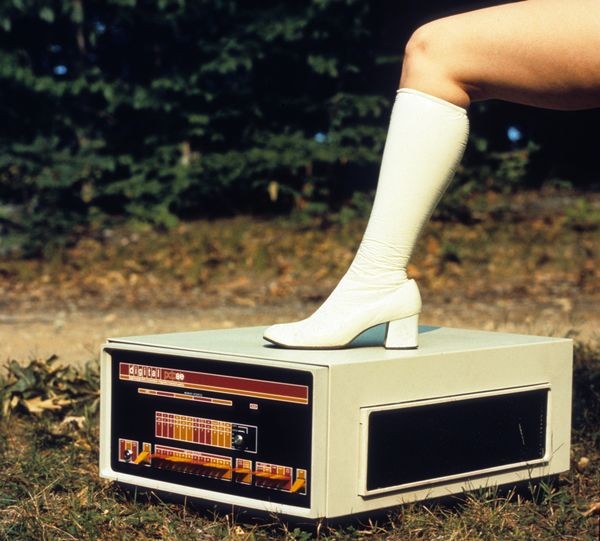
I don't think so.Perhaps you are thinking of the PDP-8, which was still not a desktop compter, but the CPU (taken out of the rack) could fit on top of a desk. http://images.computerhistory.... You'll still need peripheral devices (paper tape, maybe a disk drive) and of course a user interface (typically an ASR-33 http://physicsmuseum.uq.edu.au...).
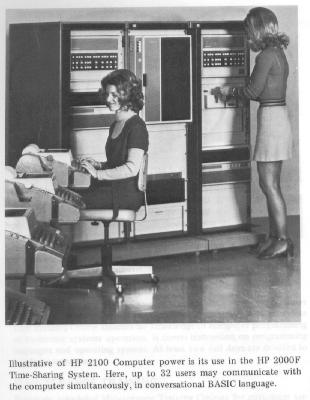
By the mid 1970s our school district had HP 2000 (that is HP 2100 series) minicomputers for timesharing (https://en.wikipedia.org/wiki/HP_Time-Shared_BASIC) and they were similar (in size and everything else) to the PDP-11 pictured above. http://www.decodesystems.com/h...
We had ASR-33s, ADM-3A CRTs. then later HP 2640 https://en.wikipedia.org/wiki/... "smart" CRT terminals.
When these HP 2000 TSB systems first came in, our school district, the richest one in the USA, was the only one outside of Cupertino (home of HP) to have this. These were very popular and by the late 70s there were a number of school districts in the country with similar setups.A sightly smaller system of the era you're talking about would be the HP 1000 series, but it is still not a "desktop" computer! http://www.memoires-informatiq...
The first desktop computer I saw was when I started programming in 1972: the Datapoint 2200 https://en.wikipedia.org/wiki/.... But I only used it as a smart terminal to submit virtual punch-card decks to the IBM/370. Well, and playing 3-D Tic-Tac-Toe (graphics!) on it, but no development environment was available to us.
The first real desktop computer I saw (and used) in those days was a few years later, in 1975, and it cost $20,000. That was the IBM 5100 https://en.wikipedia.org/wiki/.... I did APL programming on it (although mostly we worked on the mainframes, which were IBM/370 and Amdahl/470s).
The early-mid 1970s was the era of microcomputer kits (8080, Z80, 6502, 6800, etc.) and those would fit in a box on a desk. Typically with a television set on top. Keyboard separate, and probably some more boxes for periperhals (cassette tape player, floppy drives) etc. The Apple and TRS-80 complete computers all came much later.
As for tiny PDP-11 type systems...
The Heathkit H-11 https://en.wikipedia.org/wiki/... was a PDP-11 dekstop computer available in 1978 but was soon discontinued because it was too expensive for anyone to buy. (No market at that price point.) I also recall an advertisement in BYTE around 1979 for some kit that also used the LSI-11 and I am sure could fit on a tabletop by then. It might even be much slimmer than an Altair/OSI kind of box.
Of course the most beautiful desktop computer from the late 1970s was the Sol 20 http://oldcomputers.net/sol-20... . A friend of mine had one of those.
I've been programming since 1972. In the 1970s I was programming on IBM mainframes, Honeywell 6000 mainframes, HP 2000 minicomputers, PDP-10 mini-mainframes, a little microcomputer work. (A few years later I would be light years ahead, developing Lisp Machine wo
-
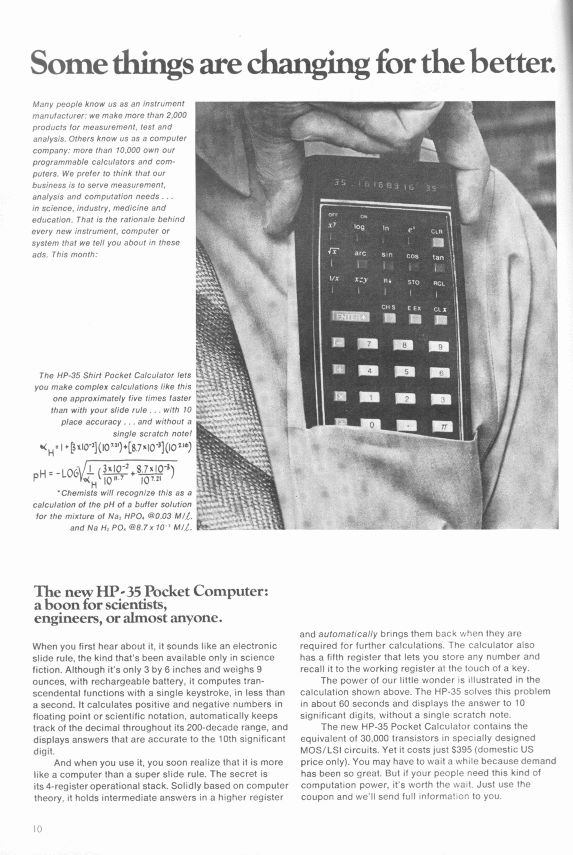
Old ad... how quaint!Google pointed me to this, where HP introduces their "electronic slide rule".
From the ad:
The HP-35 Shirt Pocket Calculator lets you make complex calculations like this one approximately five times faster than with your slide rule... with 10 place accuracy... and without a scratch note!
The HP-35 took 60 seconds to compute the formula shown on the page and it cost $395. $395 in 1972!
When I look at stuff like that I appreciate how computing has come a long way. Except for the Pentium bug.
-
Re:I'm blown away with
The government is going to *sell* the freed up spectrum. For lots of money: tens of billions of dollars. $990 million is chump change.
-
These aren't "dumb terminals" (TM LSI)
The things they're describing aren't "dumb terminals" (which is a TM of Lear Siegler International), by any stretch of the imagination. They're dumber than Xterms, but they're smarter than any of the "smart terminals" that LSI was competing with.
-
Or Bubble Memory
It was going to replace hard drives too. http://www.decodesystems.com/tib0203.html
-
Re:PCs keep lousy time.
It can. I built a Heathkit digital clock, back when you could buy electronic kits and electronic digital clocks were rare. It used the AC line as the frequency reference for the digital clock circuits. I think it used a low-voltage secondary winding on the power transformer and a schmitt trigger to generate a 60 Hz square wave. If you checked the clock against WWV, it was never off by more than a second or two. If the power company had a large load during the day, they would run the system slightly faster than 60 Hz overnight, so everyone's clock kept the proper time.
-
my first computer experience, HP 2000
In early 1970's, I recall this computer, the HP 2000, with real-time BASIC, paper tapes, and teletype terminals with modem connections. (My first computer program was on this machine, 1972!) It had great interactive games, all text of course, and some based on real physcial science. I recall one our Physics teacher wrote, trying to land Apollo Lunar module on the surface of the Moon, without running out of fuel, or crashing into the surface too fast. It wasn't easy, and I remember kids screaming with joy when they actully made it safe, which wasn't very often. This was real science teaching at its best.
-
Re:Ocean?
Simply because solar sails are purely science fiction right now.
So that's why it's so dark here? I thought it was because the sun had set.
Besides if they did actually build one it wouldn't work in low earth orbit where Hubble is because the Earth's magnetosphere deflects the solar particles away from Earth. You have to get pretty far out to get away from this effect.You're wrong. Even in a low earth orbit, light pressure can affect a solar sail. The original Echo comms satellites http://www.answers.com/topic/echo-satellite were nothing more than aluminiumised mylar balloons.
Their orbits were affected by light pressure from the sun http://www.decodesystems.com/btl-orbit.html
Another force that makes the satellite's orbit shift slightly is the faint pressure caused by the light from the sun. Although this pressure is much too small for us to perceive without the help of very delicate instruments, it is enough to affect a satellite, which has nothing to support it in space and is exposed to solar pressure for a very long time. Since the Echo balloon is a plastic sphere, 100 feet in diameter, that weighs only a little more than 100 pounds, the light rays striking its surface are enough to cause a second "wobble" effect. This wobble centers about the line from the earth to the sun. Light pressure also forces the orbit to go slightly out of round from a perfect circle, and other gradual effects on the satellite's orbit are caused by the gravitational attraction of the moon and the sun.
A small force, applied repeatedly over a long enough period of time, yadda yadda yadda... same as an ion-exhaust rocket. -
Re:Bollocks on the IBM 5100
My mistake, 1972 (And didn't certain Apple employees work at HP at the time?)
-
Bollocks on the IBM 5100
Sticklers agree: The 5100 represents the first production portable computer. So does the Smithsonian, where a prototype now resides.
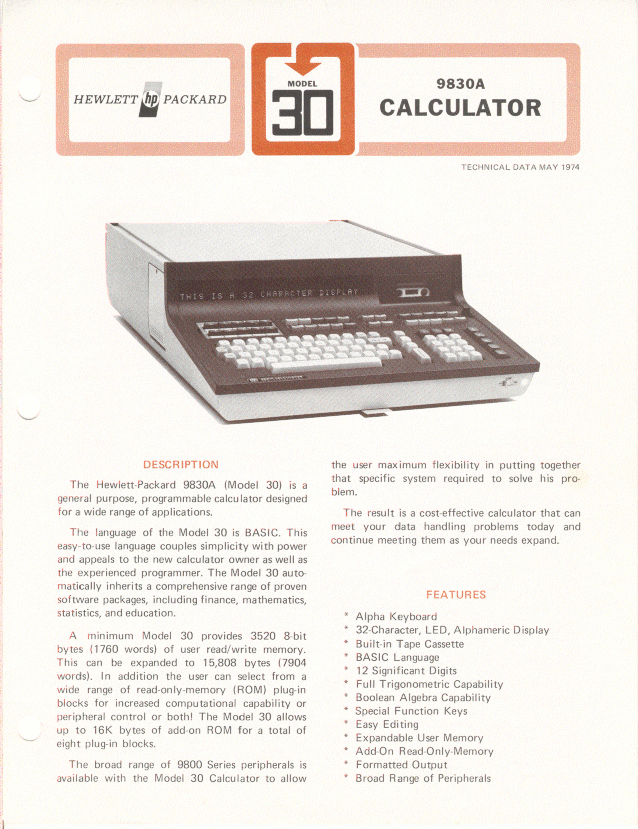
Sticklers do not agree. For some weird and stupid reason probably related to marketing, the HP9830 (1974) was classified as a "programable calculator". Balls. It was a 16 bit computer and had BASIC. (There was a thermal printer that attached to the top.) Guts and stuff -
Re:Doesn't anyone remember Lisa
No it absolutely did not.
The Lisa mouse is easily recognized by having a beige color scheme similar to the original Macintosh mouse, but with a different connector, a wider, shorter button, and somewhat different case styling.
This is a Lisa mouse.
The second mouse seen here is the original Macintosh mouse, IIRC.