Slashdot Mirror
Domain: ecomodder.com
Stories and comments across the archive that link to ecomodder.com.
Comments · 16
-
Re:Math Doesn't Add Up
"A rig hauling 80,000 lbs is going to have a constant power requirement of about 150HP to maintain 65MPH on flat, level ground. No help from aerodynamics or bearing drag"
That is nonsense.
If there is no drag: then there is no power requirement at all as soon as the car/truck has reached its speed.He didn't say no drag, he just explicitly removed 2 of the components.
By my calculations using http://ecomodder.com/forum/too... show 62HP needed for
(.0045 is based on lower end of range for truck tires from wikipedia)100HP or even 150HP is within the range of possible requirements.
I'd expect even significantly more than 150HP needs to be available for when going up a long hill.But I dont' see why the math doesn't "add up" - even if we use 150HP.
Even with 150HP, and a range (on just battery) of 190miles, the article says "travel up to 1,200 miles with the natural gas range extender"
The point isn't that it doesn't run on fossil fuels (it explicitly does)
The point is that it can run 1200 miles between refueling and do so at much lower fuel costs. 1200 miles would be 18 hours at 65mph; and truck drivers can only drive for 11 hours within a 24 hour period, so that's more than enough from that perspective - and 1200 miles will get you pretty far - enough that you wouldn't have to have the refueling points be completely ubiquitous. -
An open source car made to be customized
Modern cars are dull. I want to see more kit cars, more individual cars on the street. What we need is a new version of the Volkswagen Beetle with a self supporting frame that can be uses as a base for customized cars. The engine to ensure low emissions, the frame ans chassis for safety, the electric interfaces are provided by the base model, but the body and interior can be customized freely.
Here are examples of cars that were built on a Beetle chassis:
1952 VW-Porsche 356 Glockler Spyder Kit Car
The Apal Jet
Brubaker box
Fiberfab Bonito
Porsche 696 BeutlerAnd the engineers did not even think about customization when they designed the Beetle. Now imagine if there was a car designed from the beginning to be customized. Wouldn't that be great? I do not expect this to come from the established car manufacturers, but maybe some Chinese car company is looking for an idea to get more attention? Do this, I have been waiting long enough.
-
Re:Don't even think it
For most cars, fuel economy declines as speeds climb past 55-60mph (wind resistance being non-linear).
The truth is, it doesn't take much horsepower to maintain highway speeds.
With the current/coming flood of 7/8/9/10 speed transmissions, we can optimize the final gear or two for highway cruising speeds without compromising acceleration at lower speed.
If you want to get technical, here's a calculator that you can use if you know lots of details about your particular vehicle.
Even an F-150, which has about the same aerodynamics as a brick, only needs 80~90 hp to maintain 75 mph.
That's trivially available at super low rpms, it's just a matter of gearing down far enough to get there. -
Re:This doesn't seem very extreme.
To a large extent, it's the small car vs large car problem.
Drag depends mostly on the frontal area.
Working out Cd*area for both cars.
http://ecomodder.com/wiki/inde... looks reasonable.
This gives Cd*area (ft^2) for the Leaf as 7,
https://en.wikipedia.org/wiki/... gives the Teslas as 6.1.
(Cd*ft^2)The Tesla is - despite being a lot heavier and longer - not bigger in frontal area than the Leaf.
The Tesla is also marginally lower in absolute drag - making it 10% better in total drag or so.This would lead to the conclusion that the 3.5* battery should give about 4* the range.
But, weight does matter a bit - there is extra drag in the tyres, which knock it back to 3.5* -
We knew the gist already
We pretty much already knew that the MPG we saw on the sticker was higher than the MPG we would actually be getting. Hence the phrase "your mileage may vary."
But we also know that the sticker MPG numbers are good for comparing among similar cars, and that's mostly how we use the sticker MPGs. Kudos and thanks to 'What Car?' for calculating the 19% offset figure. I wonder if they could tell us how the offset varies among different types of cars. Maybe SUVs vs econoboxes vs sports cars have somewhat different offsets.
BTW, I would bet that different driving styles, lead foot vs hypermiling, makes a bigger differnece than the 19% calculated by 'What Car?'
-
Re:Speed is good, but what about range?
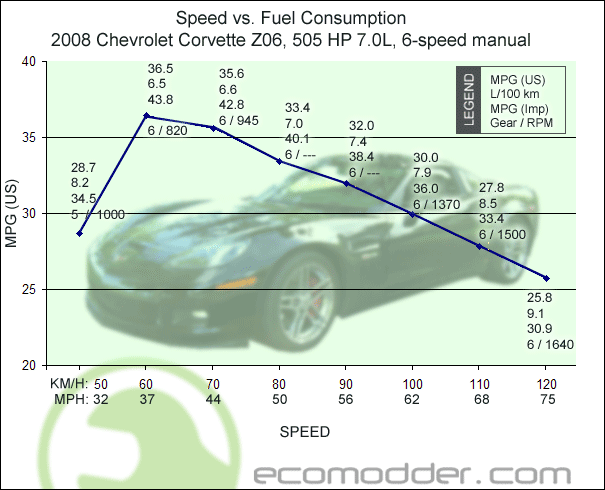
I was ready to call BS, but after a quick google search, apparently if you've got great aerodynamics, a shit-ton of torque, and a really steep 6th gear, it's entirely possible.
http://ecomodder.com/imgs/graph-speed-mpg-corvette.gif
(1640rpm in 6th at 120mph = wtf)
-
Re:Human Nature
I'm sceptical that stripping seams would make that much difference, you'd be better off with rear wheel skirts and smooth full-moon hub caps on the front. Before that I'd go to low viscosity synthetic engine and transmission oils and bearing grease, then the above. Next I'd get rid of any badges in the airstream and mod the car so the winshield wiper park below the hood out of the airflow. After that you need to get really radical like decent air dams, full belly pans, grill shutters and boat-tail the car. Lots of ideas over at Ecomoder's forums.
-
Re:Air resistance.
Add difficulty to tire changes and chaining up in the winter.
It's not that difficult to make the panels easily removable.
Make cooling less effective, which reduces engine efficiency.
Engines are more efficient when they're running hot, actually. Maybe you're referring to running rich to keep things cool... I would say that if you're doing that, you've got bigger problems, but they only stopped a few years back. It's moot now, since the emissions regs won't allow it.
The Chevy Cruze Eco has variable blocking on the grill. That seems like the way to go if you ask me.
And harder to repair. Steel can be fixed with a welding torch and a grinder. Aluminum requires special welding techniques. Patching carbon fiber is a pain, and is nowhere near as strong as the original part.
It's also too expensive for cars that are supposed to be affordable, though we're trying to fix that. Even so, the ideas for cheaper carbon fiber usually involve compromising strength. CF in a few key points might improve a car design enough to be cost effective, but in general you only use it if you're trying to go fast and have loads of $$$.
Everyone uses locking torque converters these days, and designs have improved to take less than a 5% hit to efficiency compared to manual. Once the reliability problems are solved, they'll be switching to CVTs, which beat manuals by always hitting exactly the right gear ratio for conditions, where a discrete gearbox can only manage a series of near-misses.
But will they hit the gear ratios they're supposed to for fuel economy? The Prius actually stays at a tad higher RPM than it really should, presumably for better throttle response. (Admittedly, this probably only amounts to a percent or two MPG difference.) They also appear to have neglected to map RPM against time as well as load, so (presumably to protect itself against oil overheating) it goes straight to full load when you hit about 4000 RPM. See my last paragraph...
The biggest three problems I see with fuel economy today are aerodynamics (slippery cars look weird, so they don't build them), the USA's dumb emissions regs (waaay too much weight on NOx, and most ways of making engines more efficient make more NOx), and sloppy engine computer programming.
We're getting a bit better at aero, but the public is just going to have to accept some oddly shaped cars at some point.
In Europe, they tune for good MPG rather than low NOx. The results are posted plenty of other places in these comments. You'd rather have low NOx if there weren't any tradeoff, but it tends to only be as important as our regs make it out to be some places in California.
A modern engine computer's (ECU's) software should make anyone who actually understands both engines and programming sick. To be fair, I haven't seen the actual code, but I've seen plenty of the maps used, and they're just not done sanely. The ECUs appear to have been made by programmers who knew nothing about engines, and they definitely didn't come out as well for it.
-
Re:Goalposts shifted to cover a lie
-
Engine Size
The way I figure it, sizing of the engine will be the trickiest part. Here's what I would do:
1. Figure out how much power you need to get the vehicle to go down the highway at a typical highway speed. I'm thinking 80mph is a good number, you don't want to go too low. A coast down test is the simplest way, but a rolling road wind tunnel would be the best if you can afford it. Remember to have ballast in the vehicle to simulate a fully loaded vehicle.
2. Factor in losses from your transmission type, including generator and electric motors. Plus remember to include power for air conditioning, an alternator and other power accessories you may have.
3. Select an engine. Unless you are having an engine custom made, it's not going to have the exact requirements you need. To save money, you will have to make some sacrifices. Don't forget to factor in what we engineers call "packaging". You will be installing a lot of hardware on to this vehicle and the shape of each component will become critical to ensure it all fits.
Also, it's popular to separate an engine bay into two separate sections if possible. The "hot side" is where the exhaust is. Anything that will be hot enough to fry electronics, or ignite fuel should be located on this side of the engine. The "cold side" is where your air intake is located and any sensitive electronic controllers.
I'm thinking the engine you select should have a maximum power output that is equal to the power required to drive the vehicle at 80mph (see step 1) plus any accessories. Any accelerations, or hills climbing should be performed by relying on your batteries for reserve power. Regenerative braking can be used to make up this power, as well as running the engine at maximum load while the required load to drive the vehicle is low. (i.e. the Volt's mountain mode)
Beware, diesel engines that are approved for gensets must meet different EPA requirements than those in on-road vehicles. While a genset engine is fine for your one-off vehicle, it will not be allowed in a production vehicle. -
Not new - articles for this dated 2009
-
Re:Not fugly...
They mount them on hinges and have rollers for tire contact when turning the wheels sharply, how about a Honda Civic getting 95 mpg (US) at 65 mph and Cd that tested out to be around 0.17, to make up for the inconvenience. I know the car is butt ugly, but that mostly due to the use of coroplast and duct tape instead of foam and fiberglass body work.
-
Could've had 400mi range in 10 minutes work
One thing that stands out to me is that the rear spoiler and front splitter would make for a lot of aero drag, especially where the rest of the car is rather likely to be quite aerodynamically slippery looking at it's shape. They've also tackled rolling resistance and drive-train efficiency so any gains in aerodynamics would greatly extend range. At 60mph it's the greatest force acting on this car, and with their steps towards efficiency it is even greater. If they would just ditch the big spoiler and the front splitter, they'll watch their range shoot up. 0.50 to 0.30 cd might account for 40% improvement in a vehicle where rolling resistance has been already addresed.
Don't get me wrong what these guys are doing is great, but ~270 miles range is not terribly impressive considering that's what a stock Tesla has achieved.
Ditching the wing and splitter could have yielded them 20-40% improved range at open road speed, at the small expense of the race car look. It would take a few minutes with a spanner to remove, and to put back on for parking up for a photo shoot with the local press. I hope this is what they do. Some further work with some duct tape or some more ambitious aero mods with some coroplast http://ecomodder.com/forum/showthread.php/aerocivic-how-drop-your-cd-0-31-0-a-290.html ecomodder* style and they could have squeezed out more efficiency. The very best road vehicles approach 0.15 Cd, this would have given them a shot at 500 miles range. Lower the speed a little and they may have gone 600mi / 1000km.
I can't find Radcial SR8's aero stats anywhere but I know such track day specials have a fair bit of down force by design, so a drag coefficient above 0.50 is not uncommon. This is largely the result of the wings, air damn, and underbody design. High down force set up might be over 0.70 or more. To compare, a SUV is about 0.40, a good sedan 0.32, and a Toyota Prius 0.27, Aptera is about 0.17 these vehicles are not even designed not to generate lift let alone downforce.
* Yes I do lurk there. -
Re:regen braking best case
64% is extremely good, and frankly I don't believe it. Around 33% is the norm with 50% in ideal conditions.
>>>You claim the insight's sweet spot is 50mph. Have you tried 30 mph?
The 5th gear in the insight doesn't go that low. You'd have to shift to 4th gear which of course is not as efficient due to the lower engine-to-wheel ratio. For combustion engines the most efficient RPM is in the 1800-1900 range. (Aside - greenercars.org rates the insight as about 7 points cleaner than an EV1 (i.e. 58 v. 51). The Prius was rated equal to the EV1.)
Generally speaking, the reduction in wind resistance overwhelms the efficiency penalty of running the engine in a lower gear. Look here at the fourth post down for actual numbers on a real car.
http://ecomodder.com/forum/showthread.php/mpg-vs-speed-metro-graph-115-2.html
-
Re:regen braking best case
You wrote "Consumer report test is misleading. All cars in America get rated for fuel efficiency at 55 so they are geared to perform best at that point. If they were tested at say 75 then I am sure they would be re-geared to get the best efficiency at 75."
I'm sorry, this is just wrong. I don't care how the car is geared. The formula for wind resistance is here
http://en.wikipedia.org/wiki/Drag_(physics)
Please note that there is a v^2 in that equation. That means a car at 75 mph will experience wind resistance that is six and one quarter times greater than a car going 30 mph. No gearing changes will come close to overcoming that.
If you would like to see a real world graph, look at the fourth post down here:
http://ecomodder.com/forum/showthread.php/mpg-vs-speed-metro-graph-115-2.html
-
Re:The problem is...
the best gas powered cars on the market now get 34-35 mpg. That's pretty good. A Prius gets 45, some say 50 but that's unlikely with most drivers heavy feet. The original Honda Insight could get 65mpg which is insane! Most of that efficiency was from aerodynamics. The rear wheels being covered and the shape of the tail did most of the work.
There are some cars on http://ecomodder.com/ that get more than that and are gas powered and just modded for aerodynamics. Car companies can release these kinds of low drag designs but I think they are afraid to just because it entails a different kind of styling that we are used to.