Slashdot Mirror
Domain: edge.org
Stories and comments across the archive that link to edge.org.
Comments · 307
-
Evolution
The next big step you can watch for is true AI, and as Jaron Lanier points out in his article ONE HALF OF A MANIFESTO, we're a long way from it.
New programming languages can be clever and sophisiticated - but the next step - regardless of the language, is programs that can write programs.
(mind you im quite sure these programs will use CVS!) -
Re:David Gelernter's Bio
He is well thought of by some:
From Edge:
Gelernter is one of the most brilliant and visionary computer scientists of our time. - Bill Joy
David Gelernter is one of the pioneers in getting many computers to work together and cooperate on solving a single problem, which is the future of computing. - Danny Hillis
Gelernter prophesied the rise of the World Wide Web. He understood the idea half a decade before it happened. - John Markoff
David Gelernteris a treasure in the world of computer science...a unique and profoundly important presence in the information technology community. He is the most articulate and thoughtful of the great living practitioners, and his writings examine a surprising breadth of topics with humanity, moral seriousness and aesthetic passion.... He's a full-out visionary, able to present ideas as wild and on the edge as anyone. - Jaron Lanier
There are lots of clever computer scientists; David Gelernter is one of the few who is wise. - Cliff Stoll
Still, Einstein was wise in many ways, but he also had some ideas (outside of physics) that, to be generous, weren't all that well thought out. The ideas have to stand or fall on their own merit, not on anybody's opinions of the man who has the ideas.
-
Multiverse SchmultiverseDr Lee Smolin wrote an interesting (although difficult) book about the multiple universe theory.
He theorised that all of the universe's parameters (light, gravity, strong and weak nuclear etc) were self-tuned in much the same way that life is tuned for survival. Universes where the gravity was too strong, or the charge of a particle was too weak, didn't develop black holes. Our universe appears to have thousands of black holes, and we know for a fact our universe is tuned to support life, ergo, our universe will have "off-spring", with black holes being the mothers.
He's basically doing what Creationists do - merging biological evolutionary theory with cosmological evolution, something which most scientists are quick to separate. I think he might be onto something...
_______________
-
Re:Theory
As the reply above said, great looking list. I'll have to dig a few of those out myself.
You might also want to browse some of the stuff at Edge which is right in the middle of this field. The authors who contribute there have a book called 'The Third Culture', sorry I can't give you an ISBN but UI can't find a copy myself. It's aimed as a bridge between areas in the arts and sciences. Some of the papers in it (which are on the site) are good non-technical discussions of AI/programming and the philosophy behind it. -
more thoughts
I thought about this again while carefully scraping away a week's worth of stubble from around a small crater at the corner of my mouth where an infected wisker is no more.
First of all, you need to spend some quality time with the right caliber of inspiration. Start with this web site Edge, then read some Marshall McLuhan, then some of those crazy deconstructionists and that nutbar Japanese guy who terminated history, Fukiwawa.
If it were me, I'd be inclined toward something snide such as "Cyber Hermeneutics" or plainly evasive, such as "Neo Post Modernism".
-
Good set of articles on Edge
The Edge.org has an excellent set of articles written by several of the leading evolutionists. They end up covering most of the major theories currently active in the field. Its well worth the read if you have any interest in the genetics and evolution. Here's the link:
The Third Culture -
Re: No. I hope IBM checks out Charles SimonyiXerox PARC released SmallTalk-80 to IBM sometimes in the 70s.
"INTENTIONAL PROGRAMMING" A Talk With Charles Simonyi
http://www.edge.org/digerati/simonyi/simonyi_p1.ht ml -
He was working on intentional programming
focus of his new company is to "simplify programming by representing programs in ways other than in the text syntax of conventional programming languages
No wonder.
He was working on intentional programming before he left Microsoft. -
Daniel C. Dennett
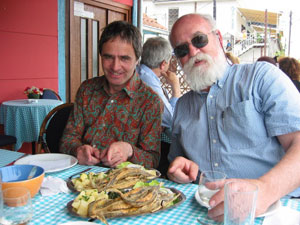
I think Mr. Dennett has a secret. His friend on the left in this picture is trying to record the secret for posterity.
-
Go to the source
Just a repackaging of what Rheingold himself wrote 2 weeks ago, Smart Mobs, with a few amusing if poorly documented anecdotes thrown in. The original is more interesting.
-
Link as html
Cool link.
Here it is in blue. -
Rheingold on Smart Mobs
FYI
http://www.edge.org/3rd_culture/rheingold/rheingol d_print.html
Howard Rheingold article on SMART MOBS, recently featured on "the Edge". Not a lot of new info for techies, but Rheingold seems to have a knack for pointing this stuff out to others... -
Rodney Books article - compiling into a DNA
Director of MIT AI lab Rodney Brooks gave a nice interview in which he mentions using a compiler to produce DNA that is then inserted in E. coli. Check this quote and read the article:
"At the wackier, far-out end, Tom Knight now has a compiler in which you give a simple program to the system, and it compiles the program into a DNA strip. He then inserts that DNA string into the genome of E. coli, and it grows into a whole bunch of E. coli. When the RNA transcription mechanism encounters that piece of DNA it does a digital computation inside the living cell, connecting them to sensors and actuators. The sensors that he's used so far are sensing various lactone molecules."
Article -
SuperComputer Dawrfed by Laptop
Being a long time Cray fan and standing in awe of how massive are the undertakings currently being driven by supercomputer, I would normally be impressed. But I just finished reading Seth Lloyd's article at the Edge. The MIT professor of Mechanical Engineering came up with "The amount of information that can be stored by the ultimate laptop, 10 to the 31st bits, is much higher than the 10 to the 10th bits stored on current laptops". I know
O yah I gotta get me a Beowulf cluster 'o these, baby.
-
Re:New and true
Indeed it is immortal, and it is a perfect, simple example of the close-mindedness of the scientific establishment. A certain amount of skepticism is healthy; but if we already know everything, then all science is pointless and we should all go join the crack suicide squad.
For a lengthier example of this bad meme see this John Horgan garbage. An example of his thinking: because it is impractical to build an device large enough to test superstring theory, it is therefore bad science. What an idiot. -
Re:I'm not sure the questions were meaningful
A great many people, including some of history's most successful scientists, have their pet irrational beliefs
Yep - amazingly Roger Penrose has some wierd beliefs. On Edge.org there is a neat summary of his very special brand of Pseudo-science - and this from a man widely aclaimed as a genius.
However that does not let him off the hook - nor others peddling Pseudo-Science, nor allow complacency when it comes to other kooks (UFOs? - Pah-leez!)...
The scientific method is the most important belief system ever invented - it allows us to overcome our inate need to explain things any which way.... and the proof of its excellence is obvious when you look at the Technological Civilisation we have built. This only happened once we conquered the hide bound teachings of religion.
I hope and pray that God will deliver us from the folly of believing in him and his works - we need to grow up and be responsible for our own lives, our culture, our impact upon the world and the realisation that the future can not be devined or foretold - that we have even more power over fate, because we live in a civilisation that can make decisions and create our own future - the way we want it to be.
That to me is better than being told to expect the foretellings of loonies, to hope for devine intervention, or saviour from ourselves by UFOs toting space aliens.
Time to grow up....
I am SOOO glad I grew up and was educated in New Zealand - it's the most secular country on the planet and it shows in the education rankings found here. The one for the US is here - check out your own country ranking here.
-
Frames of reference
Disclaimer: Math is a powerful tool, useful so long as you don't grant it primacy.
The fundamental point of the theory of relativity is that observations are relative to the observer.
An observer who is at rest or close to it will see, through relativistic time dilation, all the matter (and energy, charge, angular monentum, entropy, extropy, whatever) that has fallen towards a black hole piled up asymptotically at the event horizon.
To an observer riding along with that matter it will look very different. There will be no actual bump to indicate the event horizon, especially for a big enough black hole where gradient effects don't become problematic.
On the other side of the event horizon, the observer's flashlight beam will, at least if shone in certain directions, circle back to him. However he might still see red shifted light from the outside world that has entered the black hole with him
I suspect things get even more interesting from the frame of reference of an observer approaching near the event horizon at a velocity which will evade capture, but as far as I know the math has only been attempted for the simplest of those situations.
Given that observed gravitational curvature of space required that the substance of "empty" space form an extensive 3D manifold in some extensive 4(+)D coordinate space, the crowding in 3D coordinates might be at least partially compensated by stretching in the extra dimension(s) and thus provide an escape clause for the observer from ever actually encountering the total disruption that a singularity is presumed to imply.
While we might be attracted to such an escape clause, it would seem hard to reconcile with Lee Smolin's ideas about the evolution of physical laws over many generations of proto black holes and big bangs. -
Re:The Point
What can I say but you sir are an idiot. This is an age old problem that does need to be addressed but leave out SQL, drive letters, directory structures, and files. You need to re-examine the entire way we represent data on a computer and present it in a more though process friendly fasion for this to be sucessful.
Check out The Second Coming -
Re:Getting rid of causality?
stuart kauffman and lee smolin get rid of time (i think?) in an attempt at quantum cosmology, which i guess also removes causality in the process.
-
Re:Omega Number
you might also check out process physics and penrose's stuff on twistor theory.
-
Re:I don't think it's really been established...
HEHHE, slashdot adds random spaces to long words, to mess up the formating of spam graphics. Anyways, the proper way to do a link would be to actually code a link.
-
Re:Replies
Wow.
I wonder if Vinge ever considered that he was spawning a new religon.
Dude, the singularity is the idea of a science fiction writer. All the clever little arguments in the world about why it has to happen won't make it any more real. You're proceeding as if it was a revelation of absolute truth from on high. It's not.
It's already been referenced, but in case you haven't seen it you must immediately read the description of Cybernetic Totalism here. I can't pretend I'm on board with everything Lanier says, but he does a very nice job of debunking this mythos.
-
Delusional Technocratic Arrogance
The subject line, stated by Henry Warwick on the Jaron Lanier
Following is reality... suck it up:
- Intellectual progress, and more specifically, progress in the "art" of software engineering, is not occurring at anywhere close to the rate of Moore's Law. "Perfect" hardware coexisting with flawed, messy, human-designed software is our destiny. Technological progress will for a very long time have humankind (and its needs and quirks) as a damper.
- Biological organisms are machines! Devoting energies into enhancing our hardware/software should take vast precedence over building "cute" little AI robots.
- You want a singularity? We've already passed through multitudes of these in world history. Nothing new. The latest is the widespread expansion of the Internet. The grids it will inspire will link the collective of human thinking into one great glowing empire of public knowledge. And that's without "cute" little AI robots.
- The "future" doesn't happen if we the people don't let it. Effective social and political efforts can draw boundaries to other extremist escapades. The real exponential trend in our world has been increased democratization. As long as real people are in control, we can't go wrong.
- These "Cybernetic Totalists" who actually want their singularity to occur are anti-human or extremist/libertarian in their desire for a total collapse of the social fabric of civilization. Real people can put a halt to their nonsense.
Steve Magruder
-
Another Case of a Poor Linear Projection
Even though I appreciate the disturbing sentiments expressed in this film (and very well-documented by others in this thread), I have to say that they're somewhat immaterial. That's because this future is not going to occur. I harken back to an old view of the future, expressed in wild visions at past World's Fairs or in the early sci-fi flicks. This is the future where technology advances continuously without ebb into a perfect flowering of what we now reckon as our technological achievements to date.
What's wrong with AI is not in how the story is told or how it's presented as much as in how the story is based on old preconceived notions of a future that can't be.
The basic problem is that Moore's Law applies to hardware, not software. Jaron Lanier, in his essay One Half a Manifesto expresses what I think a lot of us programmers know to be true. He states: "This breathtaking vista [of unending advancement in hardware] must be starkly contrasted with the Great Shame of computer science, which is that we don't seem to be able to write software much better as computers get much faster." I would encourage everyone to read Mr. Lanier's very compelling thoughts about how the "cybernetic totalists" are so very, very stupidly wrong.
I think the more realistic future will evolve not as robots replacing humanity, but rather humankind finding increasingly optimal ways to create a universal conscience or mind with technology. And the great thing about this technology is that it's a far simpler endeavor to connect human minds than it is to recreate them. The current degree of software evolution will be able to handle this rather nicely. Otherwise, if we keep up the trip of developing a true AI, humankind will be spinning its wheels for a very long time to come, and for what bloody purpose?
Steve Magruder
-
Don't look now, but HAL is crawling up your leg.A fail-proof method for creating intelligence has already been developed...by Nature. Intelligence is now thought to be an emergent property - it arises naturally in certain kinds of self-organizing systems (like life) in which the ability to acquire and process information increases survival, and natural selection sorts out the best ways of doing it. That you are reading this and understanding it is proof that this mechanism can deliver the goods.
About ten years ago, Rodney Brooks (also of MIT) flipped AI on its head with his "insect bots," which took a bottom-up (instead of Minskyesque top-down) approach. Brooks put a cheap microprocessor and servo motor on each of six "legs" of a lowly bot, and programmed each leg unit to do extremely simple things like check whether the leg was bumping against something, and if so, to lift it. Repertoires of behavior learned from the environment were then stored and re-used when similar stimuli presented themselves again. What happened after a short time was that far more complex behaviors than were programmed "emerged" from the collection of puny processors and actuators. With just a few lines of code, the damned things could navigate complex environments (like a back yard) that completely foiled Minsky-style bots run by minicomputers and millions of lines of instructions. (Brooks coined the phrase "fast, cheap, and out of control" to describe not only his bots, but the behaviors they "invented" by walking around.)
George Dyson (Freeman's son) wrote a book a couple of years ago called Darwin among the Machines that is as good an explanation of machine-evolved intelligence as I've seen. It's packed with illustrative stories from both within and without the discipline. Look here for Dyson's own commentary and some good links. Hans Moravec, director of Carnegie-Mellon's Field Robotics Lab, also writes very convincingly, if speculatively, about the evolution of machine intelligence, in his recent book Robot: Mere Machine to Transcendent Mind . It's a fascinating read.
After what's been learned in the past decade about how machines can become intelligent, Minsky seems to me a bit like Lord Kelvin. Kelvin made tremendous contributions to science, especially in the fields of heat theory and thermodynamics, but in his later years, became mired in defending some pet theories that were way past their prime. He railed bitterly against Darwin, claimed the Earth was only a few million years old, and refused to accept radioactivity. One of his biographers observed that for the first half of his career, he could no wrong, and for the second half, he seemingly could do no right. Minsky, alas, has in some ways shared this fate.
-
But wait, there's much much more!What a Mega Troll this John Dork is. A Google search pulled up 422 hits for his full name. This article , which proclaims him "digerati" also just about defines troll to describe him.
Here is a list of BS articles from the last year of so. ZDnet was nice enough to inclued a description of each. "Stop the Insanity! If an OS could rest in place for five years, computing would vastly improve." Is an amusing one.
There's more but I'd rather go look at a radioactive contaminated area right now.
-
Social Identity Neurons and AutismA hypothesis for the sincere to consider:
A great deal of extended phenotypics in humans is grounded in the manipulation of mirror neurons of susceptible populations. Autism, in particular, is symptomatic of genetically recessive populations that are experiencing extended genetic dominance -- autism being a pathological byproduct of the imperfect intervention in social identity mechanisms that normally produce such extended phenotypic social structures as religions, bodies politic, etc.
The inappropriate attention historically given to autism and mirror neurons by the academic establishment is an indirect result of the genetic interest among urban elites in maintaining the extended phenotypic social structures that rely on the manipulation of mirror neuronal responses. Recent defections by Italians and Jews (e.g: Vittorio Gallese, Giacomo Rizzolatti and their colleagues at the University of Parma and Hugh Fudenberg), ethnic groups that have historically been the prime beneficiaries of such urbanizing social structures in the West, are being driven by the increasing presence of Dravidians (V.S. Ramachandran and Vijendra K. Singh) whose group is not as dependent on the existing extended phenotypic structures of JudeoChristian civilization, and whose relatedness to the recessive European populations, combined with their own genetic dominance, creates a unique relationship with northern European ethnicities -- the primary victims of autism in the U.S.
-
One Half a Manifesto
Here is the Manifesto. Interesting reading.
-
Read the original paper before commenting!
Lanier's paper, One Half of a Manifesto, is actually several months old. The article referenced at Slashdot is a fluffy interview with the author which includes out-of-context fragments of the original paper. Please read the full paper rather than posting about how shallow the article is.
-
Link
link to One Half Of A Manifesto
-
Software's not that differentOne of Lanier's points is that he thinks software should be fragmented in practice, since it's currently used in so many ways. To quote:
The software that runs your pacemaker is not even considered for a moment to be the same sort of entity as the software that you use to write music.
I have a lot of respect for Lanier, and I particularly thought One Half a Manifesto was a useful and badly needed bit of skepticism against what he terms "cybernetic totalism". But I think he's off on this point.
To be sure, different parts of software have different needs. If you're designed space shuttle guidance software, go ahead and engineer for five nines (99.999% uptime). A script that pages you when you get an e-mail from your girlfriend is probably a lot less mission-critical.
But there are certain questions that are useful to the software engineering process, regardless of what code you're writing. To think of a few, off the top of my head:
- Who are the users? What are their needs?
- How quickly are the needs likely to change in the future?
- How long should the software stay out of obsolescence?
- How reliable should the software be?
- How can you decrease the amount of repetitive work that humans have to do?
Every successful software project needs to ask these questions, preferably sooner than later. Fragmenting software engineering would have a very poor effect on the development of these base strategies, so hopefully it'll never happen.
-
Danny Hillis on Games and Culture
Danny Hillis (of Connection Machine fame and author of The Pattern on the Stone : The Simple Ideas That Make Computers Work) gave a keynote address at this year's Game Developer Conference on this topic. He made a strong case for the idea that computer games (in the broad sense) are now the dominant source of culture and narrative. And that this is probably a good thing. Culture was once participatory and social - e.g., story telling around the camp fire but reading novels, watching theater, opera, TV and movies is passive. Computer entertainment is interactive. It engages. And significant learning is involved.
-
No, they aren't
Every 18 months our technology doubles
You can't possibly be referring to software. Instead of getting smarter, it gets more bloated. I'd much rather use an 800k word processor from the early '90s than MS's latest behometh.
Even with cool new hardware, you have to admit software's not gaining much intelligence. There's a good manifesto relating to this in the latest WIRED, BTW, which they took from this Edge version.
-
Re:See Jaron Lanier's "Manifesto"
-
Quote
I'm pretty sure it was Stewart Brand. There's a reference to it here
The full quote is "Information wants to be free. Information also wants to be expensive. Information wants to be free because it has become so cheap to distribute, copy, and recombine -- too cheap to meter. It wants to be expensive because it can be immeasurably valuable to the recipient. The result is a tension that will not go away."
It must be true - I saw it on -
Smolin's comment and Lanier's good and bad pointsI hope quite a few people here read Lee Smolin's comment in the feedback to Lanier's article, in which Smolin describes different scales of problem solving (CLASS 1, simple optimization, through CLASS 5, creating entirely new fitness landscapes and simultaneously functioning within them). Lanier's article didn't say much new to me, but Smolin's analysis of what we are up against if we hope to really speed evolution is very persuasive and enlightening.
I think Lanier's whole discussion of subjective experience is a red herring. Personally, I do think I have subjective experience, but I don't see why a computer -- or some other evolved-partly-by-us creation -- couldn't also have subjective experience. Arguing the point seems to be a fundamental distraction from the deeper issue: what kind of impact ever-evolving technology will have on human society, and whether we will (eventually) create beings comparable or superior to ourselves.
I tend to agree with Lanier that one of the worst risks we face is increasing social inequity. Think about some of the nightmare totalistic scenarios -- that we will create a race of super-beings that will look down on us and use us as fodder. Now, put on a very cynical hat, and think about the world we live in now, where the "first world" consumes most resources; where the richest 1% of the population has over 30% of the wealth; where entire social classes are disenfranchised and economically shut out. Seems to me we already live in the technological dystopia people like Joy and Lanier are afraid of! (I think Lanier acknowledges this, on some level.)
I am still an associate of the Foresight Institute, because it is a good resource for tracking developments in advanced technology. But I haven't been to one of their functions in some time, largely because the prevailing meme pool there doesn't contain enough skepticism for my taste. (Cryonics in particular seems to me to be substituting overwhelming technological optimism for a real confrontation with issues of life and death.)
Putting the optimist hat on, I would hope that newer, smaller, greener technology will eventually reduce humanity's ecological impact on the planet, and that as we do start to evolve creations (creatures) that have greater independence and autonomy, that it helps us widen the "circle of empathy" Lanier mentions. You could take an almost Buddhistic view -- that compassion is the essence of the universe -- and realize that it's our moral responsibility, as creative and intelligent beings, to evolve creatures that are themselves compassionate. Whether we can do this when we are so often lacking in compassion ourselves is another question... in fact (finishing off by wearing the theist hat), that may be the question that God created us to answer.
-
Subjective Experience
I am elated to finally find a paper that so clearly elucidates my position and observations. I am also saddened to realise that people who would benefit the most from it are also the least likely to read it and understand it.
3) That subjective experience either doesn't exist, or is unimportant because it is some sort of ambient or peripheral effect.
Item 3 in particular hit home; I have had the exact same conversation and thought process ("Perhaps the person I'm talking with doesn't have a subjective experience?"), for the last five years. The last time I had it was a few days ago while talking with a fellow engineer here at LithTech.
Subjective experience is not an easy problem; in fact, it is a very hard problem, but there is something in too many scientist's minds that makes them want to treat the subject as a superstitious topic, and treat those who find subjective experience difficult to fit within a computational framework as religious or spiritual zealots. Larson has correctly identified the currently popular model of the world, "Cybernetic Totalism."
By the way; Not understanding his paper is not something to be proud of. Ignorance about *anything* is not something to be proud of. Use a dictionary or a search engine, whatever it takes, and understand these words.
-
Re:Confidence Builder
"We put a lot of money into astrology and I think it's sensible to put just a little bit in to making certain that we know if there is a danger of an object hitting our very fragile planet", said Lord Sainsbury
> if I was born a Cancer when the moon and Saturn were aligned in metaconjunction
> (or whatever), will I get hit by an asteroid?That's Sainsbury's point - that there are more people interested (and voting with their dollars) for astrology over astronomy - and that this fact does not speak well to our sense of priorities as a species, nor does it bode well for our long-term survival prospects.
Frankly, if humanity gets wiped out by an errant rock because its citizens are more interested in "looking for signs in the stars" than actually looking at the stars, then it probably deserves to be wiped out.
(It's a sad commentary on society how pseudoscientific mumbo-jumbo beats real science in the world of the mundanes. Fer chrissakes, the real universe is goddamn fascinating. Stars made of diamond. Atomic nuclei the size of cities and the mass of suns, rotating hundreds of times per second. Just for starters. The gods of the astrologers are weaklings, limited by mundane imaginations. But astronomy has opened my mind up to things I could never have imagined.)
On the appeal of science vs. mysticism: "Science, Delusion, and the Appetite for Wonder", an essay by Richard Dawkins.
The dinosaurs are extinct because they didn't have a space program. Must we follow in their footsteps?
-
Re:The Answer is obvious
Folks may be interested in "Philosophy In The Flesh," a recent book by George Lakoff and Mark Johnson. (Lakoff and Johnson made a big splash in the study of Metaphor with their 1983 book "Metaphors We Live By.")
In the new book, they take the stand that classical philosophy is based on assumptions that cognitive science finds are simply wrong. Their three main premises, backed up with tons of science:
1) Thought is inherently embodied (i.e. "Take that, Descartes")
2) Thinking is mostly unconscious
3) Abstract thought is largely metaphorical
It's dense reading, but fascinating. Here's an interview with Lakoff about the book:
http://www.edge.org/3rd_cultu re/lakoff/lakoff_p1.html -
Kai KrauseOne of the paople commenting on the article is Kai Krause - the guy who designed the Bryce interface (amoungst others).
If anyone has seen Bryce then you will know that the interface was definately not influenced by any user-interface models available today.
-
DO something: speak up.
Bruce Sterling's comments are spot on:
If you don't like a future publicly defined by wacky cranks, do something constructive about it. Let's see you creep out from behind that Hollywood water barrel and stand up in the hot light of day.
Speaking of Newt Gingrich as a "science fiction novelist" he argues that there are nobody left to assess technology and its impact on society. "Nobody but hobbyists, day-traders and cranks."
Science, models, thinking about the future and thereby shaping the future is too important to leave to Hollywood. We need informed debate, constructive arguments and a vision that can once again make Americans (and the rest of the world) passionate about science and the future. There are no great dreams anymore because, perhaps, there are no great dreamers.
All men dream: but not equally. Those who dream by night in the dusty recesses of their minds wake in the day to find that it was vanity: but the dreamers of the day are dangerous men, for they may act their dream with open eyes, to make it possible. This I did.
-- T.E.Lawerence (of Arabia): Seven Pillars of Wisdom.Dream, then, but know that dreaming in itself is not enough.
-
How this ties in with historical patterns
Jared Diamond's book - Guns, Germs, and Steel - analyzes how technology developed and why the globe is the way it is today. His theory is that when a new technology is invented in an isolated society, it progresses slowly or is lost due to the small number of people using it. In contrast, when a highly interactive society develops technology, it gets passed on to other societies, gets modified and blended with other technologies and rapidly improves.
Around 1000-1400 AD, china was the world's superpower - they had everything, massive ships, gunpowder, paper, etc. But they locked up their society and refused to let any foreigners in or explore other worlds. Many historians speculate that this is why China lost its edge, as the rest of the world rapidly interacted and exchanged technology (Arab and Hindu math, Greek geometry, Roman military and legal systems.) One might say that the US is at the center of a vibrant exchange - no other country accepts so many immigrants with so many ideas and philosophies. Just note how many recent Nobel winners are foreign born US citizens.
In other words, a society that confidently relies on its own greatness and closes its doors loses its edge. This is probably why "Fortress Europe", with so many restrictions on the movement of foreign employees and companies, does not attract the kind of talent the US does.
w/m -
Re:unix is becoming a turd?
There are so many complaints about the duplication of effort that goes on in the open source community but everyone is ready to get behind projects like this and that open source windows project.
Yes I see the benifits of "emulating" a complete machine (yes, i am speaking english.) I have used VMware, I've used Softwin. It has a use... but it's been done.
The entire point that I'm trying to make is that we need to move on.
I've simply been offering an opinion and I'm not alone... This paper about computing form a Yale professor.
I realise that most people in this community are passionate abou tnearly everything and this too. However we are holding ourselves back.
-
Responses to the Manifesto
Even better than the manifesto itself, check out these responses to it from such academics as David Farber and John McCarthy (inventor of LISP, etc.):
http://www.edge.org/discours e/gelernter_manifesto.html
Make sure you go to the bottom and read McCarthy's - it's especially well thought out and is very critical (but are not flames like here on
----------------- -
The Market as a reflection of our society
So this is probably not "News for Nerds" but it is, IMHO, "Stuff that matters", maybe not to be discussed on a daily basis but interesting still.
You see, the Market is not just one thing, it's just a name we use to refer to a large group of economical phenomenoms in which participate millions of people, whether individually or organized on companies, unions, consulting firms or whatever. So, I would dare to say that the Market is
On the other hand, this overdependence on the Market to me is interesting if not creepy. There's too much speculation which is not bad by itself but becomes dangerous when it has no real foundations. So VA Linux has a huge IPO, but is (was) the company so valuable? Of course not; there's a lot of hype affecting the investors decisions, this is not a perfect free market. Come on, there's even people saying that the Market has been behaving so irrationally lately because too many people are taking Prozac on a regular basis so they don't measure risk well. The point is that the behavior and structure of "The Market" (and the discussion about it) say a lot about our society, specially about our means of productions and development, our individual and collective goals and our ways to apply technology to get to them. This is as relevant as the Govt. policies that have been discussed here at
-
Re:The three laws: great but datedIsaac Asimov is one of my favorite writers, but the 3 laws themselves are a bit dated.
Specifically, they - although they're supposed to be encoded at the lowest level of the robot's "positronic brain" - are stated in terms of high-level concepts; "human", "harm", "orders", "inaction", "protection", "conflict" and so forth. (Needless to say, Asimov himself was quite aware of this, and all of his Robot stories involve juggling the exact definition and application of these concepts.)
When the 3 laws were first written out - in the early 50's AFAIK - the prevailing view of consciousness, the mind, and AI was upside-down from what we think today. Namely, concepts, analogies and calculations were supposed to be low-level "intelligence" operations, and robotic (or human) consciousness was built with these as building blocks.
Instead, today we view consciousness, concepts, analogies and even mental calculations as an emergent property of a great number of low-level functions which seem to be simple feedback loops, pleasure/pain learning circuits, perceptual functions, and what linguist George Lakoff calls "conceptual metaphors". One of the points to the modern view is that, probably, an AI would have to be taught to do mental calculations, and probably would do them with same speed (and the same accuracy) as a human.
So, when practical robots come about, they'll be built on physical metaphors, basic learning circuits, and will have to "learn" the equivalent of the 3 laws once they can grasp the abstract concepts involved - and they'll probably want to argue a lot about the implications.
-
Re:An honest suggestion...
(The parent comment of this deserves to be modded up to 5)
If there really is a consensus that
Any of the scientists in the book the third culture. I have a big problem with the philosophy of this book ("scientists have all the answers, and the latest old-boy's-club of self-styled iconoclasts is a new phenomenon in the history of mankind"), the fact remains that a lot of these guys make good interviewees, and love to hear themselves talk. Stephen Pinker is in this same category.
For a real iconoclast, Thomas Gold.
In my own field (how the mind and brain work - a topic I humbly feel to be interesting to most -
interview at edge.org
If you want to read an in-depth interview with Julien Barbour about this topic then I suggest that you visit this site:
http://www.edge.org/3rd_ culture/barbour/barbour_index.html
And for those who are so quick to knock on the author's credentials I remind you that some of physics greatest contributions came from an obscure patent clerk. Besides, Barbour's background hardly seems to be that of a dilettante's: http://www.julianbarbour.com/biography. html
-
here's an interview....
not sure if anyones mentioned this yet, but EDGE has a feature interview with Mr. Barbour on their site at the moment. interesting read if you're intrigued by his concept....
-
here's an interview....
not sure if anyones mentioned this yet, but EDGE has a feature interview with Mr. Barbour on their site at the moment. interesting read if you're intrigued by his concept....