 Slashdot Mirror
Domain: gnome.org
Stories and comments across the archive that link to gnome.org.
Comments · 3,430
-
Rhythmbox; Exaile
-
Re:Me tooPeople don't use operating systems - they use apps. If the apps are there, then people will use whatever OS the computer comes with.
Linux doesn't have the apps - Quicken? Nope. QuickTax? Nope. Photoshop? Nope. Office? Nope (although CrossOver is pretty good these days). Garage Band? Nope. And on and on and on... How about these apps:
GnuCash, Epiphany, Rhythmbox, F-Spot, Pixel, Star Office, Audacity?
And some of the major tax programs have online counterparts that are multi-platform. Also, is Garage Band even a fair play? Windows is regarded as ready for the desktop; what's its comparable program?
The issue is not that programs don't exist on Linux, or that they're not good enough. The issue is that ten years ago, there were a lot of people who did not have computers in their homes, so their first exposure was Windows. They learned how to use the programs on Windows and are stuck in their ways. Simply put, people don't want to re-learn something. They're capable, but just not willing because they view that it's just easier to stick with their old ways. Hell, just look at all of the criticisms on slashdot about MS Office 2007.... -
Re:Me tooPeople don't use operating systems - they use apps. If the apps are there, then people will use whatever OS the computer comes with.
Linux doesn't have the apps - Quicken? Nope. QuickTax? Nope. Photoshop? Nope. Office? Nope (although CrossOver is pretty good these days). Garage Band? Nope. And on and on and on... How about these apps:
GnuCash, Epiphany, Rhythmbox, F-Spot, Pixel, Star Office, Audacity?
And some of the major tax programs have online counterparts that are multi-platform. Also, is Garage Band even a fair play? Windows is regarded as ready for the desktop; what's its comparable program?
The issue is not that programs don't exist on Linux, or that they're not good enough. The issue is that ten years ago, there were a lot of people who did not have computers in their homes, so their first exposure was Windows. They learned how to use the programs on Windows and are stuck in their ways. Simply put, people don't want to re-learn something. They're capable, but just not willing because they view that it's just easier to stick with their old ways. Hell, just look at all of the criticisms on slashdot about MS Office 2007.... -
I doubt they will sell a boxed copy for home use
...because it didn't sell well in the past and the margins weren't there. I don't know that I'd go so far to say as they've completely abandoned the desktop though (at least not the corporate one). They've helped develop things like NetworkManager and other things like pulseaudio. I can't see how those are server/multi-user orientated pieces of software.
-
Re:i'm running it
The thing that is really bugging me is a silly problem with the calculator.
If you type in a sum long enough to make scrollbars appear on the "screen" then when you hit enter the result isn't visible, you just get a blank "screen" rather than an answer.
It's unnerving that such a simple tool has such a visible problem (and has had it for several months). -
Re:So you want programs like NetworkManager?
Perhaps you're confusing the older GNOME networking tool for NetworkManager? NetworkManager is implemented as a backend daemon and a Notification Area applet. As far as I know, NetworkManager has no Locations setting.
-
Re:Let's look at Inkscape:
> That's their problem, not mine.
If you miss out on one of the best open source applications, and one of the best vector editors in existence, just because of its version number, then it's definitely YOUR problem.
> Photoshop also has enough vector features to do most, if not all, of the other items on your list-- perhaps a bit more awkwardly, but they can be done.
"Awkwardly" is a very mild way to put that. Actually it's an absolutely braindead approach. Vectors are a higher level of abstraction than bitmaps. Forcing vectors into a bitmap editor is exactly like putting a carriage in front of the horse. It is bound to be clumsy and ugly, even if somehow workable - and yes, I did use it in Photoshop so I know what I'm speaking about. Even Illustrator is, although capable, incredibly clumsy and inconvenient; vector stuff in Photoshop is orders of magniture worse than even that simply because it's misplaced. Yet, people demand it because their brains are molded by years of Photoshop quirks, and Adobe complies. Familiarity utterly trumps usability, good design, and plain common sense.
> From the email, I gather the buck was passed to the "GTK layer" and not by Inkscape itself.
Which is exactly the right way of dealing with situations like this.
> http://bugzilla.gnome.org/show_bug.cgi?id=391461 "Unconfirmed!"
So it's not deleted after all. It's an active bug. Its being unconfirmed may mean any number of things - that it was quickly fixed (and therefore not reported or searched for by other bug reporters), or that it was something specific to your system and not reproducible on others, or that simply not enough noise is made about it to motivate someone to fix it. If you care about it, load up latest version on your Mac, test it, and add your comment to that bug report. Or write to GTK list. Or even to Inkscape list - we have some very dedicated OSX maintainers who may at least confirm the bug, and maybe even fix it for you. In short, do something if you care! If you don't, why waste time trying to use your bug as a weapon in a Slashdot discussion? It may fire upon yourself -
Re:Let's look at Inkscape:
Aren't you aware of the fact that open source is very version-shy, in general? And that a quality of an open source application is not correlated with its version number? I thought this was Slashdot where such things need not be explained.
That's their problem, not mine. If I see "0.46" in front of something, I think "buggy POS with no features." (1.0 also makes me think "buggy POS" with the difference that at least 1.0 has all the features implemented.) The version number system is quite well-established, if the Inkscape coders don't want to use it, then they can do that-- but they also can't complain when normal people like myself look at the version number and think "buggy POS."
Anything involving text? Of course vector, using GIMP/Photoshop for text is self-inflicted torture.
Photoshop stores text as vectors. (Photoshop also has enough vector features to do most, if not all, of the other items on your list-- perhaps a bit more awkwardly, but they can be done.) Doing it in GIMP, yes, is self-inflicted torture, but then again, so is using GIMP at all.
And this is sad. I know Photoshop came first and deeply entrenched itself into the brains of users. But come on people, it's time to give it a second thought. It's 21st century and vector editors have progressed far, far beyond what was available in the 90s.
So has Photoshop. It has a ton of vector features, you seem entirely ignorant of. I'm not saying that Photoshop is the end-all be-all of vector art, obviously Adobe wouldn't snipe sales from their own Illustrator, but it's not nearly as dire as you make it out to be.
It's curious that for your pick, you chose one of the things that is actually common to both Inkscape and GIMP - the file dialog provided by the GTK library! Of course Inkscape does not maliciously missort your files, it's just the default with the GTK version you were using. And I have just searched even deleted and closed bug reports and could not find yours. So, if it's still not fixed in 0.46, please go to https://bugs.launchpad.net/inkscape and report it.
Yes, Inkscape doesn't give crap about my bug and simply deletes it. (No doubt without fixing it first.) And it's my job to re-submit the bug? Screw that. What reason do I have to believe it would get fixed the second time? If they don't want my input, if they're just going to delete it without comment, they shouldn't ask for bug reports in the first place.
Whether or not you can find it, it was in there. I know, because I still have the URL it was located at on the craptactular SourceForge.net: https://sourceforge.net/tracker/?func=detail&atid=604306&aid=1609779&group_id=93438 It says "Artifact: This Artifact Has Been Made Private. Only Group Members Can View Private ArtifactTypes" which I assume is a retarded SourceForge code for "this bug has been deleted."
From the email, I gather the buck was passed to the "GTK layer" and not by Inkscape itself. I guess it's ok to delete bugs when you pass the buck to some other open source project that also won't bother to fix it. Oh look, there's the link: http://bugzilla.gnome.org/show_bug.cgi?id=391461 "Unconfirmed!"
For the record, I can't test whether it's fixed or not because I don't have a Mac anymore. (At least, not one I'm willing to install X11 on.)
P.S. To any open source developers reading this: If you want bug submissions, please do not use SourceForge.net. It would be hard to find worse bug tracking software. -
Re:Yay New FeaturesThis is why the GIMP will never be popular. Despite its lack of popularity and the overwhelming number of complaints about the user interface, the developers, and the few existing supporters, continuously rely on the excuse that users are merely familiar and conditioned to the Photoshop user interface. I must respectfully disagree. I am not an expert with either program, but I use GIMP much more and generally prefer it. I agree that the interface had some rough edges prior to the 2.0 releases, but they've improved a ton since... I find the GIMP's interface more intuitive. If I use Photoshop, I get confused
If you want the Photoshop interface, check out GIMPshop. It doesn't seem to be very popular though, I guess not EVERYONE is hankering for a Photoshop interface. Of course, it couldn't possibly have anything to do with the fact that the GIMP's user interface was haphazardly thrown together by programmers with absolutely no concern for HCI. Photoshop's interface couldn't possibly be better despite the thousands of hours of research and user interface testing that Adobe has put into it. Nope, absolutely none of that matters! Actually, I think the GIMP has put a *lot* of effort into adopting the GNOME Human Interface Guidelines. GNOME applications in general have improved immensely in usability as a result of these, in my opinion! Keep blaming people's familiarity with Photoshop and you'll be sure to continue the GIMPs long standing tradition of complete and utter failure. Failure? Why?
I use it a lot and like it a lot. So do many other people. It keeps getting better and gaining more features.
No one's getting paid to write the GIMP... they don't *have to* judge their success based on commercial competition. That's the beauty of open source/free software: if it's useful to *someone*, it will continue to be developed. -
Re:Just use the GIMP
-
Re:That's the beauty of open source...
As others said, those are Emacs shortcuts, not *nix.
As an example, what should ctrl-c do? Behave like it does in every GUI application or behave like it does in terminal?
Or, closer to Emacs, what should ctrl-a do? (beginning of line v.s. select all)
BTW, ctrl-k should work (as "expected").
I think the old heritage should go, the "new" consistent shortcuts should take over.
http://en.wikipedia.org/wiki/Table_of_keyboard_shortcuts.
http://developer.gnome.org/projects/gup/hig/2.0/input-keyboard.html#standard-shortcuts -
GNOME is Unmaintained
The problem with GNOME is that it is unmaintained. Sure modules have "maintainers." But it seems the maintainers can't be bothered to review patches on core (aka "boring") components; all they want to do is write "exciting" new code. Consider the following there are 3322 unreviewed patches on GNOME bugzilla. A significant fraction of them are over 100 days old and to gnome desktop or platform components (vs related software that uses Gnome bugzilla).
Gnome-panel has 67 unreviewed patches, 9 are over 100 days old. Where are the so-called maintainers???
Some of my favorites are:
http://bugzilla.gnome.org/show_bug.cgi?id=384783 - 39 days
http://bugzilla.gnome.org/show_bug.cgi?id=504594 - 93 days
http://bugzilla.gnome.org/show_bug.cgi?id=499374 - 119 days
http://bugzilla.gnome.org/show_bug.cgi?id=409262 - 398 days -
GNOME is Unmaintained
The problem with GNOME is that it is unmaintained. Sure modules have "maintainers." But it seems the maintainers can't be bothered to review patches on core (aka "boring") components; all they want to do is write "exciting" new code. Consider the following there are 3322 unreviewed patches on GNOME bugzilla. A significant fraction of them are over 100 days old and to gnome desktop or platform components (vs related software that uses Gnome bugzilla).
Gnome-panel has 67 unreviewed patches, 9 are over 100 days old. Where are the so-called maintainers???
Some of my favorites are:
http://bugzilla.gnome.org/show_bug.cgi?id=384783 - 39 days
http://bugzilla.gnome.org/show_bug.cgi?id=504594 - 93 days
http://bugzilla.gnome.org/show_bug.cgi?id=499374 - 119 days
http://bugzilla.gnome.org/show_bug.cgi?id=409262 - 398 days -
GNOME is Unmaintained
The problem with GNOME is that it is unmaintained. Sure modules have "maintainers." But it seems the maintainers can't be bothered to review patches on core (aka "boring") components; all they want to do is write "exciting" new code. Consider the following there are 3322 unreviewed patches on GNOME bugzilla. A significant fraction of them are over 100 days old and to gnome desktop or platform components (vs related software that uses Gnome bugzilla).
Gnome-panel has 67 unreviewed patches, 9 are over 100 days old. Where are the so-called maintainers???
Some of my favorites are:
http://bugzilla.gnome.org/show_bug.cgi?id=384783 - 39 days
http://bugzilla.gnome.org/show_bug.cgi?id=504594 - 93 days
http://bugzilla.gnome.org/show_bug.cgi?id=499374 - 119 days
http://bugzilla.gnome.org/show_bug.cgi?id=409262 - 398 days -
GNOME is Unmaintained
The problem with GNOME is that it is unmaintained. Sure modules have "maintainers." But it seems the maintainers can't be bothered to review patches on core (aka "boring") components; all they want to do is write "exciting" new code. Consider the following there are 3322 unreviewed patches on GNOME bugzilla. A significant fraction of them are over 100 days old and to gnome desktop or platform components (vs related software that uses Gnome bugzilla).
Gnome-panel has 67 unreviewed patches, 9 are over 100 days old. Where are the so-called maintainers???
Some of my favorites are:
http://bugzilla.gnome.org/show_bug.cgi?id=384783 - 39 days
http://bugzilla.gnome.org/show_bug.cgi?id=504594 - 93 days
http://bugzilla.gnome.org/show_bug.cgi?id=499374 - 119 days
http://bugzilla.gnome.org/show_bug.cgi?id=409262 - 398 days -
GNOME is Unmaintained
The problem with GNOME is that it is unmaintained. Sure modules have "maintainers." But it seems the maintainers can't be bothered to review patches on core (aka "boring") components; all they want to do is write "exciting" new code. Consider the following there are 3322 unreviewed patches on GNOME bugzilla. A significant fraction of them are over 100 days old and to gnome desktop or platform components (vs related software that uses Gnome bugzilla).
Gnome-panel has 67 unreviewed patches, 9 are over 100 days old. Where are the so-called maintainers???
Some of my favorites are:
http://bugzilla.gnome.org/show_bug.cgi?id=384783 - 39 days
http://bugzilla.gnome.org/show_bug.cgi?id=504594 - 93 days
http://bugzilla.gnome.org/show_bug.cgi?id=499374 - 119 days
http://bugzilla.gnome.org/show_bug.cgi?id=409262 - 398 days -
Re:Gnome vs KDE
B. KDE is more powerful than Gnome: The KDE IOSlaves and KDE's architecture is indeed more powerful.
GNOME has been including Gnome-VFS since the beginnings, and to the latest release they've made a better go at it. -
Major flaw in the build-process
This does not affect the users directly, but it is a major pain for integrators/porters. OO.o has a terrible habit of bundling all of the 3rd-party software packages, that it uses, into its own source tree. I'm talking about (probably missed some):
- agg
- bash
- bitstream-vera
- bsh
- bison
- boost
- curl
- db42
- dmake
- expat2
- freetype
- icu
- jpeg
- firefox (or some other Mozilla-based browser)
- libmspack
- libsndfile
- libtextcat
- libwpd
- libxslt
- neon
- nss
- nspr
- python
- sane-backends
- STLport
- unixODBC
- unzip
- vigra
- xmlsec1
- xt
- zip
- zlib
If they could, I'm certain, they would've bundled Java too, but — fortunately — Sun's license prohibits that... Now I realize, that this is done to offer "a single package" to those, who build it on their own, but nobody does. Everybody gets these from their OS' integrators. And the pain for us is enormous, because to force OO.o build to stop its silly ways is a serious undertaking. For some of the above packages there is --with-system-foo configure-flag, but not for all, and the default is to always use the bundled one, so support for the external ones bitrots quickly...
Most of the local builds don't bother and so end up wasting disk space and CPU-time rebuilding packages, which are external to OO.o. The end results are also bloated, duplicating stuff, that's already installed on the users' systems and without bug-fixes, which have already gone into each of the respective package since its most recent "bundling" into OO.o tarballs.
Download a source tarball and see for yourself... Something like: tar tjf OOo_OOG680_m9_source.tar.bz2 | grep 'z$'. No other software project does this on this scale and for good reasons — it is Just Wrong[TM]. OO.o better clean up their act in this respect...
-
Re:still need an outlook replacement
Thunderbird is more like outlook express. You are searching for Evolution I think.
-
Re:Evolution actually working?Not trying to flame here, but Pidgin/GAIM is not a Gnome app, so the question you asked can't really be answered. In fact, Empathy (based on the Telepathy framework) was set to be the default chat client for 2.22, but it didn't make the final cut. It's still slated for 2.24. When that happens, we'll have well-integrated text, voice, and video chat. Yipee!!
And my question probably got marked "off-topic" by some Gnome zealot because of that.
I understand your point that Gaim/Pidgin is not a official Gnome app, but you should reckon that for years, what everyone (using Gnome) had for IM was Gaim/Pidgin. As you mention yourself, Empathy still doesn't exist (from the perspective of a user). I mean which IM client do I get if I install the most popular Gnome distribution (Ubuntu), I get Pidgin. Is there any major distribution, installing a IM client with Gnome, which is not installing Pidgin?
So honestly, I think that asking about the state of what in practice is what people get for IM client when using Gnome, to be pretty "on-topic". Otherwise the honest answer would be along the lines of "We expect to have a great IM client on Gnome 2.24 but, for various reasons, Gnome 2.22 doesn't even have a IM client" (Or there is a default IM client set on 2.22, and nobody is telling me?)
-
Re:Evolution actually working?
Not trying to flame here, but Pidgin/GAIM is not a Gnome app, so the question you asked can't really be answered. In fact, Empathy (based on the Telepathy framework) was set to be the default chat client for 2.22, but it didn't make the final cut. It's still slated for 2.24. When that happens, we'll have well-integrated text, voice, and video chat. Yipee!!
-
Re:Uh ohDisco-era? FTP?! Hmmm... last I checked, FTP was one of the world's most widely used file transfer protocols.
- ftp://ftp.netscape.com/pub/netscape9/en-US/9.0/unix/linux/netscape-navigator-9.0.0.6.tar.gz
- ftp://ftp.gnome.org/pub/GNOME/desktop/2.20/2.20.3/
- ftp://releases.mozilla.org/pub/mozilla.org/
- ftp://ftp.netscape.com/pub/netscape9/en-US/9.0/unix/linux/netscape-navigator-9.0.0.6.tar.gz
-
Re:Apple Human Interface Guidelines
Since the original poster seems to prefer permissive licensing, he should also check out the GNOME Human Interface Guidelines 2.0. It's an extensive set of best-practices and guidelines, licensed under the GFDL. Thus he can tailor the guidelines to his needs and redistribute them without worrying about copyright issues (another poster suggested setting-up a wiki for his users, which could also work).
The KDE Usability Guide also has some good material, although at this time it looks much less mature than the GNOME docs. -
Nope, right.
No, you can't change people with software.
Do you know why Lotus 1-2-3 lost out to Excel? Because while Lotus was busy adding in all kinds of advanced mathematical and financial functions, alternate layouts, and basically tons of things for the super-advanced Lotus user, Microsoft decided to go a different route and actually ask people what they used Excel for.
The answer? People used Excel for making lists. So instead of adding all the difficult, prone to bugginess, and hard-to-user features that Lotus was working on, Excel added features to make creating lists easier. Autofill, for instance, and Auto-Format.
Because Microsoft learned this lesson, people use Excel every day (both for lists, and the advanced stuff 1-2-3 was doing), and Lotus 1-2-3 is in the history books.
The instant the open source community figures out that THE USER IS KING, the sooner open source will become popular with the general public.
1) A usability problem is a bug. Period.
2) It doesn't matter whether a user is using your program for the "right" purpose (doing large complex spreadsheet), or for the "wrong" purpose (creating lists, as a mini-database), it should work for them. I can't tell you how many times I've asked "what's why can't open source product A do X?" only to get the reply "you shouldn't be doing X." (Most recently, when I asked about a open source alternative to Microsoft Project.)
Since I'm on the topic, here are some recent usability bugs I've entered for a couple open source projects, all of which have been completely ignored:
http://sourceforge.net/tracker/index.php?func=detail&aid=1865630&group_id=95717&atid=612382
http://sourceforge.net/tracker/index.php?func=detail&aid=1865624&group_id=95717&atid=612382
http://bugzilla.gnome.org/show_bug.cgi?id=391461
There's a long way to go. That Inkscape bug (the SourceForge "artifact" has been made private, whatever the fuck an "artifact" is) is a good example of a huge "wow this computer's stupid" bug that has been around for ages.
http://schend.net/images/screenshots/alphabetical_disorder.png
Cheers. -
Re:The point being....
The problem is sometimes that we, the users, are not listened.
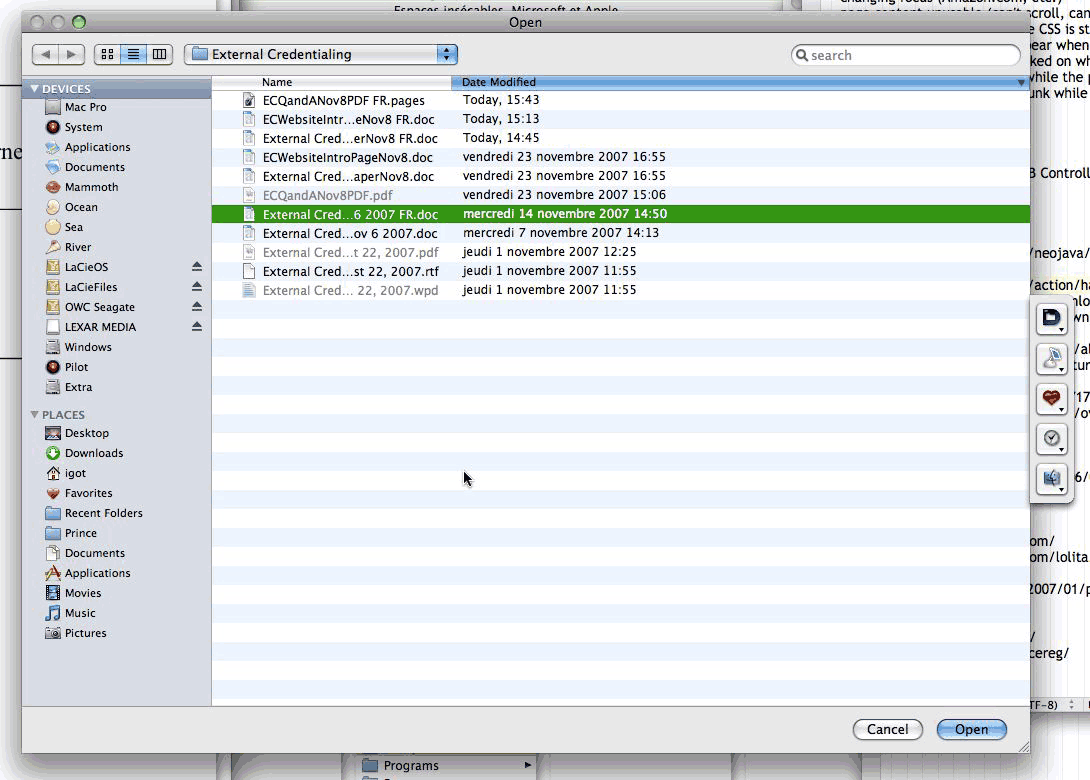
My proposal: Fix the fucking GTK-file-selection box! http://www.gnome.org/~seth/designs/filechooser-spec/
Why on earth is "Browse other folders" taking huge amount of screen estate (in save dialog)???
Do hidden files work (when I type ".bashrc" will gedit open it)?
Vista: http://www.tmssoftware.com/atbdev6.htm (?)
XP: http://www.microsoft.com/library/media/1033/windowsxp/images/using/setup/tips/68222-click-save.gif
Leopard: http://www.betalogue.com/images/uploads/finder/OpenDialogBox-ListView.gif
Java: http://java.sun.com/docs/books/tutorial/figures/uiswing/components/FileChooserOpenMetal.png
Other: http://www.guidebookgallery.org/screenshots/openfile
More: http://www.raizlabs.com/interface/hall-of-shame/default.asp
There is even a theme to change it to KDE style!!!
KGtk: http://www.kde-apps.org/content/preview.php?preview=1&id=36077&file1=36077-1.png&file2=36077-2.png&file3=36077-3.png&name=KGtk+(Use+KDE+Dialogs+in+Gtk+Apps)&PHPSESSID=83fa01cf68ec222d01626c20f3ebe9af -
Re:Still not clear how it will help?
Linux Desktop environment use bonobo implementing some of its services to achieve reusability and that too is not universal. (Gnome uses it).
No, Bonobo failed and is being phased out: http://live.gnome.org/Bonobo -
they put some buttons in a different place....
Ubuntu, opensuse and debian also ship with ipv6 enabled by default. http://ftp.gnome.org/pub/ is unresolvable until ipv6 is disabled on my GNU/Linux PCs. I'm just waiting for some unexpected ui changes in updated applications or the DE to make me reel back in fright and I'll be ready to be a big league slashdot journo. I don't use Vista, am sure it stinks worse than all the other rubbish MS inflict on the world but this article is really unimpressive. To sum it up "they put some buttons in a different place and now I don't know what to do." If someone changed this guy's zipper for buttons he'd probably piss his pants before he figured out how to get the little fellow out.
-
Re:Wha?
e.g. GNOME/Xorg/GNU/Linux
GNOME is, of course, part of the GNU project anyway. So you wouldn't need to list GNOME as well as GNU. -
Re:Everyone keeps saying...I don't see anything missing from Evolution that Outlook was able to do, the last time I used that. Fair point - it has been a while since I looked at Evolution, and Kontact similarly can do the meeting-request stuff these days. What do office drones want that Evolution doesn't do? The missing link so far has been hosting and updating server-based calendars, the MS Exchange part of the job not the Outlook part. Even Evolution's documentation says that "the Free/Busy feature only works with Microsoft Exchange servers..." CalDAV and other attempts at a protocol have been made, but nothing has emerged as a stand out...
Also, like yourself, I haven't been following this very closely recently - there may be an answer now, that just doesn't stand out very well in Aptitude...
(Actually, just remembering: the other one I've been asked about is shared addressbooks; LDAP works, but is almost completely uneditable by the end user, who is usually the secretary given a pile of business cards to enter...)
The key point is that for a single roadwarrior, most things can be made to work... But for a larger office, _sharing_ info (calendars, addressbooks, delegated email, etc) can be an issue. -
Re:The answer is simple, very simple
Please read the following Blog entry: http://blogs.gnome.org/mortenw/2008/02/02/themes-are-evil-part-ii/ It boils down to: Using a QT based theme engine resulted in a completely different behaviour of the number handling of a GTK program. So the answer might be in special cases: it is not that simple.
-
Re:Epic FUDVala is modeled after C# and compiles directly to plain-ol' generic GObject C. On top of that, the most new code going into GNOME is Python, by a rather wide margin. +1 for pointing out this neat stuff. Vala is a pretty brilliant tool, really I have to give the developers a lot of credit. I expect to see more and more GNOME development being done in Vala. Likewise, Python / pygtk is a great setting and a lot of fun, and well worth developing in.
I am pleasantly surprised that most new code is in Python, interesting, how was this measured? -
Re:mod parent up
-
Re:am I missing something here?
Even Bonobo is being phased out: http://live.gnome.org/Bonobo
-
Re:am I missing something here?
Almost five years would mean they were definitely not using Metacity when I stopped using GNOME
According to this page:
http://developer.gnome.org/news/
They were using Sawfish as late as September, 2002, although there is a Metacity reference from May of that same year. It sounds like that was the transition period, although I can't be sure; I haven't found any really clear GNOME history timeline so far. I know when I switched from GNOME to KDE, though: it was in early 2002 when KDE 3.0 was in late beta or release candidate status, and not too long before the official release. Before that I was still using GNOME and Sawfish was still the default window manager, although I usually changed it to back to Enlightenment, which I continued to prefer even after Rasterman had become very distant from the GNOME project.
I'm not currently running an ancient distro (no more security patches is a deal breaker), but as recently as 2004 I was running Debian 3.x and I do have some moderately old CDs, such as Red Hat 7.0 (Japanese edition) and I may still have the TurboLinux knockoff of Red Hat 4,2, which they released under the TurboLinux name before they actually did their own distro. I had some 2.x FreeBSD CDs around as well, although I may have dumped some of that really old stuff. -
Vala ftw!
For anyone who hasn't played with it, vala is coming along nicely. I don't care for Gnome but Vala is looking awesome, it basically wraps GLib/GObject, making the latter usable. Why run a bloated VM when you can have a C# inspired language that outputs C and compiles down to native code (with optional GC). The plan is to be able to auto-generate bindings for C libs, I've not tried this yet.
Hopefully Vala will live up to it's promise and see use in the F/OSS world far beyond Gnome. -
Re:Who cares?
While I agree with the concern that Gnome development is a little slow, in this particular case it is mainly the fault of the article author noticing the wrong eight things. Epiphany is proposed for inclusion, as is Gimmie. No guarantees of course that they will be, but nevertheless there are interesting developments going on. http://live.gnome.org/RoadMap
-
Re:Gedit wish list...
I am a fan of gedit as well. Bracket matching and line auto-indentation is indeed available! (I am using version 2.20.3).
Also keep an eye on the plugin system taking off (python and c supported):
http://live.gnome.org/Gedit/Plugins
Gedit makes for a nice minimalistic editor that you can take as close to an IDE as you see fit. -
Re:They should improve the gnome VNC server
Earlier today, I read Ubuntu Hardy Heron, Alpha 4 release announcement (due in two days). Vinagre is going to be installed by default... it looks like it might be inherited from Gnome.
-
Re:Epiphany? Really?
I used to. And my Gnome using friends that I've talked into trying it still use it.
Compared to Firefox, it's prettier (if you think "fancy colors and icons" is more important than "consistent", you'll disagree), is much better integrated into Gnome, has much nicer "search engine support" (type in the address field, and your installed search engines are at the end of the auto complete list - please, someone, give me a firefox extension for that!), and has a quite nice tag based bookmarking system which can be synchronized with del.icio.us or ma.gnolia.com. All of that, and just a fraction of the memory of Firefox.
I stopped using it approximately the same time as they switched backend, and now use Firefox 3 instead - it doesn't swallow all memory (only almost all), and it actually looks more integrated into Gnome, than Epiphany with a Gecko backend (the times I tried Epiphany/Webkit, it didn't really work yet) since it's not only has a native theme, it also has native form controls (which Epiphany/Webkit apparently has too, but not Epiphany/Gecko). It also works with Online Desktop, and has the famous extensions, which makes up for the other downsides of not using Epiphany.
In other words: people are actually using Epiphany, but I don't think they will for long.
-
Anti-Fragmentation?The updates most interesting to me are the anti-fragmentation patches,
Tests show that about 60-70% of physical memory can be allocated on a desktop after a few days uptime. In benchmarks and stress tests, it has been found that 80% of memory is available as contiguous blocks at the end of the test. To compare, a standard kernel was getting ~1% of memory as large pages on a desktop and about 8-12% of memory as large pages at the end of stress tests.
Perhaps someone can clarify exactly what this means? Reading the beginning, it talked about 4K pages, device drivers, and such, so I assumed it would just be relevant to the internal workings of the kernel. However, the quote I pasted above seems to indicate it might impact desktop performance as well.
I commonly see on my desktop, after several days uptime, that quite a lot of memory is being used (and I know how to ignore cache/buffers, as well as swapcache - that isn't the issue). Logging out and logging back in returns memory to reasonable levels (and the system becomes more responsive, but then I guess if I bought more memory I could accomplish that as well). Now, I've generally read that the problem was indeed memory fragmentation, e.g. here, but this would be internal fragmentation inside an app, and thus not relevant to the kernel, I believe? If someone can explain this issue I'd be grateful. -
Re:So, here's your answer:
If only someone would point that out to Microsoft.. the most obvious exception to your relationship.
No kidding. If it wasn't for Microsoft, I could have used the word "quite" instead of "often". It's not enough to have millions of beta testers (err, I mean customers) - you have to provide a way to listen to them. Collecting $99 or $249 to open a PSS ticket (and then spout worthless advice such as "do an in-place Windows reinstall" instead of providing a fix) doesn't cut it.
-
HIG Guidelines
Even if you don't develop for Mac, GNOME or KDE, these documents have a fairly good set of guidelines, some of them are specific to the uniformity of the "experience" however. I would imagine Microsoft having atleast some type of guidelines for interface design in MSDN.
http://library.gnome.org/devel/hig-book/stable/
http://developer.apple.com/documentation/UserExperience/Conceptual/OSXHIGuidelines/XHIGIntro/chapter_1_section_1.html
http://usability.kde.org/hig/current/ -
Re:asshats
A quick google says that PulseAudio used to be called Polypaudio, and at least as far back as 2004 it was a usable esound replacement. Vista announced it over a year later. Never mind the fact that pulseaudio has a large number of features that Vista only wishes it could implement. The RTP sinks and sources is fantastic for laptop users.
The first link has no information on when "polypaudio" added support for changing the volume of individual applications. So whether or not the PulseAudio developers supported it in response to Vista or not remains to be seen.
I have a laptop; what is an RTP sink and why would I find it useful? I Googled the term and I can't find any sites that explain what the hell it is or why I care, only sites that explain how to use it.
On the other hand, if people have been asking for this feature for years, and Microsoft gets around to it after someone else did it, then what does that mean for Microsoft?
I dunno? First you have to prove that people have been asking for this feature for years, then you have to prove that PulseAudio did it first. Right now, I got neither of those.
How about the Dashboard?
Looks interesting, but also looks dead. Sure the screenshots look nice, but try clicking through to files to check the version number and all you get is http://cvs.gnome.org/bonsai/rview.cgi?cvsroot=/cvs/gnome&dir=dashboard/doc
As far as I can tell, all there is is some screenshots and a complaint that Microsoft is using the same idea.
Chandler?
Looks like Microsoft Outlook or even a configured Lotus Notes to me. Except more cluttered. Maybe it does something hugely innovative I'm not seeing from the screenshots, I dunno, if so you'll have to be more specific.
Would the best version control system count?
Depends, how is it innovative? You can be the "best" of something while innovating nothing, look at something like the iPod if you need an example.
The Live CD?
Every Mac OS version that shipped on CD (until OS X, that is, versions 7.0-9.2 or so) could boot to a usable, fully functional, desktop from CD. Not innovative. (Note that Wikipedia is wrong on this count, per usual; Mac OS's CD boot wasn't solely a diagnostic tool, it was fully functional, if less-configurable.)
So far, the best one you got is Dashboard. Too bad the project is obviously abandoned.
Or do you really think Microsoft was advancing the state of the art when they stopped MSIE as long as they did?
No I don't. Funny thing is, I happen to realize that Microsoft is a huge corporation with 70,000+ employees and God-knows-how-many different product team. Saying that one team is doing something innovative says nothing about the rest of the company. (That's like saying that since Lotus Notes from IBM is bloated, therefore IBM's Infoprint printer software must also be bloated.)
Welcome to the year 2007: Microsoft isn't 3 guys in a garage anymore. -
Re:asshats
Answer me honestly: Does PulseAudio have that feature because they heard it would be in Windows Vista? Honestly, now, please give me an answer.
A quick google says that PulseAudio used to be called Polypaudio, and at least as far back as 2004 it was a usable esound replacement. Vista announced it over a year later. Never mind the fact that pulseaudio has a large number of features that Vista only wishes it could implement. The RTP sinks and sources is fantastic for laptop users.Because if PulseAudio implemented the feature after seeing that it was in a Longhorn beta, or hearing stories of Microsoft developing it, then I'd say "that thing that Microsoft is doing" is a pretty good definition. (At least as far as this case goes.)
On the other hand, if people have been asking for this feature for years, and Microsoft gets around to it after someone else did it, then what does that mean for Microsoft?A better example would be something that Microsoft or Apple *hasn't* done. Do you have one?
How about the Dashboard? Chandler? Would the best version control system count? The Live CD? How about every scripting language that matters?
Do you want ketchup with your crow? Or do you really think Microsoft was advancing the state of the art when they stopped MSIE as long as they did? -
Re:A Good DVD Writer For Most People
I've written myself a script that tracks certain directories (~/Code, ~/Documents, ~/Work, etc.) using FAM. When a file is modified it grabs it and stores it on a file server on the local network. Also you may want to have a look at Gamin, which is a FAM replacement maintained under the GNOME project.
-
Re:Unbalanced article.How did this get modded to +5 insightful?
the statement that 'While the Mac may present a more unified visual appearance, that's the only benefit it has over Ubuntu' is unbalanced for quite a number of reasons ...but you don't list ANY of them. Instead you ramble on about how important a HIG is. Well guess what? The two major desktop environments, Gnome and KDE, have them as well.
When speaking of user interface quality it's important to be objective... Apple spends an incredible amount of time and energy making a single, unified interface that will work as best as possible for the entire range of users. How can you be objective about a UI? Everyone likes something different, which means a single unified interface doesn't work for everyone. Why do you think there is so much variety in Linux desktops?
Ubuntu just as good? No. Free software just isn't there yet. If it were, Dell, HP and Acer would have dumped Microsoft quite some time ago in the home market. People want cheap and easy. Not necessarily good, just cheap and easy. Linux doesn't even qualify as that yet - the market has spoken as always. Or maybe proprietary applications and formats are holding back adoption. Interestingly enough my own relatives are having zero problems using Ubuntu on a day to day basis. I haven't had a single problem call since I set it up for them. Maybe Linux isn't ready for you, but it IS cheap and easy, and I would say ready for millions of everyday users.
The Mac is capable of empowering users (even seasoned Linux users) to do far more with much more efficiency, but one must accept the application of its metaphors rather than demanding that it work the way they want and complaining bitterly when it won't. Bullshit, how can it empower me if it doesn't do what I want? -
Re:More weight to KDE
KDE is Free Software. True Free Software.
KDE is "True Free Software"? OMFG, how times have changed! One of the biggest single reasons I'm a GNOME user today is because back in the "dark ages" KDE depended upon the then-proprietary qt library and GNOME and the associated GTK library were "truly Free". By the time this was rectified GNOME had improved a lot, GNOME designers were more focused on usability and I was already used to the environment.
One thing that has NOT changed is the licensing for GNOME--it's still good ol' GPL and LGPL and nothing else.
GNOME is free software lite. It is almost free software, just without the Four Freedoms. With KDE, you can be sure that all KDE software you use is truly Free. GNOME, on the other hand, is more than willing to bow to Microsoft.
With GNOME, you can see the source code, make copies of the code or resulting binaries to meet any needs you have, use it for any purpose you want (fit or unfit, without any warranty, but still use it nonetheless) and of course you can share it with your friends without the BSA beating down your door. Those are pretty good freedoms, and there are four of them. Can you explain to me SPECIFICALLY where the freedoms are lacking?
Furthermore, with KDE, what exactly give you any more assurance over GNOME that the software you are using is truly free? Trolltech will happily offer an alternative, proprietary license for its code to the highest bidder. GNOME has taken a more consistent approach by putting libraries under LGPL--so commercial apps can be made that take advantage of GTK yet the libraries are sure to remain Free. Such is not the case with commercial KDE apps. You can use KDE-based software that is totally non-Free because the publishers have paid off Trolltech.
At least with GNOME everyone has to play by the same rules and the GNOME platform itself remains uncompromised. Historically KDE with qt has been quite a moving target due to different platforms having different licensing rules and with the dual licensing scheme in place.
GNOME died the day it accepted Evolution with the proprietary Exchange connector.
What have you been smoking? I suggest you stop because it's frying your brain. From the "horses mouth" (Novell's own press release):
The Evolution Connector for Microsoft Exchange Server source code can be found at http://ftp.ximian.com/ and developer information about Evolution can be found at http://www.gnome.org/projects/evolution. The Connector code is now available to the public along with the rest of Evolution under the terms of the GNU General Public License (GPL).
When Novell included the connector with Evolution 2.0 it also relicensed it to GPL (FULL GPL at that; not LGPL) and it immediately made all the source code for it available the very second it licensed it under GPL. Do you know something I don't? How EXACTLY is this different from when Trolltech GPLed its libraries to allow them to be TRULY Free? Being you're such a devout fan of KDE surely you know how this is different?
The fact that KDE is objectively a better desktop environment is just gravy.
I've never once seen any OBJECTIVE evidence that one desktop is superior over the other from end users OR developers. It's ALWAYS been a matter of personal tastes, which are very SUBJECTIVE...visual layout, how things are configured, use of C++ or whatever. Again, I gladly welcome any concrete, specific areas where KDE is without a doubt superior to GNOME. I prefer GNOME over KDE myself, and I'll freely admit that I think KDE does SOME stuff better and that my overall impressions are largely my personal taste. To be more specific, I find the GNOME design has become more consistent than KDE (something that wasn't always the case, but has become true over time as GNOME has really pushed specific and consistent usability/UI standards for the desktop and ass -
Re:Do I have the timeline right?
If anything's to be fixed, then statistics on what's going wrong, where, and how are needed. If they can't be produced, then there's likely nothing wrong (although I admit this doesn't apply in all cases). Profiling and hard facts describe reality.
Comparing GTK+ 2 apps to GTK+ 1 apps is typically a faux pas, as the GTK+ 2 apps have much more functionality, as they've had years more development than the old GTK+ 1 versions. I admit that GTK+ 2 itself is probably a little slower than GTK+ 1, but again, that's due to extra functionality. I've looked around for some figures, and haven't been able to find any actual figures, but I've got an interview with Owen Taylor shortly after the release of GTK+ 2.0, and then a mailing list post about Ethereal performance a month or so later. The second one gives a more rosy view, and since optimisations and improvements have been made since (see Federico's 2005 presentation on optimising GNOME for an example), I'd be fairly confident that GTK+ 2 is OK.
You've been working with it for seven years, and yet every comment of yours on GNOME and GTK+ on Slashdot in the last year has been slagging it off quite badly. It makes one wonder why you continue to code with such a "steaming pile of crap written by developers whose egos are bigger than their brains". If by "interfaces" you mean library APIs then you're dead wrong. GTK+, Glib and all the other core libraries of GNOME have had complete API and ABI stability since the first 2.x release. We're more than happy to fix problems if they're pointed out to us, or if we find them ourselves. I personally get quite annoyed, however, when someone waves their hands in the air and says "it's common knowledge that Gnome has problems", without a scrap of proof or supporting data.
-
Re:More weight to KDE
I am, right now, attempting to publicly counter your incorrect perceptions. Others have also done so. See, for example, Jeff Waugh's excellent blog post on the matter.
And who are you? Are you an official spokesperson for the GNOME Foundation? A post on Slashdot by some random person doesn't equate to an official public pronouncement by the GNOME Foundation.I am Shaun McCance. I have been an active Gnome developer since 2002, and a Foundation member since 2003. You can verify my membership on the Foundation Membership List. I maintain three packages in the desktop release and one in the developer tools, and I lead the Gnome Documentation Team.
Should you just take my word for it? Of course not. But I have pointed you to concrete facts, and that should be sufficient for you to at least attempt to do some real fact-checking, rather than posting unsubstantiated drivel.
-
Re:This 'article' is bullshit flamebait
Does that means that Openoffice.org is a KDE project?
http://kde.openoffice.org/
There are only 2 projects in gnome-office it seems:
http://www.gnome.org/gnome-office/
Abiword and gnumeric and neither of them are supporting ODF



&PHPSESSID=83fa01cf68ec222d01626c20f3ebe9af)