Slashdot Mirror
Domain: gnu.org
Stories and comments across the archive that link to gnu.org.
Comments · 13,360
-
Re:RMS's choice
NO.
RMS recommended distro is Ututo-e, from ARGENTINA!. Look at this article (in Spanish, sorry). You could even find Ututo-e in FSF FTP server. The e in Ututo stands for Desktop (in Spanish). -
Re:Flash Video
Er, the Flash player is free.
I believe the original poster meant a different kind of free. -
Re:Almost free software
They *require* it:
"certain legal procedures are required when incorporating legally significant changes"
Quoted from gnu.org
They *may* require an employers disclaimer *as well* - that depends on your status. -
Open source doesn't say users should have freedom.
[S]omehow I don't think Sun is grasping the true sense of Open Source.
But this isn't surprising, right? From "Why ''Free Software'' is better than ''Open Source''": (emphasis mine)
At a trade show in late 1998, dedicated to the operating system often referred to as ``Linux'', the featured speaker was an executive from a prominent software company. He was probably invited on account of his company's decision to ``support'' that system. Unfortunately, their form of ``support'' consists of releasing non-free software that works with the system--in other words, using our community as a market but not contributing to it.
He said, ``There is no way we will make our product open source, but perhaps we will make it `internal' open source. If we allow our customer support staff to have access to the source code, they could fix bugs for the customers, and we could provide a better product and better service.'' (This is not an exact quote, as I did not write his words down, but it gets the gist.)
People in the audience afterward told me, ``He just doesn't get the point.'' But is that so? Which point did he not get?
He did not miss the point of the Open Source movement. That movement does not say users should have freedom, only that allowing more people to look at the source code and help improve it makes for faster and better development. The executive grasped that point completely; unwilling to carry out that approach in full, users included, he was considering implementing it partially, within the company.
The point that he missed is the point that ``open source'' was designed not to raise: the point that users deserve freedom.
Spreading the idea of freedom is a big job--it needs your help. That's why we stick to the term ``free software'' in the GNU Project, so we can help do that job. If you feel that freedom and community are important for their own sake--not just for the convenience they bring--please join us in using the term ``free software''.
I find this situation comparable because in both cases the work is being done under the title of "open source", not "free software" (perhaps businesses understand that the open source movement is more amenable to their goals and the free software movement exists to pursue freedom for computer users), and because in both cases the work is being done to benefit the organization that sets out the deal, not the users of the programs. Sun wouldn't grant permission to deal in their patented ideas because they want to help computer users. They're doing it to motivate more people to license their programs under the applicable Sun license, just as this executive was out to make the program "open source" for people in the organization, not the users.
-
Open source doesn't say users should have freedom.
[S]omehow I don't think Sun is grasping the true sense of Open Source.
But this isn't surprising, right? From "Why ''Free Software'' is better than ''Open Source''": (emphasis mine)
At a trade show in late 1998, dedicated to the operating system often referred to as ``Linux'', the featured speaker was an executive from a prominent software company. He was probably invited on account of his company's decision to ``support'' that system. Unfortunately, their form of ``support'' consists of releasing non-free software that works with the system--in other words, using our community as a market but not contributing to it.
He said, ``There is no way we will make our product open source, but perhaps we will make it `internal' open source. If we allow our customer support staff to have access to the source code, they could fix bugs for the customers, and we could provide a better product and better service.'' (This is not an exact quote, as I did not write his words down, but it gets the gist.)
People in the audience afterward told me, ``He just doesn't get the point.'' But is that so? Which point did he not get?
He did not miss the point of the Open Source movement. That movement does not say users should have freedom, only that allowing more people to look at the source code and help improve it makes for faster and better development. The executive grasped that point completely; unwilling to carry out that approach in full, users included, he was considering implementing it partially, within the company.
The point that he missed is the point that ``open source'' was designed not to raise: the point that users deserve freedom.
Spreading the idea of freedom is a big job--it needs your help. That's why we stick to the term ``free software'' in the GNU Project, so we can help do that job. If you feel that freedom and community are important for their own sake--not just for the convenience they bring--please join us in using the term ``free software''.
I find this situation comparable because in both cases the work is being done under the title of "open source", not "free software" (perhaps businesses understand that the open source movement is more amenable to their goals and the free software movement exists to pursue freedom for computer users), and because in both cases the work is being done to benefit the organization that sets out the deal, not the users of the programs. Sun wouldn't grant permission to deal in their patented ideas because they want to help computer users. They're doing it to motivate more people to license their programs under the applicable Sun license, just as this executive was out to make the program "open source" for people in the organization, not the users.
-
Re:Java database ?
But most of us don't care so much about free. We care about Free.
-
Re:Erm... Important how?
But we all know that Word documents are bad.
-
The Java trap
-
I want Ceren in my social web!
IMPORTANT UPDATE: Please show your support for Ceren in this poll of Geek Babes!
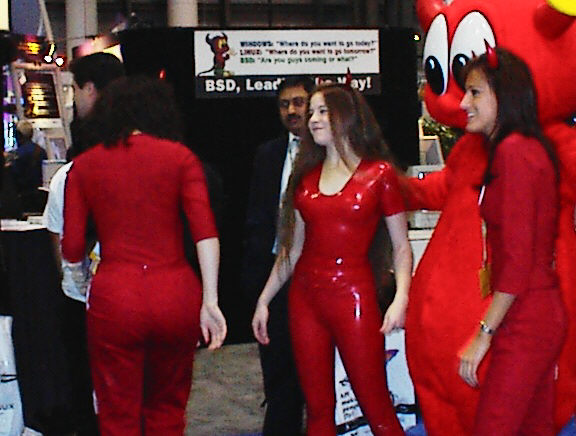
Is it any wonder people think Linux users are a bunch of flaming homosexuals when its fronted by obviously gay losers like these?! BSD has a mascot who leaves us in no doubt that this is the OS for real men! If Linux had more hot chicks and gorgeous babes then maybe it would be able to compete with BSD! Hell this girl should be a model!
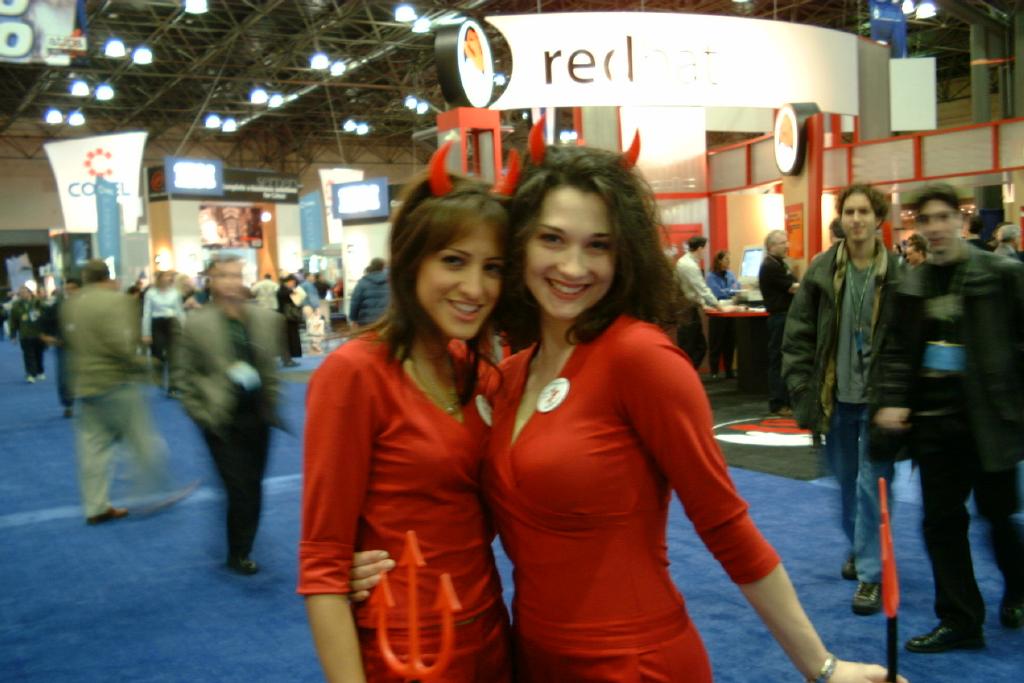
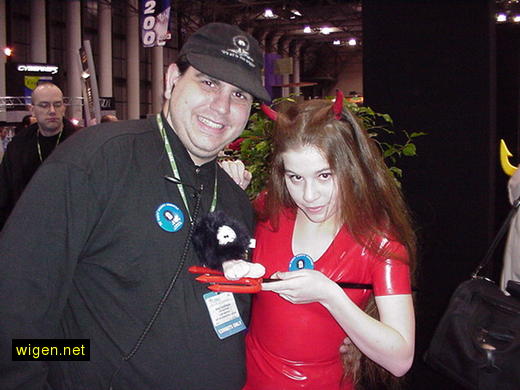
Linux is a joke as long as it continues to lack sexy girls like her! I mean just look at this girl! Doesn't she excite you? I know this little hottie puts me in need of a cold shower! This guy looks like he is about to cream his pants standing next to such a fox. As you can see, no man can resist this sexy little minx. Don't you wish the guy in this pic was you? Are you telling me you wouldn't like to get your hands on this ass?! Wouldn't this just make your Christmas?! Yes doctor, this uber babe definitely gets my pulse racing! Oh how I envy the lucky girl in this shot! Linux has nothing that can possibly compete. Come on, you must admit she is better than an overweight penguin or a gay looking goat! Wouldn't this be more liklely to influence your choice of OS?
With sexy chicks like the lovely Ceren you could have people queuing up to buy open source products. Could you really refuse to buy a copy of BSD if she told you to? Personally I know I would give my right arm to get this close to such a divine beauty!
Don't be a fag! Join the campaign for more cute open source babes today!
$Id: ceren.html,v 9.0 2004/08/01 16:01:34 ceren_rocks Exp $ -
Re:Why back Sun? Why back Solaris?Are you really that ignorant? If you don't get the joke, could you at least refrain from a rant?
GNU, seriously, is not Unix (yeah, yeah, you are saying that the name doesn't matter, but your tone says otherwise). I quote from gnu.org itself:
(GNU is a recursive acronym for "GNU's Not UNIX"; it is pronounced "guh-noo.")
Any questions?
-
Re:Small Percentage
Looks as though someone else been reading Mark 12:42-44
Of course, Bill Gates does not deserve most of this money in the first place. The whole concept on which Microsoft was founded stinks, and the correct response to this (in)famous document should have been a dragging into the nearest toilet followed by a thorough beating. What can't be owned can't be stolen.
Gates and co. might actually have earned a little respect from me if they had bought out the patent rights on a few life-saving drugs {is this another crazy concept, or what?
Really, this is no different than some ordinary working-class person buying a copy of the Big Issue. -
Re:Difference between permissive and copyleft
In this example, it's my program. If they want changes made, they're welcome to offer to pay me to make them.
Are they welcome to sue you for antitrust violation if you reply "not at any price"? Remember that the GNU project was started over a dispute with a printer maker that refused to fix a bug in a driver.
-
Pipe into MAD or something
Speaking of open source decoders, is there a good decoder that's LGPL or BSD licensed?
Yes, and it's called popen(). Take a GPL decoder such as MAD and tell it to output through a pipe. FSF's official position is that communication through a pipe constitutes "mere aggregation" rather than combining modules into one work. Or are you working on a battery-powered device whose sliver of an operating system doesn't have pipes?
-
Re:What is wrong with software patents
The Hurd exists and is usable today.
Sure, it exists and works, I've even used it in a PC emulator. But is it usable for any actual practical application ?
According to the http://www.gnu.org/software/hurd/history.html, GNU started developing HURD in 1990. Now, 15 years later, HURD isn't (AFAIK) any serious contender for any job. Nor will it likely be, since Linux is drawing all the developers.
It seems to me that HURD is to GNU what Stalingrad was to germans - a hopeless battle from which they cannot withdraw because their leader refuses to believe that victory is impossible.
-
Re:Unconvinced by substitution for freedom.
Not according to how the FSF would like their work to be credited--even putting aside this silly lack of distinction between an OS and a kernel, "GNU Hurd" is a kernel replacement (Hurd) developed under the aegis of the GNU project, not an OS (hence there is no GNU Linux because no version of the Linux kernel has been developed thusly). "GNU/Hurd" or "GNU+Hurd" is a more precise way to describe the official GNU OS--the GNU OS running on the HURD kernel replacement.
There are significant distinctions which need to be made because GNU runs on top of multiple kernels and kernel replacements (probably more than I know about: I believe Debian distributes a variant of GNU running on top of the NetBSD kernel called "GNU/NetBSD" but would more accurately be referred to as "GNU/kernelofNetBSD" because NetBSD is an OS, not just a kernel).
The syntax the FSF uses might be too subtle to convey the importance of the differences amongst GNU variants, but as variants of GNU become more numerous, we will need to clearly distinguish our choices. More importantly, we don't accurately convey how we got to where we are by allowing one contributor to get credit for all the major parts of the work. Hence the FSF asks that you give GNU a share of the credit, not just Linux.
-
Re:no surprise
All software patents, including ones for very ingenious, non-obvious algorithms, are wrong (bad). Software patents are just patents for mathematical truths. A patent, or the right of a person to restrict the use of his invention, has always been for an actualy/physical invention, not for a theory or a mathematical truth. I recommend you to read literature related to software patents on the GNU website.
-
Re:TXT is not a format
Complaining about the grep Apple shipped with the Mac seems to be valid to me.
Contrary to your claims of being dated, GNU grep (and other implementations) are in active development. Apple saw the wisdom of including grep with OS X. They should have seen the wisodm of making it into the same paragon of excellence you project onto Cocoa apps. -
Re:What is wrong with software patents
Which is incidentally something RMS has so far been unable to do.
The Hurd exists and is usable today.
While I respect the GNU people for GCC and the GPL, I don't consider the rest of the necessary stuff as all that difficult to write: libc and the unix utilities.
The name "GNU/Linux is not only about those fundamental parts of the OS but about the fact that GNU was first to have the idea of a completely free operating system. That idea has come true in GNU+Linux. -
Re:I think they did too much work on localization.
The same is true in the UNIX world. The GNU gettext package lets you internationalize your program just once by replacing each string by a call to a function that uses the string as an index into a message catalog for the appropriate language. Producing a new translation is then just a matter of producing a message catalog for that language. I believe that GNU gettext works on any POSIX-compliant system. I don't know for sure, but it probably works on MS Windows.
I was surprised to see that Firefox had separate builds for each language. I don't know why it was done that way. In addition to greatly increasing the amount of code they have to keep on the server , it means that you can't switch languages using the same copy of the program. You need to run a separate copy for each language.
-
Re:GPG?
-
Porn? Who needs it?! We have Ceren!
IMPORTANT UPDATE: Please show your support for Ceren in this poll of Geek Babes!
Is it any wonder people think Linux users are a bunch of flaming homosexuals when its fronted by obviously gay losers like these?! BSD has a mascot who leaves us in no doubt that this is the OS for real men! If Linux had more hot chicks and gorgeous babes then maybe it would be able to compete with BSD! Hell this girl should be a model!
Linux is a joke as long as it continues to lack sexy girls like her! I mean just look at this girl! Doesn't she excite you? I know this little hottie puts me in need of a cold shower! This guy looks like he is about to cream his pants standing next to such a fox. As you can see, no man can resist this sexy little minx. Don't you wish the guy in this pic was you? Are you telling me you wouldn't like to get your hands on this ass?! Wouldn't this just make your Christmas?! Yes doctor, this uber babe definitely gets my pulse racing! Oh how I envy the lucky girl in this shot! Linux has nothing that can possibly compete. Come on, you must admit she is better than an overweight penguin or a gay looking goat! Wouldn't this be more liklely to influence your choice of OS?
With sexy chicks like the lovely Ceren you could have people queuing up to buy open source products. Could you really refuse to buy a copy of BSD if she told you to? Personally I know I would give my right arm to get this close to such a divine beauty!
Don't be a fag! Join the campaign for more cute open source babes today!
$Id: ceren.html,v 9.0 2004/08/01 16:01:34 ceren_rocks Exp $ -
Re:free as in "free beer"?
Yes, it's free beer only and not "OpenSource" as advertised in the post. This does obviously not fulfil the requirements in the FSFs Free Software Definition or the OSIs Open Source Definition.
-
Re:Ok, flame away...
As far as the GPL is concerned (Linux's primary license, more or less) it so happens that RMS agrees with you. Check this out, if you're interested...it's an article he's written about that very thing.
And of course, this is only something that comes up as a potential question in people's minds with the GPL anyway...if you're talking about software that uses the BSD or virtually any other FOSS license, of which there are several, it generally doesn't need to be mentioned. It seems to be primarily the GPL with which people have the misconception that free ("libre" - liberated or open source) HAS to also mean free as in beer as well. This of course was actually the core reason why ESR started using the term "open source", although I personally probably prefer the term "liberated software" myself, and am not sure why anybody else hasn't come up with that...because it implies freedom in terms of rules, but doesn't necessarily in terms of price.
Unfortunately the fact that one encounters misinformed GPL zealots from time to time (who help spread the misconception about the GPL in particular) doesn't help matters. -
Source Control HOWTO (in the works)
Eric Sink has recently started writting a detailed HOWTO off of his personal website titles "Source Control HOWTO. He doesn't just cover his own companies project "Vault", but also touches on CVS, VSS, and Subversion.
In my IT career I've used VSS, PVCS, a bit of CVS, and now becoming more familiar with Subversion behind GForge. Of all the documentation I've consumed, Eric Sink's article has so far been the most thorough (and least dry!)
As for the comments regarding source control being overkill for personal projects; I feel there is a misconception that source control will add continually overhead to a project. The initial setup may be a pain, but when refactoring components, it's much easier to perform differences along a file's history from a source control system than diff directory which you manually copied to perserve a "version". I've done it both ways, and found using source control with my solo projects to provide a multitude of benefits. I could list them out here, but I believe they're all addressed (and then some) in the HOWTO. -
screw DVDs... look at Ceren instead!
IMPORTANT UPDATE: Please show your support for Ceren in this poll of Geek Babes!
Is it any wonder people think Linux users are a bunch of flaming homosexuals when its fronted by obviously gay losers like these?! BSD has a mascot who leaves us in no doubt that this is the OS for real men! If Linux had more hot chicks and gorgeous babes then maybe it would be able to compete with BSD! Hell this girl should be a model!
Linux is a joke as long as it continues to lack sexy girls like her! I mean just look at this girl! Doesn't she excite you? I know this little hottie puts me in need of a cold shower! This guy looks like he is about to cream his pants standing next to such a fox. As you can see, no man can resist this sexy little minx. Don't you wish the guy in this pic was you? Are you telling me you wouldn't like to get your hands on this ass?! Wouldn't this just make your Christmas?! Yes doctor, this uber babe definitely gets my pulse racing! Oh how I envy the lucky girl in this shot! Linux has nothing that can possibly compete. Come on, you must admit she is better than an overweight penguin or a gay looking goat! Wouldn't this be more liklely to influence your choice of OS?
With sexy chicks like the lovely Ceren you could have people queuing up to buy open source products. Could you really refuse to buy a copy of BSD if she told you to? Personally I know I would give my right arm to get this close to such a divine beauty!
Don't be a fag! Join the campaign for more cute open source babes today!
$Id: ceren.html,v 9.0 2004/08/01 16:01:34 ceren_rocks Exp $ -
Re:DRM
Are you trolling? Because if not, it really looks like you're just looking for something to bitch about. FairPlay, Apple's DRM scheme for iTMS songs, is the most liberal copy-protection system out there for music owned* by the RIAA. For 99% of users, I daresay it poses no impediment to the free exercise of fair use rights; for the remaining 1%, there are easy, if imperfect, ways around it. So there's no reason to believe an Apple-sponsored DRM for video would be as boneheaded and ineffectual as you suggest.
* If you even think of bringing this up, I'll kill you. -
Re:Trusted Computing is the problem...
Yeah, until it becomes illegal for ISPs to allow non-"Trusted" systems to connect, or your horribly obsolete non-"Trusted" computer finally dies and your new "Trusted" computer disallows installing evil, unsigned, un-"Trusted" hacker tools (in other words, Free Software)....
Sure, you can get a black-market Chinese computer with a V-Dragon CPU, and then spend the rest of your life in prison with all the other "zero tolerance" copyright infringers and drug addicts -- if you're lucky and aren't executed as a "Commie Ter'rist Hacker" instead.
Oh, and here, have some Kool-Aid. It's on the house! -
Re:Confusion the other way.
Free Software. You should go learn the terminology before you attempt to correct me.
I also know the difference between a copyright and a license. If you had read the post I was responding to, you might have realized that the argument I presented was exactly what I was trying to present. Copyright is what allows software to have enforceable licenses.
You also seem to be confused about copyright law, IANAL, but if your product contains even one function of code directly copied from something else, then you have to follow the license of that 'something else' You can't just say "Oh, hey, I've changed this enough, it's mine now."
And about the algorithm argument being lazy, go read the other comments to my post. That argument has been presented, and other people have come up with better responses than I could have.
Here's some of the comments arguing about software patents being 'different':
Comment 1
Comment 2 -
Re:Not to be pedantic, but.." Sigh. Listen, moron."
Your definition of moron must be rather unusual - Unlike your good self, I have found that Jonas is able to read and easily comprehend what he has read:
"All this can be found on the Free Software Foundation's website, if you ever took the trouble to visit it."
What is CopyleftThe simplest way to make a program free is to put it in the public domain (18k characters), uncopyrighted. This allows people to share the program and their improvements, if they are so minded. But it also allows uncooperative people to convert the program into proprietary software (18k characters). They can make changes, many or few, and distribute the result as a proprietary product. People who receive the program in that modified form do not have the freedom that the original author gave them; the middleman has stripped it away.
In the GNU project, our aim is to give all users the freedom to redistribute and change GNU software. If middlemen could strip off the freedom, we might have many users, but those users would not have freedom. So instead of putting GNU software in the public domain, we ``copyleft'' it. Copyleft says that anyone who redistributes the software, with or without changes, must pass along the freedom to further copy and change it. Copyleft guarantees that every user has freedom. -
Re:Even their MP3 players need Windows
-
"Any third party"
And even if they did modify the kernel, they are only reqired to distribute it to the people that the binary was distributed to
That's true only if the source always accompanies the binary, such as on a CD boxed with each synth. Otherwise, they have to make the offer available to "any third party".
-
use XQuery for transformations
To handle transformations (as a separate issue from styling) the new XQuery language has some advantages over XSLT. The syntax is a lot more readable and more concise, and it's actually a reasonable programming language. It's a superset of XPath, which may people (including XSLT users) are familiar with. On the other hand, it doesn't have XSLT's "template processing" model, which simplifies writing transformations, and it's not a finished standard yet (though it's close). My article discusses and illustrates using XQuery to transform XML for presentations. It's about generating web pages, while the parent is about generating PDF, but it does suggest it might be worth trying XQuery for generating XSL-FO (or even XHTML+CSS).
-
Re:Reasonable?
We won't even tell you when we change it, you should spend half an hour (each time you start the program) comparing the old text with the new to spot and keep yourself updated with changes
Diff. Look into it. (There's even a Win32 port.)
-Peter -
Here's how it's done
This is old news.
Set up a regular access point.
Install a web server like NoCat.
Subsitute the NoCat splash page with a copy of the T-Mobile (or whatever) login page. You can use wget to grab this.
From there you use a plain old cgi script to pipe the userID, password, credit card number, etc. into a text file. -
Re:Possible GPL violation?
That's not how it works.
The GPL only allows distribution of a work (i.e. the driver) if the source for anything the code is linked with is distributed under the GPL.
It has nothing to do with derivative works, the GPL is the only license you have to distribute the driver and the only ways you can distribute the driver in accordance with the license are:
- on its own, not linked with anything (binary or source, but if it's binary you have to make the source available)
- linked only with GPLable works
- according to some (including Linus Torvalds) a dynamically linked driver module that can be distributed separately doesn't count as linked. I believe RMS would disagree on this one, though...
The GPL FAQ is good, I recommend everyone reads it whenever they're not sure how it works
Cheers & God bless
Sam "SammyTheSnake" Penny -
GPL != EULA
I will believe that EULAs are enforcable as soon as the first EULA is enforced, but not sooner.
I think the real issue is whether shrinkwrapped EULAs are enforceable, not EULAs in general. If I can view the EULA online, for example, as with GPL'd software, then why shouldn't it be legal?
The GNU General Public License is not an EULA. Please read it:
"5. You are not required to accept this License, since you have not signed it. However, nothing else grants you permission to modify or distribute the Program or its derivative works. These actions are prohibited by law if you do not accept this License. [...]"
Now, back yo your question: "If I can view the EULA online [...] then why shouldn't it be legal?" You should have asked: "If I can view the EULA online [...] then why shouldn't it be legally binding?" And the answer would be: do you consider everything that you read a legally binding contract? When you see a sign in the store saying that when you touch anything then you have to buy it, do you think it is true?
-
Re:Reasonable?
"We don't guarantee the program will even run, much less do what we said it will do."
"We are not liable for anything, even if our software makes your company's profits implode"
Well, these two points are included in the GPL, and I wouldn't say that is very unreasonable. -
Why does his link not work?
-
Re:Damn...
Whoever designed the angle brackets as delimeters for XML certainly didn't read the sacred Long Options manuscript.
Shame and Sin. -
GNU Radio
Shouldn't GNU Radio be able to do everything and more? Given the right software decoders, you could capture with whatever HDTV encryption, and since it's open source, if the broadcast flag is included (it's not) you could just remove the detection code.
-
The manual is ...
-
Re:Valid points
Linking to GPLed libraries counts as creating a derivative work, and thus the GPL applies just as if you'd used the code directly.
See the GPL FAQ on this.
This is also why a good number of libraries are released under the LGPL, which is basically GPL without this particular restriction. The GNU C libraries, on the other hand, use the GPL plus a special exception, which is even more liberal than the LGPL. -
Re:Well, great. Or is it?
Well, you see, the reason to use Linux and GPL software is just the opposite -- to avoid bending over and having "the man" stick it to us by holding our data hostage by proprietary binary formats and "trusted" computing.
Or maybe I've been drinking too much Kool-Aid... -
Re:Pronounciation for y'all...the animal gnu (also called the wildabeast) is pronounced with a silent G...
Yes, but the Gnu (or wildebeest -- the Afrikaans name) is GNU's mascot, as seen on their site. This makes the arguement for the pronunciation a little more difficult.
Wikipedia has a writeup on the wildebeest that may be a source of the mispronunciaiton:The erroneous (but common) pronunciation 'g-noo' is largely due to the comic song 'A G-nu' by Michael Flanders and Donald Swann, in which all words starting with n have a g prepended: 'I'm a g-nu, I'm a g-nu, the g-nicest work of g-nature in the zoo.'
(Link)
And for some quick facts about the Gnu (if you're feeling desparately metaphorical):Behavior: The gnu is active both day and night, constantly moving. It generally lives in herds numbering several thousand. In periods of drought the herd moves toward watering holes during dry weather, but when the rains arrive the herds tend to scatter. It feeds mainly on grass, showing distinct preferences for certain kinds of grass. In the breeding period the males strive to isolate harems of females. After a few hours or days they rejoin the main herd. The gnu is a major prey species for many of the large predators, including lions, cheetahs, and wild dogs.
(Link) -
Re:For the mere mortal geeks
Never mind the capes. The whole notion of OS as a holy crusade is counterproductive. Fortunately Tridgell and Thorvalds have always seen OS as alternative development model, not as a great social reform.
-
Crazyness
"First off, by default IE will not allow you to run an unsigned control. A control can be digitally signed, verifying that it came from you, and the signing process is arduous enough that, say, a bored junior high school student won't bother with the process. Unfortunately, anyone with $20 and who DOES care can get signed relatively easily."
Besides the obviously stupidness inherent with ActiveX and its purpose, this is another really good reason why I refuse to use it. It doesn't have to be a program that formats my hard drive. It can be a piece of spyware, or some annoying ad pop-up that gets installed. There is no good way to implement natively executed ActiveX controls, at least for anything other than a company or website I know in advance that I trust unconditionally.
I shutter at the thought of running any code that I (or at least someone else) has not inspected. Just another reason to use Firefox and other opensource software.
-
Re:Misunderstanding maximizing software freedom.
First, it's typical to capitalize all the letters of an acronym, hence GNU which stands for "GNU's Not Unix" (a recursive acronym). And there are multiple GNU licenses--the three most commonly used GNU licenses are the GNU General Public License, the GNU Lesser General Public License, and the GNU Free Documentation License.
Your correction about the freedom of works in the PD is only partially right. In some countries, a work's entry into the PD has been temporary--the copyright on Joyce's "Ulysses" expired and then the work re-entered copyright (at least in Ireland) not long ago. The copyright holder, Stephen Joyce, the author's grandson, threatened some people from reading it aloud this past Bloomsday.
Also, the PD does nothing to ensure that derivative works will remain free. Ensuring the freedom of derivative works was a goal from the outset of the GNU project ("GNU is not in the public domain. Everyone will be permitted to modify and redistribute GNU, but no distributor will be allowed to restrict its further redistribution. That is to say, proprietary modifications will not be allowed. I want to make sure that all versions of GNU remain free."). The GPL was written, in part, to reach this goal. You say the GNU Manifesto illustrates the desire to abolish "property rights over computer source code" but you cite no specifics. I'm to assume that the abolition of this would be harmful and that I'm to think ill of the GNU Manifesto because of this, yet you don't say why.
I believe that patent policy should be decided with an eye toward what its goal is and how it affects the population it restricts. I also think that patents affect different fields differently. Patents might be a sensible thing as an industrial regulation for automobiles, for example. But RMS makes a compelling argument that software patents do not serve the interest of fostering innovation in computer software and software patents pose a serious threat to all computer users.
Finally, according to the Free Software Foundation, it is not an excercise of freedom to restrict the rights of others. This is properly called excercising a power, not a freedom.
I'm not convinced that you have taken in the FSF's arguments, so therefore I'm not convinced of the validity of your rebuttal. I suggest that you not take my word for anything the FSF stands for. I think that you should write to RMS and then share with us the exact e-mail you sent and his exact response. I would be interested to read what he has to say to your points.
-
Re:Misunderstanding maximizing software freedom.
First, it's typical to capitalize all the letters of an acronym, hence GNU which stands for "GNU's Not Unix" (a recursive acronym). And there are multiple GNU licenses--the three most commonly used GNU licenses are the GNU General Public License, the GNU Lesser General Public License, and the GNU Free Documentation License.
Your correction about the freedom of works in the PD is only partially right. In some countries, a work's entry into the PD has been temporary--the copyright on Joyce's "Ulysses" expired and then the work re-entered copyright (at least in Ireland) not long ago. The copyright holder, Stephen Joyce, the author's grandson, threatened some people from reading it aloud this past Bloomsday.
Also, the PD does nothing to ensure that derivative works will remain free. Ensuring the freedom of derivative works was a goal from the outset of the GNU project ("GNU is not in the public domain. Everyone will be permitted to modify and redistribute GNU, but no distributor will be allowed to restrict its further redistribution. That is to say, proprietary modifications will not be allowed. I want to make sure that all versions of GNU remain free."). The GPL was written, in part, to reach this goal. You say the GNU Manifesto illustrates the desire to abolish "property rights over computer source code" but you cite no specifics. I'm to assume that the abolition of this would be harmful and that I'm to think ill of the GNU Manifesto because of this, yet you don't say why.
I believe that patent policy should be decided with an eye toward what its goal is and how it affects the population it restricts. I also think that patents affect different fields differently. Patents might be a sensible thing as an industrial regulation for automobiles, for example. But RMS makes a compelling argument that software patents do not serve the interest of fostering innovation in computer software and software patents pose a serious threat to all computer users.
Finally, according to the Free Software Foundation, it is not an excercise of freedom to restrict the rights of others. This is properly called excercising a power, not a freedom.
I'm not convinced that you have taken in the FSF's arguments, so therefore I'm not convinced of the validity of your rebuttal. I suggest that you not take my word for anything the FSF stands for. I think that you should write to RMS and then share with us the exact e-mail you sent and his exact response. I would be interested to read what he has to say to your points.
-
Re: Why would Linux users care one iota.....
OSX runs on top of Apples own BSD based fork, which was designed to be stable in both server and desktop enviroments. It is not laden with 20 text editors
Yeah, only 4 of them (if you don't count TextEdit), unless I've missed one - vi, GNU EMACS, pico, and ed.
5 e-mail applications
Yeah, just Berkmail.
and loads of daemons most users will never need.
Yes, OS X has a smaller load of such daemons (I suspect most users aren't going to use distccd or the CORBA Object Request Broker Daemon orbd, for example).
-
Re:I feel I just have to say it.....
There a few.
One which is free sofware is GNU Compiler for the Java but I'm not sure if it works with swing.
AWT is not supported so I suppose swing isn't either.