Slashdot Mirror
Domain: gnu.org
Stories and comments across the archive that link to gnu.org.
Comments · 13,360
-
Copy protection and happy gods
I strongly doubt that [dropping one form of copy protection] would earn any support from content creators.
Can you phrase that without reference to happy gods? Words like "content" (presumably meaning "any work of authorship other than a computer program") and "creator" (comparing authors to deities) have connotations too sympathetic to the incumbent commercial publishers that demand HDCP in the first place.
If you want to know the reason for HDCP's existence, you need look no further than Wikipedia.
Which only illustrates my point. Preventing the owner of a lawfully made copy from making use of the work in a way permitted by fair use or other limitations of copyright isn't a "technical reason". HDCP is a technical solution to a rent-seeking problem.
-
Re:Stop raining on our OSS parade with your "facts
A proprietary plugin like Gnash?
-
Re:Nice accomplishment!
Since when does C++ needs to be converted to C?
Since it started - it was just a preprocessor. It's now changed though to compile directly. You could in theory write a compiler that goes straight from Java to machine code if you were really keen. In fact, that has already been done. It's not just the language syntax, the toolchain matters too.
-
Re:"Offers one way of doing things"
I hope you're not a software developer.
Yeah, I am. And I'm saying it because I am software developer.
Because my experience tells me that idealists rarely reach they goal. Because by definition ideal isn't achievable. (Ironically, in software it is. And now tell me how useful the ideal piece of software is?)
Bad analogy time. Where would you prefer to live: in a perfect cave (as perfect as it could get) or in a modern house, probably with few flaws?
Frankly, looking at HTML5 v. XHTML2 (well I was forced to look into it) I easily see that XHTML2 would have never became an widely adopted standard. I (and like 99% of the netizens) would rather have a web page displayed slightly (or not so slightly) incorrectly rather than not displayed at all. That whole concept was doomed from the inception.
-
Re:Status.... Um.... What?
Well, the primary thing that I can think of is "TiVoizion" (see http://gplv3.fsf.org/pipermail/info-gplv3/2006-February/000001.html ) of taking Open Source software and then bundling it with restrictions in the hardware to prevent you from actually using the software, just look at Android for a major example and phones like the Motorola Backflip in particular.
Then look at the article on Trusted Computing ( http://www.gnu.org/philosophy/can-you-trust.html ) and then look at the Kindle remotely deleting copies of purchased e-books, restrictions on various cell phones, etc.
Also, look at some of the articles on non-free file formats, the same things RMS was predicting has come true not in file formats but in social networking sites like Facebook, the root cause being the same: when you entrust your information to a format you can't control you lose control of that information.
Then of course the things against software patents, the Java trap is now quickly coming to "the Cloud" and controlled marketplaces like Apple's App store, etc. -
Copyright worst cases
so let them make ACTA as draconian as the morons want. who fucking cares?
If we allow copyright owners' power to expand unbridled, imagine not being able to create your own works for fear that they will be too similar to a work controlled by an incumbent publisher. Or imagine not being able to buy a home PC because all the PC makers have switched to making cryptographically locked-down appliances (like the iPad) for fear of contributory infringement liability. Only professional software developers working for established companies are eligible to buy PCs.
-
Re:hooray!
I for one applaud amazon's efforts at destroying the patent system by demonstrating the extent of its absurdity.
Those of you too young to be familiar with Amazon's 1999 One-Click ordering patent should have a look at the links.
The patent excerpt even states "Method and system for placing a purchase order via a communications network" without immediately clarifying the single click. The patent probably clarifies the focus on the 1-click part and avoids otherwise obvious issues with the excerpts lack of precision.
-
Glyn, why talk of selling rather than using?
It's 2010, why is Glyn of all people still talking about selling software instead of using it? Is this a fumble like in 1999 when he mistook deIcaza for a FOSS developer? Are we all so far down the Microsoft money pit that no one is even allowed to think about using the software?
That's what it's all about as far as many are concerned: using the software. Even the opening stipulation in the GPL and the GNU Manifesto are about using the software.
Volkswagen, last I checked, was a contributor to the linux kernel and a user of many other components. It has a market cap of over 32 billion. Amazon, though recently targeted for knee-capping by Microsoft goombas, has a market cap of around 55 billion. Juniper Networks was using open source, at least prior to taking on Microsofters, and had a market cap of around 10 billion. Even Apple, which seems to be succumbing to Microsoft made its comeback around GNU/Darwin. How long they can keep doing that before Microsoft party members can sabotage the company or inject their toxic personnel is anyone's guess.If you look around, it's not hard to find large companies with market caps in the range of many tens of billions of dollars that are using Free and Open Source Software to make lots of money.
-
Glyn, why talk of selling rather than using?
It's 2010, why is Glyn of all people still talking about selling software instead of using it? Is this a fumble like in 1999 when he mistook deIcaza for a FOSS developer? Are we all so far down the Microsoft money pit that no one is even allowed to think about using the software?
That's what it's all about as far as many are concerned: using the software. Even the opening stipulation in the GPL and the GNU Manifesto are about using the software.
Volkswagen, last I checked, was a contributor to the linux kernel and a user of many other components. It has a market cap of over 32 billion. Amazon, though recently targeted for knee-capping by Microsoft goombas, has a market cap of around 55 billion. Juniper Networks was using open source, at least prior to taking on Microsofters, and had a market cap of around 10 billion. Even Apple, which seems to be succumbing to Microsoft made its comeback around GNU/Darwin. How long they can keep doing that before Microsoft party members can sabotage the company or inject their toxic personnel is anyone's guess.If you look around, it's not hard to find large companies with market caps in the range of many tens of billions of dollars that are using Free and Open Source Software to make lots of money.
-
Re:What about Google?
Even according to RMS, AdSense and Google search cannot be considered proprietary in the same sense as e.g. Photoshop since they are not distributed (JavaScript notwithstanding). Google runs them on their servers, not you. And it is popular knowledge that Google started based on Linux, MySQL, Apache and many other open-source projects. Without them, there would be no Google, at least not in the past decade.
-
Got an Education?
Stupid comment, get an education. If you want to create your own Flash player you can do that. It is OPEN. Stop drinking the Apple Kool Aid without question.
http://www.gnu.org/software/gnash/
http://www.swift-tools.net/Flash/
http://www.swftools.com/tools-category.php?cat=968
There are also dozens of tools that create Flash apps so you are not restricted to Adobe's tools either.
-
Re:So its still GPL incompatible because its BSD .
I am no expert on licenses, but according to GNU, the 3-clause BSD license used by WebM is GPL-compatible. http://www.gnu.org/licenses/license-list.html#GPLCompatibleLicenses
-
Re:Does it really matter?
ISTR using lynx in screen well before 1998.
Besides, your information and the claims of NetCaptor's authors seems flawed for other reasons. Wikipedia's article on the history of tabbed document interfaces lists several ways tabbed web browsing could have been done before NetCaptor. I'll explain in the next few paragraphs, with additional links as needed. Anything not linked specifically is included in the above article.
Besides, InternetWorks had tabs in a graphical browser in 1994, which is four years before NetCaptor despite NetCaptor's authors' ignorance of that fact in their claims.
UniPress's Emacs version for NeWS had multi-document tabs in 1990, and considering that Emacs/w3 has been around since 1996 and works in pretty much any Emacs that hasn't had its Lisp engine ripped out, I'd say there was probably a document-tabbed Emacs in which some of the documents could be web browser instances before 1998 using this setup.
HyperTIES was a hypermedia browser in 1998 before there was really a world wide web, but it used document tabs to browser hypertext documents.
The NeWS windowing system actually had a window manager that could group multiple documents into tabs for any application, so any web browser for that platform could have had the capability before 1998.
Many text editors and programmer's IDEs had similar features to today's tabbed interface for years, and I'm betting someone other than the Emacs folks and the NeWSies had a web browser instance showing pages inside tabbed windows before 1998. Authoring tools certainly did, including Adobe suing Macromedia for using tabs in Flash and Macromedia countersuing for enforcing a trivial and improper patent which was filed in 1994 and granted in 1996. (Adobe won the first suit, Macromedia won the second, they settled, and then Adobe bought Macromedia anyway.)
-
Gnash: The Flash Movie Player
Information can be found here.
I hope this helps your GNU effort at software reform.
Yours In Akademgorodok,
K. Trout -
Re:Maybe they've grown up a bit
No, they simply memorize magical mantras that, when regurgitated, will do what they want.
I believe the term you're looking for is "cargo cult programming".
Besides, the exact same argument could be used to condemn first OO, then structural programming, then anything that gets compiled, then finally machine code itself as an abstraction over the physical hardware of modern processors.
Quite. Indeed, getting back to the topic at hand, people seem to have forgotten (or perhaps never realised) that GCC already uses garbage collection. Arguably, GCC hasn't been written in C for a while now.
-
Re:Developers on ChromeOS?
Where's the Emacs for Android?
Ah, but now you're asking for a specific, legacy app
-
Re:What...
Or even from the GCC build instructions:
For a native build, the default configuration is to perform a 3-stage bootstrap of the compiler when `make' is invoked. This will build the entire GCC system and ensure that it compiles itself correctly. It can be disabled with the --disable-bootstrap parameter to `configure', but bootstrapping is suggested because the compiler will be tested more completely and could also have better performance.
The bootstrapping process will complete the following steps:
- Build tools necessary to build the compiler.
- Perform a 3-stage bootstrap of the compiler. This includes building three times the target tools for use by the compiler such as binutils (bfd, binutils, gas, gprof, ld, and opcodes) if they have been individually linked or moved into the top level GCC source tree before configuring.
- Perform a comparison test of the stage2 and stage3 compilers.
- Build runtime libraries using the stage3 compiler from the previous step.
- Build tools necessary to build the compiler.
-
Re:Choices, choices
Speaking of "syntactic sugar", this link below is a good one. Someone above linked to it. I'll just add a little bit to it here. A reference is a pointer, and anyone who tries to tell you otherwise is a fool. It is there to make things more readable - it is not a copy of an object, and the simplest of exercises in the worst book I've read on the language make that very clear. So I don't know why people think they are anything other than fancy pointers.
And they aren't talking about using the headache inducing C++ code, they are going to use the advantages of C++ to make the code simpler and cleaner. At least according to this guy, and if everyone ignores this guy then it's time to fork it and keep it C. I've been using C for 15 years and C++ with STL for 12 at least, and it is natural for me to use straight C with a few C++ features. I always use 'new' instead of 'malloc' because it's harder to screw up the size calculation. Any time I use memory allocation, I use smart pointers - I don't hack them on later.
And if there is some corollary function call that has to be made with another function call, you have a few options. If one has to be called first all the time, why keep them separate? Well of course it keeps the code clean and simple, and it's harder to introduce bugs in initialize-and-use functions. So you keep both of the functions, most easily as Private members of the class, and then you implement the common usage pattern "initialize and use". Set/Get operators are the same way - the code just sets a property, and doesn't care about all of the activity that's triggered behind the scenes.
They aren't trying to make this a headache, they are trying to make the code simpler. If you let it, C++ keeps you from making the same mistakes that C is ridiculed for such as poor memory management. You can cause other side effects if you use everything the language has, but as someone else explained above, few people have gone through the trouble of learning all of the more arcane features of C++ so it's unlikely. More likely is, someone puts in a crazy overload somewhere and someone else rejects the patch saying it doesn't make sense to do it that way, simple is better.
http://gcc.gnu.org/ml/gcc/2010-05/msg00757.html
I think we've decided to switch, but we haven't decided to what subset of C++ we're switching. I think that we want what might be called the "syntactic sugar" subset. For example, single inheritance to replace our C-style inheritance, constructors/destructors to replace explicit calls to required initialization/finalization functions, and member functions to implement ADTs, namespaces to save us some typing.
-
Re:From the article it is obvious
GCC already uses a garbage collector internally although it has to be triggered explicitly.
The two main reasons for choosing a subset of C++98, instead of a different language, were mentioned on the mailing list. The most important reason is C++ will be the easiest to pick up by GCC hackers which are mostly accustomed to plain C.
The second reason mentioned were specific features of C++ like simple templates (STL containers) and multiple inheritance. They're taking everything slowly and at the moment there's no consensus even about the use vtables and RTTI. -
Safe subset
The GCC guys are not going crazy here. They are discussing what subset of C++ to allow.
If you use all the wild features of C++, the results could be scary. For example, operator overloading is great if used judiciously, but if used badly it can make the code a mess. And if it is used at all, then it means that you can't look at one page from a printout and know for sure what that code does; you need to look at all the class functions to make sure there aren't tricky overloaded operators.
I use plain C all the time at work, and the top C++ feature they should be using is simply the object-oriented class stuff. With a single global namespace you need to make functions like MyClassAddFloatAndInt(), but in C++ you could just call that function add(); it would be part of MyClass, and if you have other "add" functions with other type signatures, they won't collide. They could go from:
{
MyClass m;
MyClassInitialize(&m, foo, bar);
MyClassAddFloatAndInt(&m, 3.0f, 2);
MyClassDoSomething(&m);
MyClassCleanup(&m);
}
to:
{
MyClass m(foo, bar);
m.add(3.0f, 2);
m.do_something();
}Even better if they allow the use of C++ namespaces to keep a large project organized.
The other major win that comes to mind is simply being able to use powerful C++ libraries like the STL. Not having to cook up some kind of container data structure in plain C, but being able to use std::vector<SomeType> and std::map<SomeType, OtherType> and such is a huge win.
P.S. I read through much of the discussion and here was my favorite post:
http://gcc.gnu.org/ml/gcc/2010-05/msg00757.html
steveha
-
Great ! Another printout to burn
Looking at the GNU Coding Standard which is used for gcc, whatever 'best practices' and style guideline they come with will make a good fireplace material
-
Re:Why bother?> The GPL is a EULA of sorts, and you have to agree with whatever license the piece of software comes with.
ROFL. You don't have to agree to the GPL at all. Please read it up and stop this non-sense. http://www.gnu.org/licenses/gpl-faq.html#ClickThroughMerely agreeing to the GPL doesn't place any obligations on you. You are not required to agree to anything to merely use software which is licensed under the GPL.
-
GNU Shred?
"... but it locks up every Ubuntu and XP machine I've come across in high-speed access mode. I have read that if I low-level format it that it could be fixed, though my current one doesn't support it. My Google-fu must be weak because I cannot seem to find a USB flash reader that specifies that it will do low-level formatting."
I wonder if GNU Shred would be something to try, at the device level? Let's say your flash drive shows up as
shred -v -n 1
(You might even try -n 3.) I think this would work, but I don't know what wear leveling would do when shredding a USB flash drive.
Once you run shred, you'll have wiped the entire flash drive. That means you'll need to repartition the device and lay down a new filesystem.
Might work.
-
Re:FSF Free Software, however.
I would imagine a FSF approved license would be one of the GNU ones.
Actually the FSF approves of using any license that meets their definition of free software. They discourage the use of GPL-incompatible licenses for new projects, but have no problem with contributing to existing projects under an incompatible license.
-
Re:FSF Free Software, however.
I would imagine a FSF approved license would be one of the GNU ones.
Actually the FSF approves of using any license that meets their definition of free software. They discourage the use of GPL-incompatible licenses for new projects, but have no problem with contributing to existing projects under an incompatible license.
-
Older drafts -
The 'older versions' would be specific snapshots of the draft (in no particular order): Introduced in House, Engrossed in House, Enrolled Bill, Referred to Senate, Reported in Senate, Received in Senate, etc. It's like v0.1, 0.2, 0.3, 0.4, 0.4.1, 0.5, 1.0RC1, 1.0RC2, 1.0, etc. You get the point.
The legislative process already follows a development process rather similar to open source software development. Many can review and provide input, or just yammer. Only a few have commit privileges. At specific events, a line is drawn and a version of the bill is released.
If you follow some of the hearings, a lot of time is devoted to reading out loud what are essentially diffs expressed in prose. We can keep that for tradition's sake but it does not preclude using a proper versioning system.
one possible reason to use a distributed versioning system would be to allow schools to tear off a chunk and play with it.
-
Re:Since when does the FSF stoop to MAFIAA tactics
Not so much.. you are trying to say that by exercising whatever "policing" an ISP may do for objectionable content (even if its only malware/phishing sites) on its network
Apple doesn't "police" the App Store for abuse: they individually evaluate and approve each App on a whole raft of content and quality issues before they upload it. They enter into a licensing agreement with the author and, in many cases, collect money from custmers, keeping a wodge for themselves. That's very different from an ISP or public FTP server acting as a "common carrier" and deleting offending material as and when they discover it. Apple are actively distributing software, they're responsible, and its up to them to make sure they have the correct permissions and/or get the author to indemnify them.
and then goto the FSF website and read their take on the GPL
OK.
From the GNU FAQ:
The general rule is, if you distribute binaries, you must distribute the complete corresponding source code too. The exception for the case where you received a written offer for source code is quite limited.
What exception? From the GPLv2
3. You may copy and distribute the Program (or a work based on it, under Section 2) in object code or executable form under the terms of Sections 1 and 2 above provided that you also do one of the following:
(snip)
c) Accompany it with the information you received as to the offer to distribute corresponding source code. (This alternative is allowed only for noncommercial distribution and only if you received the program in object code or executable form with such an offer, in accord with Subsection b above.)
So, if Apple distribute the binary, Apple are responsible for distributing the source - unless you think the Apple App Store is "noncommercial".
-
Re:I hope the GPL is challenged in court.
Those terms don't attempt to bind third parties to anything, they limit what third parties can do with the code released under the GPL.
Apple is doing nothing with the code. They receive a binary from the developer.
They still need to comply with the terms of the GPL. You really need to go read the license, read the FAQ (which clarifies many of the misconceptions under which you appear to be labouring), and possible read the article, then come back and see if you can actually contribute a post to this discussion that isn't factually incorrect.
If you can't be bothered to do any of that, I think I'm going to have to assume you're a troll.
-
Re:I hope the GPL is challenged in court.
Those terms don't attempt to bind third parties to anything, they limit what third parties can do with the code released under the GPL.
Apple is doing nothing with the code. They receive a binary from the developer.
They still need to comply with the terms of the GPL. You really need to go read the license, read the FAQ (which clarifies many of the misconceptions under which you appear to be labouring), and possible read the article, then come back and see if you can actually contribute a post to this discussion that isn't factually incorrect.
If you can't be bothered to do any of that, I think I'm going to have to assume you're a troll.
-
Re:Quandry
In case you didn't read the summary, the project in question is GNU Go. Just in case the 'GNU' before the project name didn't tip you off, the copyright blurb for that program is: 'Copyright 1999, 2000, 2001, 2002, 2003, 2004, 2005, 2006, 2007, 2008 and 2009 by the Free Software Foundation.' Yes, indeed the FSF actually writes code. Who woulda thunk? A snowball will freeze in hell before we see the FSF dual-license any of their own code just to make this sort of accommodation. They have been staunch idealists since 1984.
I seem to remember that the FSF actually tangled with Steve Jobs before (in his NeXT days), and won, and so we have a Free Software Objective-C compiler:
Consider GNU Objective C. NeXT initially wanted to make this front end proprietary; they proposed to release it as
And so to this day Apple's developer suite includes a modified version of GCC, for which they provide the sources in compliance with the GPL.
The FSF's motive in this action, as in everything they do, is the promotion of the Free Software ideology. They see it as an opportunity to get Apple to ease the draconian restrictions they impose on the App Store. Now, Apple is free to impose whatever restrictions it likes, but if they're not careful, they can step on other people like this. That's the downside to being platform dictator. Apple can possibly weasel around the GPL violation they seem to be guilty of by directing the action to the developer somehow. If they can't do this, and go to court, and lose (which is not outside the realm of possibility since they imposed additional restrictions in violation of section 6 of the GPLv2 which applies to GNU Go 3.6 and below, or section 10 of GPLv3 which applies to GNU Go 3.8), the FSF will have gotten a bunch of cash for their troubles. If Apple settles and eases restrictions, that would be even better for the FSF's mission. No one yet has been motivated enough to actually fight the FSF in court over a GPL violation, but if it comes to that Apple just might, given that what's at stake here is their business model for the App Store. It will be interesting to see how this develops.
-
Re:Quandry
In case you didn't read the summary, the project in question is GNU Go. Just in case the 'GNU' before the project name didn't tip you off, the copyright blurb for that program is: 'Copyright 1999, 2000, 2001, 2002, 2003, 2004, 2005, 2006, 2007, 2008 and 2009 by the Free Software Foundation.' Yes, indeed the FSF actually writes code. Who woulda thunk? A snowball will freeze in hell before we see the FSF dual-license any of their own code just to make this sort of accommodation. They have been staunch idealists since 1984.
I seem to remember that the FSF actually tangled with Steve Jobs before (in his NeXT days), and won, and so we have a Free Software Objective-C compiler:
Consider GNU Objective C. NeXT initially wanted to make this front end proprietary; they proposed to release it as
And so to this day Apple's developer suite includes a modified version of GCC, for which they provide the sources in compliance with the GPL.
The FSF's motive in this action, as in everything they do, is the promotion of the Free Software ideology. They see it as an opportunity to get Apple to ease the draconian restrictions they impose on the App Store. Now, Apple is free to impose whatever restrictions it likes, but if they're not careful, they can step on other people like this. That's the downside to being platform dictator. Apple can possibly weasel around the GPL violation they seem to be guilty of by directing the action to the developer somehow. If they can't do this, and go to court, and lose (which is not outside the realm of possibility since they imposed additional restrictions in violation of section 6 of the GPLv2 which applies to GNU Go 3.6 and below, or section 10 of GPLv3 which applies to GNU Go 3.8), the FSF will have gotten a bunch of cash for their troubles. If Apple settles and eases restrictions, that would be even better for the FSF's mission. No one yet has been motivated enough to actually fight the FSF in court over a GPL violation, but if it comes to that Apple just might, given that what's at stake here is their business model for the App Store. It will be interesting to see how this develops.
-
How do they know anyway?Oh, because the developer says so http://soupdogsoftware.com/igo/
uses GnuGo, an open source game engine. Source code is available.
And on the fucking App Store page, it even says where: http://www.gnu.org/software/gnugo/. So where is the problem?
-
FSF stands for software freedom
The FSF almost invariably tries to contact companies and take a non-litigious approach first.
Quite right, the FSF has a history of contacting people first and silently arranging compliance.
Their goal is to promote OSS and they can do that a lot better by contacting companies and convincing them to comply and contribute, rather than costing those companies cash out of pocket and making them scared of OSS in future.
Actually the Free Software Foundation's goals have nothing to do with "OSS" (open source software) and should not be confused with that movement's goals. The FSF predates the open source movement, the Open Source Initiative, and the FSF is appropriately critical of the open source movement's goals. People from the FSF (most notably Richard Stallman) are the principal authors of the GPLs, and Stallman makes a sharp distinction between the free software movement (which he founded) and the open source movement. You can find clear descriptions of that difference and practical consequences of that difference in almost any of his talks online or the essay I linked to.
-
Re:Fat Chance
When you purchase a disc at Best Buy you are not agreeing to limit your use of that disc. When you purchase something at the iTunes store you "sign" an agreement restricting you from doing many things. That is the issue. The GPL requires that you give permissions and NOT restrict the user (well, only restrict them in ways detailed by the GPL).
If Best Buy made you sign a contract stating that you would not do XYZ to the software on the disc, they would be in violation of the GPL as well.
Obligatory GPLv2 link:
http://www.gnu.org/licenses/old-licenses/gpl-2.0.html
From the license:
6. Each time you redistribute the Program (or any work based on the Program), the recipient automatically receives a license from the original licensor to copy, distribute or modify the Program subject to these terms and conditions. You may not impose any further restrictions on the recipients' exercise of the rights granted herein. You are not responsible for enforcing compliance by third parties to this License.
As for what restrictions. RTFA. Half the article is just listing the restrictions. Yes I know, I expect you to actually be informed and read things, I'll apologize latter.
-
Re:Fat Chance
Apple would just have to remove the clause that says if you create an app with their SDK you can't distribute that same version elsewhere
I don't see this clause anywhere in the developer agreement. It does say that you can't redistribute the SDK and that you can't distribute the application once you have contracted with Apple to distribute the application but nothing is ever said of the source code itself. It seems to me that you could freely distribute the source code under the developer agreement, you just couldn't distribute the binaries other than on Apple's App store.
I believe the problem with section 6 of the GPL v2 is that once you get the app you should be able to copy, distribute, or modify it. This is prohibited under the App store, each download is code signed to only work for one account. Thus it is a prohibition on the user, not the developer.
-
Why yes, you do
Hey, I gave someone a Linux ISO once, does that mean I have to host (or otherwise make directly available from me) the source code for them if they ask me?
Yes, according to both a close reading of the license, and the FSF's FAQ. In fact, according to a close reading of the license, you were probably in technical violation of the license as soon as you handed out the copy without a written offer of source.
-
Re:Fat Chance
But only the copyright owners (those listed in AUTHORS) have legal standing to sue over copyright infringement.
Who do you suppose owns the copyright on GNU Go? Hint: It's three letters:
http://git.savannah.gnu.org/cgit/gnugo.git/tree/patterns/compress_fuseki.c -
Re:Fat Chance
This says it all:
bukkit:~ bunky$ curl -s http://www.gnu.org/licenses/gpl-2.0.txt |wc -l
339bukkit:~ bunky$ cat new_bsd_license.txt |wc -l
8The consequences, I'm afraid, of writing a legal document, if you want it to accomplish anything at all.
-
Re:The answer is simple.
Emphasis mine:
Indeed, they have already taken the app down because it is a GPL violation. There are other GPL apps on the store though that are in compliance, with the source available via developer website linked within the app - it's not a fundamental incompatibility with the app store, it seems to be a developer issue.
Actually, linking to a separate web site from within an App is not exactly meeting the terms of the GNU GPL. IMO, this might work under certain circumstances, but should be avoided where possible. Section 3 of the GPL says:
3. You may copy and distribute the Program (or a work based on it, under Section 2) in object code or executable form under the terms of Sections 1 and 2 above provided that you also do one of the following:
a) Accompany it with the complete corresponding machine-readable source code, which must be distributed under the terms of Sections 1 and 2 above on a medium customarily used for software interchange; or,
b) Accompany it with a written offer, valid for at least three years, to give any third party, for a charge no more than your cost of physically performing source distribution, a complete machine-readable copy of the corresponding source code, to be distributed under the terms of Sections 1 and 2 above on a medium customarily used for software interchange; or,
c) Accompany it with the information you received as to the offer to distribute corresponding source code. (This alternative is allowed only for noncommercial distribution and only if you received the program in object code or executable form with such an offer, in accord with Subsection b above.)And 3c doesn't apply to the Apple App Store at all.
So a developer would need to comply with 3a (include the source code at the time of distributing the binary - i.e. as part of the App, etc.) or 3b (include a written offer to provide the source code upon request.)
But providing a link to a separate web site for users to get the source code doesn't exactly meet either of these.
This example is similar to a question in the GNU GPL FAQ: Can I put the binaries on my Internet server and put the source on a different Internet site? Only if you make special arrangements with that other site for them to keep the source code available, then that would be ok. If that linked web site is owned & managed by the developer/maintainer of the App, then that's a default positive arrangement. But the developer should not link to some other site, and say "Get the source code from these guys" without making arrangements ahead of time. That's why the preference is to do either 3a or 3b.
-
The terms of service conflict
The GPLv2 section 6 states
6. Each time you redistribute the Program (or any work based on the Program), the recipient automatically receives a license from the original licensor to copy, distribute or modify the Program subject to these terms and conditions. You may not impose any further restrictions on the recipients' exercise of the rights granted herein. You are not responsible for enforcing compliance by third parties to this License.
The iTunes Store Terms of Service section 10b states:
b. Use of Products. You acknowledge that Products (other than the iTunes Plus Products) contain security technology that limits your usage of Products to the following applicable Usage Rules, and, whether or not Products are limited by security technology, you agree to use Products in compliance with the applicable Usage Rules.
Usage Rules
(i) Your use of the Products is conditioned upon your prior acceptance of the terms of this Agreement.
(ii) You shall be authorized to use the Products only for personal, noncommercial use.
(iii) You shall be authorized to use the Products on five Apple-authorized devices at any time, except in the case of Movie Rentals, as described below.Therefore distributing through the iTunes Store adds restrictions on use that are prohibited by the GPL.
-
Re:Apple isn't stopping you from sharing the sourc
It seems to me that if the source code is available freely, than the license terms are fulfilled, but what do I know, I'm not a lawyer...
No, no you are not. But this is really something that software developers who plan on reuse should know. From Section 6 of the GPLv2:
6. Each time you redistribute the Program (or any work based on the Program), the recipient automatically receives a license from the original licensor to copy, distribute or modify the Program subject to these terms and conditions. You may not impose any further restrictions on the recipients' exercise of the rights granted herein. You are not responsible for enforcing compliance by third parties to this License.
Is Apple redistributing the Program or a derivative thereof? What's more they're relicensing it with a noncompliant license. I think we got a legitimate problem here
-
Re:Don't care about Copyright?
She said (paraphrasing), "Open Source. Those people decided they wanted nothing to do with copyright." She's a little bit wrong there when you consider that the GNU General Public License uses copyright as the vehicle through which the license is enforced. What she meant to say was that the free software movement requires people be able to copy and modify their software as part of the definition of software freedom. Not quite as good for a sound bite but a truer meaning for those who care.
Your claim is not correct either. Just because the GNU GPL uses copyright as a vehicle to enforce the license does not mean that the FSF wants, endorses, or supports software copyright. In fact, if you search through Richard Stallman's writings and speeches, he makes it pretty clear that using software copyrights in the GPL is merely his way of making the best of a bad situation. Although the GPL uses software copyrights, the FSF does not support software copyright, by any means.
For example, in "Why Software Should Not Have Owners", Richard Stallman writes:
Digital technology is more flexible than the printing press: when information has digital form, you can easily copy it to share it with others. This very flexibility makes a bad fit with a system like copyright.
That's a clear and unambiguous statement against software copyright. The motivation for the GPL and copyleft is described as follows:
I figure that since proprietary software developers use copyright to stop us from sharing, we cooperators can use copyright to give other cooperators an advantage of their own: they can use our code.
In summary, it's not entirely correct to say that the FSF wants anything to do with copyright just because the GPL uses copyright. It's more accurate to say that the FSF wants nothing to do with copyright, but that practical considerations forced them to participate in the copyright system against their will.
Of course, it's certainly true that not all developers agree with the FSF, but if you're going to cite the GPL as an example of the free software community's stance on software copyright, then you are obliged to give greater weight than usual to the FSF's position on software copyright in this context, because the FSF created the GPL.
-
Re:Don't care about Copyright?
She said (paraphrasing), "Open Source. Those people decided they wanted nothing to do with copyright." She's a little bit wrong there when you consider that the GNU General Public License uses copyright as the vehicle through which the license is enforced. What she meant to say was that the free software movement requires people be able to copy and modify their software as part of the definition of software freedom. Not quite as good for a sound bite but a truer meaning for those who care.
Your claim is not correct either. Just because the GNU GPL uses copyright as a vehicle to enforce the license does not mean that the FSF wants, endorses, or supports software copyright. In fact, if you search through Richard Stallman's writings and speeches, he makes it pretty clear that using software copyrights in the GPL is merely his way of making the best of a bad situation. Although the GPL uses software copyrights, the FSF does not support software copyright, by any means.
For example, in "Why Software Should Not Have Owners", Richard Stallman writes:
Digital technology is more flexible than the printing press: when information has digital form, you can easily copy it to share it with others. This very flexibility makes a bad fit with a system like copyright.
That's a clear and unambiguous statement against software copyright. The motivation for the GPL and copyleft is described as follows:
I figure that since proprietary software developers use copyright to stop us from sharing, we cooperators can use copyright to give other cooperators an advantage of their own: they can use our code.
In summary, it's not entirely correct to say that the FSF wants anything to do with copyright just because the GPL uses copyright. It's more accurate to say that the FSF wants nothing to do with copyright, but that practical considerations forced them to participate in the copyright system against their will.
Of course, it's certainly true that not all developers agree with the FSF, but if you're going to cite the GPL as an example of the free software community's stance on software copyright, then you are obliged to give greater weight than usual to the FSF's position on software copyright in this context, because the FSF created the GPL.
-
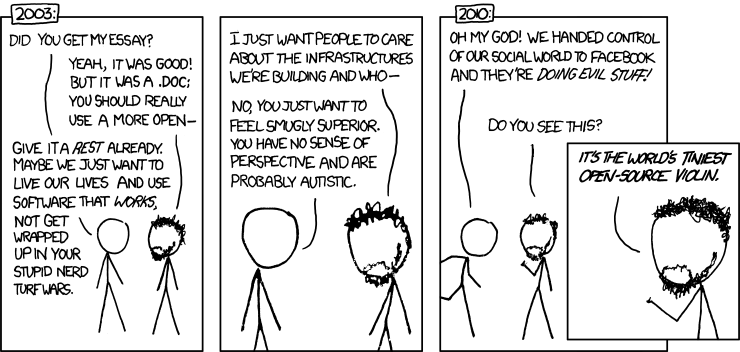
Re:OSI is getting exactly what they pushedThe thing is, as much as I'd really like to dismiss RMS and the rest of the FSF as a bunch of loons who don't understand how software works, I can't because they've been spot on for a lot of things. And really it seems like http://imgs.xkcd.com/comics/infrastructures.png we say that their policies are unreasonable, that their predictions are outlandish but then they come true.
Look back at "Can you trust your computer?" written by RMS in I believe 2002The technical idea underlying treacherous [trusted] computing is that the computer includes a digital encryption and signature device, and the keys are kept secret from you. Proprietary programs will use this device to control which other programs you can run, which documents or data you can access, and what programs you can pass them to. These programs will continually download new authorization rules through the Internet, and impose those rules automatically on your work. If you don't allow your computer to obtain the new rules periodically from the Internet, some capabilities will automatically cease to function.
Does that not sound like it hasn't already happened? In 2002, yeah, it sounded stupid, sounded outlandish. But look at the iPhone, restrictions on even Android devices like the BackFlip, DRM in the form of "unlimited music", etc.
And this isn't an isolated incident, look at http://www.gnu.org/philosophy/essays-and-articles.html and see when they were written, a lot of them, if not all of them, came true. Perhaps not in the way that it was written, but the underlying forces did it in a different way.
I'd really, really like to say that the FSF has unworkable policies, and many times they do, but I can't help but looking at their past work and seeing how they were right on track. -
Re:If they really want to boost Flash adoption ...
From John Gruber: Adobe Flash: Almost as Open as Microsoft Office
From Christina Warren: Adobe and Apple: Please Spare Us the Platitudes About "Open" While Adobe can argue that elements of Flash (through its Open Screen Project) are indeed open source, Flash itself is not an open standard. While Adobe cites some open source implementations in its "truth about Flash", like Gnash -- the open source Flash alternative -- those same runtimes cannot achieve parity with the closed-source alternatives [emphasis added] because parts of Flash associated with DRM and other content controls aren't available... Unlike HTML5 and CSS3 and related technologies, Flash is not an open standard on the web. Adobe might license some of its technology free of charge, and it may have some of its SWF spec available, but the entirety of the Flash ecosystem is not open, nor is it a web standard.
From GNU Gnash page - Gnash is based on GameSWF, and supports most SWF v7 features and some SWF v8 and v9.
From Wikipedia - SWF v7 (the one that Gnash supports "most of") came out in 2003--SEVEN YEARS AGO. They support "some" of the new features in v8 and v9 and, based on the omission, none of the features that are new in v10.
-
Re:What about gnash?
Gnash has a large number of problems, see the following thread for details: Stable branch of Gnash.
-
Re:What about gnash?
http://en.wikipedia.org/wiki/Gnash
http://www.gnu.org/software/gnash/
Gnash is a GNU Flash movie player. Flash is an animation file format pioneered by Macromedia which continues to be supported by their successor company, Adobe. Flash has been extended to include audio and video content, and programs written in ActionScript, an ECMAScript-compatible language. Gnash is based on GameSWF, and supports most SWF v7 features and some SWF v8 and v9.
But does it actually work now? I try Gnash once in awhile only to realize it still doesn't work whatsoever. The only foss flash player I'd ever had *any* luck with was swfdec, and development on that project appears dead now. I mean, don't get me wrong, swfdec worked like crap, but I could still watch videos on YouTube and Google Video with it at the very least.
-
What about gnash?
http://en.wikipedia.org/wiki/Gnash
http://www.gnu.org/software/gnash/
Gnash is a GNU Flash movie player. Flash is an animation file format pioneered by Macromedia which continues to be supported by their successor company, Adobe. Flash has been extended to include audio and video content, and programs written in ActionScript, an ECMAScript-compatible language. Gnash is based on GameSWF, and supports most SWF v7 features and some SWF v8 and v9.
-
Re:GPLv3
``I don't really understand what is pragmatic about the kinds of cases I described.''
Well, perhaps you can explain what you meant by the following, then:
The original GPL was a reasonable idea and made a lot of sense to a lot of people. GPLv3 is RMS and co's attempt to turn that popularity into a vehicle for their minority views on software development, and I guess we can see now how little of the community's support of the GPL was really down to believing in the FSF's political stance, and how much was just pragmatism.
``Code that is designed to run on specific hardware and requires specialist software or hardware to build/install is probably of most interest to others who also work on that hardware and already have access to the corresponding build/install systems. Those others are probably the most likely to contribute something of value back to the community as well. In trying to make everyone open up everything to everyone else, GPLv3 appears to get in the way of people opening up most of what they do to share with those who would most benefit from it, with the result that no-one can share anything with anyone in these fields under GPLv3.''''
While I agree that having source code for software that runs on specific hardware is probably of most interest to those who have that hardware and the build systems necessary for compiling the code, and while I agree that those who have the hardware and the build systems are the most likely group to contribute something of value, I don't see where your next sentence comes from.
The GPLv3 is not trying to open up everything to everyone else. Neither is it getting in the way of people opening up most of what they do to share with those who would most benefit from it. What the GPLv3 is doing is applying certain conditions to products licensed under it. Same as every other license.
In case of GPLv3, as relevant to this discussion, it aims to amend the GPLv2 so that entities can't distirbute "GPL-covered software that you can't effectively change" (Why Upgrade to GPLv3). In other words, where GPLv2 requires that source code be made available to those who receive binaries, GPLv3 takes some extra steps to make sure that people receiving that source code will actually be able to use it to make changes to the binaries that they received.
As you say, source code is most useful to those who have the required tools to build it, and the required hardware to run it. GPL, whether v2 or v3, aims to make it so: both require corresponding source to be made available to those that binaries are distributed to (in this discussion, people who purchase the hardware the code runs on), where corresponding source includes not only the source code proper, but basically anything required to build the software, with the possible exception of general-purpose tools or generally available free programs. In other words, far from getting in the way of making things available to those who would most benefit from it, GPL aims to _require_ making available everything needed to build the software to those who purchase the hardware.
``It's like the FSF presented the industry with an all-or-nothing proposition, and since it had no choice, the industry said "Well, too bad, we'll have nothing then."''
I don't understand where that is coming from, either. The FSF and others (e.g. the Linux and Busybox projects) presented the industry with software licensed under the GPL, and some players in the industry chose that software in preference to software licensed under other licenses (e.g. VxWorks). Of course, that does mean they have to abide by the terms of the license. In all cases I am aware of, they have also made an effort to do so. Some have done so up front. Others have done so after being reminded of their obligations. And yet others have only lived up to their obligations after having been threatened with lawsuits. None of that looks like "we'll have nothing then"
-
Completely Inaccurate InformationThe examples provided previously are completely congruent and relevant, contrary to your claim they aren't.
If a person uses copyrighted work without paying for it, it is theft of service, the same goes for FOSS. In lieu of monetary payment, the FOSS developer requests and legally requires you to acknowledge the provenance of the code, and provide your changes back to the community. If you can't comply, don't use the code period, develop it from scratch yourself, or legally buy the code. Some FOSS developers (if they didn't use upstream FOSS code) would probably be willing to sell you a commercial license to their code, so you don't have to provide your changes to the community. It has nothing to do with control over a downstream product, other than requiring remuneration for services provided. And claiming otherwise is disingenuous.
No GPL license requires you to provide internal closed source development tools or build environments. If you think different, please show me. http://www.gnu.org/licenses/agpl-3.0.html. Some crazy person could come to you and claim otherwise, but the FSF won't be knocking on your door. The same can be said of closed source tools when some NPE patent troll decides they own IP to a tiny part of a process with plenty of prior art. They're crazy, but they're playing chicken to see who flinches first.no matter how much tinkerers claim otherwise, the original company still ends up getting the blame when user modifications break the product.
Absolutely not true and I dare you to try to prove otherwise. If you get sent a product without factory firmware on it, it gets disclaimed from warranty. If someone tries to publicly shame you, the sane response would be to release a statement that you usually don't discuss customer information publicly, but the product was returned to you with tinkered software, specifically not allowed for warranty claims, and you believe the customer stating otherwise in public is defamatory to your company.