Slashdot Mirror
Domain: gnu.org
Stories and comments across the archive that link to gnu.org.
Comments · 13,360
-
Re:Please
Besides which, why the blue fuck would a developer piss about reading environment variables when a fully-specified API exists for finding that information?
From http://www.gnu.org/software/libc/manual/html_node/ Standard-Environment.html#Standard-EnvironmentFor most purposes, it is better to use HOME, precisely because this lets the user specify the value.
-
Re:No, reallyThe GPL is really more of a social instrument than a software license
I agree with you here.
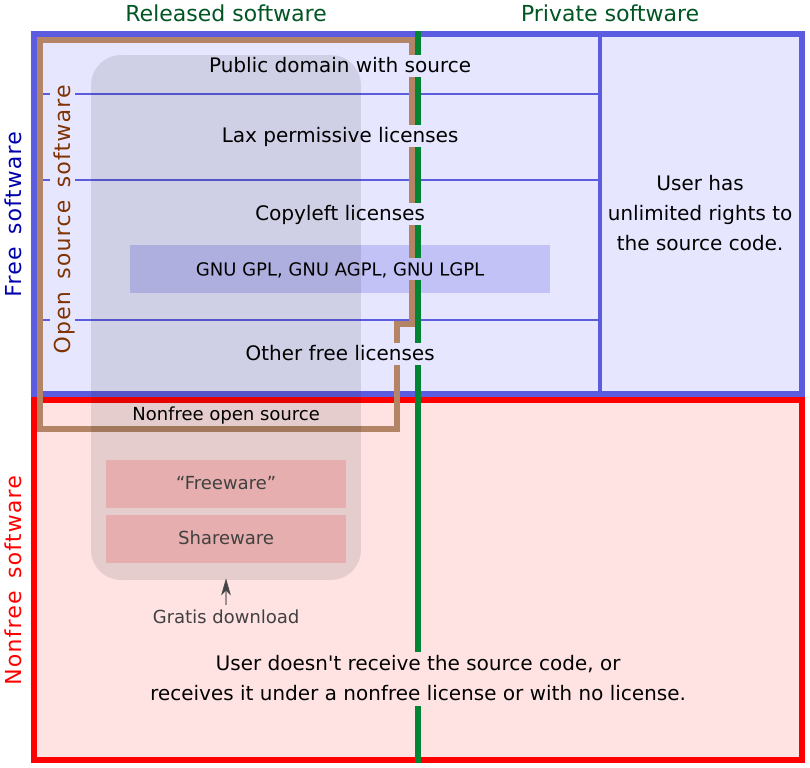
so for people like Stallman a BSD-style license (which is just one step above public domain and true freedom) would be unacceptable.
Here I disagree: it's not unaceptable at all, only less prefered. It's a free license, but lacks the "social instrument" provisions that you mentioned, but it *is* a free license nonetheless. From the FSF licences page:
If you are contemplating writing a new license, please contact the FSF by writing to . The proliferation of different free software licenses means increased work for users in understanding the licenses; we may be able to help you find an existing free software license that meets your needs. We try to list the most commonly encountered free software license on this page, but cannot list them all; we'll try our best to answer questions about free software licenses whether or not they are listed here. Modified BSD license
This is the original BSD license, modified by removal of the advertising clause. It is a simple, permissive non-copyleft free software license, compatible with the GNU GPL.
If you want a simple, permissive non-copyleft free software license, the modified BSD license is a reasonable choice. However, it is risky to recommend use of "the BSD license", because confusion could easily occur and lead to use of the flawed original BSD license. To avoid this risk, you can suggest the X11 license instead. The X11 license and the revised BSD license are more or less equivalent.
This license is sometimes referred to as the 3-clause BSD license.
From the What is Free Software page: In the GNU project, we use copyleft to protect these freedoms legally for everyone. But non-copylefted free software also exists. We believe there are important reasons why it is better to use copyleft, but if your program is non-copylefted free software, we can still use it.
Of course, the FSF prefers and recommends the GPL: it's their license, made with a specific purpose. But I just don't see the confrontantional tone that would make the BSD/X11/ISC-type licenses "unacceptable".
As for the rest, you are of couse more than free to like or dislike RMS, the FSF or the GPL, I'm not trying to change that. -
Re:No, reallyThe GPL is really more of a social instrument than a software license
I agree with you here.
so for people like Stallman a BSD-style license (which is just one step above public domain and true freedom) would be unacceptable.
Here I disagree: it's not unaceptable at all, only less prefered. It's a free license, but lacks the "social instrument" provisions that you mentioned, but it *is* a free license nonetheless. From the FSF licences page:
If you are contemplating writing a new license, please contact the FSF by writing to . The proliferation of different free software licenses means increased work for users in understanding the licenses; we may be able to help you find an existing free software license that meets your needs. We try to list the most commonly encountered free software license on this page, but cannot list them all; we'll try our best to answer questions about free software licenses whether or not they are listed here. Modified BSD license
This is the original BSD license, modified by removal of the advertising clause. It is a simple, permissive non-copyleft free software license, compatible with the GNU GPL.
If you want a simple, permissive non-copyleft free software license, the modified BSD license is a reasonable choice. However, it is risky to recommend use of "the BSD license", because confusion could easily occur and lead to use of the flawed original BSD license. To avoid this risk, you can suggest the X11 license instead. The X11 license and the revised BSD license are more or less equivalent.
This license is sometimes referred to as the 3-clause BSD license.
From the What is Free Software page: In the GNU project, we use copyleft to protect these freedoms legally for everyone. But non-copylefted free software also exists. We believe there are important reasons why it is better to use copyleft, but if your program is non-copylefted free software, we can still use it.
Of course, the FSF prefers and recommends the GPL: it's their license, made with a specific purpose. But I just don't see the confrontantional tone that would make the BSD/X11/ISC-type licenses "unacceptable".
As for the rest, you are of couse more than free to like or dislike RMS, the FSF or the GPL, I'm not trying to change that. -
FSF and Stallman have endorsed permissive licensesThe GPL is really more of a social instrument than a software license, so for people like Stallman a BSD-style license (which is just one step above public domain and true freedom) would be unacceptable. Not so fast. The GPL FAQ states that there exist situations where a permissive license is appropriate, in particular short programs and web site templates. Mr. Stallman has also endorsed the use of a permissive license for a library designed as the reference implementation of a Free file format that replaces patented file formats.
-
FSF and Stallman have endorsed permissive licensesThe GPL is really more of a social instrument than a software license, so for people like Stallman a BSD-style license (which is just one step above public domain and true freedom) would be unacceptable. Not so fast. The GPL FAQ states that there exist situations where a permissive license is appropriate, in particular short programs and web site templates. Mr. Stallman has also endorsed the use of a permissive license for a library designed as the reference implementation of a Free file format that replaces patented file formats.
-
FSF and Stallman have endorsed permissive licensesThe GPL is really more of a social instrument than a software license, so for people like Stallman a BSD-style license (which is just one step above public domain and true freedom) would be unacceptable. Not so fast. The GPL FAQ states that there exist situations where a permissive license is appropriate, in particular short programs and web site templates. Mr. Stallman has also endorsed the use of a permissive license for a library designed as the reference implementation of a Free file format that replaces patented file formats.
-
Re:Bureaucratic nonsense
Except that most really good stuff is a labor of love and has been made available for free -- ranging from the alphabet through the number zero to mathematical proofs and much web content (including Slashdot and other community sites). Consider:
"Creativity and intrinsic interest diminish if task is done for gain"
http://www.gnu.org/philosophy/motivation.htmlSome really good stuff is. A fair bit of mediocre stuff is as well. I did write "most" not "all" in my previous post when talking about useful works created in places with IP frameworks.
However, things like books and software have come to be known collectively as "works" for a reason: making good ones typically does require a lot of hard work. Good books and magazines need proofreading, fact-checking, editing, and typesetting. Good software needs things like debugging, usability testing and documentation. Making a good movie needs more than special effects and a big-name leading couple.
Compare fan fiction to serious, published novels. Compare hobbyist computer games with professional titles. Compare home videos on YouTube to films from movie studios (and not just Hollywood, please). Compare FOSS developed by volunteers to software developed under the traditional, commercial model. In each case, while there are a few examples of good, volunteer-produced material, most of the best work is done on a commercial basis, and even the good volunteer stuff isn't particularly better than the good commercial stuff.
Even if you look at borderline cases, compensation plays a role. Much of the most successful FOSS is developed primarily by businesses these days, not amateur volunteers: Linux distros, MySQL, Firefox, and the list goes on. Things like peer-reviewed scientific journals have a strange economic model, but even academics, who are perhaps the most natural example of volunteers working hard to produce good material, publish partly out of enlightened self-interest: they need the reputation and recognition that will get them their next funded project. I post here primarily for personal enjoyment, and if someone finds my comments interesting or informative then that's great, but again I also come here because I find comments by others interesting or informative and in a sense I'm just doing my part to support the community as a whole.
Now, you can get into arguments about the duration of IP protection and how many advances have been made by breaking the rules, and there is some merit in those arguments, but frankly, I think they are straw men here. Most of the time, people do play by the rules, and places that have IP rules produce more useful works on balance than those who don't. And most of the time when people don't play by the rules in the West, they're just being selfish, and if everyone was as selfish as them, then everyone would lose out. This is no different to petty thieves ripping off a store because "the store can afford it", or poor drivers cutting others up because "it doesn't cause accidents", or aggressive people pushing to the front of a queue because "it's only making everyone else one person later".
-
Re:Bureaucratic nonsense
Except that most really good stuff is a labor of love and has been made available for free -- ranging from the alphabet through the number zero to mathematical proofs and much web content (including Slashdot and other community sites). Consider:
"Creativity and intrinsic interest diminish if task is done for gain"
http://www.gnu.org/philosophy/motivation.html
Food and shelter used to be free for the taking and making -- except enclosure acts promulgated by rich and powerful people took away the commons and privatized it. (Well, population pressure changed things too, but there remain vast tracts of only sparsely occupied land.) Shortly we will be able to print things in 3D for cheap or free, just like we now can print in 2D for cheap or free.
The history of the USA is essentially the history of violation of copyrights and patents and trade secrets. The early colonies recognized not foreign copyrights and so copied all the British books for free, and all the early designs for industrial mills were taken from the British -- clandestinely as the British had instituted a death penalty for stealing mill secrets. Further ironically the British in turn had stolen technology from China -- silkworms which were illegally smuggled out in a hollow walking cane.
It is when a country becomes dominant that copyrights and patents are heavily enforced -- otherwise they generally hurt both the common person and the elite as they attempt to shut those at the edges away from productive ideas.
Are you narrowly defining "work"? Why let people claim, say, novels as totally their own even if they draw on centuries old folk tales and use an alphabet and lexicon created by a collaborative effort of generations? Why ignore the costs and risk from pollution and nuclear war hanging over the heads of everyone in the world produced overall by a related economic system based on competition and an (enforced) scarcity world view in an abundant universe? Why ignore the chilling effects and legal costs imposed on society (including imprisonment of people who share) when society receives no value back for what are now effectively indefinite copyrights? The brgain with the public -- copyright for a limited time in exchange for works returning to the public domain -- has been broken.
Your post is a great example of making information available for free. Why did you do it if not for immediate gain? -
Re:Is Linus too much of a nerd?Nice try. Read: http://www.gnu.org/gnu/linux-and-gnu.html Nice try. Try reading the rest of the first paragraph of GP's post.
-
Re:Is Linus too much of a nerd?
Linux is the name for both the kernel and the OS.
Nice try. Read: http://www.gnu.org/gnu/linux-and-gnu.html
Linux has no UI. Linux is a kernel, the heart of the operating system. Linux is not an operating system. Linux is the core--or kernel--of one. Linux by itself would be pretty useless. -
Re:Open source projects?Care to explain
Sure.
You said: You can't use GPLv3'd software with DRM, with or without redistribution. That's restricting use.
From the GPL V3 FAQ:Does GPLv3 prohibit DRM?
It does not; you can use code released under GPLv3 to develop any kind of DRM technology you like. However, if you do this, section 3 says that the system will not count as an effective technological "protection" measure, which means that if someone breaks the DRM, he will be free to distribute his software too, unhindered by the DMCA and similar laws.
As usual, the GNU GPL does not restrict what people do in software, it just stops them from restricting others.
You also said:It also tries to stonewall the MS-Novell agreement. That's also restricting use.
Please explain how Microsoft and Novell's use of the software is restricted. (You dumbass) -
Re:What's "open" about that source?
Not necessarily all platforms, but it's hard to see something as really being Free Software when it requires proprietary tools to build or run. See The Java Trap for more information; the example it uses is slightly dated now, but the rest is sound.
-
Re:Open for Closed
-
[OT sig discussion] GNU TLS
What does GnuTLS do that is different?
GnuTLS supports OpenPGP certifications. OpenPGP can do everything X.509 style certs can do, but more, the main things being:- Multiple certifiers for a given identity, so even if (one of) your CAs turns out to be untrustworthy (which does sometimes happen) your identity may still be trustable.
- Web of Trust: X.509 self-signed certs don't help much, but with OpenPGP, what if you (as a CA) happen to be signed by someone that person who is trying to talk to you, does know?
- An acknowledgement of "degree" of trust. X.509 is all-or-nothing; you either have to believe it or not. OpenPGP allows for gray areas, or in other words: reality.
- The barrier to entry into the OpenPGP WoT is very low, even cacert can't quite match it.
-
Re:But there should be a native port!
As I pointed out in another post, there's a version of gnash for Linux on amd64 that's already available (but still way too buggy).
-
Re:You can use Flash on AMD64 Firefox
Also, gnash has recently matured to the point of being able to play YouTube movies on all supported architectures, including amd64. Well, sort of - in my experience, the version in Ubuntu Feisty repositories is still way too buggy in many ways, including, but not limited to, some of the GUI components misplaced or not working, huge memory leaks (don't leave it overnight) and stopping to load after viewing a dozen of clips. But hey, it's a start.
-
Re:GPL Comment
I hereby release this comment under a GPL.h
You are free to use this comment or modify this comment in away you feel fit. But if you distribute this comment or any modifications of it, you need to also retain the release statement (first paragraph of the comment).
(I never was drunk, wine is part of my place's culture so getting drunk is not a transgression. Pity for our youngsters which are becoming idiotic drinkers of shitty stuff like everywhere else.
There, settled.) -
A good step, but also won't work
First, replacing DRM with watermarks is a very nice step. It changes those companies position from support a future like Right to Read to merely accusing people on baseless evidence. So, we can stop acting like they want to leat us to an Orwellian society, and just ask for a better judicial system.
Now, watermarking also doesn't work. If it is audible, people won't like it. If it is not audible, it is useless information, what works against compressors and will be removed on every possibility. With time, all watermarks will be removed.
-
This just in...Doctors and dentists around the nation are being sought by the SIIA for allegedly sharing and distributing magazines containing copyrighted articles to any and all people that visit their waiting areas. Each Doctor or Dentist will be fined $100000 per magazine found in their waiting area, and an additional fee per current client that has visited the establishment over the past 10 years to be determined by the total size of the Doctor's bank account. Anonymous Coward will be awarded $6000 per Doctor or Dentist successfully sued for tipping off the SIIA. The SIIA has hinted that this is just the beginning, and that veterinarians will be next, followed by Libraries and then your wife's weekly book club....
Reminds me of the short story from Stallman that was linked into another
Tm
-
Re:Misspelling
I believe he knows full well what "Intellectual Property" means -- he is (rightly, in my opinion) trying to point out that we should avoid using the term altogether. I know I may be alienating some of you who harbor ill feelings or feelings of suspicion towards RMS by linking to this, but even if you don't agree with RMS on other issues, I would suggest you read what he has to say about the term "Intellectual Property" before you use the term too much yourself.
The basic thesis of his article is that "intellectual property" lumps three completely different legal constructs (copyright, patents, and trademarks) together even though in reality, they have essentially nothing in common. This suits people who profit from these assets, because by getting people to use the term "intellectual property" they encourage people to think of them as real property, despite the fundamental differences between these concepts. By cultivating this sort of intuitive (but incorrect) understanding, the long term effect is that so-called "IP" laws are tightened and morphed to increase their similarities to real property laws.
RMS is anti-copyright, or at the very least pro-copyright reform (of the extreme, extreme variety). This view is controversial at best, and I know many Slashdotters take a much more conservative position on these issues. However, I doubt very much that any of you would be in favor of eternal copyright, for example -- we all want copyrighted works to fall back into the public domain at some point, even if we differ on the details of when exactly that should be.
But consider, if copyrights were treated like real property -- something people who profit tremendously from copyrights would like -- copyrights would never revert to the public domain.
In China, property rights (real ones) are like copyright in the US today. That is, property belongs to the state, and you only "own" it for some renewable period (70 years, I think). Since Deng Xiao Ping's economic reforms were enacted, this is really just a formality, something left over from old school socialism -- unless you're unlucky enough to have property that's worth an awful lot and unwilling to sell it, "extension" on your "ownership" is pretty much automatic. Of course, this isn't de facto all that different from the US what with eminent domain and all, but I want you to see something sinister here: the idea that property reverting to the commons is "socialist". Europeans may not see the big deal here, but in the USA, "socialist" is synonymous with "evil" and calling something socialist is a very effective political weapon.
Now, there's a very good reason that copyright and real property are different: the former is not truly scarce, in the sense that any perceived scarcity is enforced by a government granted monopoly (not necessarily a bad thing). Real property, for example land, is truly scarce. If the land your house is built on "reverts" to the state, well, surely you can see how unfair that would be -- because you'd have to move out of your house. But with copyright, say a program you wrote, your work entering the public domain does not take the program away from you. You still have it.
As long as people don't think of copyright as property -- I'm singling out copyright here because I know the most about it, others can comment on trademarks and patents, which are very different animals and cannot be treated the same way -- it's fairly easy to make them understand that having a temporary copyright term with eventual reversion to the public domain is not socialist at all. But if they think of it as property -- which they will, if they don't care much about the issues, are ignorant of the legal distinctions, and are constantly hearing the term "intellectual property" bandied about -- a politician saying that having limited copyright terms is a socialist notion will seem reasonable to them.
With recent copyright term extensions in the US -
Re:Not "Free as in beer"
The BSD licence, if you read it one way, gives you the freedom to withhold the Source Code if you make an improvement. (If you read it differently, it gives other people the freedom to distribute Source Code they didn't actually get. We'll gloss over this for now.) The GPL obliges you, if you make an improvement, to choose between distributing Source Code or keeping your trap shut. Some (specifically, those who would take another person's hard work which they intended to be given away for free; then alter it just a little, cage it up and earn a living from selling it) have complained that this equates to less freedom.
In a society where slavery is legal, you have the freedom to own slaves -- which theoretically makes you more free than you would be in a society where slavery were illegal. In practice, however, the average level of freedom in a society where slavery is permitted will be rather less than the corresponding level of freedom in a society where slavery is not permitted.
In other words, taking away some "freedom" actually makes people more free!
See also Freedom or Power?. -
Re:Off-topic questionIgnore what I just posted. I found a simpler method. Use the shell-expand-line function (M-C-e), combined with command substitution. For example, you'll have the command line:
$ `sed 'sed_commands' input_file`
The use the M-C-e combination and the stuff gets expanded without final execution. In other words, the command line will read$ sed_output
Then you can inspect and press enter. -
Re:ObligatoryGo simply has too many possible moves. I know of no programs made thus far that can even approach Go playing capacity. And I doubt there will be any time soon.
I agree with you as does the publisher of IEEE Intelligent Systems in a recent editorial of his.
Not only is the combinatorics in Go greater than that of Chess but also the pattern recognition requirements in Go are much greater than that of Chess. With Chess, you have things like passed pawns, zugzwang, sister squares, and open files to recognize. In Go, you have things like life and death, thickness, shape, and the direction of play that you must be able to recognize. IMHO, the Go patterns are much more abstract than the Chess patterns.
However, let me take this moment to plug a great OSS Go program, GNU Go, which is the AI player part, and Panda-glGo, which simulates a Go board and can integrate with GNU Go. This is a great way for beginners to drill and improve their Go playing skills.
-
Re:The blurb is actually pretty accurate
-
Re:What?Exactly what I thought. Unless I completely misunderstood everything, MySQL is not becoming "closed source", the enterprise version is just not going to be free as in beer any more. You can pay for the enterprise version, and you'll have access to the source code...that's free as in freedom. What is so hard for people to understand about that? From http://www.gnu.org/philosophy/selling.html: Selling Free Software
Many people believe that the spirit of the GNU project is that you should not charge money for distributing copies of software, or that you should charge as little as possible -- just enough to cover the cost.
Actually we encourage people who redistribute free software to charge as much as they wish or can. If this seems surprising to you, please read on.
The word "free" has two legitimate general meanings; it can refer either to freedom or to price. When we speak of "free software", we're talking about freedom, not price. (Think of "free speech", not "free beer".) Specifically, it means that a user is free to run the program, change the program, and redistribute the program with or without changes.
Free programs are sometimes distributed gratis, and sometimes for a substantial price. Often the same program is available in both ways from different places. The program is free regardless of the price, because users have freedom in using it.
Non-free programs are usually sold for a high price, but sometimes a store will give you a copy at no charge. That doesn't make it free software, though. Price or no price, the program is non-free because users don't have freedom.
Since free software is not a matter of price, a low price isn't more free, or closer to free. So if you are redistributing copies of free software, you might as well charge a substantial fee and make some money. Redistributing free software is a good and legitimate activity; if you do it, you might as well make a profit from it.
Free software is a community project, and everyone who depends on it ought to look for ways to contribute to building the community. For a distributor, the way to do this is to give a part of the profit to the Free Software Foundation or some other free software development project. By funding development, you can advance the world of free software. -
Re:The community has to grow upCan you point to any instance where Microsoft, or some other comparable company has been held liable for defects in their software? Since when have software producers been liable for anything? As long as EULA's have clauses like the ones below, no user has any comeback for defective software.
"15. Disclaimer of Warranty. THERE IS NO WARRANTY FOR THE PROGRAM, TO THE EXTENT PERMITTED BY APPLICABLE LAW. EXCEPT WHEN OTHERWISE STATED IN WRITING THE COPYRIGHT HOLDERS AND/OR OTHER PARTIES PROVIDE THE PROGRAM "AS IS" WITHOUT WARRANTY OF ANY KIND, EITHER EXPRESSED OR IMPLIED, INCLUDING, BUT NOT LIMITED TO, THE IMPLIED WARRANTIES OF MERCHANTABILITY AND FITNESS FOR A PARTICULAR PURPOSE. THE ENTIRE RISK AS TO THE QUALITY AND PERFORMANCE OF THE PROGRAM IS WITH YOU. SHOULD THE PROGRAM PROVE DEFECTIVE, YOU ASSUME THE COST OF ALL NECESSARY SERVICING, REPAIR OR CORRECTION.
16. Limitation of Liability. IN NO EVENT UNLESS REQUIRED BY APPLICABLE LAW OR AGREED TO IN WRITING WILL ANY COPYRIGHT HOLDER, OR ANY OTHER PARTY WHO MODIFIES AND/OR CONVEYS THE PROGRAM AS PERMITTED ABOVE, BE LIABLE TO YOU FOR DAMAGES, INCLUDING ANY GENERAL, SPECIAL, INCIDENTAL OR CONSEQUENTIAL DAMAGES ARISING OUT OF THE USE OR INABILITY TO USE THE PROGRAM (INCLUDING BUT NOT LIMITED TO LOSS OF DATA OR DATA BEING RENDERED INACCURATE OR LOSSES SUSTAINED BY YOU OR THIRD PARTIES OR A FAILURE OF THE PROGRAM TO OPERATE WITH ANY OTHER PROGRAMS), EVEN IF SUCH HOLDER OR OTHER PARTY HAS BEEN ADVISED OF THE POSSIBILITY OF SUCH DAMAGES."
In case you're wondering, here's the source for the above: http://www.gnu.org/copyleft/gpl.html
-
Re:I like the linkClick here to get the latest prices on Linux distributions! Erm... free?
You can charge money to distribute free software. I am allowed to sell you a copy of the latest Unbuntu CD for a million dollars if I want. Remember that free refers to liberty, not price.
This comes right from the GNU website: "Actually we encourage people who redistribute free software to charge as much as they wish or can."
-
Citation for GNU plus Linux?He uses GNU+Linux now (says it GNU plus Linux). Can you give a citation? GNU/Linux on Wikipedia mentions this in passing, but only as an alternative to "GNU slash Linux". I prefer reading the slash as "over" myself, as in "chicken over rice" or "x over quantity x plus 1". A "plus" sounds to me more like equals, not the "on top of" meaning implicit in "TCP/IP". But if Mr. Stallman has chosen to deprecate the slash, then FSF needs to update the explanation of GNU/Linux.
-
Re:Depends on usage, entirelyBut when someone sends me a Word 2007 document, what do I do?
Ask them to send the document in a different format. Also, politely remind them that what they sent was stored in a proprietary format (yes, OOXML is proprietary), much like sending someone a document written in Latin and expecting them to be able to read it.
I make it a point to respond to every word document attachment with a request for information in a non-proprietary format, even if I don't care about reading it anyway (I get a few every week). However, you will find that 90%+ of people will completely ignore your request. I have only done this with personal e-mail, not business.
More information on dealing with this information here: We Can Put an End to Word Attachments
-
Re:Linus released the 'Linux' OS?I've never heard anyone say GNU correctly in person (it's always G.N.U.) Sez who?
Stallman, who ought to know, does not spell it out, so why do you think it needs to be? when it's the name of our system, the correct pronunciation is
"guh-NEW" -- pronounce the hard "G".
Free Software: Freedom and Cooperation -
Re:Let me be the first to say...
Its simple to see the game:
Imagine this conversation at the high seat of power:
"Linux is a community, it can be fractured by buying a few players.
They are soft targets. First we divide them and conquer, upto legal and marketing requirements.
Then we dump SCO - SCO's boss gave us a lot of support, we give him a nice house beside the beach in California. And a nice bank balance.
Now, Novell is SCO Reloaded!
With a hand in OIN and a big market following with SUSE, we can now fight the real emerging enemy who actually has a legal department to stop us at our game using our IP tricks, and that is SUN
Now it is SUN versus Novell, a newer, much more organized, battle where we have more powerful instruments - plus we have Linuxers hating SUN and we have SUN with all their best open sourced.
Now BOTH Linux AND SUN are soft targets,
Cheers Embalmer, Pearly!
To your wealth!"
(single "l", mind you)
Surely, Noorda is crying.
This is not apparently related, but after you read it, you will find just how deeply connected to this issue it is - you do not need to spend millions on marketing, just write the code and announce it on digg/here:
http://savannah.gnu.org/task/?7027
Note that they have also _threatened_ Jim Zemlin to say what he has been saying and they are going to _threaten_ everyone who tries to speak against them.
I doubt they have bribed anyone, especially because Jim Zemlin was the only person to say:
"dont touch the community, you touch even one of us and we will all unite and fight against you".
Now they've threatened Jim to say what he has said. He is not bribed, I am sure.
There's something very very fishy going on out there.
It looks like a threat from all angles, but IANAPolitican.
So the best we the community, could do, is this:
A thousand people shouting out loudly against _threats_ of all kinds will definitely help save these leaders who are being individually singled out as targets.
The mighty $$ powers are doing everything they can to stop _anything_ opensource that will give them even a minor problem. Linux, SUN, GNU, all are their daily _nightmares_
However, before speaking up or shouting loud, remember what they did to the guy who wrote: "show us the code" - he lost his job or website or both.....
Now that law isn't going to help them on the 235 patents and their product is exposed to be technically rubbish, they are losing market share because of _their_ _own_ technical mistakes - so many unfulfilled promises and such a bad product, they are using _threats_ to FOSS leaders and being opportunistic (sure?) with favorable judgements.
Really nice way to fix bugs in your program - sue your competitor.
They are extremely good legally and so they use other entities as proxies.
PJ might be happy that this is the end of SCO.
But dont think they have waited for more than a day or two to file against SUN, now that they have succeeded in breaking Linux unity.
Someone has to do what PJ did all this while. Who is PJ v2.0?
Essentially, no company _likes_ their users. They all like _money_. Users are, well, users.
Use and throw. That's why they are "user"s. -
Re:Not interesting... Yeah right.
Even Linux isn't anything unreplacable.
That's funny, because I could have sworn that GNU was having problems doing that with Hurd.
You could go use OpenSolaris, though. Tell me how it works out for you. -
Canons of conduct
This (and in fact the rest of the pages) offers some very useful pointers to people advocating Linux. To quote:
- As a representative of the Linux community, participate in mailing list and newsgroup discussions in a professional manner. Refrain from name-calling and use of vulgar language. Consider yourself a member of a virtual corporation with Mr. Torvalds as your Chief Executive Officer. Your words will either enhance or degrade the image the reader has of the Linux community.
- Avoid hyperbole and unsubstantiated claims at all costs. It's unprofessional and will result in unproductive discussions.
- A thoughtful, well-reasoned response to a posting will not only provide insight for your readers, but will also increase their respect for your knowledge and abilities.
- Don't bite if offered flame-bait. Too many threads degenerate into a ``My O/S is better than your O/S'' argument. Let's accurately describe the capabilities of Linux and leave it at that.
- Always remember that if you insult or are disrespectful to someone, their negative experience may be shared with many others. If you do offend someone, please try to make amends.
- Focus on what Linux has to offer. There is no need to bash the competition. Linux is a good, solid product that stands on its own.
- Respect the use of other operating systems. While Linux is a wonderful platform, it does not meet everyone's needs.
- Refer to another product by its proper name. There's nothing to be gained by attempting to ridicule a company or its products by using ``creative spelling''. If we expect respect for Linux, we must respect other products.
- Give credit where credit is due. Linux is just the kernel. Without the efforts of people involved with the GNU project, MIT, Berkeley and others too numerous to mention, the Linux kernel would not be very useful to most people.
- Don't insist that Linux is the only answer for a particular application. Just as the Linux community cherishes the freedom that Linux provides them, Linux only solutions would deprive others of their freedom.
- There will be cases where Linux is not the answer. Be the first to recognize this and offer another solution.
A classic case of this would be Twitter, who in the rare moments when he does come out with something constructive and insightful, tends to ruin any credibility by creatively misspelling Microsoft and Windows.
Naturally that is his prerogative, but the decision to do that, which he (and others) take, do not particularly help the advocacy of Linux.
-
Re:So what about gcj?
it's still being actively developed. GCJ is part of GCC, so I don't think it will be abandoned anytime soon.
-
Re:Patent, schmatent -- supply and demand wins
Bootleg bottled water in Beijing was recently revealed to often be fake, using filtered Beijing tap water
By relying on the IP minsiformation, you miss a very important distinction.
There is no argument against trademarks, unless they are abused in principle they guide people to products with expected quality levels.
The argument is against software patents, and against the continuous expansion of copy rights both in scope and in time.
-
Re:You've misread the terms
The FSF does the same thing...so if you contribute to any GNU project, you must assign your copyright to them. See this for details.
-
Re:Karma gets even with MS!
I am new to writing on slashdot but have been reading evry now and then.
Although this might seem unrelated, I insist that you see this and if anyone has the time, effort, contacts or anything positive to give to this, go ahead and do it:
http://savannah.gnu.org/task/?7027
Maybe it is crap. Or already made somwehere. If so, mod me down, and that is the end of it.
If not, pleeeaassee write the code.
yubnub.org (Ruby on Rails) has code ready for the shell imitator.
Eyeos / Cornelios / 100+ AJAX/GUI toolkits have the code ready for the GUI imitator.
ibiblio has the bandwidth and so do slashdot, sf.net, linux.com AND www.linux.org
(and yes, I have a keyboard and you have the "bad karma" widgets in your browser
Maybe, you think that the project is unimportant, but I am damn sure not everyone on the sother side of the fence thinks the same and they *DO* read these pages as well --*not* fud.
As a side plus, you could make good money as well
And yes, remove the XUL part - nowadays, mozilla sux. -
Re:GPL Question - Yes you can
I am going to say that yes, you CAN make your app GPL even if it depends on your proprietary library. I base my answer on this FAQ entry:
http://www.gnu.org/licenses/gpl-faq.html#FSWithNFL ibs
As you can see that does go against the philosophy of Free software. If you still have questions send an email to licensing@fsf.org. I have asked GPL questions to this address and have received prompt advice. -
Re:Ummm..
--atime-preserve updates the ctime
Not on Linux: http://www.gnu.org/software/tar/manual/tar.html (search for "O_NOATIME").
Besides, the way files are generally manipulated on Unix, ctime has limited value. At my current job, we even have a cron job that runs once a week, and updates all the permissions on all of our important files, just in case someone screwed them up, so here, ctime has practically no value at all. I'd rather have atime, thanks. -
Re:This just reminds me of my friend.
On the other hand, our first year Java lecturer insisted that K&R was the One and Only Correct Brace Placement Style and marked us down if we used ANSI C++ style brace placement instead of K&R. 'Tard.
Both you and he need to discover a little piece of software called indent.
-
Why Schwartz? 3rd pole, he wants popularity.
I suppose that Schwartz wants that the people know the Sparc64 architecture against PowerPC64 architecture.
What 64-bit CPU targets dominate in the future?
http://gcc.gnu.org/ml/gcc/2007-08/msg00112.html
http://gcc.gnu.org/ml/gcc/2007-08/msg00113.html
http://lists.gnu.org/archive/html/qemu-devel/2007- 08/msg00072.html
There are x86-64 soft-simulators for 32-bit PCs but i don't known Sparc64 soft-simulators for running linux or opensolaris OSes in my existent 32-bit PC. -
Why Schwartz? 3rd pole, he wants popularity.
I suppose that Schwartz wants that the people know the Sparc64 architecture against PowerPC64 architecture.
What 64-bit CPU targets dominate in the future?
http://gcc.gnu.org/ml/gcc/2007-08/msg00112.html
http://gcc.gnu.org/ml/gcc/2007-08/msg00113.html
http://lists.gnu.org/archive/html/qemu-devel/2007- 08/msg00072.html
There are x86-64 soft-simulators for 32-bit PCs but i don't known Sparc64 soft-simulators for running linux or opensolaris OSes in my existent 32-bit PC. -
Why Schwartz? 3rd pole, he wants popularity.
I suppose that Schwartz wants that the people know the Sparc64 architecture against PowerPC64 architecture.
What 64-bit CPU targets dominate in the future?
http://gcc.gnu.org/ml/gcc/2007-08/msg00112.html
http://gcc.gnu.org/ml/gcc/2007-08/msg00113.html
http://lists.gnu.org/archive/html/qemu-devel/2007- 08/msg00072.html
There are x86-64 soft-simulators for 32-bit PCs but i don't known Sparc64 soft-simulators for running linux or opensolaris OSes in my existent 32-bit PC. -
Re:Please Stop Using "GNU/Linux"
Linux is about 3% of the code in a typical Linux distribution. GNU is about 28%.
http://www.gnu.org/gnu/linux-and-gnu.html
"Linux is what it is, using GNU/ in front of it is irrelevant and meaningless" --- Err, no.
You can have a GNU system without Linux -
Re:Please Stop Using "GNU/Linux""Hmm, nope. Linux is only a tiny little part of a typical system."
While it is true that GNU is the largest part of a typical distribution, technically the OS is the layer that runs between the hardware and the system software. I quote the Wikipedia article referenced above:
"Operating Systems themselves have no user interfaces; the user of an OS is an application, not a person. The operating system forms a platform for other system software and for application software. Windows, Linux, and Mac OS are some of the most popular OSes."
As such, the Linux OS is the kernel. The kernel has nothing to do with GNU. If you want to run a GNU OS, run the HURD kernel.
-
Re:Should be tagged with haha
What about IIS7? Faster than Apache, just as modular, easier to install and configure. It's even the recommended server for PHP.
Except it doesn't have this very useful feature, and it never will. -
Re:Does this mean
And BSD-style licenses are pretty damn close to public domain, wouldn't you say?
No, I wouldn't. BSD license is as close to public domain as it is (in the opposite direction) to GPL.
There's no "may or may not be copyleft" about [Free Software], that's the definition of copyleft.
The people who invented the term "Free Software" disagree with you. -
Re:that may not be sufficient
There is no basis for what you are claiming and I think you are missing the point. First, you can never lose the rights to use the software. Read it yourself. By design, steam can fix an oversight by simply uploading the license to you when you log in. This isn't the same as a proprietary license, so they can distribute as long as they comply, as there is no court order forcing them to stop. You NEVER need to ask permission to distribute GPL software, outside of a court order banning you.
Most important: it was a simple oversight, ID is very pro GPL, and everyone who is making a big deal out of this, accusing them of "theft" has not a single clue. It is good that it was found and fixed, and that maybe someone can learn a little about the GPL, but they god damn sure aren't going to learn about the GPL from reading slashot and the linked blog. jeez... -
Re:call me a noob...
Since they distribute DOSBox in binary form they are obligated under the GPL to make the source to DOSBox available. They are not obligated to provide source for the games since DOSBox is an emulator, which is to say, a kind of interpreter, not a library with which the games are linked. The distribution of both the games and DOSBox on the same medium does not bring the games under the GPL. This is made explicit in the "aggregation" clause of the GPL. See also the GPL FAQ.
-
Re:Exactly.Each version is given a distinguishing version number. If the Program specifies a version number of this License which applies to it and "any later version", you have the option of following the terms and conditions either of that version or of any later version published by the Free Software Foundation. If the Program does not specify a version number of this License, you may choose any version ever published by the Free Software Foundation. from http://www.gnu.org/licenses/old-licenses/gpl-2.0.
h tml
that would seem to imply that I as the user of gpl 2.0 licensed software, if it contained the statement referenced above, would be free to choose the GPL-3 would be free to impose the conditions of the gpl 3, on the distributer even if they were entered into an agreement with a third party.
Further, The GPLv3 specifically states that if _you_ include something, you have to have the rights to do so while following the other conditions of the same clause. If the disputed IP is placed in without the rights, it isn't in there. This is something people are going to be running into problems with when they take existing GPLv2 projects and move them to the GPLv3. If something is in them that another person or company has a claim to, they are taking the personal liability for including it under a license that pretends to have the right to use it. When ever you distribute a GPLv3 covered work, unless you place something in it, or specifically know about the issue, you aren't adding anything to the covered work. You cannot be tricked out of your property by mere association. There has to be some purposeful act that you take. The idea that the GPL now attempts to trick people out of their possessions by sneaking a copy into something without your knowledge or permission is ridiculous. If ever there was something wrong with life, that would be it.
MS did give the rights to include that IP to Novell in the deal they made, so that rules that bit out. since it sounds as if you give the rights to do so, or do so yourself that you are then bound by the license.
IMO(IANAL) I do think that if any of the software that MS gave out vouchers had the clause in it to allow the use of any other later license that is grounds to hold them to it for that piece of software, now i think that SAMBA is licensed in such a way, I'd have to go look it up, but if it is then they just gave out a copy of all patents free to use.
P.S. that'll be a 5000USD fine for breaking the encryption on my post.