Slashdot Mirror
Domain: grantham.de
Stories and comments across the archive that link to grantham.de.
Comments · 58
-
They tried something like this in GermanyA couple of years ago, some students tried the same tactic. Germany's third- or fourth-largest party, the Free Democrats (basically a business-friendly, semi-quasi-libertarian party) have only a very small membership, but have a lot more "punch" than their size would otherwise allow, because the two big parties (the Christian Democrats and Social Democrats) rarely are able to get a majority on their own.
So some students in effect overwhelmed the Berlin office of the FDP by joining it en masse. The FDP, though, actually welcomed it (what *else* could they do) and interestingly chose to start to work with the students, and now they have been in effect absorbed into the party with little effect other than to cheer up the FDP. (Which is not really a bad thing anyway. The two big parties are full of idiots, especially the Christian Democrats.) Some of the students stayed and were assimilated, many lost interest and left, but in the end it had little real effect.
For that matter, I also ran as a delegate in the Democratic caucus in Minnesota in 1996 (I was a Tsongas guy, if you remember him). I easily got elected because, as you say, there was hardly anyone at the caucus in my district (and those that were there were all loony-left types worshipping Tom Harkin and/or Jerry Brown). But once I got to the district level, I was simply outnumbered by the usual party hacks and had little to do other than watch them elect the delegates they always elect. So again, in the end it really doesn't seem to make a difference long-term. (Sad to say.)
Cheers,
-
I'm no expert, but......it seems to me that Java has a lot going for it because of its versatility, like in embedded devices, as a web development platform and so on. I could be totally wrong here, but
Cheers,
-
Tookkit?Is that a kind of thing used by Gandalf for dealing with foolish little hobbits from Great Smials?
(OK, I've been reading LOTR again...)
Cheers,
-
Well, Shakespeare said it best...Kill the lawyers!
Oh, wait....
Go lawyers!
Really, it's great to see a law practice doing something positive online for once. I'm sure there are others, but they never seem to be mentioned in the press (and are no doubt outnumbered by the idiots suing over patents, linking, etc.).
Cheers,
-
Paper? Be careful...
The problem with paper is that only highly specific types of paper are all that durable over many years. Most normal kinds of paper that you typically see have a high acid content, which causes them to yellow and then disintegrate with age. Your average paperback book will start to crumble in a few decades or so, most newspapers even earlier. I have quite a few paperbacks that are about 20 years old (which is when I started buying my own books), and they have definitely started to yellow and turn brittle even though they have been stored in a dry, clean, reasonably climate-controlled place (i.e. my living room).
Acid-free paper can also deteriorate over time, especially if handled a lot (since sweat from fingers also contains acids and bacteria) or just exposed to the air (which is also slightly acidic in normal circumstances, especially if the air is at all polluted), and also depending on the kind of inks used. Soy inks, which are increasingly popular with mass-printed media, may decay or fade over time (though they have not been in use long enough to know for sure); offset inks can also turn acidic if not properly mixed and/or discolor over time.
So it's not as simple as just "printing on paper". You need to use specially-produced acid-free (slightly alkaline) paper; use a non-acidic ink with a chemically stable pigment; and store it in climate-controlled conditions, where it can't be handled or even breathed upon.
Ironically, parchment and soot ink have proven remarkably stable over time. So long as parchment books were not stored in overly bad conditions (too damp or in polluted air), they held up for many hundreds of years with no trouble.
In a way, this story comes as no surprise to anyone who's interested in calligraphy and medieval history -- take a look at the books in museums, like the Lindisfarne Gospels at the British Museum or the Book of Kells at Trinity College, Dublin, and they look amazingly bright and fresh some 1300 years after they were made.
Those monks wanted to write for a very long posterity, and stumbled on just the way to do it -- sheepskins (vellum) and ink out of bone black.
If you're interested in medieval writing materials, check out these pages:
Ink Recipes
Handmade Paper -- Archival Paper
Medieval ManuscriptsCheers,
-
Classic example:A few years ago in the Hamburg (Germany) main newspaper, the Abendblatt, they reported (I'm not joking) that Russians program especially dangerous virii -- because the code is in Cyrillic, which "normal" computers can't handle.
I figure some jerk reporter was pecking some geek to provide him with some juicy info, and the geek made something up...
cya
-
I would like to revise the headline for Reuters..."Irish Inventor on Crack Says World Needs His Energy"
cya
-
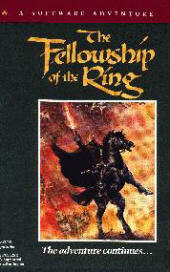
Oh my God!I actually still have this game:
It's "The Fellowship of the Ring", a.k.a. "The Lord of the Rings: Game One" for MS-DOS, from 1985. It was actually just sort of a text-based adventure with occasional illustrations, and as I remember I always got hopelessly stuck somewhere before getting to Bree (before which I got hopelessly stuck in Michel Delving -- the plot of the game is rather different from the book). It had amazing CGA graphics (wow! four colors!) and ran on two 5.25" floppy drives (our computer didn't even have a hard drive at that point).
The funny thing is, I was just thinking about that game a day or so ago. It's buried in a box of my stuff at my parents' place...*sigh*
I also was pretty amazed at how UGLY the Atari 2600 game looks. I was addicted to the 2600 in the late 70s/early 80s (and the 5200 was awesome), though I didn't have one of my own. But I never remembered the graphics being THAT bad. Just a sign how far we've progressed, I suppose...
Ah well, Memory Lane. *sigh* I feel old...
cya