Slashdot Mirror
Domain: ilsr.org
Stories and comments across the archive that link to ilsr.org.
Comments · 21
-
Re:I trust my credit unions
You're lumping in National Banks with Community Banks, and they are very different. You might want to take a look at a Community bank in addition to your Credit Union.
https://ilsr.org/top-5-reasons-choose-community-bank-or-credit-union/
-
Yancey County NC
I'm paying almost $40/month to Frontier for a 1.5 Mbps DSL connection. Country Cablevision has a fiber optic line running across my front yard but says I can't have any of it. I assume the line runs over the next ridge to the new gated community development... can't have us poor riff-raff cutting in on their bandwidth...
http://www.govtech.com/dc/arti...
"The grant funded a $25.3 million fiber-to-the home broadband project in Yancey and neighboring Mitchell County. Now completed, the network can deliver service at speeds from 25 mbps to 1 gigabit upload and download to every household in the county." That's just a God-damned lie. -
Local nets battle in colorado and NC
the fight continues at the local level in Colorado for energy and data local autonomy from terrible corporations: https://muninetworks.org/conte....
The institute for local self reliance has been at this a long time: https://ilsr.org/ and the specific site for local internet, https://muninetworks.org/ .
Comcast succeeded in throwing its weight around in Seattle: https://ilsr.org/comcast-money... .
The battle of Pinetops North Carolina is critical here, there is a documentary about it even . https://muninetworks.org/conte... Trailer https://vimeo.com/222595040 .
Imagine having twenty service providers https://muninetworks.org/conte...
It's a hassle to figure out but it is possible to achieve victories in this area.
-
Local nets battle in colorado and NC
the fight continues at the local level in Colorado for energy and data local autonomy from terrible corporations: https://muninetworks.org/conte....
The institute for local self reliance has been at this a long time: https://ilsr.org/ and the specific site for local internet, https://muninetworks.org/ .
Comcast succeeded in throwing its weight around in Seattle: https://ilsr.org/comcast-money... .
The battle of Pinetops North Carolina is critical here, there is a documentary about it even . https://muninetworks.org/conte... Trailer https://vimeo.com/222595040 .
Imagine having twenty service providers https://muninetworks.org/conte...
It's a hassle to figure out but it is possible to achieve victories in this area.
-
Re:Amazon
Moreover, cities don't force Amazon to build abundant, cheap customer parking as they do to brick and mortar stores, so that's another cost Amazon doesn't have to pay.
And, cities gave big-box stores deed restrictions as a way to prevent competition from other brick and mortar stores.
So I wouldn't give Amazon or big-box stores so much credit for their own success. It's the gross incompetence of city planners that has been destroying small business for decades.
-
Re:From the linked information
Well
http://ilsr.org/technological-...
http://ilsr.org/wp-content/upl...
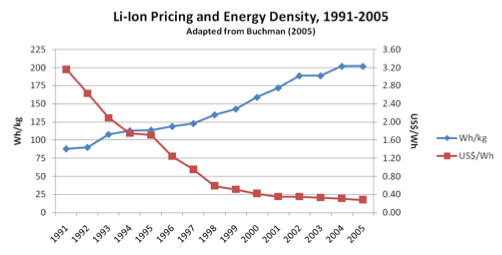
Lithium storage pricing / watt hour seems to have flatlined in recent years, but energy density still has a little positive slope to its curve. The cheap enough in 10 years looks like it needs more to support the statement.
What prompts you to say compressed air storage will drop in price ? That process is very mature and has been for a very long time
-
Re:From the linked information
Well
http://ilsr.org/technological-...
http://ilsr.org/wp-content/upl...
Lithium storage pricing / watt hour seems to have flatlined in recent years, but energy density still has a little positive slope to its curve. The cheap enough in 10 years looks like it needs more to support the statement.
What prompts you to say compressed air storage will drop in price ? That process is very mature and has been for a very long time
-
How do you tell when competition is fair?
While I broadly agree with your ideal that fair competition is good for customers and specifically with the example you gave, there is more to cheap prices than meets the eye. For example, not that long ago Walmart got into trouble for predatory pricing.
The complaint accused Wal-Mart of selling butter, milk, laundry detergent, and other staple goods below cost at stores in Beloit, Oshkosh, Racine, Tomah, and West Bend. A bottle of laundry detergent that cost Wal-Mart $6.51, for example, was sold for less than $5 at several stores> . The company’s intention, according to the complaint, was to force competitors out of business, gain a monopoly in local markets, and ultimately recoup its losses through higher prices.
I think most people will agree this kind of competition is bad from the consumer's point of view. The problem is, it is very hard to prove intention. That very same marketing tactic, i.e. selling products at or below their cost price, is also a popular marketing tactic known as loss leading.
It’s a classic retail technique: Attract shoppers by lowering prices on certain items, with the idea that once customers are in the store, they’ll buy full-priced items as well.
From the merchant's point of view, he is willing to take a loss on some items to earn traffic for his other goods. To his competitors selling the same loss leader items however, this is unfair competition. My point is, it is a very thorny issue deciding when certain competitive strategies are fair or unfair and much depends on the facts of each case.
-
Re:Coal (sadly) isn't going away
There's nothing at all unclear about when solar is at parity with traditional power prices: http://www.ilsr.org/projects/s...
-
Re:No, because they are not compatible
Wind and solar have variable output, so they need to be partnered with flexible power generation. Nuclear is fundamentally inflexible because you can't quickly ramp up or down electricity output from a nuclear power plant.
See this short video for a nice explanation of the incompatibility: http://www.ilsr.org/coal-nucle...
Wrong. Nuclear power can load follow (ramp up and down rapidly to meet instantaneous demand) perfectly fine.
Not exactly true. Yes you can throttle nuclear power plants, some times quite a lot in a short time, but as power plants go, it is harder to effectively throttle nuclear power than all other sources commonly used to generate power. Late in the nuclear fuel cycle there is a problem known as Neutron poisoning which can cause serious problems when trying to change the power output of a nuclear reactor. The engineering problem becomes increasingly more difficult as you use up your fuel, making it necessary to make power changes slower and slower. Eventually, it becomes impossible to vary the power without shutting down the reactor all together. Usually, when you reach that point, it's time to shutdown and refuel. Fossil fuels suffer no such fuel cycle issues.
-
Re:No, because they are not compatible
Wind and solar have variable output, so they need to be partnered with flexible power generation. Nuclear is fundamentally inflexible because you can't quickly ramp up or down electricity output from a nuclear power plant. See this short video for a nice explanation of the incompatibility: http://www.ilsr.org/coal-nucle...
It's plenty flexible for use aboard a ship or a submarine. So if it's good enough for a submarine, then why isn't it good enough for the land?
-
Re:No, because they are not compatible
Wind and solar have variable output, so they need to be partnered with flexible power generation. Nuclear is fundamentally inflexible because you can't quickly ramp up or down electricity output from a nuclear power plant.
See this short video for a nice explanation of the incompatibility:
http://www.ilsr.org/coal-nucle...Wrong. Nuclear power can load follow (ramp up and down rapidly to meet instantaneous demand) perfectly fine. They just typically do not because they are large baseload plants and there is no reason to run them anything lower than 100% when you need fossil fuel plants to make up the difference. IAANE.
-
No, because they are not compatible
Wind and solar have variable output, so they need to be partnered with flexible power generation. Nuclear is fundamentally inflexible because you can't quickly ramp up or down electricity output from a nuclear power plant. See this short video for a nice explanation of the incompatibility: http://www.ilsr.org/coal-nucle...
-
Re:I don't get it
Flame away, but [...] People want to trade one fiat currency, for another? Okay. What's the point?
Our economic challenge is one of resource scarcity. Coming up with schemes to trade compute time for fiat paper is not doing anyone any good.
Your post was neither inflammatory nor derisive. Ask, and it will be answered.
Crypto currency has three major advantages over state-issued currency: reduced transaction fees, no counter-party risk, and lower barrier for use.
1) Counter party risk in this case is where some agent involved in a transaction does something which is not in the interests of the participants.
For example, consider the parties involved in making an eBay purchase: eBay can sell your purchasing habits to advertizers, PayPal could take your money and not give it back, ChoicePoint can lose your identity info, VISA can sell your buying habits, and your bank can give all your history to the government.
Each party adds a little bit of risk to your transaction without any benefit to you and without your consent.
Cryptocurrencies eliminate these risks entirely.
2) Transaction processors charge a hefty fee for their services - upwards of 5% in total cost, with a high minimum charge.
Crypto currency transactions have much smaller fees. With no employees or physical cards or credit scoring mechanism, there's very little overhead - just a few cpu cycles per transaction.
This will push prices down (or profits up) by 5% or more for anyone who uses the new system. A merchant could lower prices by 5% for crypto-currency transactions, and make the same profit with a competitive advantage over their competitors.
That's huge.
Lower fees will admit micropayments. That's also huge.
3) Crypto-currencies increase market liquidity in two ways: the reduced fees allow micro-transactions, and they have no barrier to use.
Anyone can use cryptocoin without a credit check, permanent address, or bank account. Cryptocoin is similar to a "prepaid" credit card with no fees. If you have the money, you can use it... there's no need to connect to government or the financial system. Anyone with a cell phone and the money can make transactions online, which will be popular in poor nations. The world economic market could skyrocket.
That's also also huge.
Overall, crypto-currencies hold a lot of promise for being more valuable and easier to use than traditional systems. Whether this added value is enough to foster widespread adoption is up for debate, but there's enormous incentive to do so.
-
Re:This is disputed
So this Fox News story was idiotic. Solar only works in Germany because it is heavily subsidized. German consumers pay a great deal more for electricity than they would without the solar subsidies. Solar will always be expensive until you figure out a way to create a much less expensive solar infrastructure, such as nano-tech based solar that you paint on a road or a roof. You have to maintain solar arrays and the low power density means large areas are needed for solar capture, and the sun does not shine at night, so you have to solve the energy storage problem too.
Solar used to only work in Germany because of the subsidies. At this point, solar is Germany is much cheaper than retail electricity. As far as German's paying much more for electricity because of solar, that's not really so clear either. If you look here:
http://www.transparency.eex.com/en/
you can see where Germany's power is coming from at any given time. Solar is doing an incredible job of peak shaving, which lowers the cost of electricity. The accounting problem then becomes that people know how much the solar subsidy costs, but don't know how much lower the cost of all the other power is because of solar.
You mention solving the storage problem, and the Germans are working on that as well:
http://bosch-solar-storage.com/
Best estimate I've seen is that solar+storage for an average retail German customer will be cheaper than grid power sometime next year.
Even if none of this is cheap enough for you, just wait a bit. Solar is getting around 7-8% cheaper every year. Best estimate I've seen for the USA is that between 1/3's and 2/3's of American's will be able to save money by 2020 with unsubsidized solar power. A great tool to play around with and see this is here:
-
Re:No backlash will be headed off
it is time to stop trying to drag down those that are actually creating jobs and employing people and start trying to pull everyone else up so that they can have those same successes.
Agreed. However we need to address the rich AND the poor who are abusing the system in order to do that. That is what OWS was truly about for those of us who do have a clue. Those with money who abuse their power are a far larger force for damage then the 4% who "rather sit in their trailer and collect money from the government than work". Minimum wage jobs like working at Walmart are my go to example for this. They pay people so low that huge groups of people have to go on welfare in order to survive. Quite honestly if I looked around and saw that as my only job option you bet I would rather sit around then work. What would be the point?
California taxpayers are spending $86 million a year providing healthcare and other public assistance to the state’s 44,000 Wal-Mart employees, according to a new study by UC Berkeley’s Institute for Industrial Relations.
from http://www.ilsr.org/new-study-finds-walmarts-miserly-wages-cost-taxpayers/
http://www.goodjobsfirst.org/corporate-subsidy-watch/hidden-taxpayer-costs This link contains over 20 states that have companies like Walmart as the biggest contributer to "lower-income workers are turning to taxpayer-funded healthcare programs such as Medicaid and the State Children's Health Insurance Program (SCHIP)."
And if you think "that's just the cost of low prices!" wellBy Ed Smith's math, the CEO of Walmart earns more in an hour than his employees will earn in a year.
So I seriously think they can afford to pay much better or at least give decent benefits.
-
End OIL subsidies as well
-
Re:New York's Problem Becomes New Jersey's?
There's a financial compensation that New Jersey's comfortable with. Otherwise, they'd say to just move along.
It's not that easy to say "Move along". Virginia has tried to stop/stem the inflow of out-of-state garbage but was forbidden to do so by the federal government. States no longer have any right to refuse refuse from being dumped into their state! I can't imagine that the founding fathers ever envisioned the Commerce Clause being used to force interstate commerce.
From this article:
"Virginia tried to ban garbage shipments by barge and cap the capacity of the state's seven giant private landfills at 1998 levels. All these state laws have been struck down by higher courts. The U.S. Congress has the power to act. Federal judges have consistently ruled that based on the Commerce Clause of the Constitution, Congress has exclusive power over the interstate trash business."http://virginia.sierraclub.org/issues/recycling-solid-waste.html
-
culmination of quite a long attempt
Minnesota's attempt to do this dates back nearly 20 years, long before the current global-warming political debate, so interesting to see it finally passing. I believe the first bill was proposed in 1992, which would've imposed a $6 per ton tax; here's a 1994 report by a MN environmental group as well. Major attempts seemed to happen every 3-5 years.
-
An opposing viewpointReading the Fox News Article linked isn't very enlightening. It basically says:
- millions of dollars were spent
- some people are worried about longterm sustainability but things haven't been around long enough to draw any conclusions
- random Mary Joe Citizen (someone who sells software out of their house and a student) doesn't like it
Local governments have taken the lead in U.S. broadband policy. Hundreds of communities of all sizes are making decisions about how to best deliver universal, affordable access to high-speed information networks. Many are offered seemingly attractive arrangements with no upfront cost to the city. They do themselves and their households and businesses a disservice if they do not seriously explore the costs and benefits of a publicly owned network.
And this paper has better case studies than pulling random people off the street.- High-speed information networks are essential public infrastructure.
- Public ownership ensures competition.
- Publicly owned networks can generate significant revenue.
- Public ownership can ensure universal access.
- Public ownership can ensure non-discriminatory networks.
-
Re: The US isn't subsidizing oil?Depending on whether or not you count US presence in the middle east, estimates of US government subsidies to the oil industry range from twenty cents to a buck and half per gallon.
Read up at:
The US government funds the building of pipelines, exploration for new oil reserves, leases federal land at below market rates, etc., etc. And all that before the latest energy bill just signed into law which massively increases the amount of subsidies going to oil firms.