Slashdot Mirror
Domain: iter.org
Stories and comments across the archive that link to iter.org.
Stories · 13
-
MIT Inches Closer To ARC Reactor Despite Losing Federal Funding (computerworld.com)
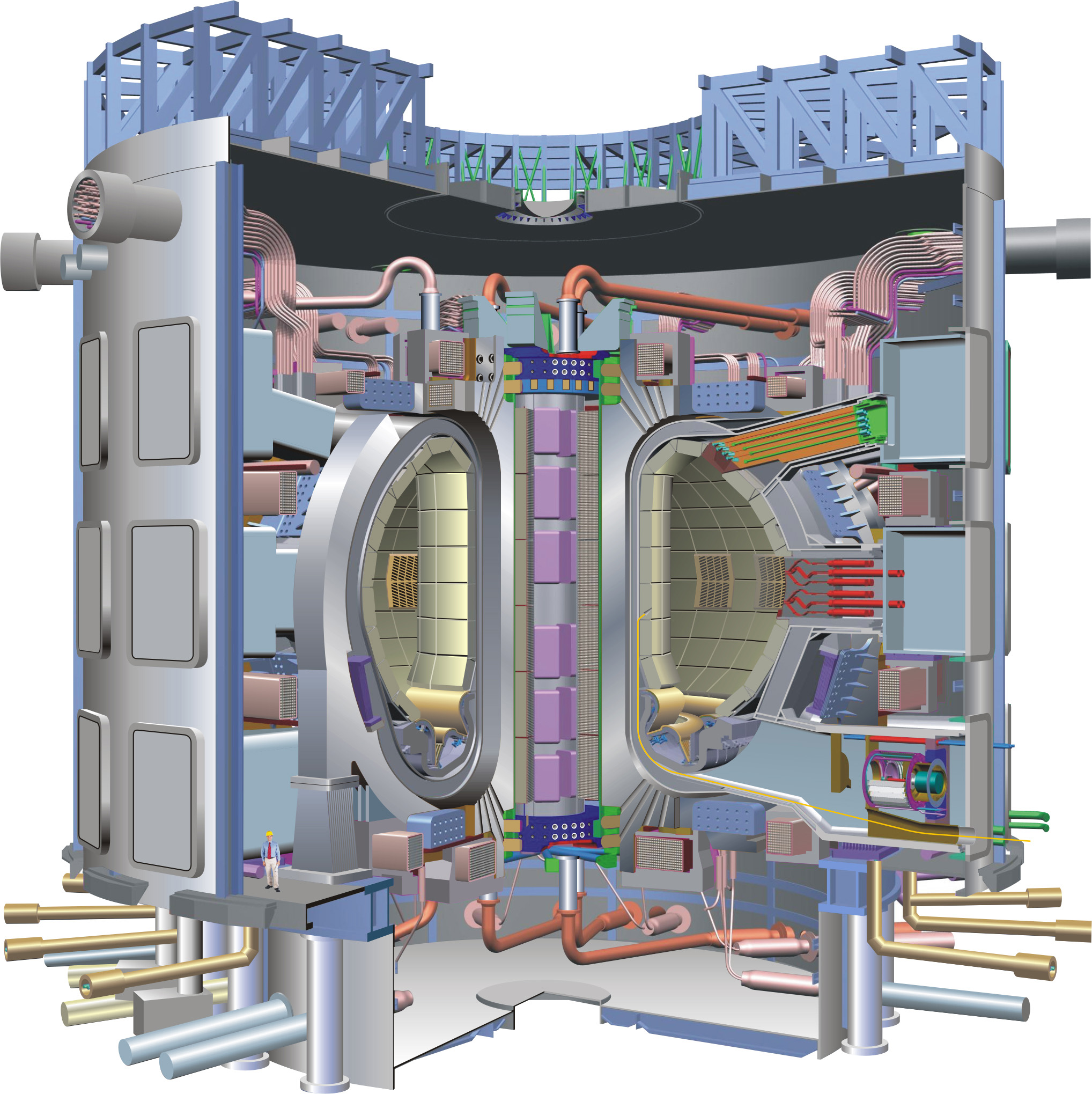
Lucas123 writes: Experimenting with a fusion device over the past 20 years has edged MIT researchers to their final goal, creating a small and relatively inexpensive ARC reactor, three of which would produce enough energy to power a city the size of Boston. The lessons already learned from MIT's even current Alcator C-Mod fusion device — with a plasma radius of just 0.68 meters — have enabled researchers to publish a paper on a prototype ARC that would be the world's smallest fusion reactor but with the greatest magnetic force and energy output for its size. The ARC would require 50MW to run while putting out about 200MW of electricity to the grid. Key to MIT's ARC reactor would be the use of a "high-temperature" rare-earth barium copper oxide (REBCO) superconducting tape for its magnetic coils, which only need to be cooled to 100 Kelvin, which enables the use of abundant liquid nitrogen as a cooling agent. Other fusion reactors' superconducting coils must be cooled to 4 degrees Kelvin. While there remain hurdles to overcome, such as sustaining the fusion reaction long enough to achieve a net power return, building the ARC would only take 4 to 5 years and cost about $5 billion, compared to the International Thermonuclear Experimental Reactor (ITER), the world's largest tokamak fusion reactor due to go online and begin producing energy in 2027. -
Fusion Power By 2020? Researchers Say Yes and Turn To Crowdfunding.
Luminary Crush (109477) writes "To date, the bulk of fusion research has been channelled towards a plasma containment and stabilization method. This is the approach used by ITER's tokamak reactor, the cost of which could exceed US$13.7 billion before it's online in the year 2027 (barring further delays). Researchers at LPP Fusion, in a project partially financed by NASA-JPL, are working in a different direction: focus fusion, which focuses the plasma in a very small area to produce fusion and an ion beam which could then be harnessed to produce electricity. It is small enough to fit in a shipping container, can double as a rocket engine, and would cost US$50 million to produce the working 5 MW prototype. To reach the next hurdle and demonstrate feasibility, LPP Fusion has started an Indiegogo campaign to raise $200K." -
Ask MIT Researchers About Fusion Power
Nuclear fusion power is the process of fusing light nuclei together to release energy, and ultimately, to put electricity on the grid. Today, we have six researchers from MIT's Plasma Science and Fusion Center here to answer your questions about fusion power, tokamaks, and public support and funding in the U.S. for this research. The Obama Administration's budget request for fiscal year 2013 is paying for the U.S. share of ITER construction out of the domestic program, starting with the closure of the MIT fusion lab. The interviewees are ready to answer technical and policy questions, so don't be shy! And, as always, please break unrelated questions into separate posts. Read on for information about the researchers who will answer your questions. Dr. Martin Greenwald is a Senior Scientist and Associate Director of the MIT Plasma Science and Fusion Center. His experimental work focuses on turbulence and transport, density limits, and pellet fueling of magnetically confined plasmas. More recently, Dr. Greenwald has been heavily involved with data management, computation, simulation, networks, and remote collaborations for fusion research.
Professor Ian Hutchinson is interested in plasma control in tokamaks, as well as spatially resolved measurements of the radiated power coming from the plasma. He is the author of the standard fusion textbook Principles of Plasma Diagnostics. Prof. Hutchinson also works on particle-in-cell simulations of astrophysical and laboratory plasmas.
Assistant Professor Anne White researches turbulence phenomena on the Alcator C-Mod tokamak, developing new diagnostics to resolve the small fluctuations which cause energy and particles to leak out. She is the recent recipient of the U.S. Department of Energy Early Career Award.
Professor Dennis Whyte pursues research into plasma–material interactions; that is, the way the hot plasma in a magnetic fusion reactor interacts with the surrounding solid materials walls. His team is also developing novel diagnostics for fusion nuclear science, which is critical as fusion reactors start producing power (and neutrons) over long periods of time.
Nathan Howard and Geoff Olynyk are Ph.D students on the Alcator C-Mod project. Nathan, who is in the final year of his studies, studies turbulent transport phenomena experimentally and through simulation. Geoff, in his fourth year, is working on disruption mitigation, which is a way to quickly and safely shut a tokamak plasma down in a few thousandths of a second. -
ITER Fusion Reactor Enters Existential Crisis
deglr6328 writes "The long beleaguered experimental magnetic confinement fusion reactor ITER is currently in what some are calling the worst crisis of its 25 year history. Still existing only on the paper of thousands of proposed design documents, the latest cost estimates for the superconducting behemoth are soaring to nearly 20 billion USD — roughly twice the estimates from as recently as a few years ago. Anti-nuclear environmentalist organizations have seized upon the moment as an opportunity to use the current global economic crisis as a means to push for permanently killing the project. If ITER is not built, the prospect of magnetic confinement fusion as a technique to reach thermonuclear breakeven and ignition in the laboratory would be in serious question. Meanwhile, the largest laser-driven inertial confinement fusion project, the National Ignition Facility, has demonstrated the ability to use self-generated plasma optical gratings to control capsule implosion symmetry with high finesse, and is on schedule to achieve ignition and potentially high gain before the end of the year." -
EU Fusion Experiment's Financial Woes Get More Concrete
fiannaFailMan writes "An international plan to build a nuclear fusion reactor is being threatened by rising costs, delays and technical challenges. 'Emails leaked to the BBC indicate that construction costs for the experimental fusion project called Iter have more than doubled. Some scientists also believe that the technical hurdles to fusion have become more difficult to overcome and that the development of fusion as a commercial power source is still at least 100 years away. At a meeting in Japan on Wednesday, members of the governing Iter council will review the plans and may agree to scale back the project.' Iter will be a Tokamak device, a successor to the Joint European Torus (JET) in England. Meanwhile, an experiment in fusion by laser doesn't seem to be running into the same high profile funding problems just yet."
-
French Fusion Experiment Delayed Until 2025 or Beyond
An anonymous reader writes "The old joke is that fusion is the power of the future and always will be. But it's not looking so funny for ITER, an EU10 billion fusion experiment in France. According to Nature News, ITER will not conduct energy-producing experiments until at least 2025 — five years later than what had been previously agreed to. The article adds that the reactor will cost even more than the seven parties in the project first thought:'...Construction costs are likely to double from the 5-billion (US$7-billion) estimate provided by the project in 2006, as a result of rises in the price of raw materials, gaps in the original design, and an unanticipated increase in staffing to manage procurement. The cost of ITER's operations phase, another 5 billion over 20 years, may also rise.'" -
Japan's JT-60 Tokamak Sets New Plasma Record
Dipster writes "The Japan Atomic Energy Agency has announced that its JT-60 Tokamak has almost doubled the previous record for sustained plasma production, which is now sits at 28.6 seconds. It is believed that once 400 seconds can be achieved, a sustained nuclear fusion reaction will be possible. While 28.6 seconds is a long way from 400, it raises hopes for what will be possible from the ITER reactor, expected to be finished in 2016." -
EU Intent on Hosting International Fusion Reactor
Raunch writes "The BBC says that EU is determined to be one of the sites that host the multi-billion-dollar International Thermonuclear Experimental Reactor Even if they have to do so less-than-internationally: 'If there is no agreement at six we are determined to do it with fewer.' Not only that, but 'The EU wants an agreement on the project before the end of the year'" -
U.S. Cancels Fusion Program
-
Giant International Fusion Reactor Draws Nearer
nnnneedles writes "BBC is reporting that scientists are deciding on where to build the world's first big fusion reactor. The international effort is described as the boldest nuclear initiative since the Manhattan Project, and holds promise for future unlimited, clean energy. The choice on where to build the reactor currently stands between Japan and France, but apparantly, the U.S. is opposing a french site because France opposed the war in Iraq." There's also an AP story. -
U.S. and China Join Fusion Project
Garp writes "According to the BBC News website, the U.S. has finally decided to join the international Fusion project, Iter, along with China, with the aim of building the worlds first commercially viable Fusion reactor. Fusion is one of the cleanest forms of energy conversion, excluding renewable natural sources, like wind farms, tidal generators, and solar cells." -
US Joins ITER Tokamak Fusion Project
WannabePhysicist writes "Energy secretary Spencer Abraham announced at the Princeton Plasma Fusion Laboratory that the U.S. will join ITER , the international plasma fusion reactor effort. They're currently planning a tokamak (doughnut) design, and have some pretty optimistic energy production predictions for 2014. As many of us in science know, estimated times are usually off by a factor of two, and then sometimes and order of magnitude -- but hopefully they'll get it to work. Many people push this as the cleanest form of energy, but fusion reactors will most likely contain deuterium, tritium, and lithium (tritium's not exactly water) The deuterium and tritium fuse, giving off an alpha (4He nucleus), a neutron, and some energy. This energy causes more reactions (the controlled fusion part). The neutrons hit a 6Li blanket (surrounding the chamber) which then produces more tritium for burning." -
U.S. to Rejoin the ITER Fusion Project
spiro_killglance writes: "BBC news is reporting here, that the USA may be about the rejoin the International Thermonuclear Experiment Reactor project. The USA left the ITER consortinum in 1999 when it bulked at the 10 Billion dollar price tag. Canada, Europe and Japan continued in the project, downscaling it to a cheaper 4.5 Billion dollars. The project claims to be the final step before commcercial reactors are possible, although the price tags might still be daunting to utility companies. ITER is designed to generate bursts of fusion energy, producing over 10 times the ammount of energy used to generate the fusion reaction (a Q factor >10), will not quite reach ignition (a self sustaining fusion reaction, or Q=infinity), but should pave the way for devices that will."