Slashdot Mirror
Domain: kinja-img.com
Stories and comments across the archive that link to kinja-img.com.
Stories · 7
-
Customer Service Agents Might Be Able To See What You're Typing In Real Time (gizmodo.com)
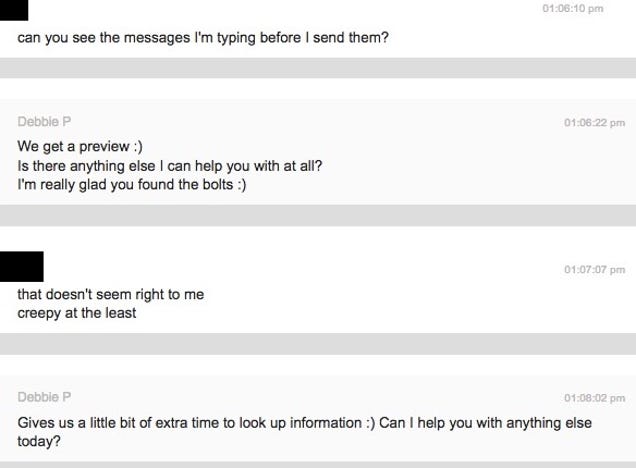
Gizmodo is warning that some customer service agents might be able to see what you're typing in real time. A reader sent them a transcript from a conversation they had with a mattress company after the agent responded to a message he hadn't sent yet. From the report: Something similar recently happened to HmmDaily's Tom Scocca. He got a detailed answer from an agent one second after he hit send. Googling led Scocca to a live chat service that offers a feature it calls "real-time typing view" to allow agents to have their "answers prepared before the customer submits his questions." Another live chat service, which lists McDonalds, Ikea, and Paypal as its customers, calls the same feature "message sneak peek," saying it will allow you to "see what the visitor is typing in before they send it over." Salesforce Live Agent also offers "sneak peak."
This particular magic trick happens thanks to JavaScript operating in your browser and detecting what's happening on a particular site in real time. It's also how companies capture information you've entered into web forms before you've hit submit. Companies could lessen the creepiness by telling people their typing is seen in real time or could eliminate the send button altogether. So if you don't want to be monitored or send secret messages to agents, put your phone on mute while on hold and copy/paste messages from another document to your customer service chatbox. And in general, be nice to customer service agents. It's not their fault. -
Verizon's New Phone Plan Proves It Has No Idea What 'Unlimited' Actually Means (gizmodo.com)
Verizon has unveiled its third "unlimited" smartphone plan that goes to show just how meaningless the term has become in the U.S. wireless industry. "In addition to its Go Unlimited and Beyond Unlimited plans, Verizon is now adding a premium Above Unlimited plan to the mix, which offers 75GB of 'unlimited' data per month (as opposed to the 22GB of 'unlimited' data you get on less expensive plans), along with 20GB of 'unlimited' data when using your phone as a hotspot, 500GB of Verizon cloud storage, and five monthly international Travel Passes, which are daily vouchers that let you use your phone's wireless service abroad the same as if you were in the U.S.," reports Gizmodo. Are you confused yet? From the report: And as if that wasn't bad enough, Verizon has also updated its convoluted sliding pricing scheme that adjusts based on how many phones are on a single bill. For families with four lines of service, the Above Unlimited cost $60 per person, but if you're a single user the same service costs $95, which really seems like bullshit because if everything is supposed to be unlimited, it shouldn't really make a difference how many people are on the same bill. As a small concession to flexibility, Verizon says families with multiple lines can now mix and match plans instead of having to choose a single plan for every line, which should allow families to choose the right service for an individual person's needs and help keep costs down. The new Above Unlimited plan and the company's mix-and-match feature arrives next week on June 18th. -
YouTube Unveils New Streaming Service 'YouTube Music,' Rebrands YouTube Red (gizmodo.com)
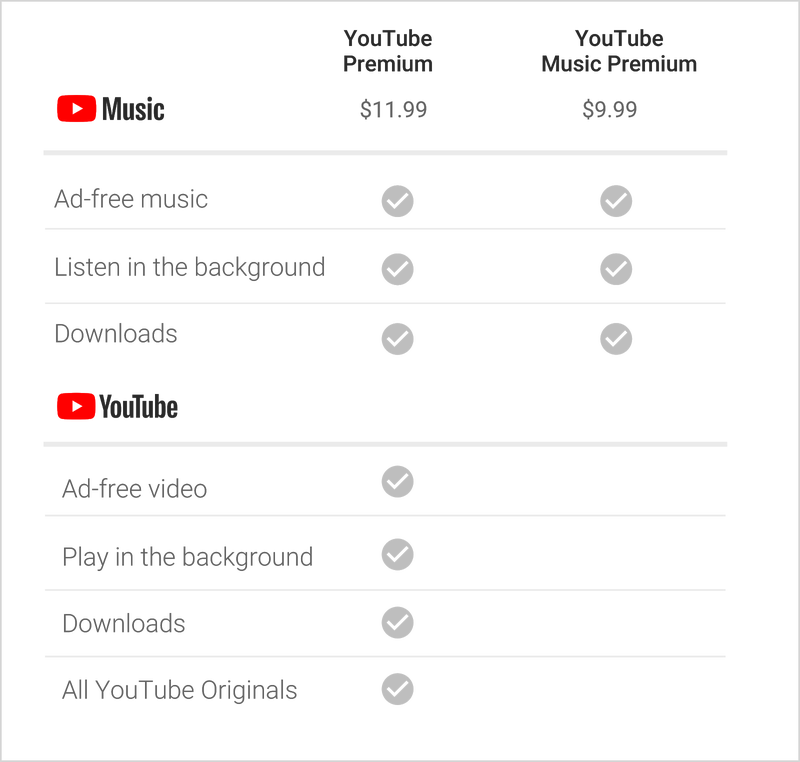
An anonymous reader quotes a report from Gizmodo: YouTube Music, a streaming music platform designed to compete with the likes of Spotify and Apple Music, officially has a launch date: May 22nd. Its existence will also shift around YouTube and Google's overall media strategy, which has thus far been quite the mess. YouTube Music will borrow the Spotify model and offer a free, ad-supported tier as well as a premium version. The paid tier, which will be called YouTube Music Premium, will be available for $9.99 per month. It will debut in the U.S., Australia, New Zealand, Mexico, and South Korea before expanding to 14 other countries.
One of the selling points for YouTube Music will be the ability to harness the endless amount of information Google knows about you, which it will use to try to create customized listening experiences. Pitchfork reported that the app, with the help of Google Assistant, will make listening recommendations based on the time of day, location, and listening patterns. It will also apparently offer "an audio experience and a video experience," suggesting perhaps an emphasis on music videos and other visual content. From here, Google seems to be focused on making its streaming strategy a little less wacky. Google Play Music, the company's previous music streaming service that is still inexplicably up and running despite teetering on the brink of extinction for years, will slowly be phased out according to USA Today. Meanwhile, the paid streaming subscription service, known as YouTube Red, is being rebranded to YouTube Premium and will cost $11.99 per month instead of $9.99. (Pitchfork notes that existing YouTube Red subscribers will be able to keep their $9.99 rate.) YouTube Premium will include access to YouTube Music Premium. Here's a handy-dandy chart that helps show what is/isn't included in the two plans. -
NASA Images of Puerto Rico Reveal How Maria Wiped Out Power On the Island (jalopnik.com)
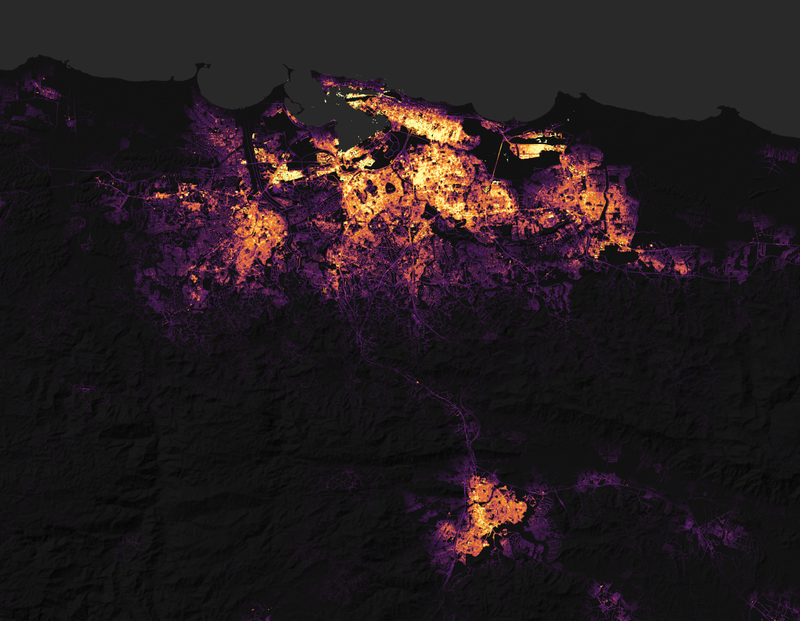
An anonymous reader quotes a report from Jalopnik: Hurricane Maria was the most devastating hurricane to make land in Puerto Rico in nearly 100 years and the country is still reeling in its wake. Much of the island still doesn't have running water, reliable communication or electricity. Recently, NASA published a set of date-processed photos that show the island's nighttime lights both before and after the storm. Here, you can see images of the country's capital, San Juan, on a typical night before Maria. It's based on cloud-free and low moonlight conditions. Conversely, the following composite image is of data taken on the nights of Sept. 27 and 28 -- nearly a week after the storm hit -- by the Visible Infrared Imaging Radiometer Suite, a scanning radiometer that collects visible and infrared imagery of land, atmosphere, cryosphere and oceans, according to NASA's website. -
NASA Images of Puerto Rico Reveal How Maria Wiped Out Power On the Island (jalopnik.com)
An anonymous reader quotes a report from Jalopnik: Hurricane Maria was the most devastating hurricane to make land in Puerto Rico in nearly 100 years and the country is still reeling in its wake. Much of the island still doesn't have running water, reliable communication or electricity. Recently, NASA published a set of date-processed photos that show the island's nighttime lights both before and after the storm. Here, you can see images of the country's capital, San Juan, on a typical night before Maria. It's based on cloud-free and low moonlight conditions. Conversely, the following composite image is of data taken on the nights of Sept. 27 and 28 -- nearly a week after the storm hit -- by the Visible Infrared Imaging Radiometer Suite, a scanning radiometer that collects visible and infrared imagery of land, atmosphere, cryosphere and oceans, according to NASA's website. -
Facebook's Secret Censorship Rules Protect White Men From Hate Speech But Not Black Children (propublica.org)
Sidney Fussell from Gizmodo summarizes a report from ProPublica, which brings to light dozens of training documents used by Facebook to train moderators on hate speech: As the trove of slides and quizzes reveals, Facebook uses a warped, one-sided reasoning to balance policing hate speech against users' freedom of expression on the platform. This is perhaps best summarized by the above image from one of its training slideshows, wherein Facebook instructs moderators to protect "White Men," but not "Female Drivers" or "Black Children." Facebook only blocks inflammatory remarks if they're used against members of a "protected class." But Facebook itself decides who makes up a protected class, with lots of clear opportunities for moderation to be applied arbitrarily at best and against minoritized people critiquing those in power (particularly white men) at worst -- as Facebook has been routinely accused of. According to the leaked documents, here are the group identifiers Facebook protects: Sex, Religious affiliation, National origin, Gender identity, Race, Ethnicity, Sexual Orientation, Serious disability or disease. And here are those Facebook won't protect: Social class, continental origin, appearance, age, occupation, political ideology, religions, countries. Subsets of groups -- female drivers, Jewish professors, gay liberals -- aren't protected either, as ProPublica explains: White men are considered a group because both traits are protected, while female drivers and black children, like radicalized Muslims, are subsets, because one of their characteristics is not protected. -
Researchers Solve One Of The Biggest Mysteries About How Water Flows On Mars (gizmodo.com)
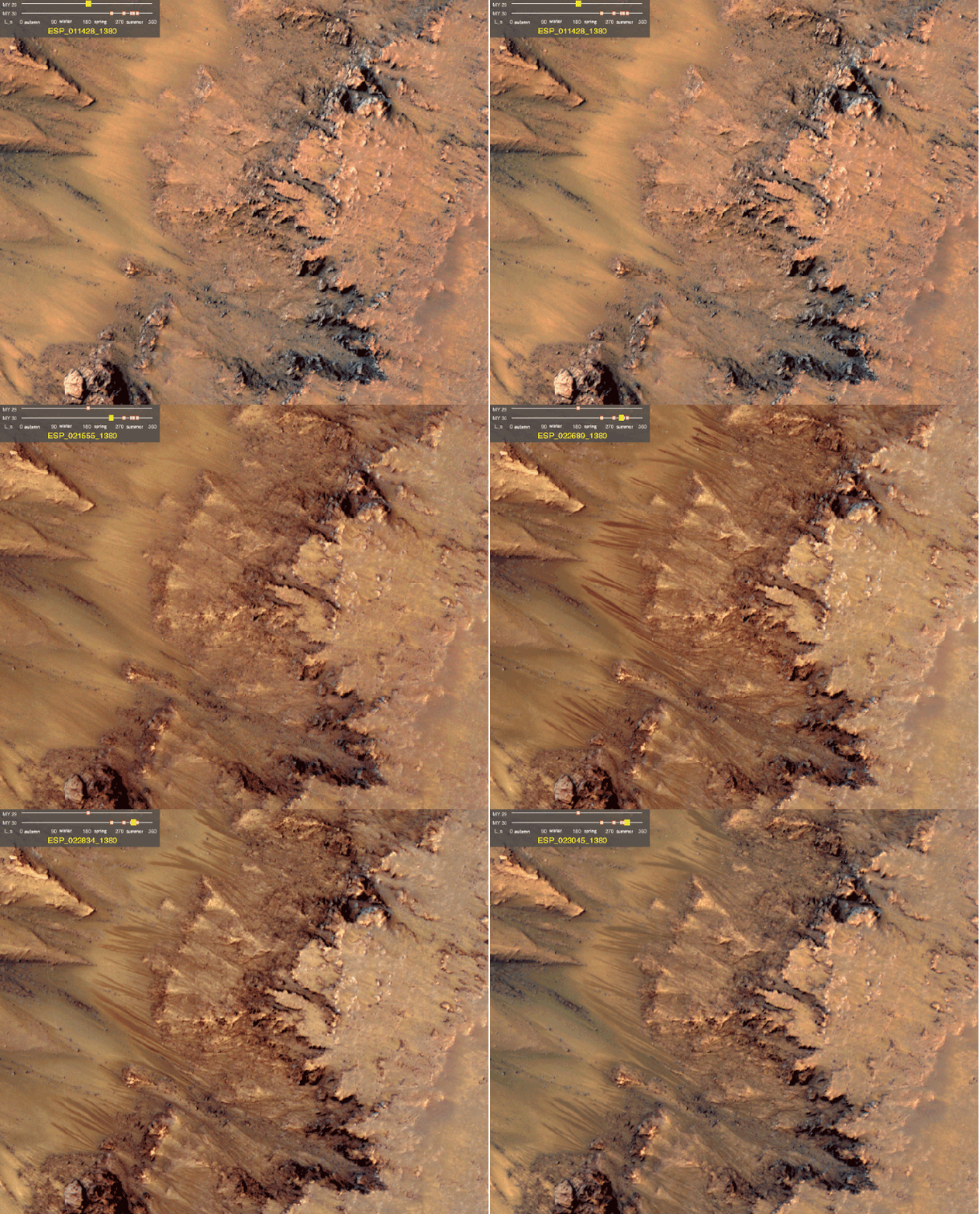
An anonymous reader writes: Not only is water flowing on Mars, it's also boiling. This experiment published today in Nature Geoscience solves one of the major mysteries about the surface of the red planet. Gizmodo writes, "Researchers built a chamber simulating the conditions and atmosphere of Mars, then put ice in there to melt. The ice did melt and the water from it flowed -- but there was also a surprise. The surface of the water boiled as it flowed, and that boiling was strong enough to move not just the water but also dirt and debris surrounding the streams. Importantly, temperature was not the major factor in this boiling water, it was due to the pressure of the atmosphere." You may remember pictures of flowing water on Mars which surfaced last year. One would think the summer temperatures should be too cold for water to flow on Mars (as seen in the images), however, the water that flows on Mars is a salty-brine which lowers the freezing point of the water. So how does the water manage to carve out the landscape so quickly and visibly? Easy: the boiling water theory. Boiling water hits a boiling stage along its surface, where it kicks up dust and dirt and debris in the water's wake. The research team did see the boiling water move debris, but they also saw collapses along the sides of the flows. The boiling and disturbance it causes etches those lines on Mars clearly enough for satellites to notice them.