Slashdot Mirror
Domain: lemonodor.com
Stories and comments across the archive that link to lemonodor.com.
Comments · 24
-
Re:Great but...
-
Re:I don't really like REPL
You might like this: http://lemonodor.com/archives/2002_05.html#000103
-
Well, the LA sheriff's department is trying...
http://lemonodor.com/archives/001405.html It does say that the FAA does not approve. The autonomous nature of the aircraft is the big sticking point it seems. As for actual use of UAVs in domestic operations, I don't know of any, but law enforcement seems very interested.
-
Re:The "Oh Shit" train poster
A Dijkstra or McCarthy inspirational poster would fit as well. I love the "Quick and Dirty: I would not like that."
-
Re:despair.com
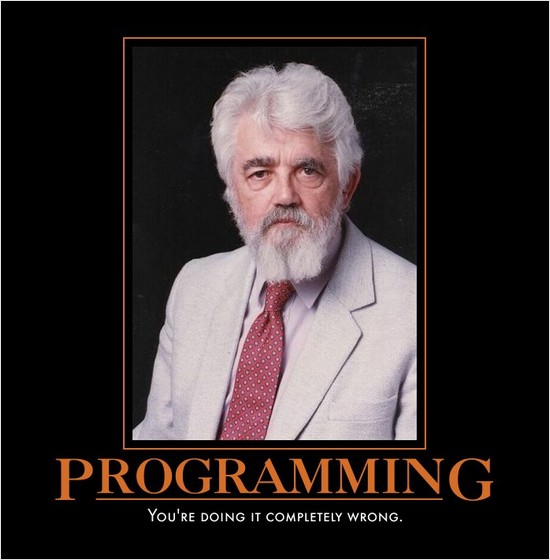
And from the AutoMotivator comes this gem of a poster of John McCarthy. Oh, how I laughed...
-
You're Doing It Wrong
I have these hanging from my walls: http://lemonodor.com/archives/2007/10/youre_doing_it_wrong.html
-
That explains Lisp's longevity
-
Re:lies right off the top ...
Yea, it does sound like they are lying through their teeth.. It turns out to fly a UAV in the US National Airspace System requires a Certificate of Authorization (COA) from the FAA. These are not easy to get, so a lot of law enforcement agencies end up circumventing the process (as they did in LA here: http://lemonodor.com/archives/001405.html). I wouldn't be surprised if that was the real reason for the secrecy...
-
Re:The price
The other issue to remember is that to fly a UAV in the US National Airspace System requires a certificate of Authorization (COA) from the FAA. These are not easy to get, so a lot of law enforcement agencies end up circumventing the process (as they did in LA here: http://lemonodor.com/archives/001405.html). I wouldn't be surprised if that was the real reason for the secrecy... --Ed
-
Re:uhhhh...
And his name was John McCarthy.
-
Re:Well, you can still see it.
http://en.wikipedia.org/wiki/Archie_search_engine
As we all know, search engines do not matter with regard to the web
dot.com bubble - not in a way connected to either the web or money and no bang at all; uucp - no relation to the history of the web either.
http://www.lemonodor.com/
Semantic web and LISP? Never heard of either.
Public domain? GPL? Licences? What is that all about.
Go educate yourself.
CC. -
Re:Qs
Huh, no kidding? Well, maybe you should tell reddit.com (one of Paul Graham's spinoffs). Because, you see, they switched from Lisp to Python a while back (sorry, I can't find the original block entry). And why? Because, to quote:
"If Lisp is so great, why did we stop using it? One of the biggest issues was the lack of widely used and tested libraries. Sure, there is a CL library for basically any task, but there is rarely more than one, and often the libraries are not widely used or well documented."
So, sure, there may be tons of libaries, but who wants a library that's poorly documented, poorly tested, and may not even work on your CL implementation?
Moreover, in addition to the ffi, things like sockets and threads, which I think we can all agree are important, aren't standardized across implementations, which just makes things harder.
Now, is this a problem with the language? No, it's the implementations. But the fact is that until you can grab a library off the net and drop it into your Lisp implementation of choice (assuming they've implemented the standard) and hit the ground running, it will, like Scheme, Smalltalk (my poison of choice), and others, remaining a niche language.
Unfortunately, this is, in part, also an issue of critical mass. Unless you can get people using your language, there won't be high quality, well tested modules for it. OTOH, Perl, Python, and Ruby have all proved it's possible... 'course, it helps that the people running those projects aren't sequestored in ivory towers (well, okay, Guido just deigns to join us down here, occasionally). -
A Lisp Machine
Find a TI Explorer or one of the MIT Lisp Machines. Those are something I'd love to see restored!
-
KILLER BEES!!!
-
Re:back to the future
Didn't they used to cost more than $50,000 each?
http://lemonodor.com/archives/001190.html shows a November 1985 quote for a Symbolics 3675 with 474 MB disk, 8 Megawords of memory, 24-bit graphics card, monitor, and console, which came out to $124,900. (*after* a Christmas discount of roughly 30%) -
Arc would probably get widely taken up
Paul Graham's Arc is the great hope (there's a lot of interest in it at least). If it is elegant as promised I think Lispers would take it up. But, it's pretty ambitious and he appears stuck for the time being; the most recent I've heard on the subject is this comment (2nd down) at lemonodor. He's said he intends it to be a hundred-year language and that he'll take his time, so, everyone'll have to make do with CL for the while.
-
Well..Reinventing the past.
"Even still, I think these problems require a radically new way of thinking about the future of computing. They can't be solved with a new window manager, or a tiny new input device, we have to think about what people will be doing 20 years down the road, and redesign. E.g., the mouse and keyboard are completely useless and space-inefficient at anything but a desk. Speakable commands, maybe, but who knows? I think the next innovations will be something so wildly different it will be both "duh, why didn't we think of this before" and "this looks completely different"."
The problem with everyone's WOW! interface is that they fail the litmus test of practicality.
http://lemonodor.com/archives/000103.html
http://lemonodor.com/archives/000441.html
Maybe instead of trying to invent something new. Let's say that we try using what never really saw the light of day. -
Well..Reinventing the past.
"Even still, I think these problems require a radically new way of thinking about the future of computing. They can't be solved with a new window manager, or a tiny new input device, we have to think about what people will be doing 20 years down the road, and redesign. E.g., the mouse and keyboard are completely useless and space-inefficient at anything but a desk. Speakable commands, maybe, but who knows? I think the next innovations will be something so wildly different it will be both "duh, why didn't we think of this before" and "this looks completely different"."
The problem with everyone's WOW! interface is that they fail the litmus test of practicality.
http://lemonodor.com/archives/000103.html
http://lemonodor.com/archives/000441.html
Maybe instead of trying to invent something new. Let's say that we try using what never really saw the light of day. -
the other mouse-Draw with a LISP.
The Foonly F1 was used in the making of TRON and Flight of the Navigator.
Lisp machines have played a part in the making of some movies.
"
Many of the people who worked at III (off the top of my head - Larry Malone, Craig Reynolds, Dave Dyer, Barton Gawboy, and a few others I can't remember) went on to work at Symbolics, most of them on the S-Graphics products. Particularly noteworthy is Larry Malone's S-Geometry. He modeled all the ships in TRON using his own polygon-based software, which was pretty revolutionary back then (to contrast, the light cycles were made using parametrically defined curves, which has been the standard technique in movies up until just a few years ago, and is now starting to be replaced by the polygon approach). I believe S-Geometry was the first 3d package to use subdivison surfaces as well."
http://lemonodor.com/archives/000103.html
Many of the shorts produced in "The Minds Eye"* were produced on Symbolics (LISP) Machines.
*Does anyone know if this is available on DVD?
-
the other mouse-Draw with a LISP.
The Foonly F1 was used in the making of TRON and Flight of the Navigator.
Lisp machines have played a part in the making of some movies.
"
Many of the people who worked at III (off the top of my head - Larry Malone, Craig Reynolds, Dave Dyer, Barton Gawboy, and a few others I can't remember) went on to work at Symbolics, most of them on the S-Graphics products. Particularly noteworthy is Larry Malone's S-Geometry. He modeled all the ships in TRON using his own polygon-based software, which was pretty revolutionary back then (to contrast, the light cycles were made using parametrically defined curves, which has been the standard technique in movies up until just a few years ago, and is now starting to be replaced by the polygon approach). I believe S-Geometry was the first 3d package to use subdivison surfaces as well."
http://lemonodor.com/archives/000103.html
Many of the shorts produced in "The Minds Eye"* were produced on Symbolics (LISP) Machines.
*Does anyone know if this is available on DVD?
-
Re:split in the computers just like that...
-
lemonodor/ Roland's bias / Geographic models
I've noticed a lot of generally negative reaction to Roland's blog entries that are often on Slashdot, primarily due to his shameless self-promotion and some high-noise/low-content posts. The funniest reply I have ever seen to Roland Piquepaille is over at John Wiseman's lemondor . Read the Comments thread. Now to address some of the points in one of Roland's typical posts:
'Wireless expectations rose in 2003, but growth was hobbled by security concerns and unproven business models.' It's much worse than you think and I'm going to tell you why Wi-Fi will still not be broadly used in 2004 in this column [MY BLOG!!!].
Roland: why don't you just tell us the main thrust of your blog entry? That's the whole idea of the Slashdot SUMMARY. It's obvious from your many posts all over the place (not just Slashdot -- although we now know at least 60% of your traffic comes from here) that you are constantly trying to drive traffic to your blog. Anyone who is interested in what you have to say will click through anyway, so why not just call it what it is? Your BLOG.
Technology columnists are usually looking at their own part of the world, in Silicon Valley or on the East Coast of the U.S. And obviously, their opinions are largely biased. Our world is much bigger than that. My arguments are based on real-world examples, both in Greece and in Paris.
Roland can compare himself to technology columnists instead of bloggers if he likes, but how does Roland's obviously biased opinion in his obviously biased blog entry make him any different from the people he criticizes and accuses of geographic bias?
Roland may not be aware of it, but Silicon Valley is 3000 miles (that's about 4800 kilometres) from the US East Coast. They are part of the same country but they are also distinct geographic regions. And they are no less "real-world" than Roland's home (France) and favorite vacation spot(?) (Greece). Roland's geographic bias and the implicit superiority of his argument smacks of snobbery.
If that's his argument, I have to agree with Wingchild's assessment of Roland's post as nothing more than self-indulgent whining.
Since Roland is someone who used to work in the technology industry he should know that any new technology will have its growing pains, especially when it is adopted at a rapid pace. Roland's bias does not make the rapid growth of wireless networking any less explosive or disruptive, and we will probably see accelerating adoption of wireless networking everywhere -- not just in North America, but in developing and impoverished parts of the world that lack a vast wireline infrastructure to support a traditional Internet/telecom environment. The low cost and rapid ease-of-deployment make wireless networks an obvious choice for these regions.
Europe has always had a pay-per-use model. For example, it is the dominant model for mobile phone use in Europe. It was the dominant model for Internet access (is it still? I haven't checked lately). Flat-rate pricing is the dominant model in North America. Internet and mobile phone packages all started out as pay-per-use but are now dominated by flat-fee pricing. It is a cultural difference.
If the culture is something Roland dislikes so intensely, Roland can:
- Tolerate it
- Do something to change it
- Go somewhere where the culture is more to his liking
Is Wi-Fi access worth $10/hour? That depends on how much you need it. Especially to business users, the convenience of fast, reliable wireless Internet access may be worth every penny.
-
CLIMA lot of Lisp applications used to use CLIM, the Common Lisp Interface Manager. It integrates command line and GUI style interaction naturally - it is based around "presentations" of the objects in your program, i.e. whenever you "present" something as either text or an icon or whatnot, it remebers what it is, and the output can be used as input for other functions, be they called by name at the command line or, for example, as a menu entry.
The symbolics Lisp Machine user interface was based around this. For an impression of it looked like and worked, look at this movie. CLIM is available for the two major commercial Lisp implementations from Franz, Inc. and Xanalys; there is also a free implementation in the works. Here are some relevant links.
-
Re:smarter than AIBO?
Well, it does have a two-layer robot control AI. The thing that makes it cooler than an AIBO is that you can program your own tasks on their second layer, using C++ and Python APIs. (Ha, take that Mr. Wiseman's weblog!