Slashdot Mirror
Domain: leo-computers.org.uk
Stories and comments across the archive that link to leo-computers.org.uk.
Comments · 20
-
Re:Not known for speed?
"Who do you suppose were the first businesses to use computers?"
Not the banks! Actually a British chain of tea shops! https://en.wikipedia.org/wiki/J._Lyons_and_Co.
https://en.wikipedia.org/wiki/LEO_(computer) The LEO I (Lyons Electronic Office I) was the first computer used for commercial business applications. Overseen by Oliver Standingford, Raymond Thompson of J. Lyons and Co.and and David Caminer, modelled closely on the Cambridge EDSAC. LEO I ran its first business application in 1951. In 1954 Lyons formed LEO Computers Ltd to market LEO I and its successors LEO II and LEO III to other companies. LEO Computers eventually became part of English Electric Company (EELM) and then International Computers Limited (ICL) and ultimately Fujitsu. LEO series computers were still in use until 1981.
One of the LEO III's quirkier features was a loudspeaker connected to the central processor which enabled operators to tell whether a program was looping by the distinctive sound it made.
http://www.leo-computers.org.uk/ In 1951 the LEO I computer was operational and ran the world's first regular routine office computer job.
-
Re:mercury delay
I think the first post war British computer was developed by Lyons, a food retailer/wholesaler/manufacturer. If memory serves, the British Government of the day rented it for batch jobs.
There's a good book about it, A Computer Called Leo: Lyons Tea Shops, and the worlds first office computer.
-
You might get commercial software to run
... since LEO, the first commercial business computer, was based on the EDSAC design. Amazingly LEO computers were still in use in 1981. Check out the LEO Computers Society.
-
Re:What?
The Leo 1 claims to be the 'first business computer'.
-
Re:What on earth would they do with this computer?Lyons was a huge company. It didn't just make tea, it had a massive bakery division and also ran a very successful line of high street tea and coffee shops (think Starbucks - they were that common). It also did almost everything in-house - from vehicle maintenance to manufacturing its own machinery.
Finally, the company was seen as a very progressive concern - from the way it treated its workers (many of whom were women), through to adopting the latest business techniques - often from the US.
One of the original tasks was payroll automation - a huge task in a massive company with hundreds of pay grades and pre-decimalised coinage. But LEO came into its own when it was to process orders from these shops.
At the end of each day's business, managers would telephone a summary of their day's trading and their next order to Lyons HQ where the information was put on to punch tape and sent to LEO. The computer could then produce a collation of the orders to go to the bakeries, print dispatch slips, even generate a packing order for the trucks so that fragile items were added last!
LEO was even used to predict buying patterns - which foods were most popular at certain times of the year or in certain regions and ensure that supplies were ready for timely manufacture.
LEO was so successful it was then put to work for the government determining tax information for the Chancellor's budget and timetabling British Railways. Naturally it was such an advanced computer that it had to be killed off by one of the Labour Party's periodic bouts of nationalisation. The spin-off LEO Computers Ltd. was folded into the larger English Electric to become English Electric LEO, which then became English Electric LEO Marconi and finally ICL who eventually disappeared into the maw of Fujitsu.
There's an excellent book about LEO: 'A Computer Called LEO' by Georgina Ferry, ISBN 1841151866, Harper Collins UK, 2004. Well worth anyone's time. And the LEO project is remembered at LEO Computers Society.
-
Drool Britannia!
And never managed to maintain the loyalty of their colonies and ended up losing them all.
Another nitpick: LEOs were not exactly mini. See the pictures on this enthusiasts web site.
And we've been here before.
-
Re:UNIVAC = Johnny-come-lately
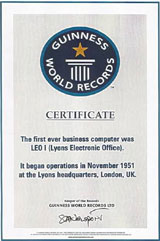
The Guinness Book of Records examined all the evidence from both sides and awarded this certificate . They accept that, although UNIVAC was produced commercially a few weeks ahead of LEO, the LEO was the first computer designed for business use and the first actually used for business.
-
The Guinness Book of Records
awarded this certificate to end the arguements.
-
Not the first business computerThe LEO, Lyons' Electronic Office, was built earlier in 1951...
Here is a site with some history. Apparently, they started on it back in '47. Lyons was originally a tea shop in London, before they branched out into computing.
-
UNIVAC = Johnny-come-lately
...this message brought to you courtesy of the memory of LEO.
Of course, like all British technological innovation, any lead over the rest of the world was quickly thrown away by an incompetent government and business sector.
-
Piffle...
It was the first American commercial computer, as well as the first computer designed for business use.
Leo -
Re:He's rightThink about what a gold mine in terms of IP value a hash table would have been if it invented at a commercial organization instead of in academia.
Absoulutely , It would have given us eutopeand software authors a 17 year advantage (until the patent expired) over you americans.
Maybe our beancounters would have seen computers as useful by then.
-
Leo Computer Society
The LEO veterans have a web site with some interesting pics here.
Y'know, that Leo 1 desk looks awfully like the computer that terrorized Emma Peel in The House that Jack Built. Spooky! -
Re:12 bit is best for the US patriot
The LEO (Lyons Electronic Office) was the first ever computer designed to be used by business, and was developed by Lyons Bakery.
There's a site about it here. -
Re:Non-US systems ignored...
Yeah, and what about the LEO?
The Lyons Electronic Office was the world's first business computer, and it was British through and through.
See here and here to learn more about the first ever business application of computing. The foresight shown by Lyons executives in the late 1940s put them way ahead of everyone in the world, and this from a company best known at the time for their teashops. -
Re:My Dad worked on one of those!
What you have to realise is at the time, my Dad and other people working on the LEOs genuinely believed that these were the world's first computers ever, not just the world's first business computers as they later became known.
Your Dad mustn't have hung around the University of Manchester, then; they had a stored program computer running in 1948, but the leo-computers.org.uk site says that, although the directors of Lyons "decided to take an active role in promoting the commercial development of computers" in October 1947, the LEO wasn't operational until 1951. Were the Manchester SSEM or Mark I military secrets?
-
My Dad worked on one of those!
For a wealth of information on the computer mentioned in the article, the LEO, see:
www.leo-computers.org.uk [i.hate.square.brackets] [probably.already.slashdotted.to.hell]
What you have to realise is at the time, my Dad and other people working on the LEOs genuinely believed that these were the world's first computers ever, not just the world's first business computers as they later became known.
You see, at the time, all the World War Two computer developments were covered under the millitary Official Secrets Act.
When these secrets broke to the general public in the 1970s, needless to say my Dad was somewhat dissapointed to discover he was not a great computing pioneer after all!
My Dad fondly recalls being able to boil a kettle and fry bacon & eggs on these monsters.
-
Re:LEO
Hope that helps. A search on "lyons bakery" should throw up more information in any decent search engine.
-
No, the LEO was "the first commercial computer"
#include pedantism;
#include friendly_uk_us_rivalry;Depends how you define "commercial". Sure, the Univac 1 was the first computer built by a company and sold, but the actual computer did not perform commercial transactions- the owners, the US Census Bureau, were a government organisation, not a business.
The computer that performed the world's first regular routine office job was the LEO Lyons Electric Office in the UK. As well as the Lyons catering firm, LEOs were used by Ford.
My dad worked on a LEO.
--
-
LEO Computers Society
As far as Lyons and their LEO (Lyons Electronic Office) computers go there is actually a LEO Computers Society for people who worked for LEO Computers Ltd. or worked with LEO Computers.